Dispatch: Reenacting the loop. Notes on conflict and historiography
In the first in a series of dispatches from the summer school 'Landscape (post) Conflict' reseacher Giulia Terralavoro, following her time on the island of Ireland, proposes thinking of post conflict societies as 'temporal loops'.
There was a multitude of British flags on the unionist side of West Belfast. Red, blue and white dominated our perception of the space, creating a phantasmagoria where the houses signified and represented conflicting and collective feelings. This need for self-representation and exhibition of belonging to the United Kingdom was palpable. Something similar occurred on the nationalist side of West Belfast: green, white and orange of Éire mixed with the colours of the Palestinian flag, exactly how the blue of the Union Jack was placed next to that of the Israeli flags. Present and past overlapped, something so far from a Western perception of history: linear, straightforward, Hegelian and progressive. ‘Time’ and ‘place’ were deconstructed on both sides, embracing in different ways intersectional, international struggle.
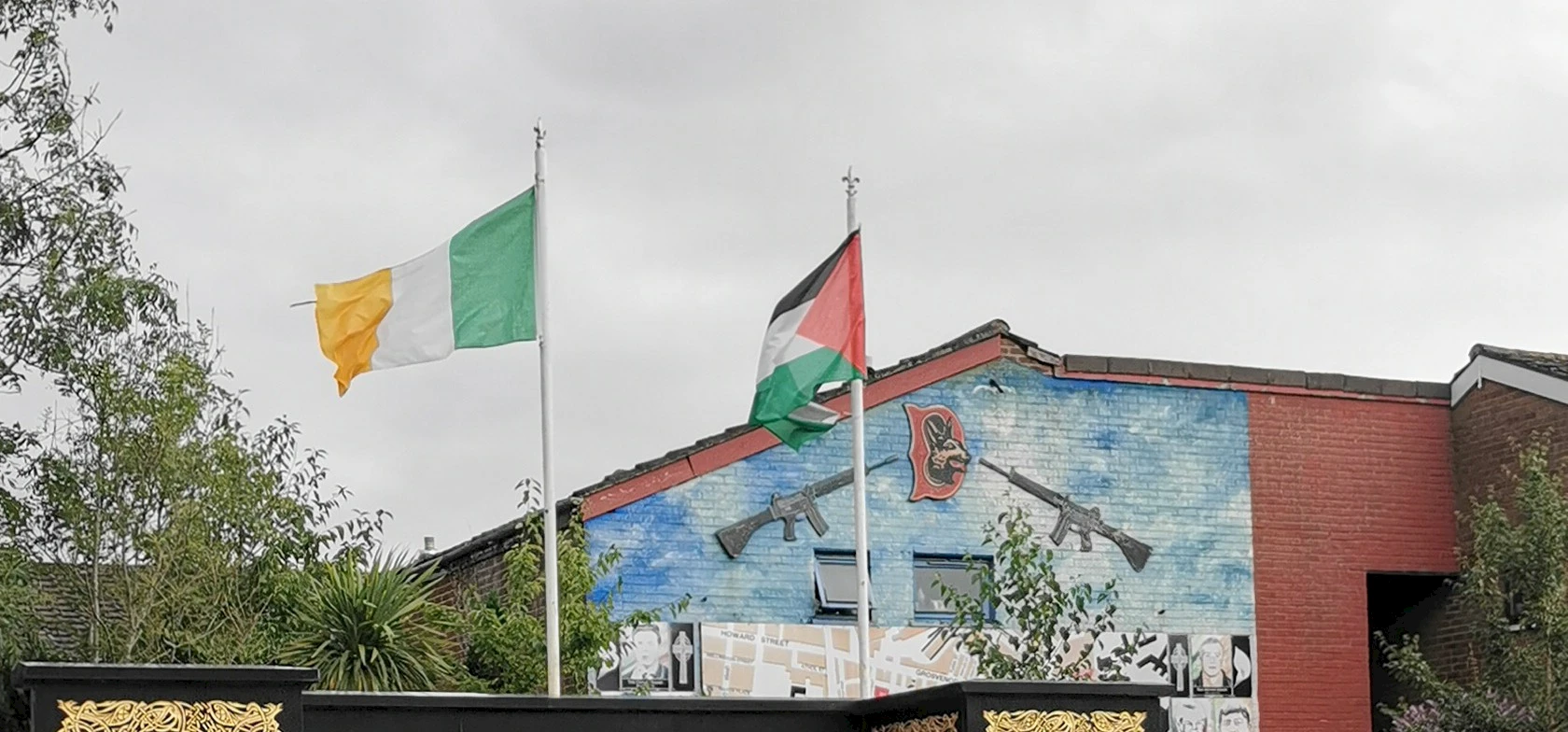
West Belfast during the field trip of July 8, 2025. Photo: Giulia Terralavoro
However, this phantasmagoria was divided by a Peace Line, a wall whose physical presence took all of us by surprise. What made everything even more complex was not its perpetuation in the present, its continued existence – it would be naïve to assume that the definition of ‘post-conflict society’ applied to Belfast in a literal sense, as the city embodied an agonistic arena where feelings were far from dormant – but the fact that it had opening and closing hours. At 8:30pm on weekdays, at 6:30pm at weekends and public holidays, the wall divided West Belfast again: a wound stitched with barbed wire until it bled out once again.
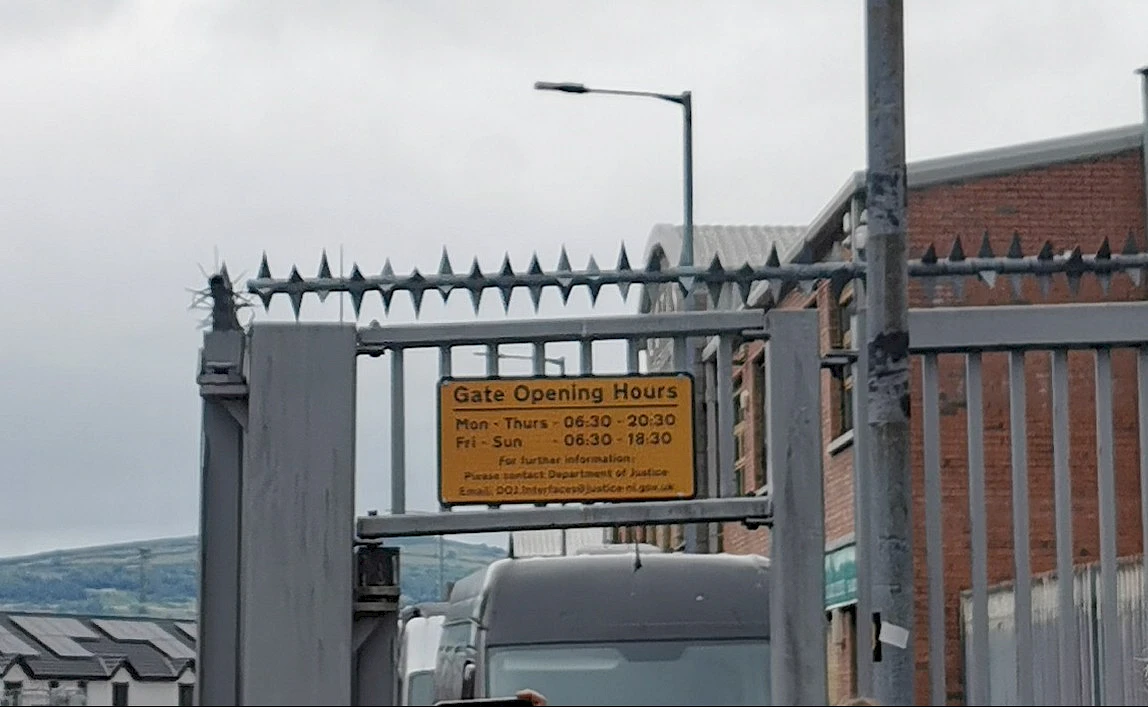
The gate of the Peace Line in Belfast during the field trip of July 8, 2025. Photo: Giulia Terralavoro
Although it is difficult to control time, exercising such control is the real oppression of subjectivity. Factories are a prime example of this: consider how factory owners manipulated clocks to make people work overtime. They controlled the workers’ perception of time and, consequently, controlled them as subjects. This is what neoliberal hegemony does: it subjects time to capitalist control, making no alternative seem possible, as Mark Fisher reminded us.
This is also reflected in our perception of the past. Walter Benjamin had already underlined how it was important for historians to maintain a certain distance from the past in order to avoid legitimising history’s course and especially the oppression it entails.1 Capitalism’s control of time and history is exactly a legitimising one, an attempt to show how there are no other possibilities for freedom. But we can also reclaim time.
This was evident in the Summer School and, especially, in one of the artworks we have discussed. A companion to our Summer School, repeated in a loop on IMMA’s Living Canvas, was Ammar Bouras’ Traces, 24°3’55”N 5°3’23”E (2011-2022). As we passed every day in front of the Living Canvas as we entered IMMA for our workshops and talks, we were greeted by slow voices speaking tamahaq and providing their own testimonies of this collective trauma. The video, previously presented at the 12th Berlin Biennale, is the result of the artist’s research on the Béryl incident, a nuclear test carried out by the French in Algeria, and its impact on the local population. It is a reflection on French colonial rule of Algeria and the role of the Algerian state itself, as the story of what happened on May 1st, 1962, is yet to be fully accounted for.
The artist collected five testimonies – four from Algerian Targuis whose lives were impacted by the Béryl incident, and one from a French chemist who worked for the French army at the time of the explosion – to build a counter-historiography of what happened. Professor Jill Jarvis, who presented us the artwork, reminded us that it was very difficult to reconstruct this history from a traditional historiographic approach, as there were no records on the French side.
The archive is indeed a powerful institution, not only for what it contains – the kind of history that the state wishes to narrate – but also for what it lacks: the archive’s mute voices, the echoes of those who were erased by hegemonic narration. This is what struck me.
Seeing Bouras’ work reminded me of Belfast. There is a kind of memory that cannot be found in archives, a counter-hegemonic account of history that goes from murals to oral testimonies. I searched the words to better convey what I felt and then I realized: post-conflict societies are temporal loops. ‘Loop’ is here intended as a past that repeats itself circularly, a violent and traumatic embodied reenactment. What Abbas proposed with his work was a decolonisation of a forgotten history by contrasting archival and official accounts – or lack thereof – with a reenacted memory, as evident not only in the artwork - presented itself as a loop - but in the very way the Targuis recounted their experiences. They repeated and emphasised every word. It was a circular narrative, an affirmation and reclamation of testimony. Trauma was rehearsed, re-performed and re-embodied. The past became alive again in a deconstruction of the Hegelian and linear approach to historiography. The loop was the artist’s way of reclaiming forgotten histories, to affirm this collective trauma and demand attention and justice. This is what I also found in the way the walls in West Belfast close and open, negotiating the present to further reclaim the contemporaneity of this collective trauma.
Finally, the loop was a kind of affective and embodied memory that worked through repetition and reenactment as reclaiming counter-hegemonic strategies. Vanessa Agnew talked about reenactment as a kind of history from below2, an anomaly compared to traditional historiographical practice which gives voice and space to marginalised communities: if I repeat my story constantly, you will have to hear me and my repetition will deconstruct a linear past which removes responsibility in the present to take into account past traumas.
The a-historicity of the loop signifies the reclamation of the value of embodied and personal experience, fighting against the regimes of the archive. Its proposal is not only an act of voice giving for the people whose stories were unheard and forgotten, but the construction of a different past to create a possibility of future against capitalism and one of its tools, colonialism, and its fatalistic view of collectivity.
Related contributions and publications
-
Reading List: Summer School, Landscape (post) Conflict
Summer School - Landscape (post) ConflictSchoolsLand RelationsPast in the PresentIMMANCAD -
Decolonial aesthesis: weaving each other
Charles Esche, Rolando Vázquez, Teresa Cos RebolloLand RelationsClimate -
Climate Forum I – Readings
Nkule MabasoEN esLand RelationsClimateHDK-Valand -
…and the Earth along. Tales about the making, remaking and unmaking of the world.
Martin PogačarLand RelationsClimatePast in the Present -
Art for Radical Ecologies Manifesto
Institute of Radical ImaginationLand RelationsClimateInstitute of Radical Imagination -
Ecologising Museums
Land Relations -
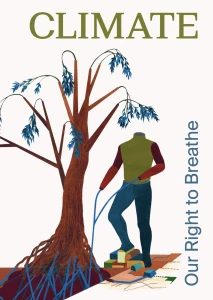
Climate: Our Right to Breathe
Land RelationsClimate
Related activities
-
HDK-Valand
Climate Forum I
The Climate Forum is a space of dialogue and exchange with respect to the concrete operational practices being implemented within the art field in response to climate change and ecological degradation. This is the first in a series of meetings hosted by HDK-Valand within L'Internationale's Museum of the Commons programme.
-
–Van Abbemuseum
The Soils Project
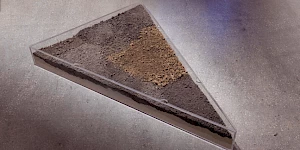
‘The Soils Project’ is part of an eponymous, long-term research initiative involving TarraWarra Museum of Art (Wurundjeri Country, Australia), the Van Abbemuseum (Eindhoven, Netherlands) and Struggles for Sovereignty, a collective based in Yogyakarta, Indonesia. It works through specific and situated practices that consider soil, as both metaphor and matter.
Seeking and facilitating opportunities to listen to diverse voices and perspectives around notions of caring for land, soil and sovereign territories, the project has been in development since 2018. An international collaboration between three organisations, and several artists, curators, writers and activists, it has manifested in various iterations over several years. The group exhibition ‘Soils’ at the Van Abbemuseum is part of Museum of the Commons. -
–MACBA
Where are the Oases?
PEI OBERT seminar
with Kader Attia, Elvira Dyangani Ose, Max Jorge Hinderer Cruz, Emily Jacir, Achille Mbembe, Sarah Nuttall and Françoise VergèsAn oasis is the potential for life in an adverse environment.
-
–Museo Reina Sofia
Team of Teams
This project researches citizen participation as a fundamental pillar in the creation of community.
-
–tranzit.ro
Non-Western Technologies for the Good Life
The experimental course ‘Non-Western Technologies for the Good Life’ (November 2023–May 2024) celebrates as its starting point the anniversary of 50 years since the publication of Tools for Conviviality, considering that Ivan Illich’s call is as relevant as ever.
-
–Moderna galerijaZRC SAZU
Summer School: Our Many Easts
Our Many Easts summer school is organised by Moderna galerija in Ljubljana in partnership with ZRC SAZU (the Research Centre of the Slovenian Academy of Sciences and Arts) as part of the L’Internationale project Museum of the Commons.