Dispatch: Landescape – bending words or what a new terminology on post-conflict could be
In her dispatch from the summer school 'Landscape (post) Conflict' researcher Amanda Carneiro reflects on escape and fugitivity across contexts, landscapes and languages.
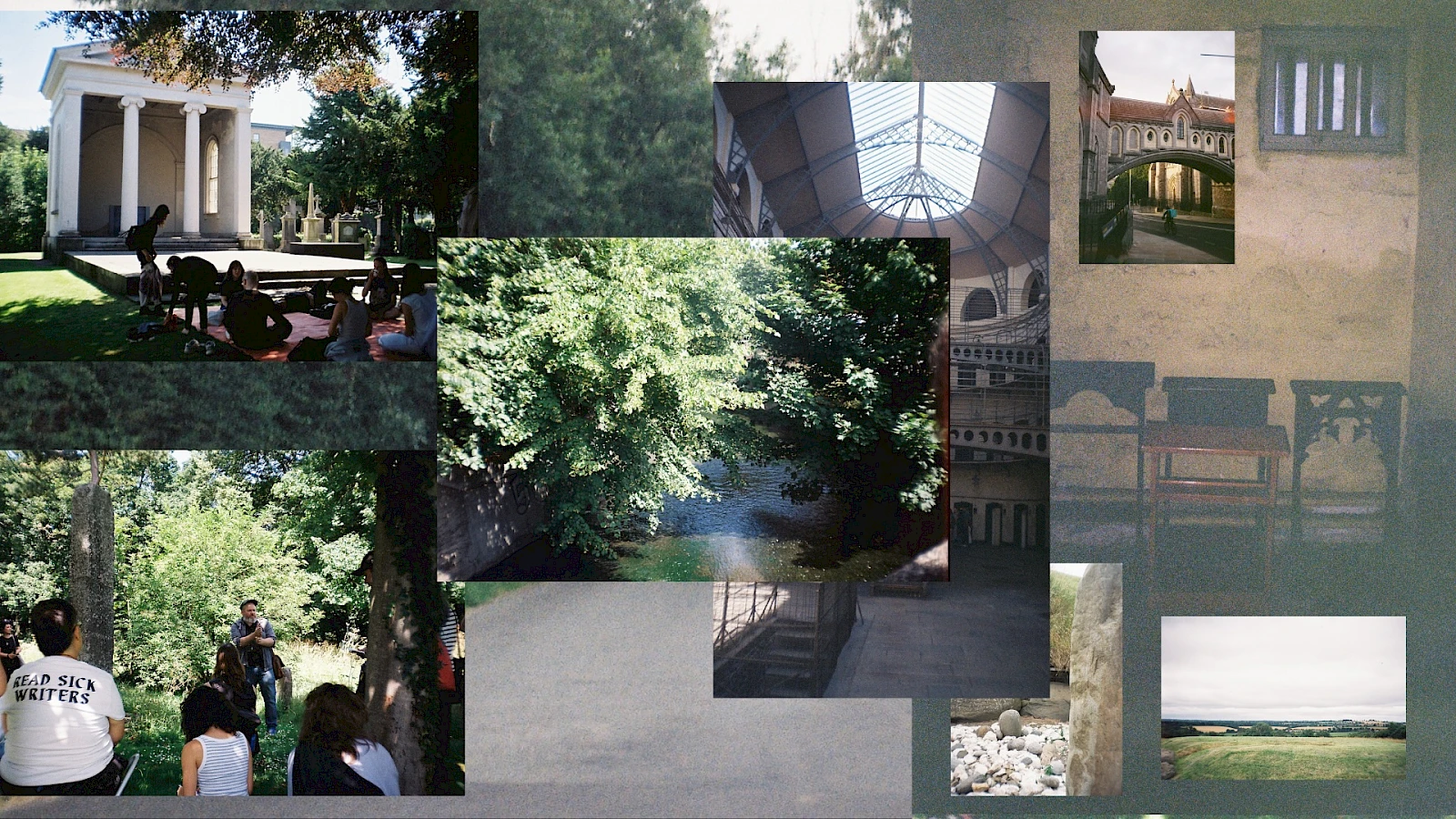
Amanda Carneiro, Collage I, L’Internationale Museum of the Commons Summer School, Landscape (post) Conflict, 2025
Five of us gathered in the studios on the left side of IMMA, the Ireland Museum of Modern Art. Each one from a different place: Ukraine, Brazil, Canada, USA, Ireland. Different places, different conflicts. A lot of similarities emerged as we shared our understandings and our suggestions of a lexicon that could compose shared understandings of: self-determination, fieldcraft, natural resources, visualising language, border-enacting, border-thinking and entanglements.
A particular word stood out: landscape, without an e. For Latin language-speakers, it is a common mistake to add vowels in words started by ‘s’, as the mute s sound is rarely used. As I started erasing the word and trying to rewrite it, I found myself writing it, once again, ‘landescape’, with an e. Sabine’s words, my colleague from the summer school, came to my mind: ‘no one owns the language, there is no right or wrong.’
Can there be anything as ‘right or wrong’ in languages as violent as the languages of empires? What is an ‘English mistake’? An e in a word? In the face of more problematic and violent actions attached to the possible correspondents of an ‘English mistake’, I stayed with landescape and faced what it was telling me. What does it mean to escape the land?
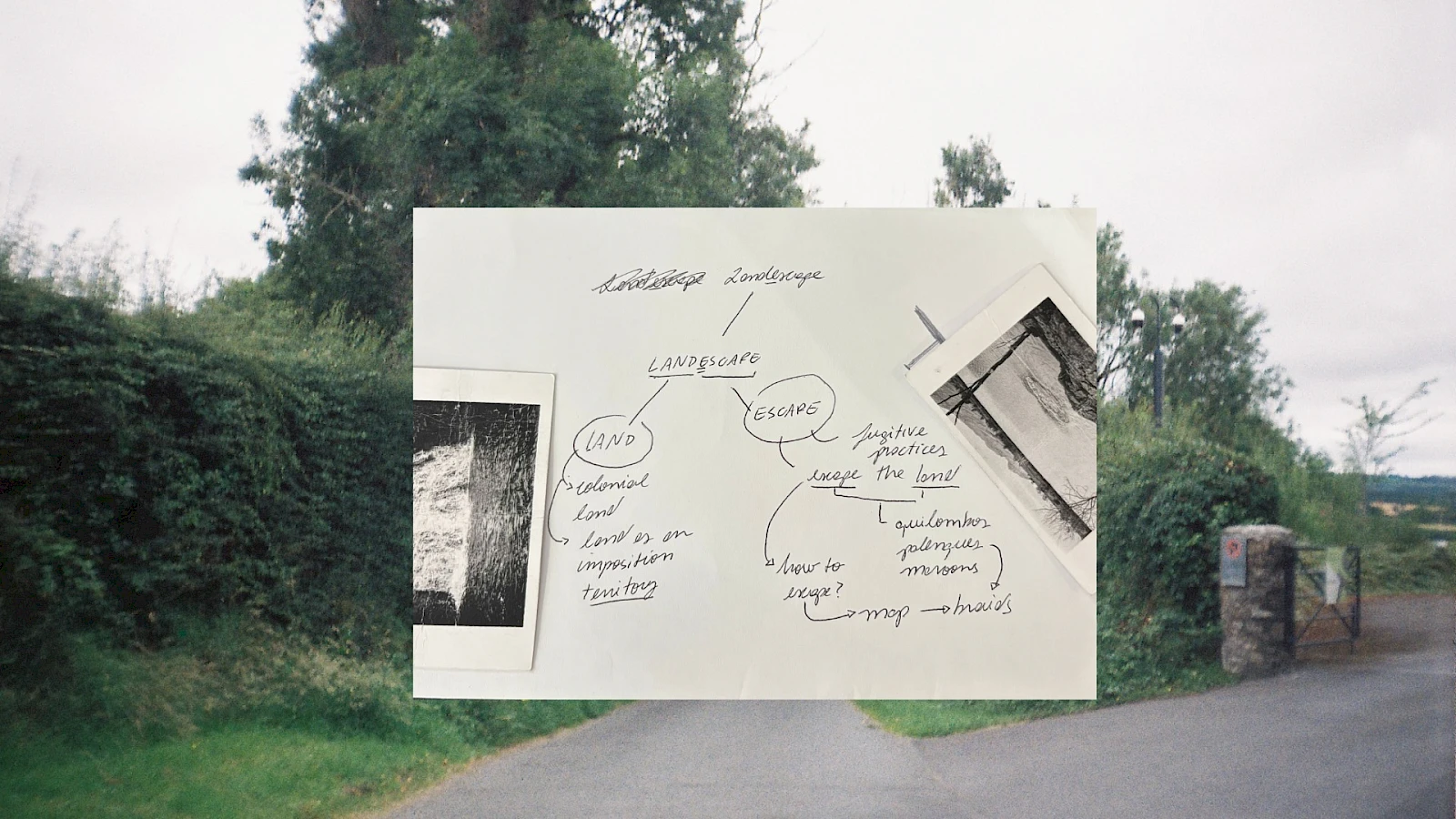
Amanda Carneiro, Collage II, L’Internationale Museum of the Commons Summer School, Landscape (post) Conflict, 2025
Escaping here aligned closely with notions of fugitive planning, or the necessity of making maps, a fugitive cartography that led the way out of the dominant and colonial notions of a ‘land’. The land itself is an idea. The soil, a piece of ‘land’, does not know it is a land. It is a bigger set of laws, of people, articulations and mostly, of words, which confine the soil under the violent grammar of territoriality and state logic. If we were to escape the idea of a land, what would a cartography of the act of escaping look like? A possible answer lies close to the history of cornrows, braids made by women in Colombia, when they were confined inside senzalas.
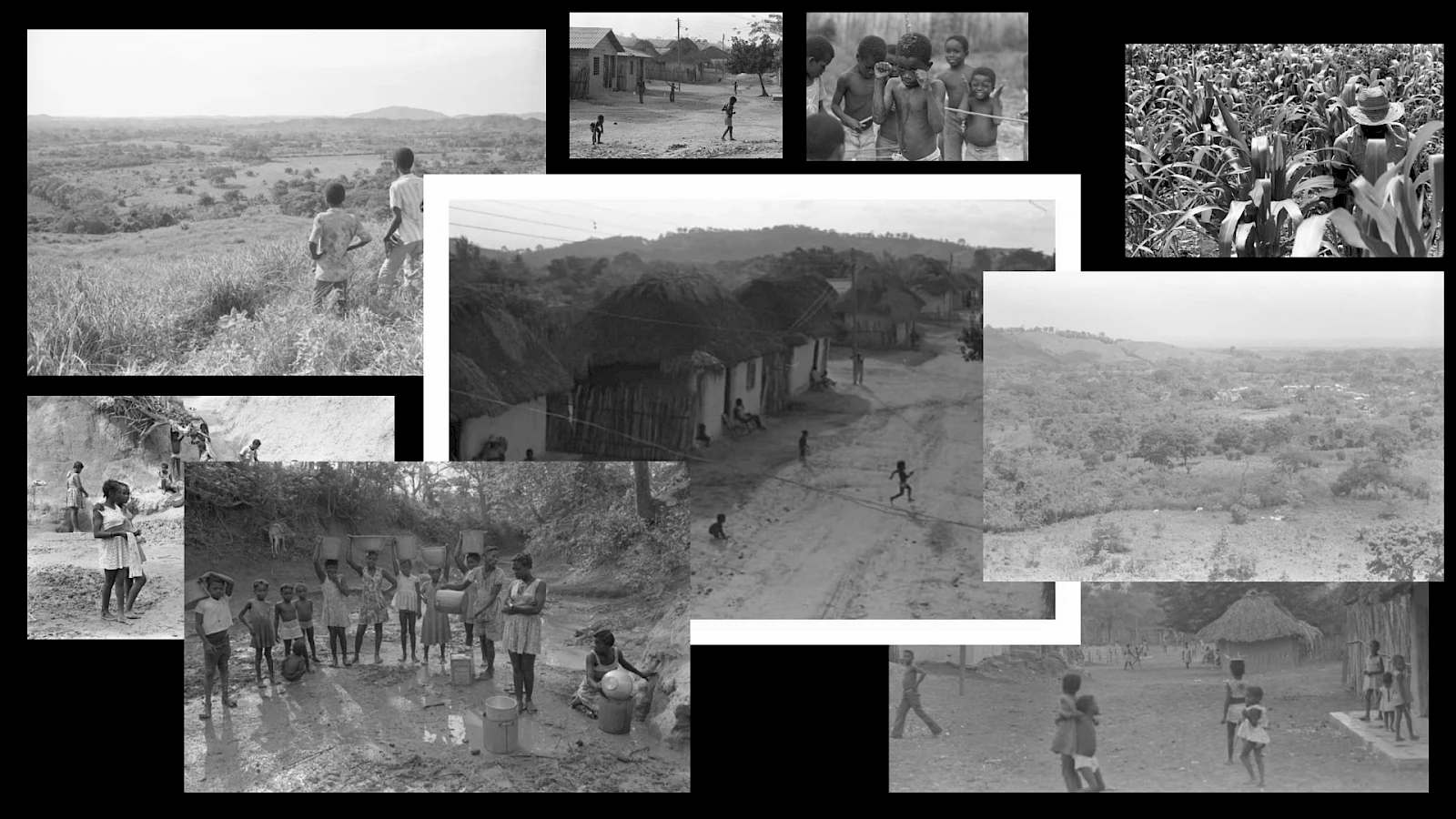
Amanda Carneiro, Collage III, L’Internationale Museum of the Commons Summer School, Landscape (post) Conflict, 2025
Cornrows is a traditional hair braiding technique of closely braided styles, in which the hair is braided closely to the scalp in straight rows or more intricate patterns. Senzalas were the enslaved quarters. The word comes from the Bantu language Quimbundo, meaning ‘dwelling’. In colonial South America, it became a living quarter for enslaved individuals. Those precarious accommodations, lacking any privacy or luxury of any kind, were described as overcrowded and unsanitary. 50km away from the Caribbean Sea, women mapped survival through an ancestral braiding technique. When people were trafficked all over Africa and brought to the other side of the Atlantic, a painful subtraction operation was articulated. It meant not only losing one’s language and family but also losing geographical reference. Life played by the rules of a foreign land, a foreign language and mostly, a foreign landscape.
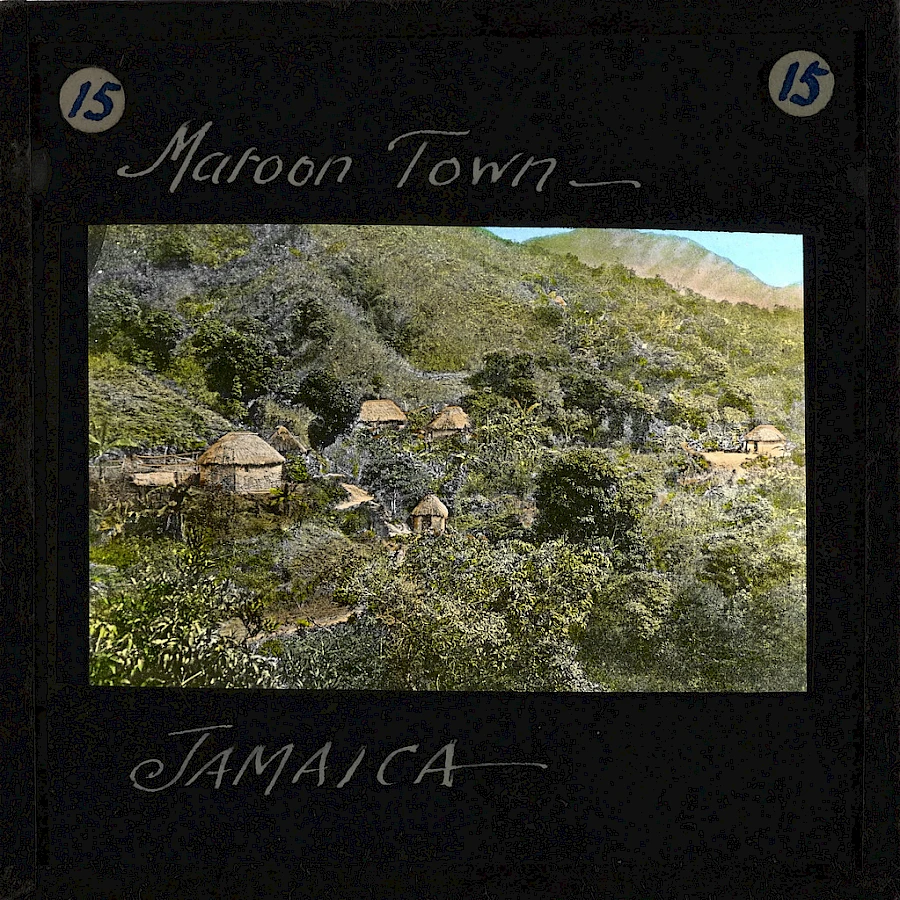
Accompong, Jamaica, early 20th century, Fæ is licensed under CC BY 2.0.
However, whenever forced to go from farm to farm, they paid attention to the roads, becoming familiar with specific landmarks. By visualising the roads and the forests, they translated escape routes into maps. Braids have always carried deep cultural significance, indicating tribe, age, marital status and social rank. After the forced crossing of the Atlantic, they carried the possibility of freedom. The braids were used as a secret code, indicating the way through which they could escape. In an activity of cartography, the scalps became maps to freedom.
But the map to freedom would not mean just an escape route, it meant to arrive in the palenques, quilombos or maroons. These three words represent very similar spaces in the colonial American continent, referring to communities formed by cimarrons, the people who escaped the plantation regime and established independent settlements. Quilombo is more commonly used in Brazil, palenque in Colombia and maroon in the Caribbean.
In the hairstyles, women also kept objects that would be useful when they arrived at the palenques, like matches, gold nuggets or seeds. To plan escapes, they gathered and drew maps on the scalps of younger women. The different patterns of braids would mean different things. For example, a twisted braid would indicate a mountain; those that were sinuous, like snakes, indicated rivers or water sources, and a thick braid indicated that in that section, there were soldiers. The hair also represented meeting points, marked by various lines of braids, that converged in the same place, each representing a possible path. If they would meet under a tree, they would finish the braid vertically and upwards, so that it would stand up. If it was by the riverbank, they flattened it in the direction of the ears. Additionally, the braids were sometimes of different lengths along the same paths, indicating to different groups how far they should go.
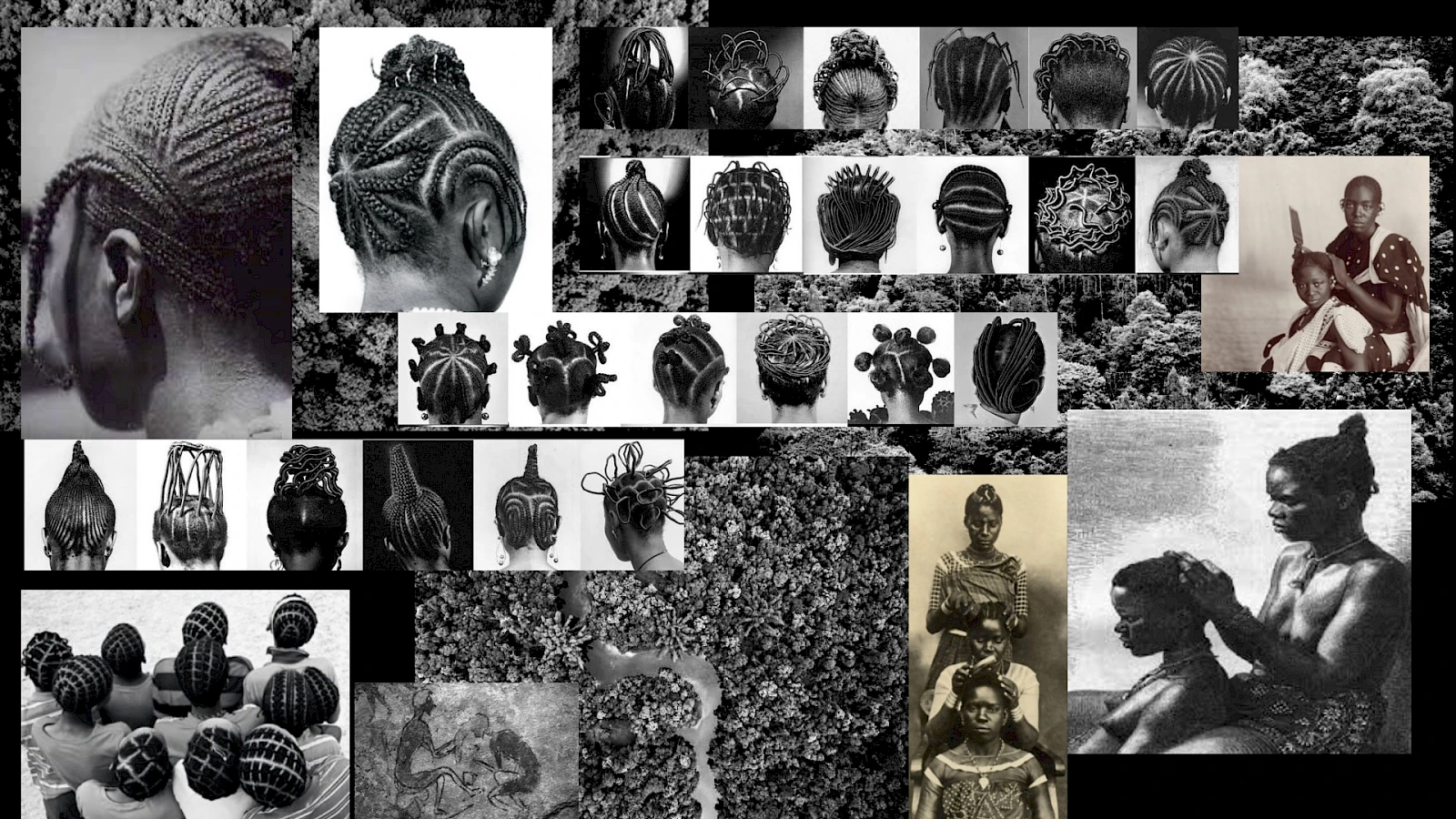
Amanda Carneiro, Collage IV, L’Internationale Museum of the Commons Summer School, Landscape (post) Conflict, 2025
The maps were not solely representing geographic characteristics, they would communicate what the escape strategy would be. As I return to the initial task of proposing a new lexicon for landscape, I realize that it is through our collective voices and words that a lexicon of escape can begin to take shape:
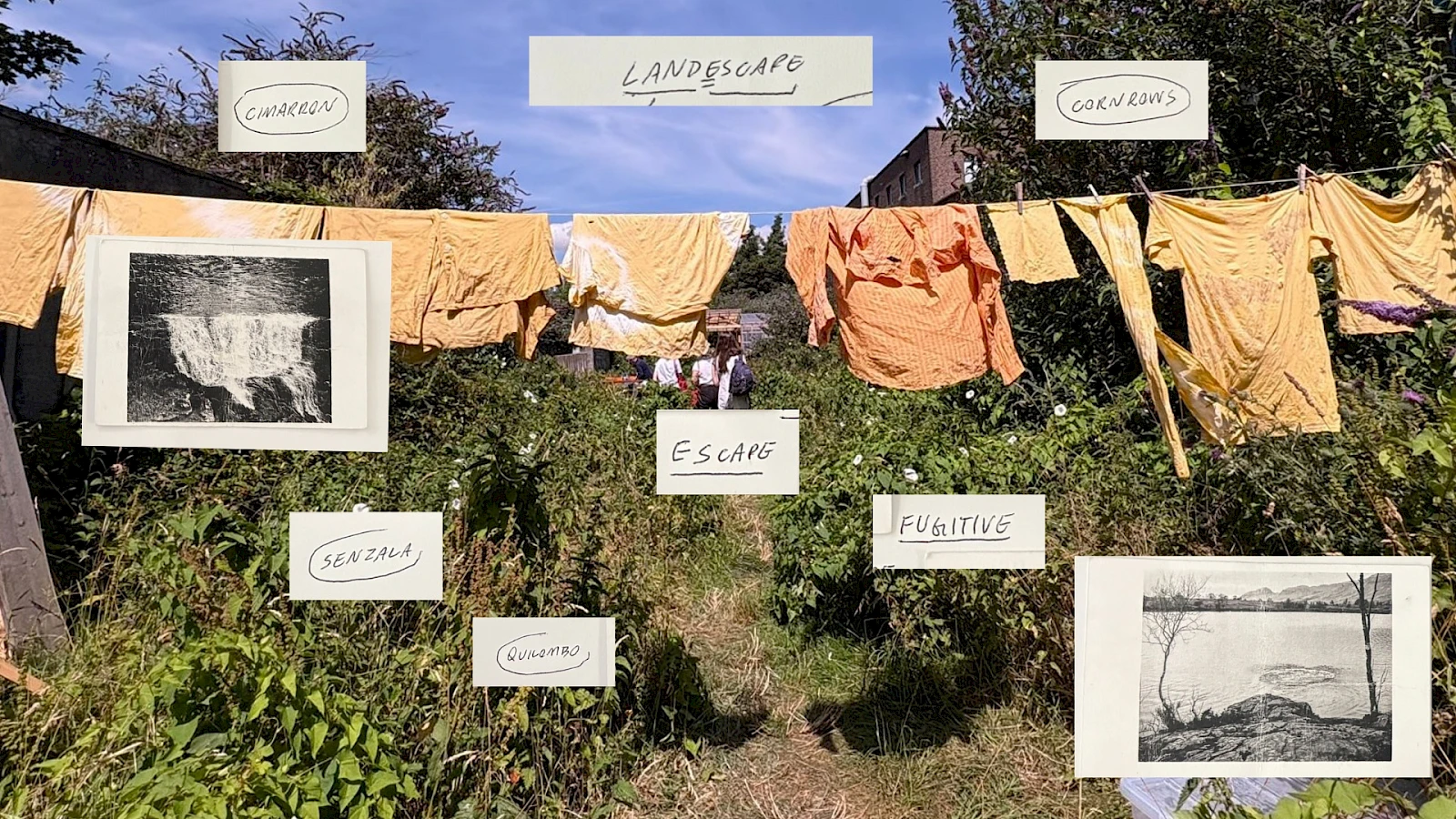
Amanda Carneiro, Collage V, L’Internationale Museum of the Commons Summer School, Landscape (post) Conflict, 2025
To escape can mean to think of a land that is not fixed, but imagined, shifting, unfinished, always becoming. What does it take for knowledge to be called ancestral? Does it need to be stable, or only carried, remembered, felt? Stones, bonfires, monuments and archaeological sites are structures that hold memory, but they also confine it. We inherit their weight and must ask: in what ways are they still pushed upon us and how might we loosen their hold? Liberation may not lie in rejecting these forms outright, but in learning to walk alongside them differently, seeing them not as final truths, but as starting points, porous and alive, where other stories might also take root.
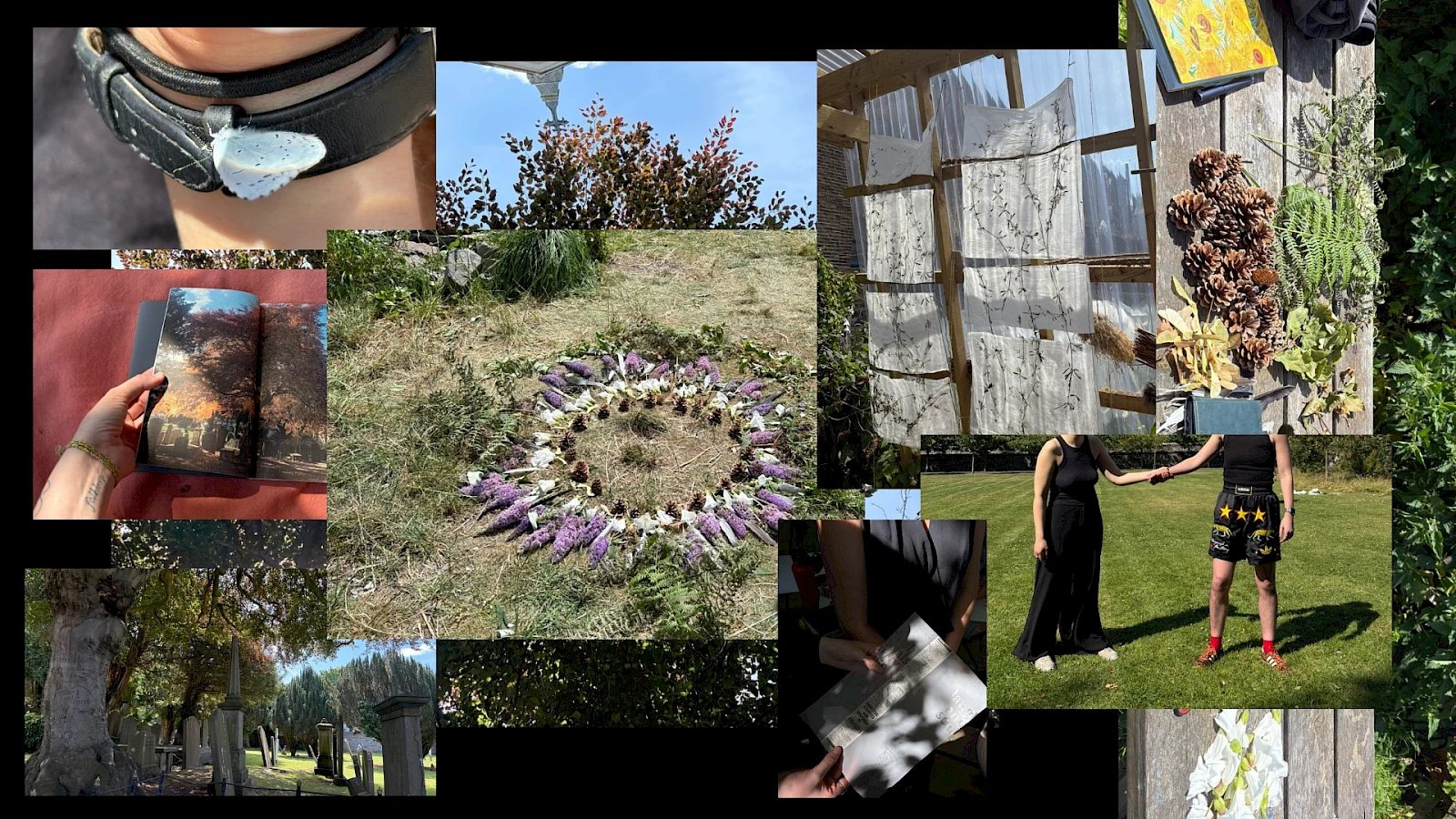
Amanda Carneiro, Collage VI, L’Internationale Museum of the Commons Summer School, Landscape (post) Conflict, 2025
Related contributions and publications
-
Dispatch: Haunting, cataloging and the phenomena of disintegration
Coco GoranSchoolsLand RelationsIMMANCAD -
Dispatch: Reenacting the loop. Notes on conflict and historiography
Giulia TerralavoroSchoolsLand RelationsIMMANCAD -
Reading List: Summer School, Landscape (post) Conflict
Summer School - Landscape (post) ConflictSchoolsLand RelationsPast in the PresentIMMANCAD -
Decolonial aesthesis: weaving each other
Charles Esche, Rolando Vázquez, Teresa Cos RebolloLand RelationsClimate -
Climate Forum I – Readings
Nkule MabasoEN esLand RelationsClimateHDK-Valand -
…and the Earth along. Tales about the making, remaking and unmaking of the world.
Martin PogačarLand RelationsClimatePast in the Present -
Art for Radical Ecologies Manifesto
Institute of Radical ImaginationLand RelationsClimateInstitute of Radical Imagination -
Ecologising Museums
Land Relations -
Climate: Our Right to Breathe
Land RelationsClimate
Related activities
-
HDK-Valand
Climate Forum I
The Climate Forum is a space of dialogue and exchange with respect to the concrete operational practices being implemented within the art field in response to climate change and ecological degradation. This is the first in a series of meetings hosted by HDK-Valand within L'Internationale's Museum of the Commons programme.
-
–Van Abbemuseum
The Soils Project
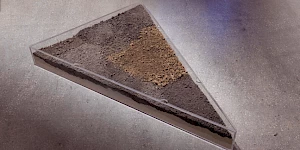
‘The Soils Project’ is part of an eponymous, long-term research initiative involving TarraWarra Museum of Art (Wurundjeri Country, Australia), the Van Abbemuseum (Eindhoven, Netherlands) and Struggles for Sovereignty, a collective based in Yogyakarta, Indonesia. It works through specific and situated practices that consider soil, as both metaphor and matter.
Seeking and facilitating opportunities to listen to diverse voices and perspectives around notions of caring for land, soil and sovereign territories, the project has been in development since 2018. An international collaboration between three organisations, and several artists, curators, writers and activists, it has manifested in various iterations over several years. The group exhibition ‘Soils’ at the Van Abbemuseum is part of Museum of the Commons. -
–MACBA
Where are the Oases?
PEI OBERT seminar
with Kader Attia, Elvira Dyangani Ose, Max Jorge Hinderer Cruz, Emily Jacir, Achille Mbembe, Sarah Nuttall and Françoise VergèsAn oasis is the potential for life in an adverse environment.
-
–Museo Reina Sofia
Team of Teams
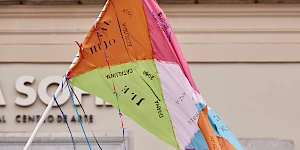
This project researches citizen participation as a fundamental pillar in the creation of community.
-
–tranzit.ro
Non-Western Technologies for the Good Life
The experimental course ‘Non-Western Technologies for the Good Life’ (November 2023–May 2024) celebrates as its starting point the anniversary of 50 years since the publication of Tools for Conviviality, considering that Ivan Illich’s call is as relevant as ever.
-
–Moderna galerijaZRC SAZU
Summer School: Our Many Easts
Our Many Easts summer school is organised by Moderna galerija in Ljubljana in partnership with ZRC SAZU (the Research Centre of the Slovenian Academy of Sciences and Arts) as part of the L’Internationale project Museum of the Commons.