Dispatch: ‘I don't believe in revolution, but sometimes I get in the spirit.’
In the first of a series of dispatches from the recent 'Summer School: Our Many Easts' curator and researcher Megan Hoetger assembles quotes and images from the workshops, lectures and conversations in Ljubljana, reflecting on the "charged laughter", "internal contradictions" and space of "respite" that permeated the summer school.
On our last night in Ljubljana, I sat around a table with other participants in the ‘Our Many Easts’ summer school program, and, rather anachronistically, we drank red wine in the summer heat. While others were inside dancing to a playlist composed by the program participants, I was absorbed in a sprawling conversation on non-alignment, imagination, structural racism, and the (im)possibilities of collective formation under EU neoliberal regimes. I recounted a phrase from a button I had seen once in a satirical social media post by the Belgo-Dutch grassroots media collective Black Speaks Back: ‘We were going to fight for liberation, but we didn’t get the grant.’ We all laughed — it was that slightly pained and nervous laughter that couches grief in a veneer of self-protective scepticism.
For all of the tensions and internal conflicts held together in a capacious title like ‘Our Many Easts’ (which East? whose East? imaginary Easts? And what of European state socialist ‘friendship cooperations’ with the South? who was aligning with whom? when and why?), the six days of the summer school also held space for this kind of charged laughter. It is not so often that space gets held open for this, that time can be made to feel our way towards what else might be within that laughter alongside the grief, even as we cannot yet see what might come after it. It is a privilege and a respite to be in such a space, and it is one which is always lined with the barely imaginable depths of state violence. This space outside the Research Centre for the Slovenian Academy of Sciences and Arts (ZRC SAZU) in late August was no different. As we gathered in Ljubljana, the ongoing genocide in Gaza approaches one year with the active support of the United States and its NATO bloc (and the Bosnian genocide loomed large in our workshop discussions); the full scale Russian war in Ukraine continues for over two years (and the living spectres of Soviet colonialism loomed large in our workshop discussions too); and deep infrastructural violence at the bloody intersections of the state and global capital grips places all over the world, from Haiti to Sudan, the DRC and Bangladesh, as well as along EU borders and their ever-extending zones of policing. One need only remember that the Slovenian forests are part of the Balkan refugee route, and here is only the ‘last step’ of the treacherous journey – Jošt Franko’s contribution to the 2024 U3 triennial exhibition, The Feeling of Europe; A Memory Without Evidence, Until I Become Home, is devoted to the stories of migrants and their experiences here. Hope in any of the political imaginaries from transnational socialist pasts seems further than ever when it comes to confronting the material conditions on the ground today. Hence the pained, nervous laughter around the table.
As the conversation continued, another colleague offered words that are still reverberating in my ears: ‘I don't believe in revolution, but sometimes I get in the spirit.’ (Ava Zevop, 30 August 2024) The words were shared with a smile and a wink. Another shared some thoughts from a recent article she’d written entitled ‘The Role You Made Me Play’. Art museums talk to geographies, talk to teachers, talk to time. I thought of all of the characters in Ala Younis’s Plan for Greater Baghdad. I thought of the work on character development that we do in a collective to which I belong and our newest characters - the political art power couple from hell. The laughter erupted from deep in my belly. Rising up alongside the grief was a certain joy in remembering (like Walter Benjamin’s flashes) all the fleeting moments, like this one, of getting in the spirit — of being in spirit — with others (peers, elders, and ancestors) across times and spaces.
For this dispatch, I’ve assembled a sampling of citations, phrases, and a few images from other fleeting moments that “erupted” across the ten workshops and numerous presentations (performance-lectures, screenings, exhibition tours, moderated conversations, and so forth) in the summer school’s curriculum. Invoking my colleagues’ words, I try to keep them with me in spirit and to share with readers a glimpse into the spirit(s) of our six days together.
‘What it’s like to be faced with an archive and feel it’s expecting something from you.’
Mila Turajlić, introductory remarks for Non-Aligned Newsreels: Fragments from the Debris lecture performance, 25 August 2024
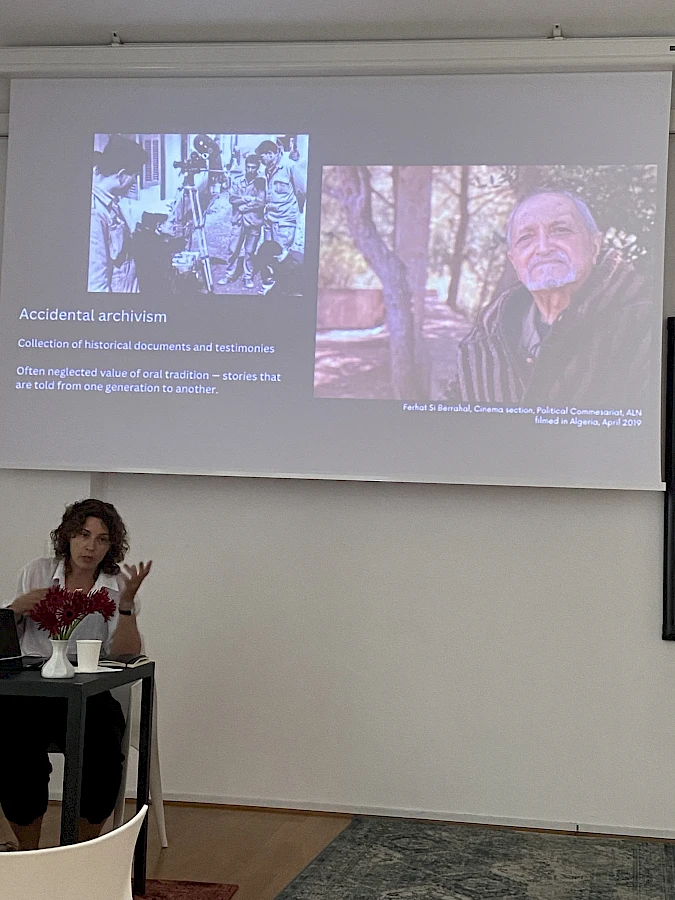
Mila Turajlić, 'Accidental Archivism' presentation slide from the workshop 'Non-Aligned Newsreels: Fragments from the Debris', 26 August 2024
‘Archives are usually boring things unless we make them interesting.’
Ala Younis in a Discussion Café presented within the frame of the Mladi Levi festival, 28 August 2024
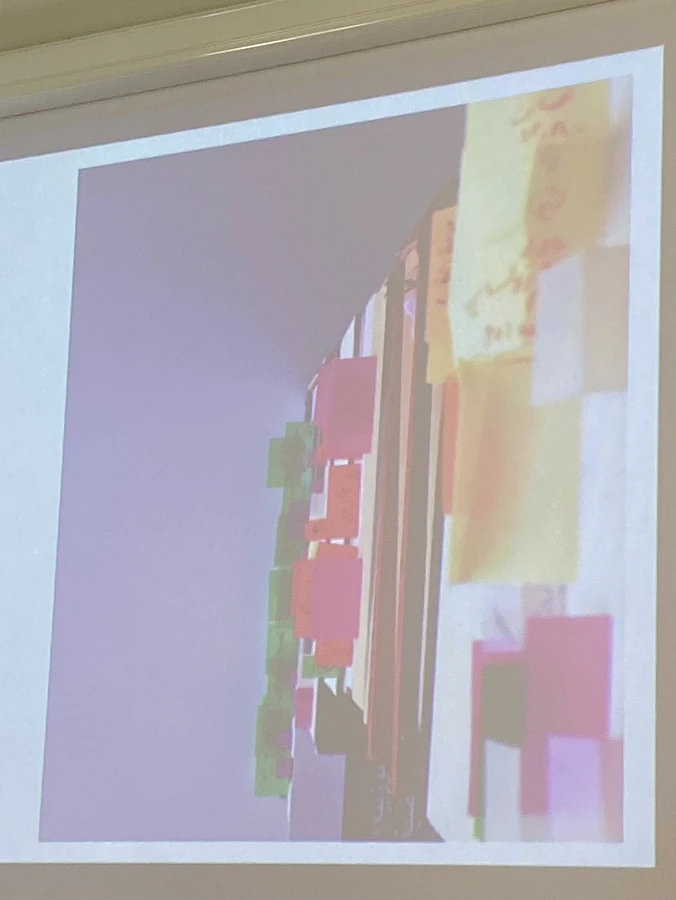
Ala Younis, Presentation slide with notated shelf of books (every time a woman is mentioned) from the workshop 'Book of Transfers', 28 August 2024
‘History is facts which become lies in the end.’
Jean Cocteau quoted in David Crowley’s lecture 'Imagined East', 28 August 2024
‘equip the people with information…’
Bojana Piškur in the workshop 'Constellations from the South to the East and back again', 27 August 2024
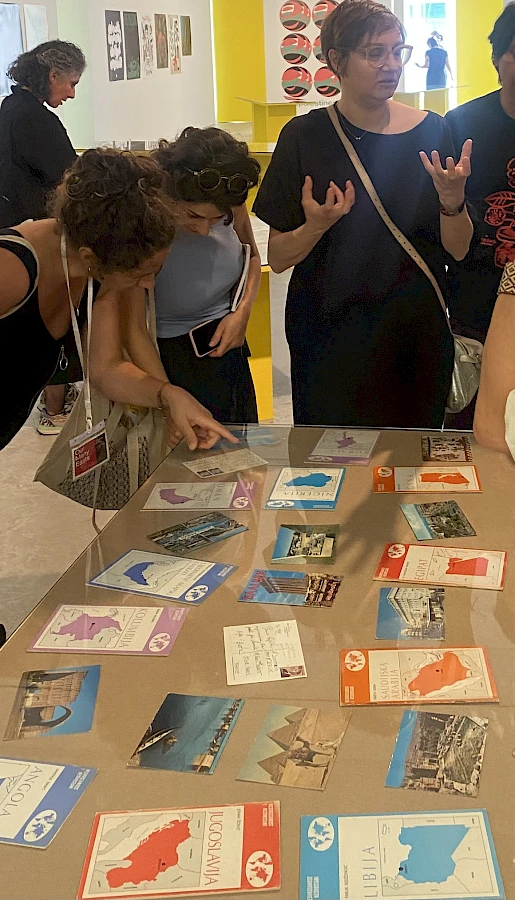
Yugoslav information booklets on non-aligned countries as found at flea markets by Bojana Piškur and featured in the exhibition 'Constellations of Multiple Wishes: Along the Eastern Horizon' (pictured from left to right: Maria Markovic, Seda Yildiz, Dubravka Sekulić)
‘regimes of interpretation’
Tanja Petrović in the workshop 'An Adventure in Collectivity: Revisiting the World of Yugoslav Comics', 30 August 2024
‘What of socialism remains in the post- ?’
Dasha Filippova, Part of self-introduction at the start of workshops, 26-28 August 2024
‘In general, we are more interested in the ethics than the politics at this moment.’
Zdenka Badovinac, in discussion during the workshop 'What is all this "East"?', 26 August 2024
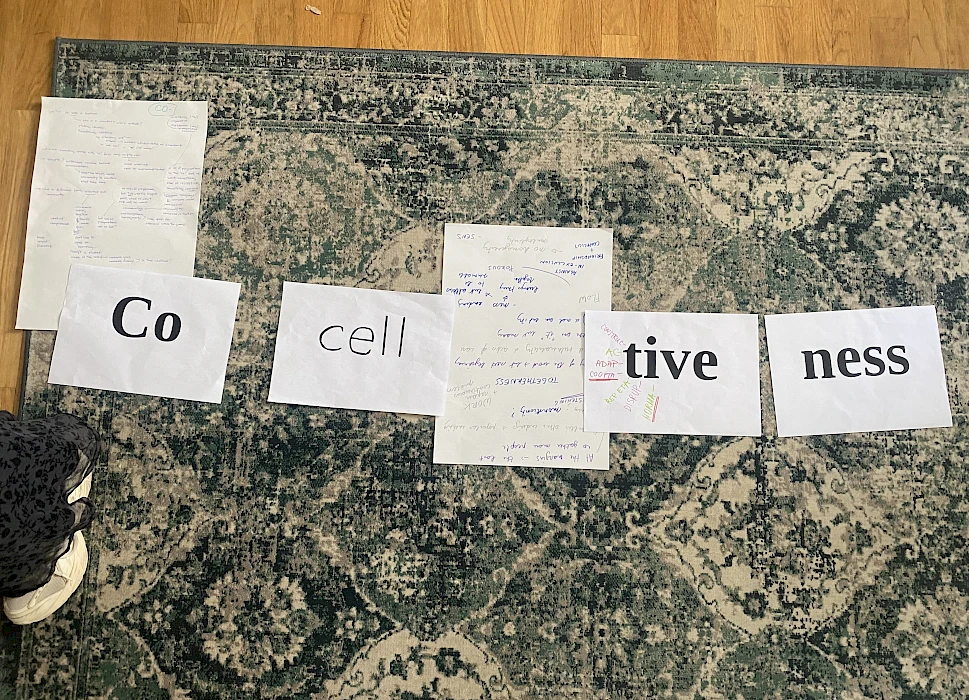
Collective notes as written by workshop participants and compiled by Mabel Tapias in the workshop 'Collectiveness as method and as wish. Alliances and friendship as ways of intervening in the world', 28 August 2024
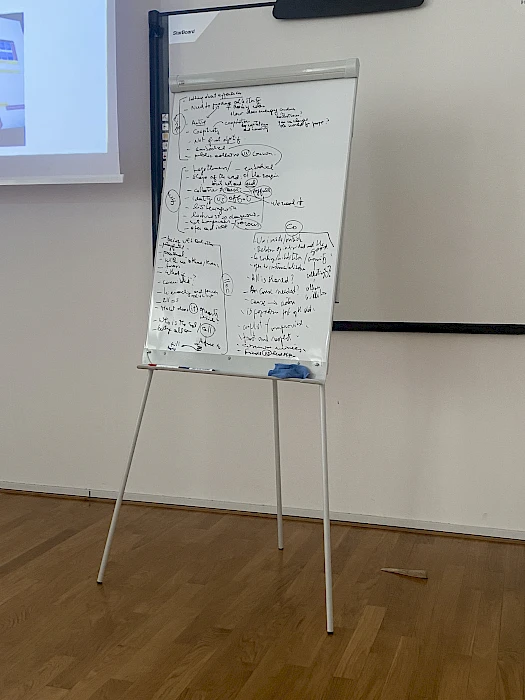
‘You don’t need to be friends but perhaps a politics of friendship is needed to produce things differently.’
Mabel Tapia in the closing remarks for the workshop 'Collectiveness as method and as wish. Alliances and friendship as ways of intervening in the world', 28 August 2024
‘Cooking opens the space for poetry.’
Martin Pogačar in the workshop 'Matters of Memory: Tin Cans, Trains, and the Mediation of the Past Experience', 28 August 2024
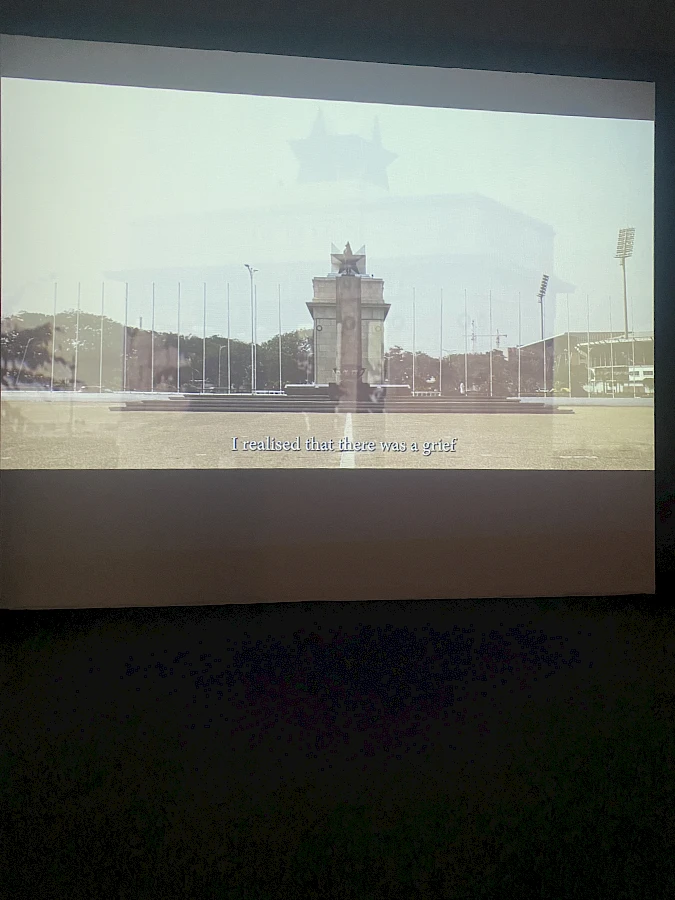
Still from Larry Achiampong, A Letter (Side B), 2023
‘If you are [I am] to go… please keep your [I will keep my] radio on, even when the pain of silence deafens, don’t lose hope one day beyond the frequencies you [I] will return.’
Larry Achiampong, A Letter (Side B), 2023; watched during the exhibition tour at +MSUM with Bojana Piškur during the workshop 'Constellations from the South to the East and back again', 27 August 2024
Related contributions and publications
-
Dispatch: Notes on (de)growth from the fragments of Yugoslavia's former alliances
Ava ZevopSchoolsPast in the Present -
Reading list - Summer School: Our Many Easts
Summer School - Our Many EastsSchoolsPast in the PresentModerna galerija -
…and the Earth along. Tales about the making, remaking and unmaking of the world.
Martin PogačarLand RelationsClimatePast in the Present -
The Kitchen, an Introduction to Subversive Film with Nick Aikens, Reem Shilleh and Mohanad Yaqubi
Nick Aikens, Subversive FilmSonic and Cinema CommonslumbungPast in the PresentVan Abbemuseum -
The Repressive Tendency within the European Public Sphere
Ovidiu ŢichindeleanuInternationalismsPast in the Present -
Glossary of Common Knowledge, Vol. 2
Schools -
Glossary of Common Knowledge
Schools -
Troubles with the East(s)
Bojana PiškurInternationalismsPast in the Present
Related activities
-
–Moderna galerijaZRC SAZU
Summer School: Our Many Easts
Our Many Easts summer school is organised by Moderna galerija in Ljubljana in partnership with ZRC SAZU (the Research Centre of the Slovenian Academy of Sciences and Arts) as part of the L’Internationale project Museum of the Commons.
-
–Van Abbemuseum
The Soils Project
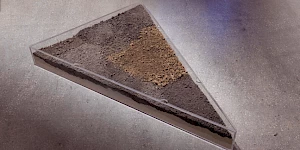
‘The Soils Project’ is part of an eponymous, long-term research initiative involving TarraWarra Museum of Art (Wurundjeri Country, Australia), the Van Abbemuseum (Eindhoven, Netherlands) and Struggles for Sovereignty, a collective based in Yogyakarta, Indonesia. It works through specific and situated practices that consider soil, as both metaphor and matter.
Seeking and facilitating opportunities to listen to diverse voices and perspectives around notions of caring for land, soil and sovereign territories, the project has been in development since 2018. An international collaboration between three organisations, and several artists, curators, writers and activists, it has manifested in various iterations over several years. The group exhibition ‘Soils’ at the Van Abbemuseum is part of Museum of the Commons. -
–VCRC
Kyiv Biennial 2023
L’Internationale Confederation is a proud partner of this year’s edition of Kyiv Biennial.
-
–MACBA
Where are the Oases?
PEI OBERT seminar
with Kader Attia, Elvira Dyangani Ose, Max Jorge Hinderer Cruz, Emily Jacir, Achille Mbembe, Sarah Nuttall and Françoise VergèsAn oasis is the potential for life in an adverse environment.
-
MACBA
Anti-imperialism in the 20th century and anti-imperialism today: similarities and differences
PEI OBERT seminar
Lecture by Ramón GrosfoguelIn 1956, countries that were fighting colonialism by freeing themselves from both capitalism and communism dreamed of a third path, one that did not align with or bend to the politics dictated by Washington or Moscow. They held their first conference in Bandung, Indonesia.
-
–Museo Reina Sofia
Team of Teams
This project researches citizen participation as a fundamental pillar in the creation of community.
-
–Van Abbemuseum
Maria Lugones Decolonial Summer School
Recalling Earth: Decoloniality and Demodernity
Course Directors: Prof. Walter Mignolo & Dr. Rolando VázquezRecalling Earth and learning worlds and worlds-making will be the topic of chapter 14th of the María Lugones Summer School that will take place at the Van Abbemuseum in Eindhoven.