Dispatch: Excerpts from the six days and sixty one pages of the black sketchbook
In her dispatch from the summer school 'Landscape (post) Conflict' filmmaker Sabine El Chamaa is prompted by Ammar Bouras’ short film Traces and a lecture by Jill Jarvis to think through the ongoing reverberations of nuclear warfare.
Looking back at my notes in August 2025 around the 80-year anniversary of the Hiroshima bombing, I realised that nuclear politics and warfare accompanied me from Beirut to Dublin and back. I arrived in Dublin during the month of July to the soothing sound of sea gulls in the sky – a huge relief from the buzz of Israeli drones. A week earlier my flight from Beirut had been cancelled, then reinstated a few days later, following what is now referred to as the 12 day Iran-Israel war. The sudden Israeli attack on Iranian nuclear sites was given the operational name: ‘Rising Lion’, and the response by Iran was named: ‘True Promise 3’. Radio announcements in Lebanon informed citizens to ensure they had enough drinking water in homes to last three days in preparation for the worst, namely nuclear radiation.
Arriving at the green fields surrounding IMMA on the first morning, I saw empty deckchairs underneath a large outdoor screen playing Ammar Bouras’ short film 24°3′55″N 5°3′23″E (2012/2017/2022), or what we referred to as Traces. Still images of desert landscapes, close shots of twisted metal, and male voice overs speaking of sudden death, cancer and radiation transmitted nuclear radiation as the film's central theme. We only watched the film, stretched out on comfortable chairs, alongside the wonderful colleagues from the summer school, days later.
Jill Jarvis’ lecture talk at the National College of Art & Design was an elaboration on Bouras’ work. ‘Gerboise Bleue’ I wrote in my notebook. This was the code-name given by the French government to their secret nuclear tests done in the Algerian Sahara in the 1960s when the country was still under French occupation. The Gerboise (jerboa in English) is known as a tiny desert mouse that inhabits the Sahara Desert. Camouflaged, the term indicates locality due to the presence of that rodent in the Sahara desert as well as innocence, secrecy, speed and cuteness. How many ‘Gerboises’ ended up dying as a result of the testing, I wondered.
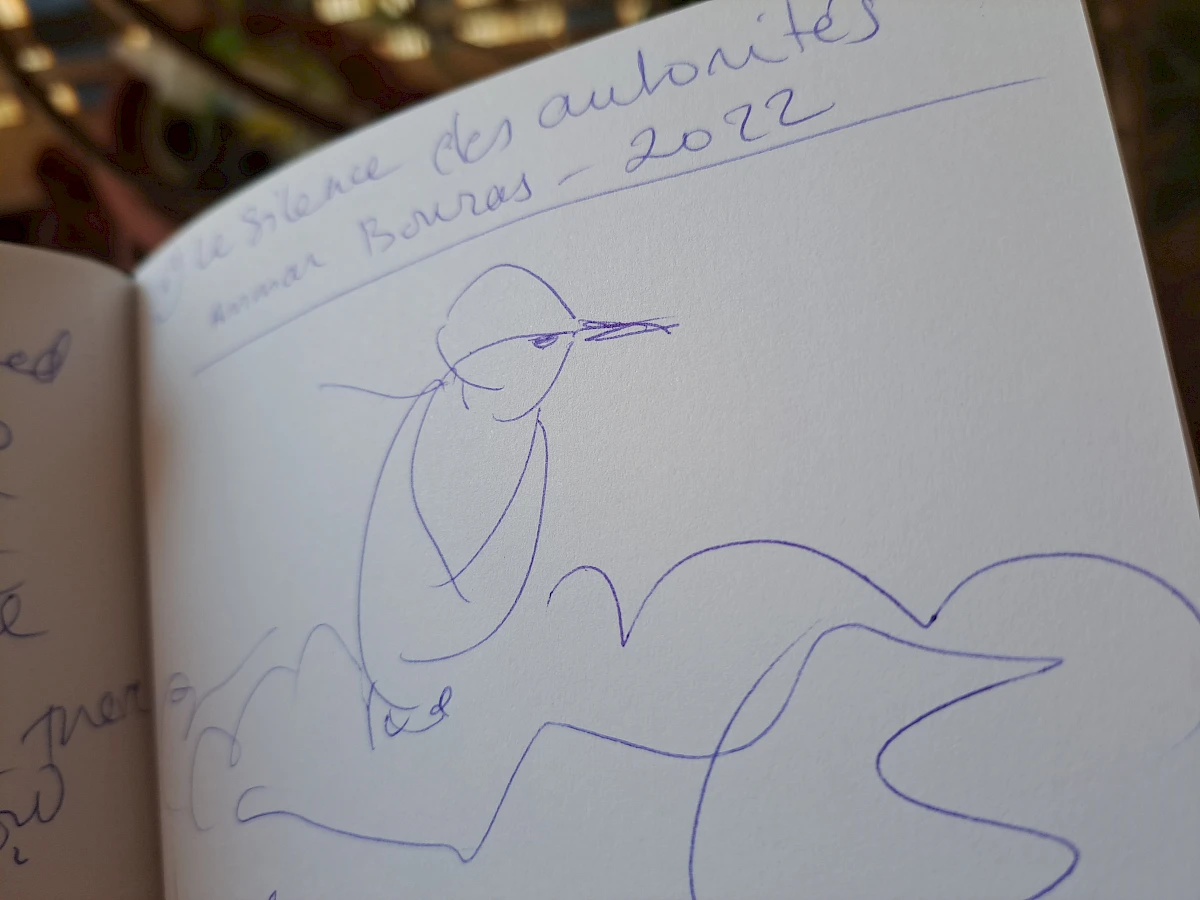
A bird on a cloud ponders, the silence of the officials
As I listened to Jarvis’ elaboration on other color-coded names, I wondered why nuclear tests are not called what they are and came up with UPLPLSHNHI which would stand for: Uncontrollable Potentially Lethal Poisoning of the Lands, Skies, and all Human and Non-human Inhabitants.
Official language masks the embodiment of pain and loss. According to Carol Cohn, the language used by nuclear scientists to describe their work helps them to cohabitate with their lethal creations. In her seminal feminist article ‘Sex and Death in the Rational World of Defense Intellectuals’ (1983), she describes how she was not heard if she spoke English and had to learn technostrategic ways of speaking in order to be ‘taken seriously’. ‘Little boy’ and ‘Fat man’, the two code names of the Hiroshima and Nagasaki bombs respectively may imply innocence, and lack of agility, yet brought forth indescribable tragedy and pain on the ground. Both names were coined by the physicist Serber who was a fan of the film Maltese Falcon (1941) directed by John Huston in which the villain is referred to as ‘fat man’.
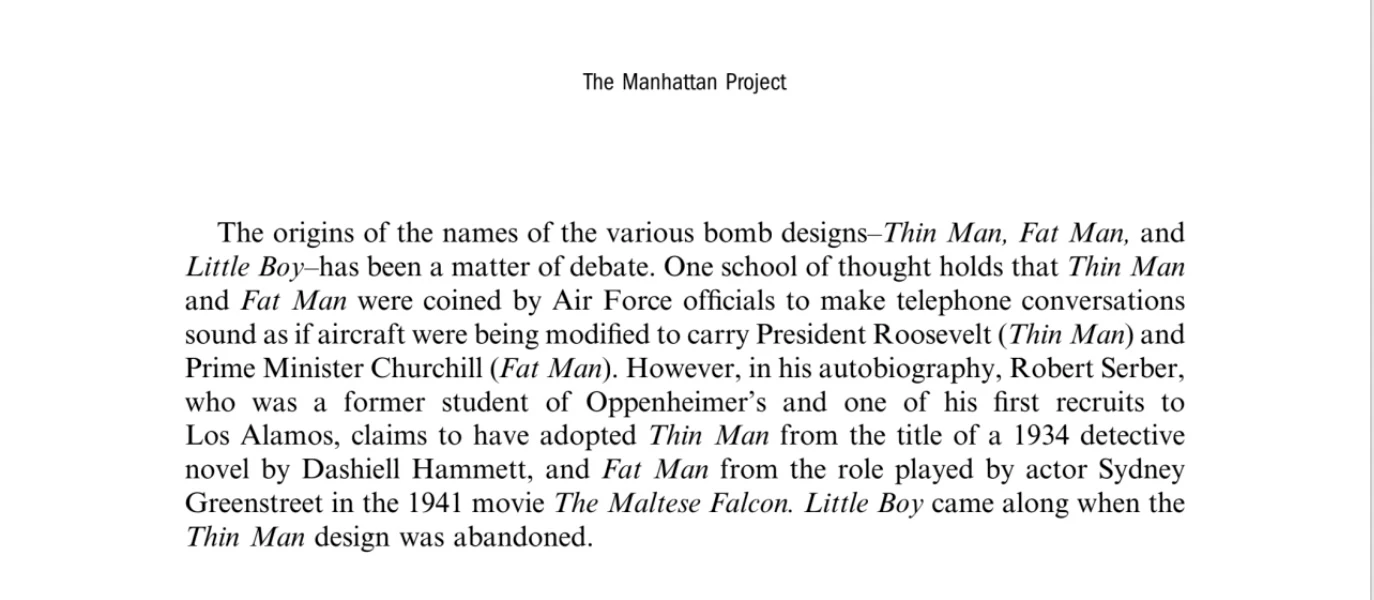
Reed, B. Cameron. ‘Los Alamos, Little Boy, Fat Man, Trinity, Hiroshima and Nagasaki’ in The Manhattan Project: A very brief introduction to the physics of nuclear weapons, 2017
Jarvis’ talk evoked the combined effects of the French nuclear tests’ destructive potential and the politics of silence embraced by the officials. ‘The Saharan dust brings back radiation from 60 years ago’, Jarvis added, revealing the time-travelling nature of radioactive dust.
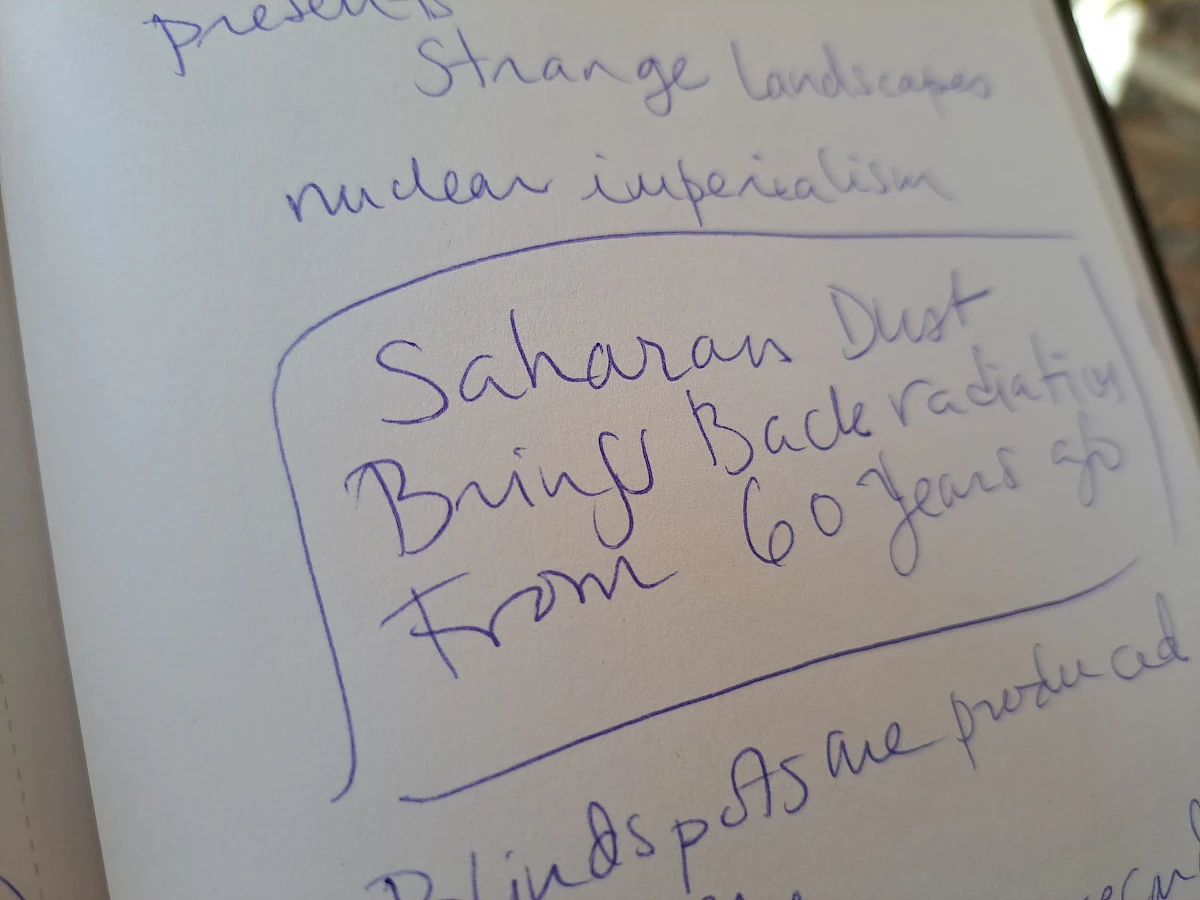
'Saharan dust brings back radiation from 60 years ago', Jill Jarvis
On #SaharanDust on x (formerly known as twitter) the topic of radioactive dust from the Sahara reaching France and other parts of Europe in 2021 is debated. A small search listed various articles about nuclear tests (all over the world) still blowing radioactive dust from years back. If the silence of officials is linked to their refusal to take responsibility and pay for damages, the passage of time reveals how forms of life are inextricably intertwined through space and time.
'Un nuage s’échappa'
One of the interviewees in Bourras’ film explained the Beryl incident at the Reggane nuclear testing site in the Algerian Sahara by saying that ‘a nuclear cloud had escaped’. The choice of words, and the very notion of lethal /clouds was striking. One often looks at the shape of clouds to dream and detect shapes that quickly transform and vanish. In this case, a cloud caused havoc for years to come.
Bourras’ film left us, in my small group, discussing feelings of responsibility and guilt as we sat on comfortable chairs on a sunny day in Dublin, listening to the voices of those impacted directly by the Beryl incident. What does one do with the image-witnessing which continuously reveals what we have missed in the past and continue to be blind to in the present? What does one do with the feeling of being incapacitated by military structures that use cute code names to describe such destructive processes with horrendous effects that incapacitate life? One falls silent. One is forced into silence, but it is not a peaceful silence, it is one that wonders how agency is being removed from people’s lives, and how we are all being turned into silent witnesses.
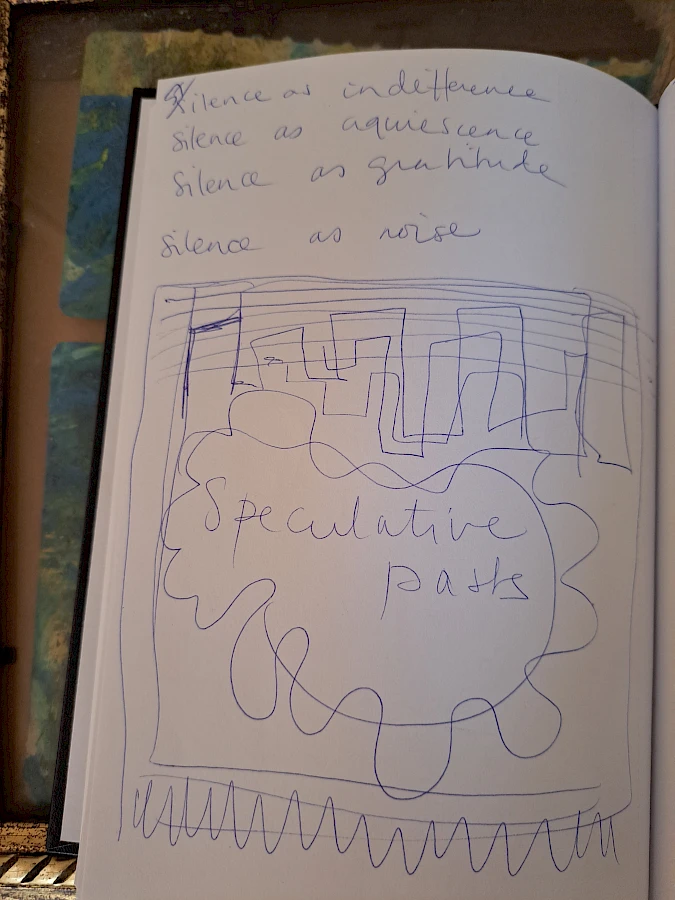
Speculative pasts
As long as a few countries can destroy parts of the earth through nuclear wars everybody is supposed to keep silent and feel grateful that they are in safe hands. But dust particles from the past say otherwise.
Related contributions and publications
-
Dispatch: Reenacting the loop. Notes on conflict and historiography
Giulia TerralavoroSchoolsLand RelationsIMMANCAD -
Dispatch: Landescape – bending words or what a new terminology on post-conflict could be
Amanda CarneiroSchoolsLand RelationsIMMANCAD -
Dispatch: Haunting, cataloging and the phenomena of disintegration
Coco GoranSchoolsLand RelationsIMMANCAD -
Decolonial aesthesis: weaving each other
Charles Esche, Rolando Vázquez, Teresa Cos RebolloLand RelationsClimate -
Climate Forum I – Readings
Nkule MabasoEN esLand RelationsClimateHDK-Valand -
…and the Earth along. Tales about the making, remaking and unmaking of the world.
Martin PogačarLand RelationsClimatePast in the Present -
Art for Radical Ecologies Manifesto
Institute of Radical ImaginationLand RelationsClimateInstitute of Radical Imagination -
Ecologising Museums
Land Relations -
Climate: Our Right to Breathe
Land RelationsClimate
Related activities
-
HDK-Valand
Climate Forum I
The Climate Forum is a space of dialogue and exchange with respect to the concrete operational practices being implemented within the art field in response to climate change and ecological degradation. This is the first in a series of meetings hosted by HDK-Valand within L'Internationale's Museum of the Commons programme.
-
–Van Abbemuseum
The Soils Project
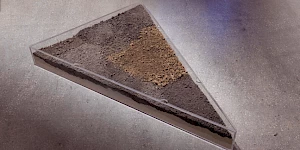
‘The Soils Project’ is part of an eponymous, long-term research initiative involving TarraWarra Museum of Art (Wurundjeri Country, Australia), the Van Abbemuseum (Eindhoven, Netherlands) and Struggles for Sovereignty, a collective based in Yogyakarta, Indonesia. It works through specific and situated practices that consider soil, as both metaphor and matter.
Seeking and facilitating opportunities to listen to diverse voices and perspectives around notions of caring for land, soil and sovereign territories, the project has been in development since 2018. An international collaboration between three organisations, and several artists, curators, writers and activists, it has manifested in various iterations over several years. The group exhibition ‘Soils’ at the Van Abbemuseum is part of Museum of the Commons. -
–MACBA
Where are the Oases?
PEI OBERT seminar
with Kader Attia, Elvira Dyangani Ose, Max Jorge Hinderer Cruz, Emily Jacir, Achille Mbembe, Sarah Nuttall and Françoise VergèsAn oasis is the potential for life in an adverse environment.
-
–Museo Reina Sofia
Team of Teams
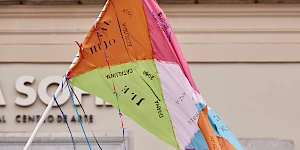
This project researches citizen participation as a fundamental pillar in the creation of community.
-
–tranzit.ro
Non-Western Technologies for the Good Life
The experimental course ‘Non-Western Technologies for the Good Life’ (November 2023–May 2024) celebrates as its starting point the anniversary of 50 years since the publication of Tools for Conviviality, considering that Ivan Illich’s call is as relevant as ever.
-
–Moderna galerijaZRC SAZU
Summer School: Our Many Easts
Our Many Easts summer school is organised by Moderna galerija in Ljubljana in partnership with ZRC SAZU (the Research Centre of the Slovenian Academy of Sciences and Arts) as part of the L’Internationale project Museum of the Commons.