Dispatch: Withstanding. Notes on the material resonance of the archive and its practice
In his dispatch from the summer school 'Landscape (post) Conflict' Giulio Gonella revisits the pages of his notebook, prompting a reflection on the questions and impulses that run throughout the week, as well as the act of archiving itself.
I am listening to Kneecap on a Dublin to Paris flight that will bring me back home. Sun illuminates the aisle of the plane as French kids around me exchange thoughts and words, correcting each other’s language after the English-learning holiday they probably undertook in the country. I had to check in my bag – something that I am not used to do for such short flights and, the object I was most scared to leave behind, apart from my laptop, was the summer school notebook. It was given to us the first day at IMMA, the Irish Museum of Modern Art that would host us these days. The suggestion was to use it to track anything that might ‘speak to us’ in the days ahead. It soon came to contain all the stimuli, words, ideas, and suggestions of a week: thousands of questions, openings, and question marks populate its pages. Its thick, detachable A5 white sheets arguably came to be carved with the marks of (shared) time; reading it again, means to leap back into the memories of an intense week. It’s a deep-dive in intensity.
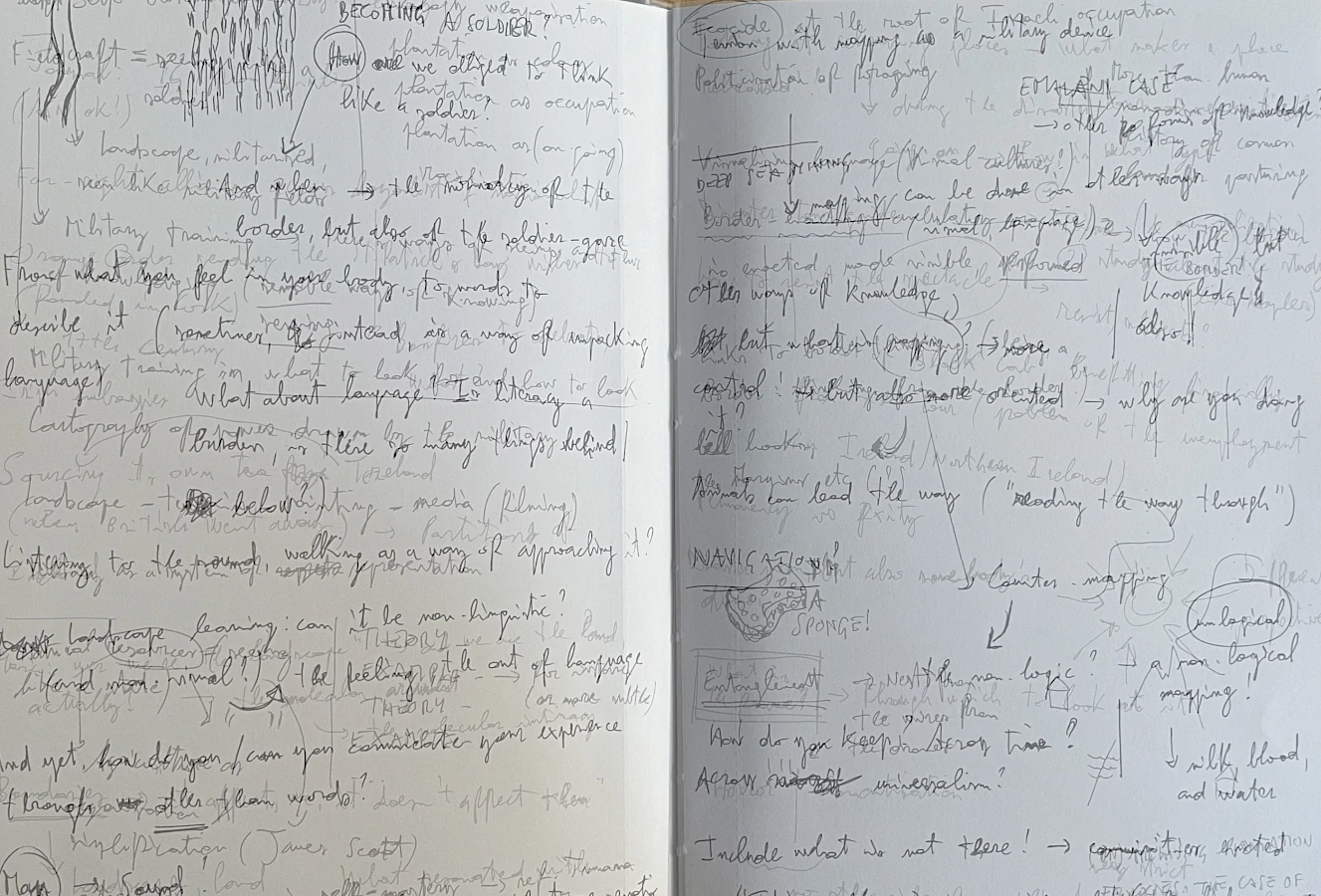
1. To a certain extent, the notebook reproduces on a micropolitical scale our personal, private attempt to materially archive the (impossible) plural narratives around a (post) conflict land. Brackets are essential here: ‘so far for the post-conflict’ was arguably every participant’s recurring thought these days, as we experienced the withstanding presence of the Troubles across the landscape of the North of Ireland. We could feel such a presence in the streets; more so, we could touch and see its materialities. The murals of Belfast were its most poignant, visible traces. Two raised fists showed the solidarity between the Irish cause for independence and the liberation of Palestine. On the same street, stood memorial sites to those killed. But others, less explicit memorials emerged: buildings carried the holes of past gunshots. Peace line walls still stand; in some areas, metallic gates are opened by the day, but closed at night. Every place we visited in Belfast spoke more of an ever-going conflict than of its wished post-phase.
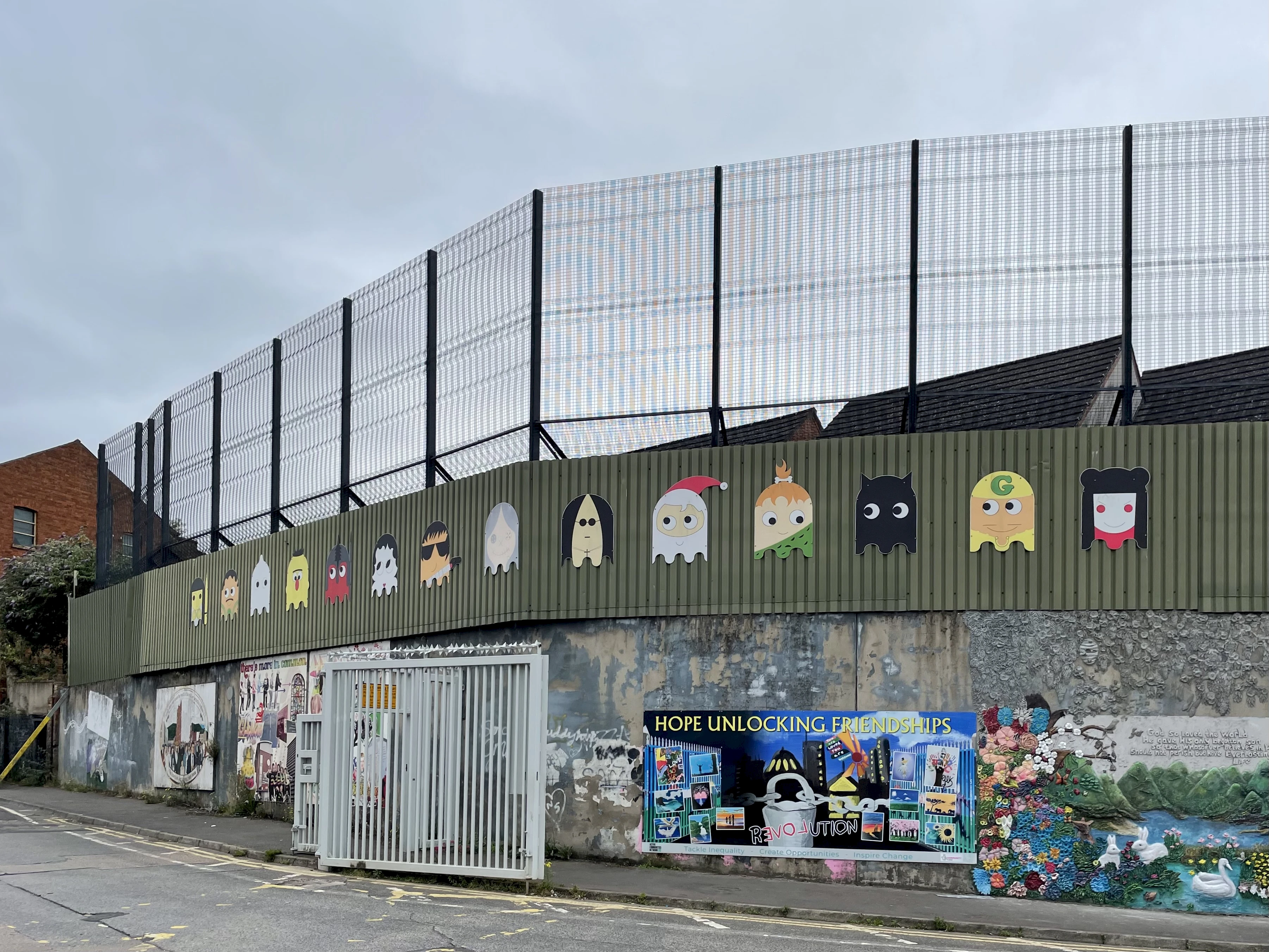
West Belfast, July 2025. Photo: Giulio Gonella
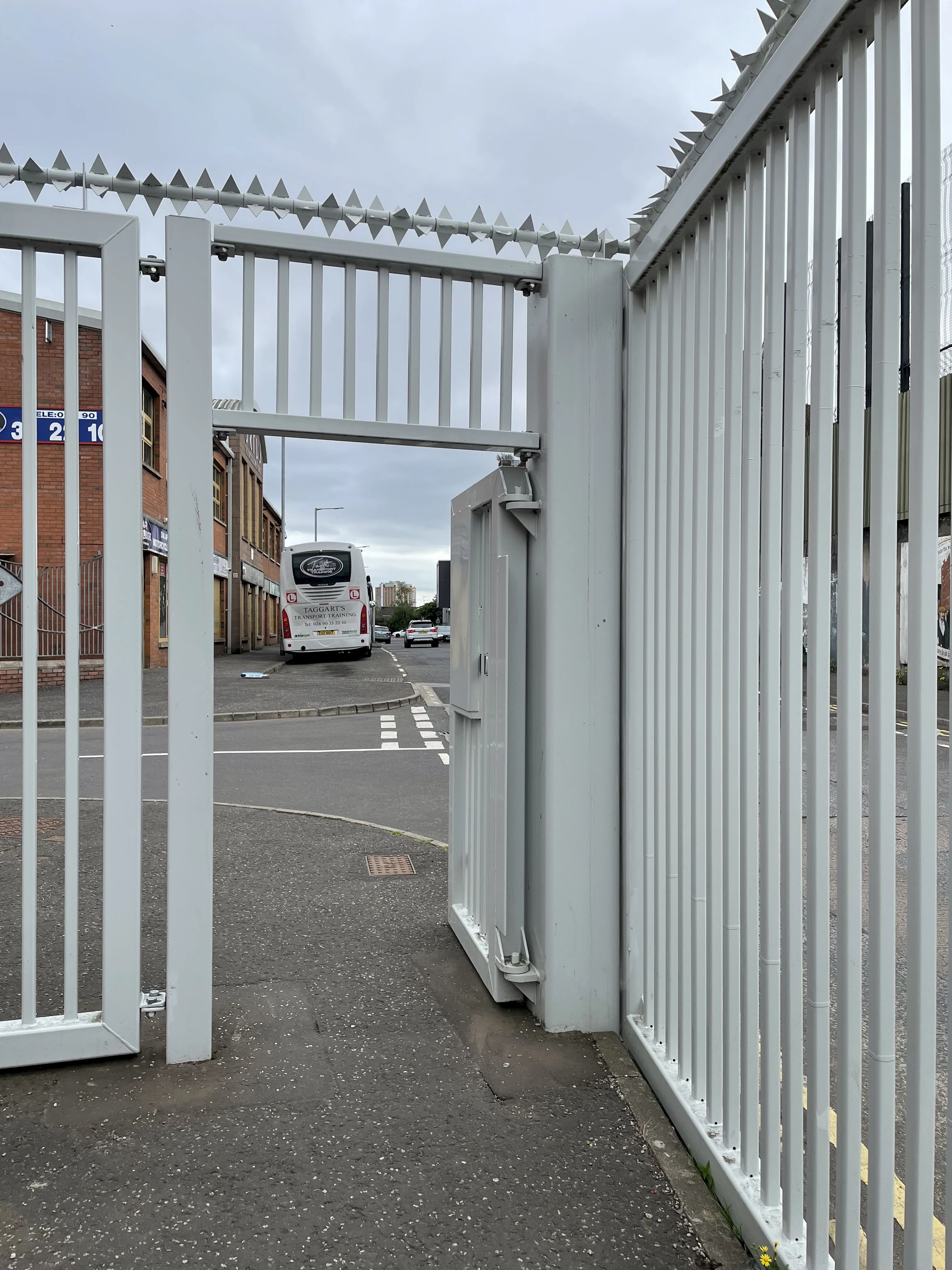
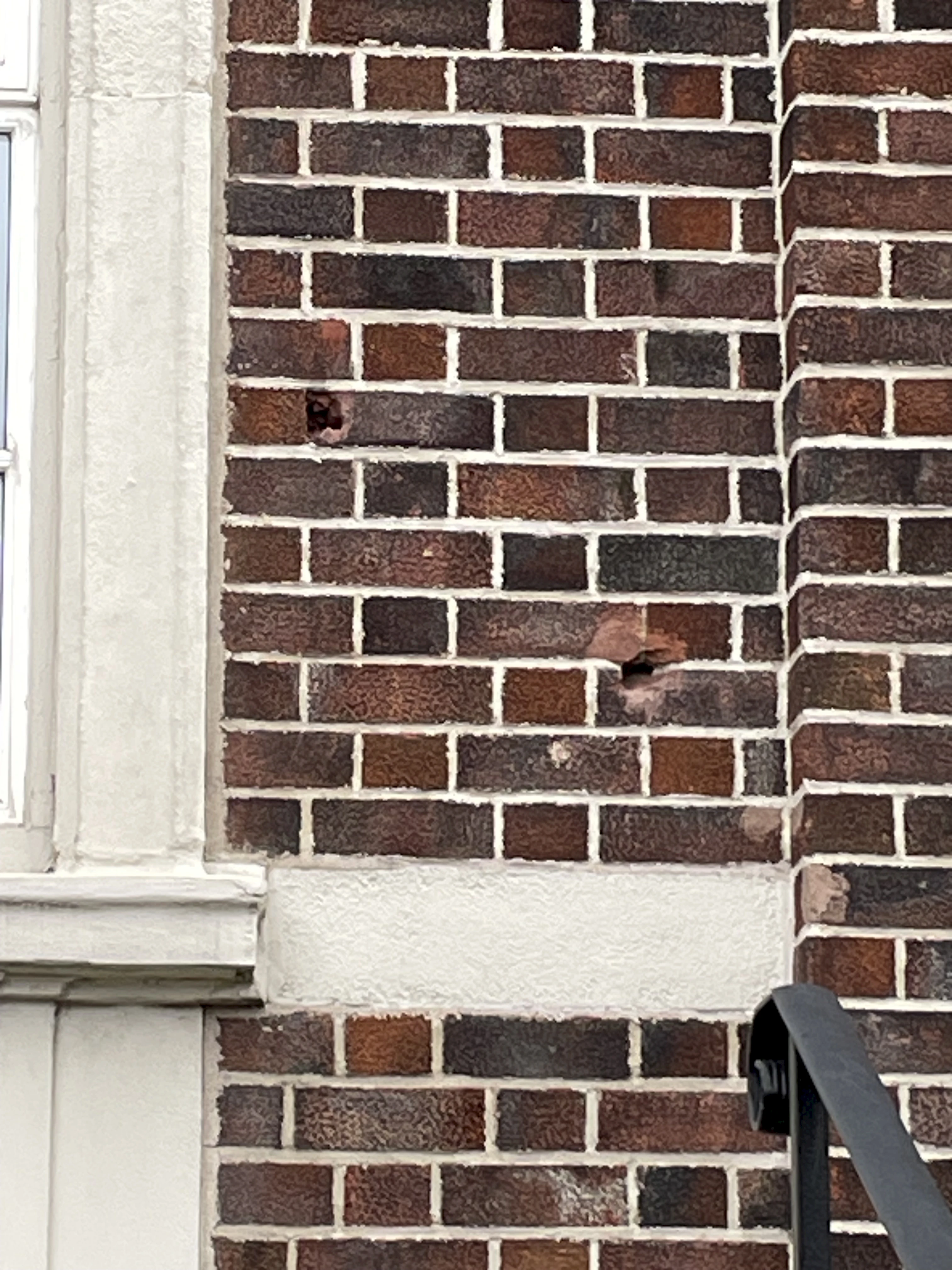
Through the pages of my notebook, I could turn these events into a language of memory – one that tentatively archives, registers, and translates facts on paper. As such, language also actively participated in shaping those events, by projecting meanings into them, as well as partially transposing some (always incomplete) bits of information. I translated the walls. I made them present in yet another place. To my ear, things ever only reverberate in English; they echo. (I came to understand that the ‘e’ in ‘echo’ is /e/, while the e in ‘ego’ is /iː/. I felt relieved and yet troubled by this difference). On my notebook, instead, things stood precariously. They fixate(d).
2. On the way to Belfast, we noticed huge stacks of pallets towering over the suburban landscape. Bonfires, Nikita told me some days later, are symbols of the unionist/loyalist cause, as they were arguably lit up to show the King its way to Ireland at some moment in history. Today, they stand as memorial architectures to the protestant support of the unionist cause, yet only for a few days: every 12th of July, they are set on fire, disappearing into toxic ash. Recently, controversies ignited over some of them, as they were spotted carrying signboards against migrants. Signs would read: Migrants go home, or Stop the boats (the slogan against immigration used by former British PM Rishi Sunak in 2023). On one bonfire, a sign read Veterans before refugees; under the first word, stood the symbol of two rifles. On the top of the piled pallets, a kayak-like boat with some fake black busts was ready to be set on fire.
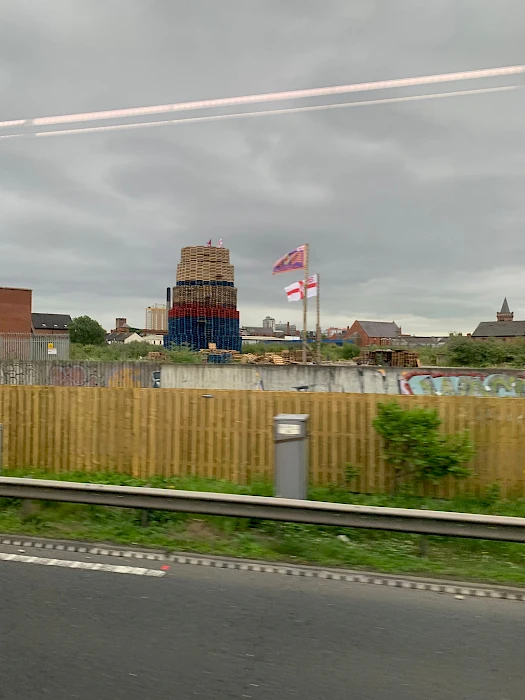
Bonfire in suburban Belfast. Photo: Garry Loughlin
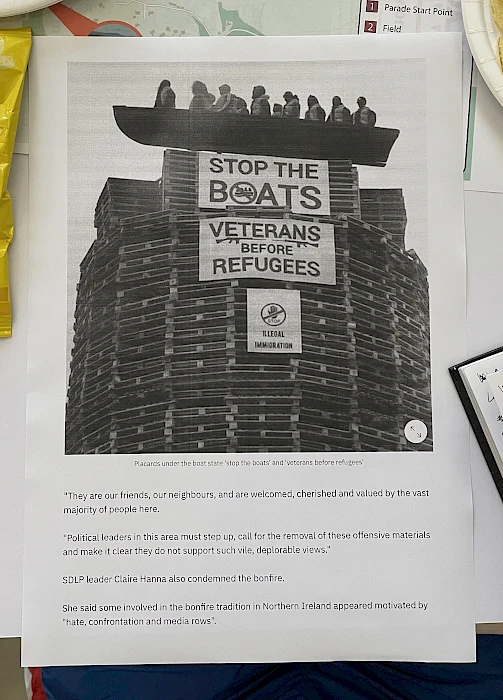
Collage materials. Photo: Giulio Gonella
Bonfires are ephemeral architectures, rebuilt and destroyed every year. They stand for a few days as unequivocal monuments of colonial violence and yet, they perform such violence through absence – by literally fading into air. I am reminded of Christina Sharpe: ‘antiblackness is as pervasive as climate’.1 Fake black bodies were placed on top of the stacks to be burned. Bonfires are a controversial practice, I acknowledge, also for the environmental threat they pose.
3. The story goes that everyone remembers the name of Herostratus, the individual who set fire to the Temple of Artemis, but not the name of the architect who built it.2 Destroying is often a more spectacular, remembered gesture, than patiently designing, building, and preserving. As much as archiving might entail the keeping of objects and artefacts, we often acknowledge their importance once they are gone — blasted away, or destroyed. What happens then, when objects stop to resonate their stories? The last day of the summer school, we discussed collectively on the entanglement between the body and the landscape. Maria, a Ukrainian artist, said: “we are the landscape”. I read a cry of ephemerality in her words: just as the body decays, so do we, and the grounds around us. Tae, artist and educator, added: “stuff that never dies is not magical”. She told us the story of a book written by a Palestinian artist. As s/he attempted to bring their memories somewhere, in a place where they could be shared, s/he got fatally shot and killed. Memories faded along. Who gets to write histories of the (memorial) landscape, and who erases them? How can we abandon the material resonance of a practice of archiving, towards less dissolutive modalities of memorialising, keeping, and caring? And who gets to speak of such memories? In short: what should I do with my notebook?
Related contributions and publications
-
Dispatch: Reenacting the loop. Notes on conflict and historiography
Giulia TerralavoroSchoolsLand RelationsIMMANCAD -
Reading List: Summer School, Landscape (post) Conflict
Summer School - Landscape (post) ConflictSchoolsLand RelationsPast in the PresentIMMANCAD -
Dispatch: Landescape – bending words or what a new terminology on post-conflict could be
Amanda CarneiroSchoolsLand RelationsIMMANCAD -
Dispatch: Haunting, cataloging and the phenomena of disintegration
Coco GoranSchoolsLand RelationsIMMANCAD -
Dispatch: Excerpts from the six days and sixty one pages of the black sketchbook
Sabine El ChamaaSchoolsLand RelationsIMMANCAD -
Decolonial aesthesis: weaving each other
Charles Esche, Rolando Vázquez, Teresa Cos RebolloLand RelationsClimate -
Climate Forum I – Readings
Nkule MabasoEN esLand RelationsClimateHDK-Valand -
…and the Earth along. Tales about the making, remaking and unmaking of the world.
Martin PogačarLand RelationsClimatePast in the Present -
Art for Radical Ecologies Manifesto
Institute of Radical ImaginationLand RelationsClimateInstitute of Radical Imagination -
Ecologising Museums
Land Relations -
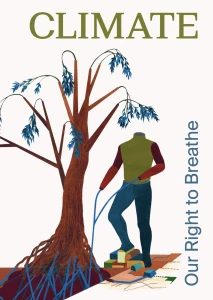
Climate: Our Right to Breathe
Land RelationsClimate
Related activities
-
HDK-Valand
Climate Forum I
The Climate Forum is a space of dialogue and exchange with respect to the concrete operational practices being implemented within the art field in response to climate change and ecological degradation. This is the first in a series of meetings hosted by HDK-Valand within L'Internationale's Museum of the Commons programme.
-
–Van Abbemuseum
The Soils Project
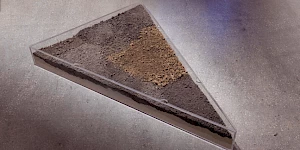
‘The Soils Project’ is part of an eponymous, long-term research initiative involving TarraWarra Museum of Art (Wurundjeri Country, Australia), the Van Abbemuseum (Eindhoven, Netherlands) and Struggles for Sovereignty, a collective based in Yogyakarta, Indonesia. It works through specific and situated practices that consider soil, as both metaphor and matter.
Seeking and facilitating opportunities to listen to diverse voices and perspectives around notions of caring for land, soil and sovereign territories, the project has been in development since 2018. An international collaboration between three organisations, and several artists, curators, writers and activists, it has manifested in various iterations over several years. The group exhibition ‘Soils’ at the Van Abbemuseum is part of Museum of the Commons. -
–MACBA
Where are the Oases?
PEI OBERT seminar
with Kader Attia, Elvira Dyangani Ose, Max Jorge Hinderer Cruz, Emily Jacir, Achille Mbembe, Sarah Nuttall and Françoise VergèsAn oasis is the potential for life in an adverse environment.
-
–Museo Reina Sofia
Team of Teams
This project researches citizen participation as a fundamental pillar in the creation of community.
-
–tranzit.ro
Non-Western Technologies for the Good Life
The experimental course ‘Non-Western Technologies for the Good Life’ (November 2023–May 2024) celebrates as its starting point the anniversary of 50 years since the publication of Tools for Conviviality, considering that Ivan Illich’s call is as relevant as ever.
-
–Moderna galerijaZRC SAZU
Summer School: Our Many Easts
Our Many Easts summer school is organised by Moderna galerija in Ljubljana in partnership with ZRC SAZU (the Research Centre of the Slovenian Academy of Sciences and Arts) as part of the L’Internationale project Museum of the Commons.