Schools: Editorial
Within this publishing strand readers will find material relating to different schools, pedagogical projects or broader reflections on learning within (extra)institutional structures.
Within the Museum of the Commons, the current four year project of L’Internationale, a number of the confederations partners are hosting diverse forms of schools as places of learning and conviviality. From the six month ‘Non Western Technologies of the Good Life’ (2023-24) at the Experimental Station for Art and Life, hosted by tranzit.ro to the roaming ‘School of Common Knowledge’ (2024, 2025), as well as summer schools in Ljubljana (‘Our Many Easts’,2024) and Dublin (‘Landscape (post) Conflict, 2025) and further interactions of the longstanding Independent Study Programme (PEI) at MACBA, the emphasis on experimental forms of education speaks to the need to rethink how, by and for whom knowledge is produced and shared within institutional frameworks, whilst also centering processes, rather than outcomes, of research and learning.
This section contains a number of reading lists from these different projects compiled by faculty members including PDFs and links to over one hundred texts; keynote lectures and dispatches from the school participants where reflections and notes are shared. The PDFs of the two iterations of the Glossary of Common Knowledge (vol. 1, 2018 and vol. 2, 2022), the precursor and inspiration for the ‘School of Common Knowledge’ are also available for download here, as is the handbook Taking Part: A Guide to Participatory Tools and Techniques (2024). In this way, the Schools strand of L’Internationale Online is itself conceived as a resource for participants of the different schools and a wider public.
Elsewhere in this section readers will find contributions that consider broader questions of education and mediation. For example a conversation amongst curators María Berríos, Fran MM Cabeza de Vaca, Yolande Zola Zoli van der Heide, Nick Aikens asks how might education within the museum be approached beyond generational and departmental frames. Elsewhere activists and researchers Dagmary Olívar Graterol, Paola de la Vega Velastegui look to naming techniques and approaches from racialised collectives as a model that might serve as generative tools of mediation with and through the institution. And Fran Cabeza de Vaca in his introductory essay to the publication Taking Part: A Guide to Participatory Tools and Techniques reflects on the (re)turn to ‘participation’ – as term and practice – within the Museum of the Commons programme.
Related contributions and publications
-
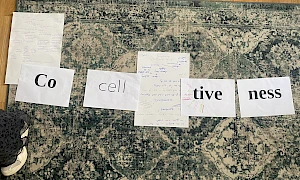
Dispatch: ‘I don't believe in revolution, but sometimes I get in the spirit.’
Megan HoetgerSchoolsPast in the Present -
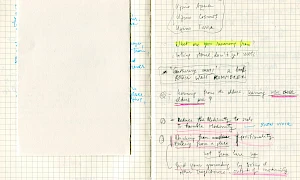
Dispatch: Notes on Separation and Conviviality
Raluca PopaLand RelationsSchoolsSituated OrganizationsClimatetranzit.ro -
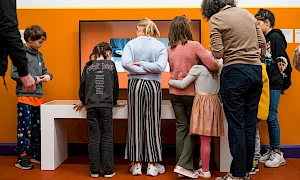
Towards Collective Learning, or, Decompartmentalizing Education
María Berríos, Fran MM Cabeza de Vaca, Yolande Zola Zoli van der Heide, Nick AikensSchoolsSituated Organizations -
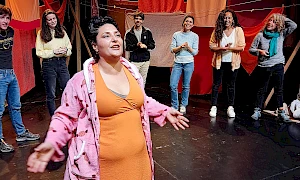
Poner el nombre a una causa en tierra extraña
Dagmary Olívar Graterol, Paola de la Vega VelasteguiEN esSchoolsSituated OrganizationsMuseo Reina Sofia -
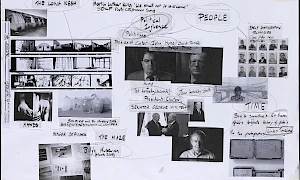
Reading List: Summer School, Landscape (post) Conflict
Summer School - Landscape (post) ConflictSchoolsLand RelationsPast in the PresentIMMANCAD -
Reading list - Summer School: Our Many Easts
Summer School - Our Many EastsSchoolsPast in the PresentModerna galerija -
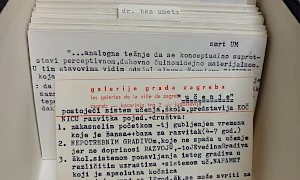
Reading list: School of Common Knowledge 2024
School of Common KnowledgeSchoolsSituated OrganizationsMSU ZagrebModerna galerijaZRC SAZU -
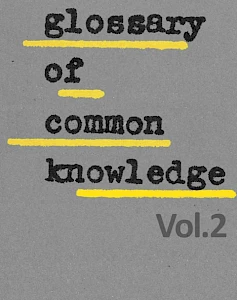
Glossary of Common Knowledge, Vol. 2
Schools -
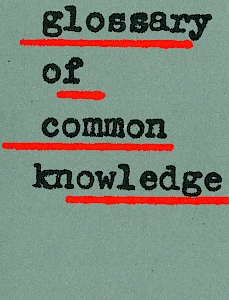
Glossary of Common Knowledge
Schools -
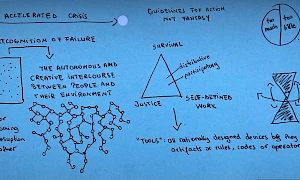
Dispatch: Harvesting Non-Western Epistemologies (ongoing)
Adelina LuftLand RelationsSchoolsClimatetranzit.ro -
Dispatch: From the Eleventh Session of Non-Western Technologies for the Good Life
Ana KunLand RelationsSchoolstranzit.ro
Related activities
-
–MACBA
Where are the Oases?
PEI OBERT seminar
with Kader Attia, Elvira Dyangani Ose, Max Jorge Hinderer Cruz, Emily Jacir, Achille Mbembe, Sarah Nuttall and Françoise VergèsAn oasis is the potential for life in an adverse environment.
-
–Museo Reina Sofia
Team of Teams
This project researches citizen participation as a fundamental pillar in the creation of community.
-
–tranzit.ro
Non-Western Technologies for the Good Life
The experimental course ‘Non-Western Technologies for the Good Life’ (November 2023–May 2024) celebrates as its starting point the anniversary of 50 years since the publication of Tools for Conviviality, considering that Ivan Illich’s call is as relevant as ever.
-
–Moderna galerijaZRC SAZU
Summer School: Our Many Easts
Our Many Easts summer school is organised by Moderna galerija in Ljubljana in partnership with ZRC SAZU (the Research Centre of the Slovenian Academy of Sciences and Arts) as part of the L’Internationale project Museum of the Commons.
-
–MSU ZagrebVan AbbemuseumModerna galerijaZRC SAZU
Open Call – School of Common Knowledge 2024
MSU (Zagreb), Van Abbemuseum (Eindhoven), MG+MSUM (Ljubljana), ZRC SAZU (Ljubljana) and L'Internationale invite applications for the new School of Common Knowledge (SCK) to be held in Zagreb and Ljubljana 24–29 May 2024. The School of Common Knowledge draws on the network, knowledge and experience of the L’Internationale museum confederation. Its ambition is to be both nomadic and situated, looking at specific cultural and geopolitical situations while exploring their relations and interdependencies with the rest of the world. The SCK is built on the basis laid by the Glossary of Common Knowledge project initiated by Zdenka Badovinac and Moderna galerija (Ljubljana) and continues its co-learning methodology.
-
–MSU ZagrebModerna galerijaZRC SAZU
School of Common Knowledge 2024
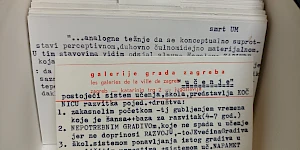
School of Common Knowledge draws on the network, knowledge and experience of the L’Internationale museum confederation. Built on the basis laid by the Glossary of Common Knowledge, a project initiated by Zdenka Badovinac and Moderna Galerija in Ljubljana, it continues its co-learning methodology. Its ambition is to be both nomadic and situated, looking at specific cultural and geopolitical situations while exploring their relations and interdependencies with the rest of the world.