A Date Palm Against the Re-Deportation of Parables, or Europe’s Palestine Monument
Joanna Rajkowska's Greetings from Jerusalem Avenue (2002) is a fifteen metre palm tree in the centre of Warsaw. In the first substantial piece of writing on the work, Robert Yerachmiel Sniderman uses deftly crafted prose and citation to weave together its multiple genealogies and lives. Written from the context of Israel's ongoing genocidal war, Yerachmiel Sniderman recasts Greetings as Europe's monument to Palestine.
For Nelly. For Gaza’s children. For Rosa.
Me, a palm tree? I’m the steel that wounds it, and the terrifying moon that
sacrifices it. I can’t bear my exile any longer.
– Zakaria Mohammed1
What I’m saying at this moment is not being said by me
But is dug from the ground like grains of petrified wheat.
– Osip Mandelstam2
To our European friends, I never ever want to hear you lecture us on human
rights or international law again. And I mean that.
– Reverend Dr. Munther Isaac3
The confusion is monumental. The confusion is the monument.
– Dot Devota4
Dear world,
In short, we are the culmination of your deep and brutal grief.
We are your salt lakes.
– Hind Joudah5
But it’s just my eye.
– Krystyna Budnicka/Hena Kuczer6
I think when ideas are put down by force as opposed to actually defeated
because they fail, when they’re just crushed, they can come back. They’re seeds.
– Naomi Klein7
Avraham spoke up, saying, Here I venture to speak to my Sovereign, I who am
but dust and ashes:
– Genesis 18:278
But Robert, the palm tree is projected into the future.
– Joanna Rajkowska9
1. seeds
X
I will tell this story or tell it again.
Because I was asked to write, definitively, if subjectively, at this hour, on what was, after it, and became swiftly, anything but art,10 and was called, as I have heard, not named, Warsaw’s palm or the palm or the palm tree: an artwork, more often understood, if not in language, to be, in feeling, an anti-monument, still, a woman-tree, and a Holocaust monument, as my cousins’ cousin, without knowing much about art or political violence, responded to me at a seder, but unlike any other we know, I should have told him, anywhere, somehow; or, if not, and definitely never, at least, rooted there-in, genuinely so, and a central gathering place and major prop11 for decades of what we could well call a spectrum of anti-fascist gestures, nests, disguises, in a city Nazism all but entirely razed, incinerated, incarcerated, and displaced; and since which, regimes have tried, at times furiously, to order, in ethnosectarian demolitions, as in 1968,12 in femicidal lawfare, as in 2020,13 and not without resistance, you see, the palm, and yesterday, in Białowieża Forest;14 a destruction myth in the city, a foundation; the palm, humus in the unrested.
The oak forest is arrhythmia.
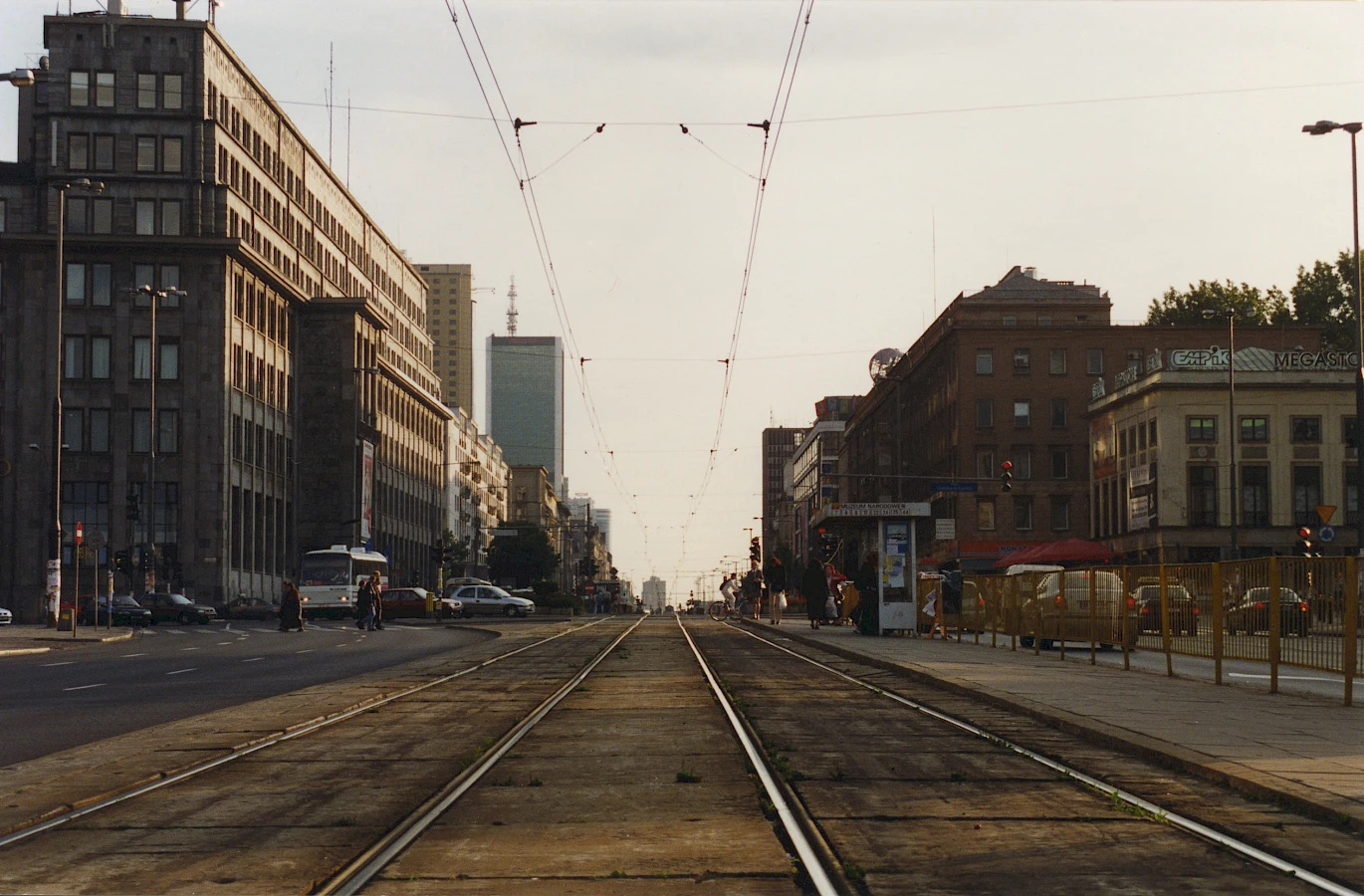
Jerusalem Avenue, 2001. Photo Joanna Rajkowska
X
At this hour, I hear myself talking to someone. When will our rapid whispering end?
Two meanings – call them, here, in Warsaw, at the crossing of Nowy Świat (New World) and Aleje Jerozolimskie (Jerusalem Avenue), resistances to and forces – of the word draft, in the only language I write, soothe my deepest fears, my small form, and metaphysical nosebleed.
I am smaller than my five-year-old daughter, one of the million children to whom I dedicate this text, not because she is unafraid and not because she is less corrupted, so to speak, by the assassination of the Earth’s land and environmental defenders in Atlanta, in Columbia, in India, in The Philippines;15 daily school massacres in kindergartens, elementary schools, and high schools across the State, the planet’s arsenal, in which we live;16 the seventy thousand tons of bombs that have destroyed Gaza;17 the floods, forest fires, deportations, droughts, which ferment with enclosure, I think I am beginning to understand, as we age alongside others, and calcify, amputate, slice the tongue of the trajectories and genealogies of love. I am smaller than Nelly because she lives with visceral hope. Its language is her existence. As it is Hind Rajab’s existence z"l, one of the million children to whom I dedicate this text, who was twenty-three months older than Nelly when she was murdered last January, fleeing, trapped with five relatives’ bodies, alive with her cousin, in a car, north from Gaza City, stilled, within an enclosure, on the phone with the Palestinian Red Crescent within an enclosure within an enclosure, not unlike two million others, there, in a macro- or micro-cosmic sense, recording their destruction, in real time, in letters to us, since what was to me, and many, the blinding flash of the 7 October attack and massacres, and before.18
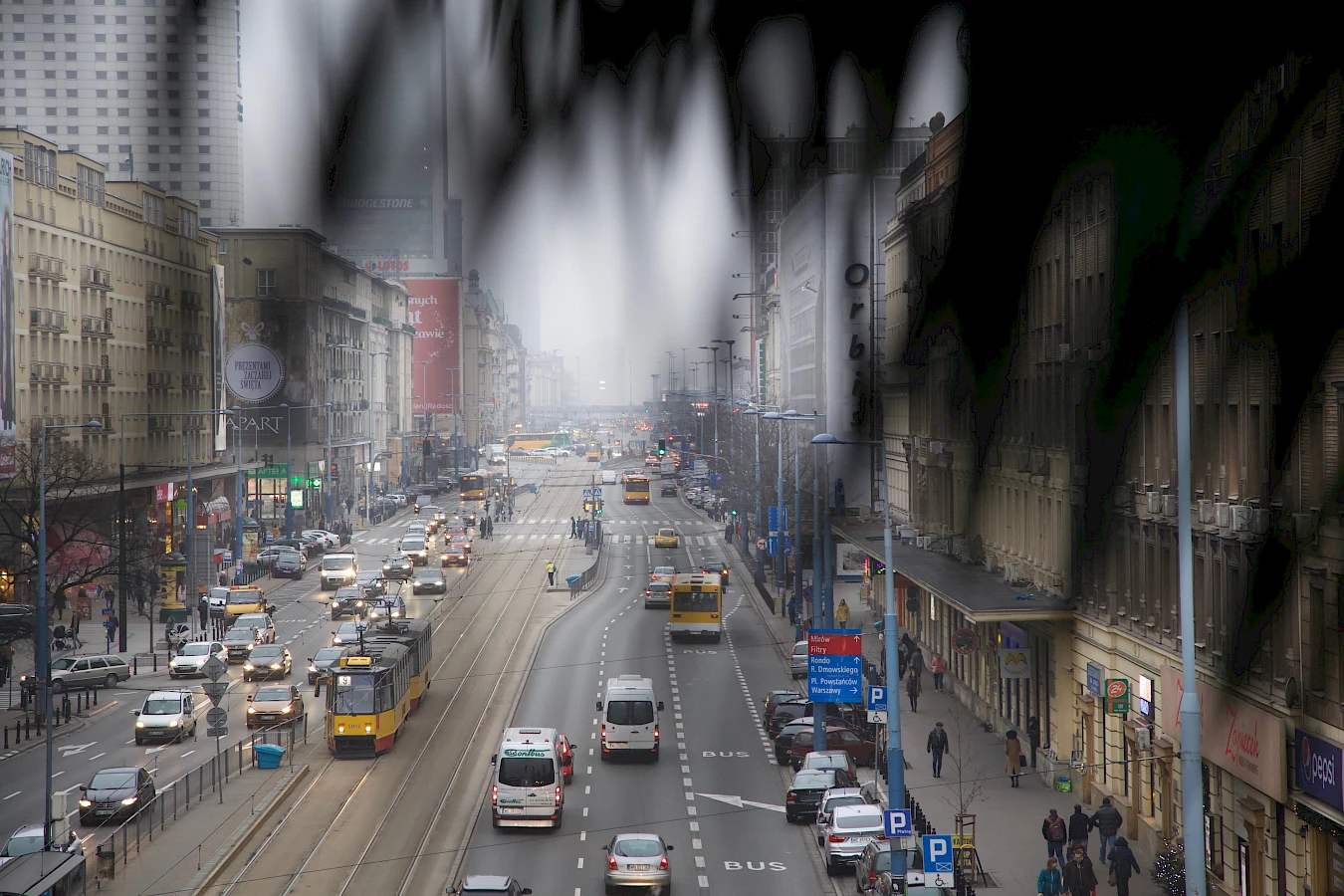
Joanna Rajkowska, Greetings from Jerusalem Avenue (2002), 9 February 2015, 2:30pm
How long before? How many centuries? How many hours? And from each direction? How many days? Who is asking, because I don’t see the end, because I am small, because I see the beginning?
And the immeasurable courage of medics en route to Hind’s immeasurable courage, stilled, also, near her, also, murdered. The language of hope, its viscerality, if I can say, from deep up here, from far out and behind, and from way in down there, is Hind’s existence, the theft of which, among at least sixteen thousand others, and many more, buried in ruins, emits the truth of the Gaza genocide. If I have anything, I have my place in this viscerality, every moment another word, another act, unto my child, who gets raging, who gets tearful, who gets hungry, who gets sleepy, who gets wise, who gets thirsty, who gets empathetic, who gets laughing fits, who gets returned, who gets greed, who gets remembering, who gets distrusted, who gets confused, who gets calling me in the night for water.
I remember, over the phone, several years ago, Joanna Rajkowska, the artist who created and emplaced the palm, spoke of interacting with a new generation of politicized artists in Poland, those perhaps near my age and tendencies, at a time when the democratic institutions of the State had been sabotaged by judicial coups,19 Polish fascists marched in great numbers through Warsaw,20 abortion in almost all cases had been banned, research implicating ethnic Poles in crimes of the Holocaust was criminalized,21 and European Union asylum laws were chronically violated, exploiting the primeval Białowieża Forest on the Belarusian border to murder asylum seekers by attrition. Supporting their intensity and commitment, Joanna fretted over a constraint in their approach, where the anxious focus on an exacting materialization of a politics elides the primal ignorance and helplessness that makes it possible to become an artist.22 She pleaded, You need to go somewhere, stand there, and feel what is happening in your body.23
2. just my eye
X
The first resistance to and force of the word draft, in my mind, is the attempt to create, and what this attempt materializes before the created thing is actualized and given up and out (to no one or to others), such as right now, these very thoughts you read, written in the margins of a tan-colored biography on Martin Luther, titled Luther, printed in Munich in 1943, at which time, in Warsaw, that April, two armed Jewish fronts — the Leftist Yidishe Kamf Organizatsie of Bundists (anti-Zionist) and Socialist Zionists, and the fascist Revisionist-Zionist Yidishe Militerishe Fareynikung — incarcerated, starving, behind ghetto walls, in an apartheid city, of Aryan and Jew, portending the auto-destruction of Europe, amidst the last deportations to Treblinka concentration camp, began to fight their occupiers and mass murderers. In counter-response, the Nazis burned the entire ghetto akin to a huge bloodshot eye.24
I found this book Luther beside two other books in a box on the stone windowsill of a Catholic church next to Nelly’s kindergarten in Prenzlauer Berg, while we were staying in Berlin, last September, and decided then to take notes in its margins. There were two or three other books on the church’s windowsill, and I intuited, upon approaching the cardboard box, that one of them would be written by Martin Luther, someone I had long intended to face, which turned out to be false and near the truth. Within the framework of Luther’s revolutionary influence on Christianity, founding Protestantism in what is known as the Reformation, he wrote two persecutory books, one of which endorsed and encouraged the ruthless suppression and mass killing of one hundred thousand revolting German peasants and the other a fundament of the Nazi project and anti-Judaism at large: Wider die Mordischen und Reubischen Rotten der Bawren in 1525 (Against the Murderous, Thieving Hordes of Peasants) and Von den Jüden und iren Lügen in 1543 (On the Jews and Their Lies). The intersection of these works and its afterlife in this present continues to beckon my attention.
Luther is now beginning to crumble and fill with my writing, some of the earliest of which I created during last year’s holy days of Teshuva in Warsaw two weeks before 7 October, such as the above-mentioned phrase – akin to a huge bloodshot eye – transcribed when standing, mesmerized, some distance from Joanna’s light box, We live day by day, hour by hour, minute by minute (The Eye of Krystyna Budnicka/Hena Kuczer) (2023) in the exhibition, ‘Around Us a Sea of Fire. The Fate of Jewish Civilians During the Warsaw Ghetto Uprising’. We live day by day… is a 160:1 macro-scale photograph of the eye of Krystyna Budnicka, commissioned by the POLIN Museum of the History of Polish Jews for the eightieth anniversary of the Warsaw Ghetto Uprising. Budnicka, born and incarcerated by the Nazis as Hena Kuczer, is a lifelong Warsaw resident, retired schoolteacher, and the only known survivor of the Warsaw Ghetto Uprising still alive as of this moment.25 When I showed the photograph to the curator and philosopher Almut Shulamit Bruckstein Çoruh, she muttered to herself, Shahid… the witness. Shahid, I think I had known, more often from Arabic is translated as martyr, but Shulamit clarified that as in Hebrew this meaning is bound to and emerges from witness. When I saw Budnicka’s eye – pupil, iris, sclera and eyelids26 – before then, in the light box, in the exhibition, without yet Shulamit’s word, here is what I knew.
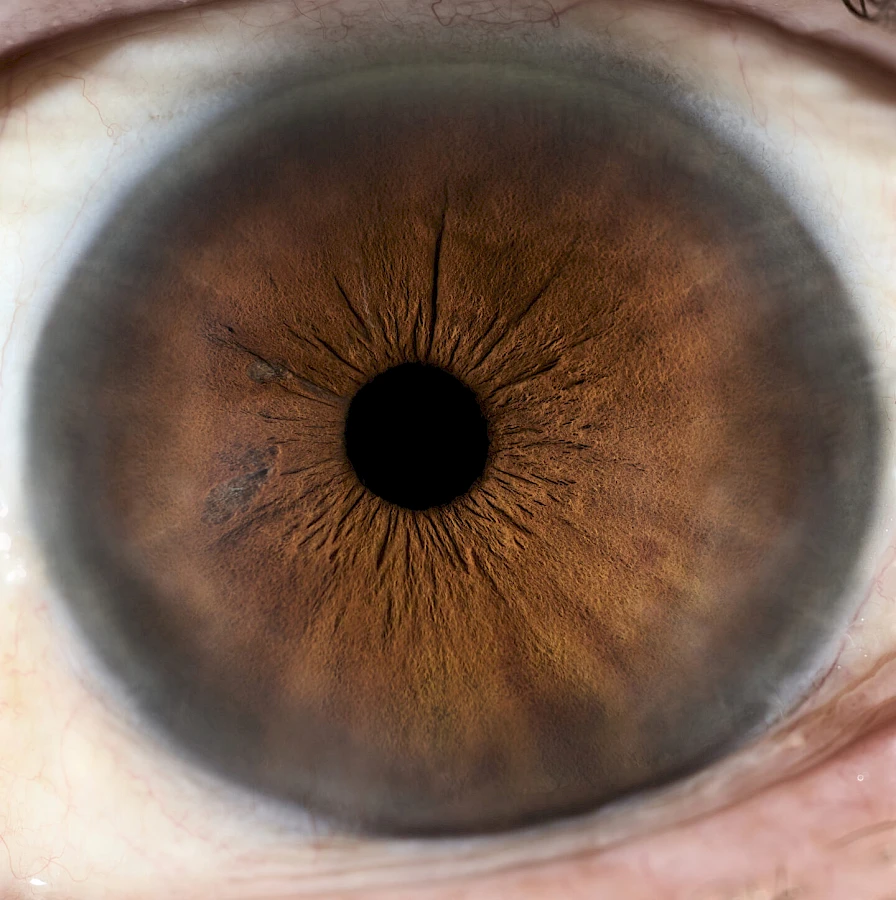
Joanna Rajkowska, We live day by day, hour by hour, minute by minute (Eye of Krystyna Budnicka/Hena Kuczer), 2022. Photo Jędrzej Sokołowski
The scale of the photograph projects the eye as a tremendous primeval surface (yes, think Białowieża Forest), such as sometimes we see in another, when staring close in a consensual concentration that exceeds the contractual edges of the imperative Look into my eyes. I remember doing so with my first love, as teenagers, and finding something seething with a fragile knowledge, almost like the eye was never there, like the eye is almost not even there. I say eye, as it is with the light box, because it was not possible, I remember, to see another’s set of eyes this way, and perhaps that is where the act departs from Look into my eyes. I saw the eye – my beloved’s and Budnicka/Hena’s – nearly in separation, alone, not in the sense of a disembodied or excised encounter, but rather because I was seeing something that was seeing me and yet unconcerned with my gaze and nearly distinct from what I could rationally perceive to be a part of a whole being. At least, and all at once, the eye felt inhabitable, nonhuman, unrepeatable, ephemeral, mirroring, alone, and distant. Perhaps a tension between these poles of nonhuman and unbearably human qualities carries that porous border, that potentiality, in the Shahid, between martyr and witness.
Where the exhibition told the story of the Warsaw Ghetto Uprising according to a radical principle – using only the survived and fragmented accounts and material traces of its subjects and witnesses, as opposed to extensive documentation taken by the Nazis – We live day by day… was the only contemporary artifact and artwork. In the first room, where the eye was installed, the light box intensively refracted the trope Gliksman recorded, by way of what Walter Benjamin called Jetztzeit (Now-time),27 which in full read: At night, the burning ghetto – akin to a huge, bloodshot eye – gazes towards the city and awaits rescue in vain. Other writings and photographs, in this room of the exhibition, continued to circulate that tension of witness and separation between those outside and those incarcerated in the ghetto; the tension, which is to say the sociological fact of encounters under apartheid in the midst of a genocide, as to whether Poles outside the walls would join in arms and expand the uprising to resist the devastating counter-response, which would soon leave nothing in the ghetto standing except for some of whom and some of those which were underground, like Hena in a bunker; the primal imagining of why or what or when those on the other side of a wall touch, see, listen, think.
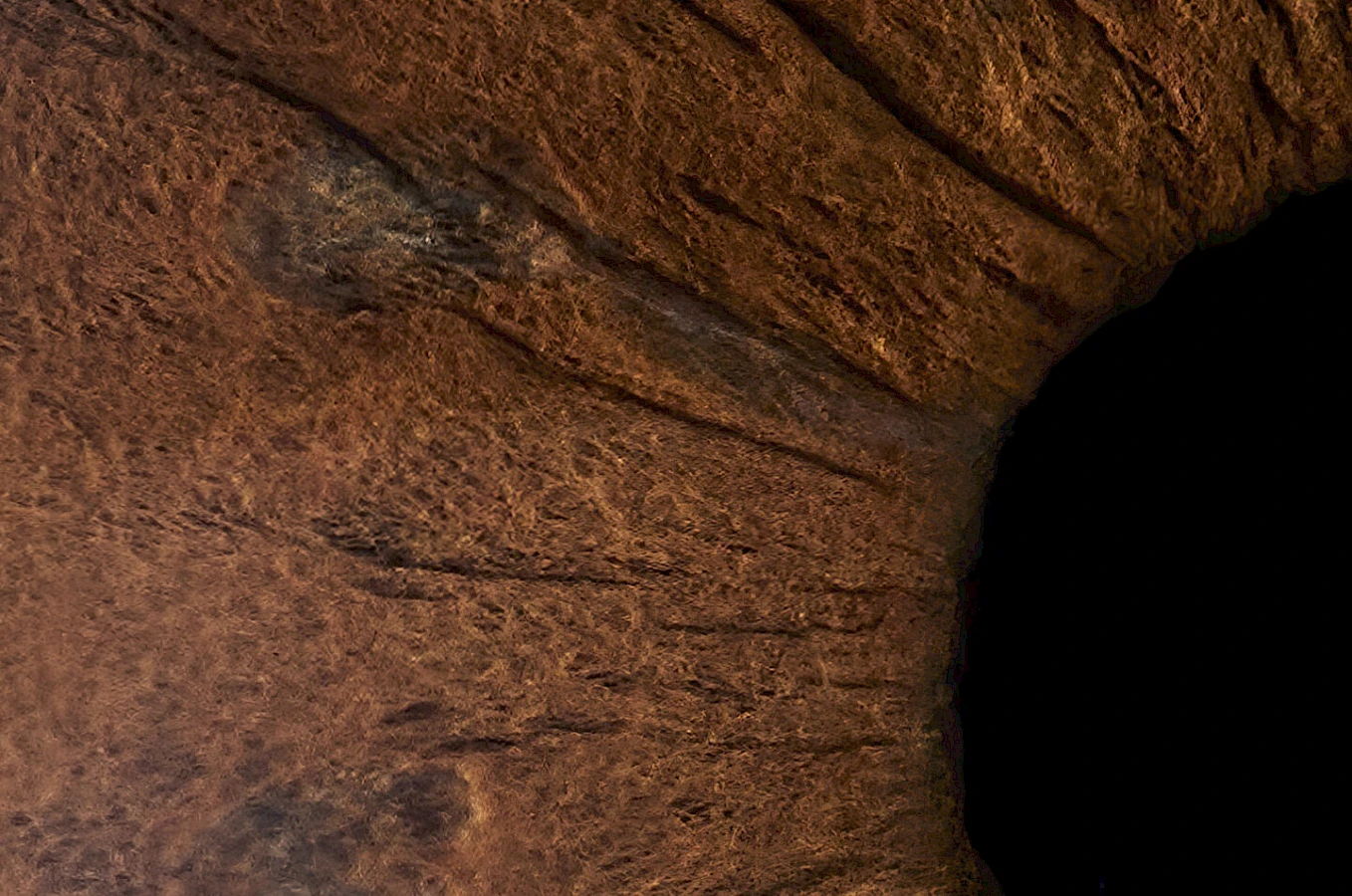
Joanna Rajkowska, We live day by day, hour by hour, minute by minute (Eye of Krystyna Budnicka/Hena Kuczer), 2022 (detail). Photo Jędrzej Sokołowski
Joanna created the photograph with her partner Andrew Dixon and the photographer Jędrzej Sokołowskiin in his studio, setting up a little wooden frame Andrew had built to gently hold still and rest the subject’s head. But it’s just my eye, she told Joanna. We live day by day… facilitates the concentrated hyper-proximal gaze, incorporating into a present a consensual concentration that exceeds the imperative look into my eyes. For, regardless of what one asks or is asked by a lover, a witness, or someone who claims long ago to have been your neighbor and is now burning your ancient olive trees, or your entire community alive locked in a barn, or your whole family all at once in a collapsing apartment, the eye up-close is mutational, peripatetic, and kairotic, a tiny quarrel in the current. And yet the project text calls this degree of mortal materiality an ultimate border line – mere survival defined by fragility of human organism. Just the eye of Krystyna Budnicka/Hena Kuczer, it is written, is not an abstract eye, it is not symbolic or metaphoric, but part of the body, that was suffering, being confined and sentenced to extermination, and repeats and reaches for the play of glances, the ghastly exchange of 1943.28
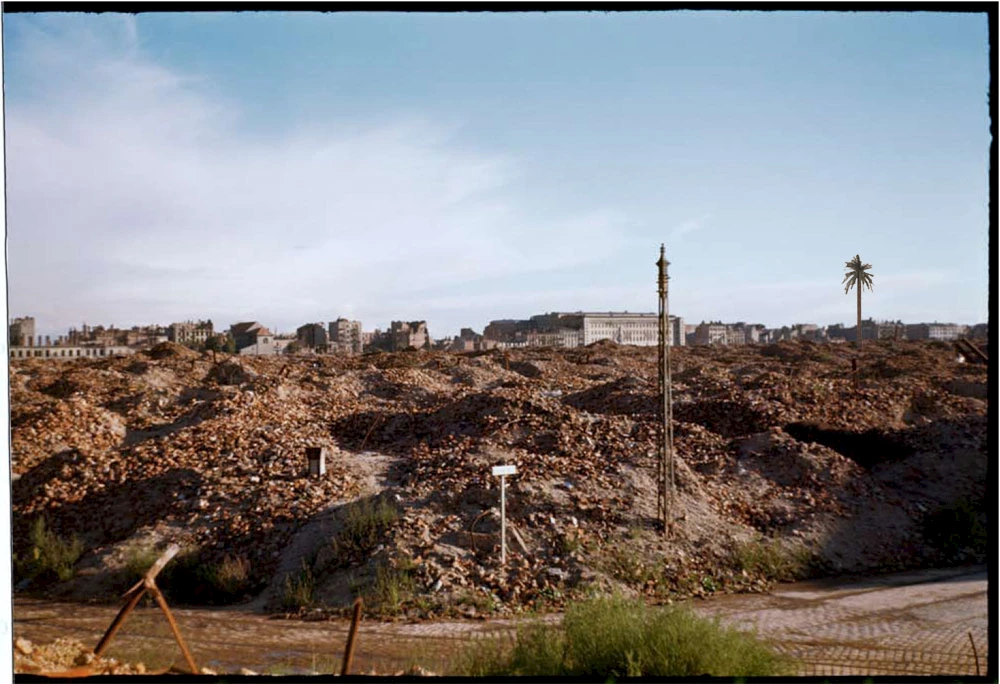
Henry N. Cobb, WARSAW, AUGUST 1947 with rendering of the palm tree by Joanna Rajkowska, 2022
I think, therefore, there is a very basic power in We live day by day… , which decocts what capacities to sow human beings and their art hold and withhold within overwhelming life-destroying systems. For it is not that aforementioned repetition and reaching by themselves that bear and incite this very basic life-giving power, but rather their enfoldment in the force of the eye’s aging, which is stored, for us, also, diacritically, in the slash between Budnicka and Hena, and transmits most intensely – because it is what is real to us, beyond and through reenactment – what the project text above called fragility, and I a primeval seething knowledge, and Budnicka herself just.
3. from the ground
X
In the second force of or resistance to the word draft, fragments of weather move through an enclosed shelter. Typically, where I have lived and in what I have experienced, in winter, or just when it’s cold, such force is unwelcome, an irritant, unknown until felt or evidenced nefariously. When it’s hot, this force of the word gives pleasure and relief, so that, even, the word mutates to breeze and negates almost all relations with draft.
Greetings from Jerusalem Avenue (2002) is an artificial, life-size date palm tree in the city center of Warsaw, created twenty-two years ago by a then young and unknown Polish artist from Bydgoszcz, upon returning from a three-month visit to the State of Israel – her very first of many to historic Palestine – staying near the Damascus Gate during the Second Intifada. Towering, real and unreal, from a mounded island in the Charles de Gaulle roundabout, from where two major avenues, Nowy Świat (New World) and Aleje Jerozolimskie (Jerusalem Avenue), centrifuge, the work, in one sense, as I have experienced it, is a threshold, when walking to cross the long bridge over the Vistula River, one’s back to the central train station and Stalin’s imposing Palace of Culture and Science, passing the National Museum, facing the Praga district and the forests lining that side of the river, sometimes alight at night with peoples’ little fires, south of the bridge, and a bright metal-feeling football stadium on the north. Warsaw’s palm is taken at face.
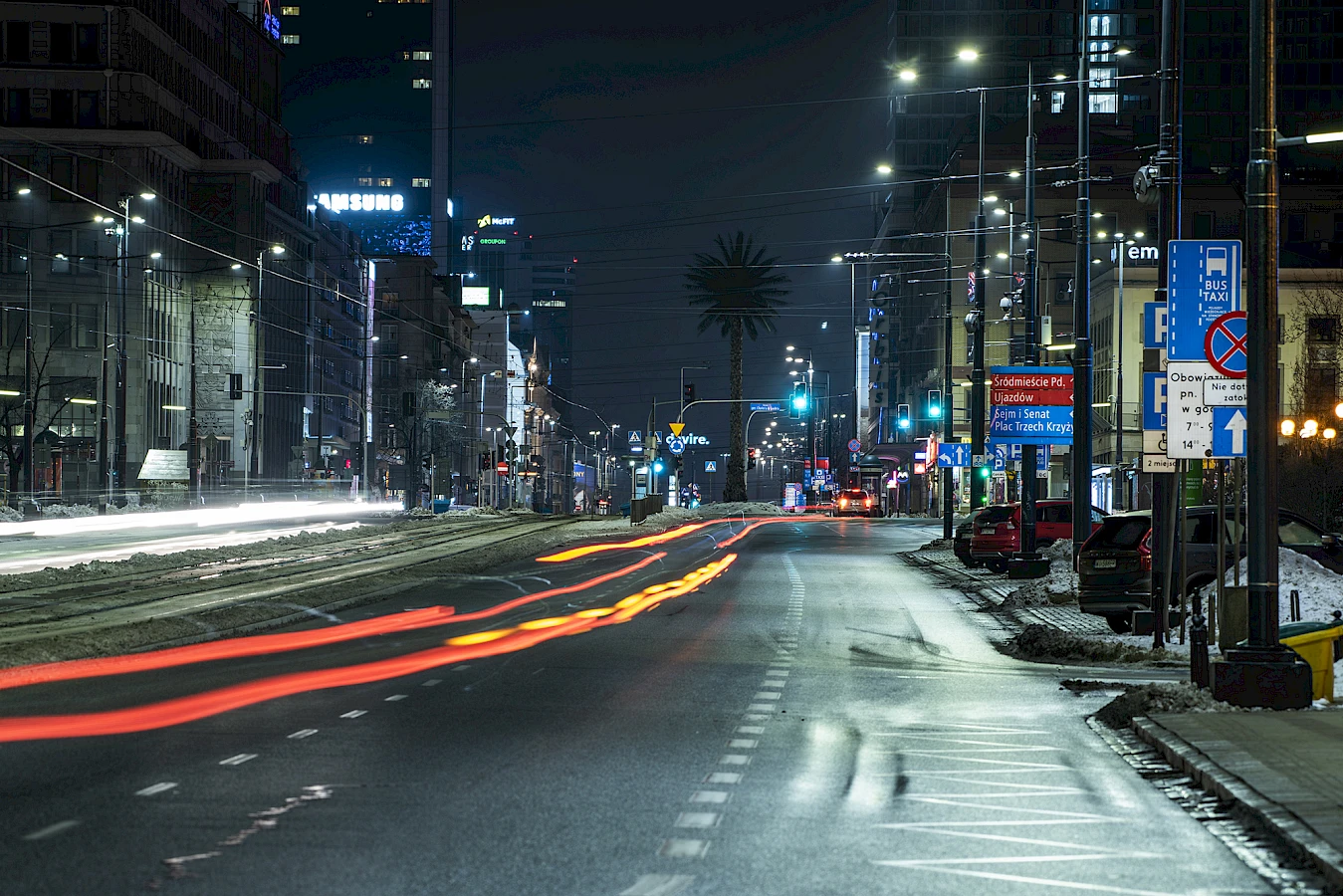
Joanna Rajkowska, Greetings from Jerusalem Avenue (2002), 15 February 2021, 12:50am. Photo Marek Szczepański
The artist’s book Where the Beast is Buried (2013) narrates this and future confrontations with the region of postwar European-Jewish refuge, settler-colonialism, and Palestinian expulsion and subjugation. A central thread in the book’s chronological array of public projects, Joanna encounters the region’s extant catastrophe and moral triangulation with Europe,29 drafting what I have found to be an equal parts rare and ventricular set of monumental whispers, from within her Polish vantage, of its unprocessed areas.30 Subsequent (but also precedent) projects, often public works, exert shards or the whole of this triangle, taking the artist physically and conceptually to the interstices of Polish, Palestinian, and Jewish forms, voids, and spaces, either implicitly or explicitly, to manifest a shifting crystallization of potentialities and repercussions within what I have before called, in this case, their inter-isolations: No Sign of Dying Soon (1995), State of Israel (2001), Maja Gordon Goes to Chorzów (2006), Oxygenator (2007), Uhyst Refugee Asylum (2008), Camping Jenin (2008), Postcards from Switzerland (2009), Minaret (2009–11), Bund! (2012), Born in Berlin (2012), Forcing a Miracle (2012), Stones and Other Demons (2019), our film Night Herons (2020), Sorry (2022), Birds in Gaza / Greetings from Gaza (2024), and an ongoing chain of actions staged with the palm, including Death of the Palm Tree (2019), Refugee Flag (2021), and our performance with Grupa Granica (Border Group) Do Not Uproot! (2023).31
For Joanna, Greetings… initiated decades of unrelenting insomnia, a homemaking in the city her mostly estranged father’s mixed Jewish-Slavic family left to its rubble, and a series of what are often considered the most important public artworks in post-Communist Poland. Moreover, and more precisely, Greetings… constitutes a groping manifestation of the fear and confusion the artist felt through the Israeli siege of occupied Bethlehem and her subsequent return to a Warsaw she felt was perforated with voids. It was neither anxiety nor fear of anything specific, she wrote of her experience in Palestine-Israel, but a tension that was in the very air itself – in the smell of the sweat, in every bus I entered, between people. Sometimes, I lay down in my bunk during the day, closed my eyes and felt myself shaking all over.32
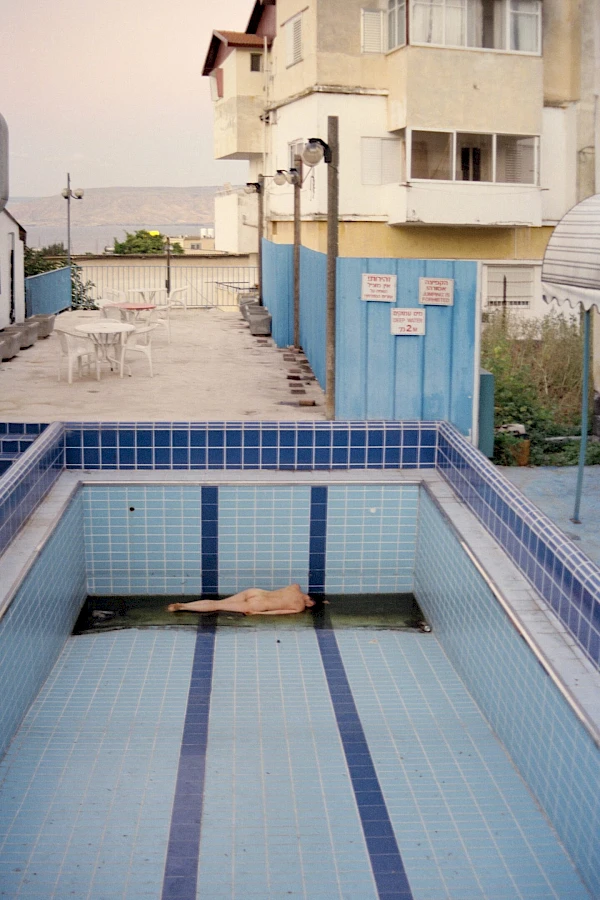
Joanna Rajkowska, State of Israel I, 2001. Photo Artur Żmijewski
In these, what I think of as Greetings… ’ contractions, Joanna created a series of situations where she lies face down on the ground: across a sidewalk in long sleeves and long skirt in the Haredi neighborhood of Mea Shearim, and naked against the bottom of an empty private swimming pool in Tiberias. The latter was photographed and titled State of Israel. I see her forehead rested on the blue tiles, face submerged in the bit of green water, her free ears listening for what hovers, eyes staring into the ground where the beast is buried because the ground is where everything is buried, like five hundred Palestinian villages. My friend Dirar Kalash, a sound artist and musician from Kafr Qari, who like Joanna is both completely deaf in one ear and was definitively politicized in the Second Intifada, tells me that to listen in a destroyed, colonized village one must refuse to hear with one’s ears.33
Of the time of the Second Intifada, Fida Jirtis writes, in her book Stranger in My Own Land (2022), that while working in a Jewish-majority office in Karmiel, an Israeli city built on the ruins of Deir el-Assad, Bi’neh, and Nahaf, she found herself unable to stand on Yom HaShoah, the day commemorating Jewish victims of the Nazi genocide. Suddenly, a high-pitched sound broke the silence. Everyone rose to their feet. It was the memorial siren. At that moment, I could not get up… I felt sick. All I saw were flashes of coverage: the blood, the mutilated bodies, the women screaming and tearing their hair, the rubble, the funerals with body after body wrapped in Palestinian flags. A colleague confronts her decision. After a few moments, I found my voice. ‘They’re killing my people as we speak. As they stand to remember their dead, they’re making more of mine.’34
On the days before her leaving, Joanna wrote, Though it was not my conflict and not my war, it was my misfortune, for reasons I could not understand. She continued, recalling, At the marketplace people often fell silent when they heard us speak Polish. I looked at the unfriendly, bitter faces. I thought, No wonder, if I were a Polish-Jewish woman, nothing could make me return to Poland.35
The palm grows from the ground to connect the underworld and the overworld.
X
When the first and second forces of or resistances to the English word draft entangle, they appear in fragments of weather moving through the enclosed thing actualized and given up. In relation, they soothe me. Because of it, I am on time. What’s more is that we are not alone in it. So, I am late.
One could say Joanna’s Greetings… is a tone that crosses and so carries time and territory: a spectral demarcation and line of flight,36 nevertheless rooted in a place, an intersection, a river, where territory is rendered, but a member of whole life. Monuments freeze the memory, Joanna wrote to me, after I referred to Greetings… as a monument in a voice note. Yes, Joanna, I know this, and I learned it from you, when I was twenty-nine, before we met, and yet, Greetings… freezes something, perhaps, something that is not exposure, not the exposure of a wound, a harm, a power either emergent or nostalgic. Warsaw’s palm freezes a vitality that remains in motion as in a winter that will thaw but also recur. What I do, she wrote me, lets them [public projects] work, evolve and change in an almost biological way. Layer after layer, gaze after gaze … reenacting everything, what happened, but turning it into a life process.37
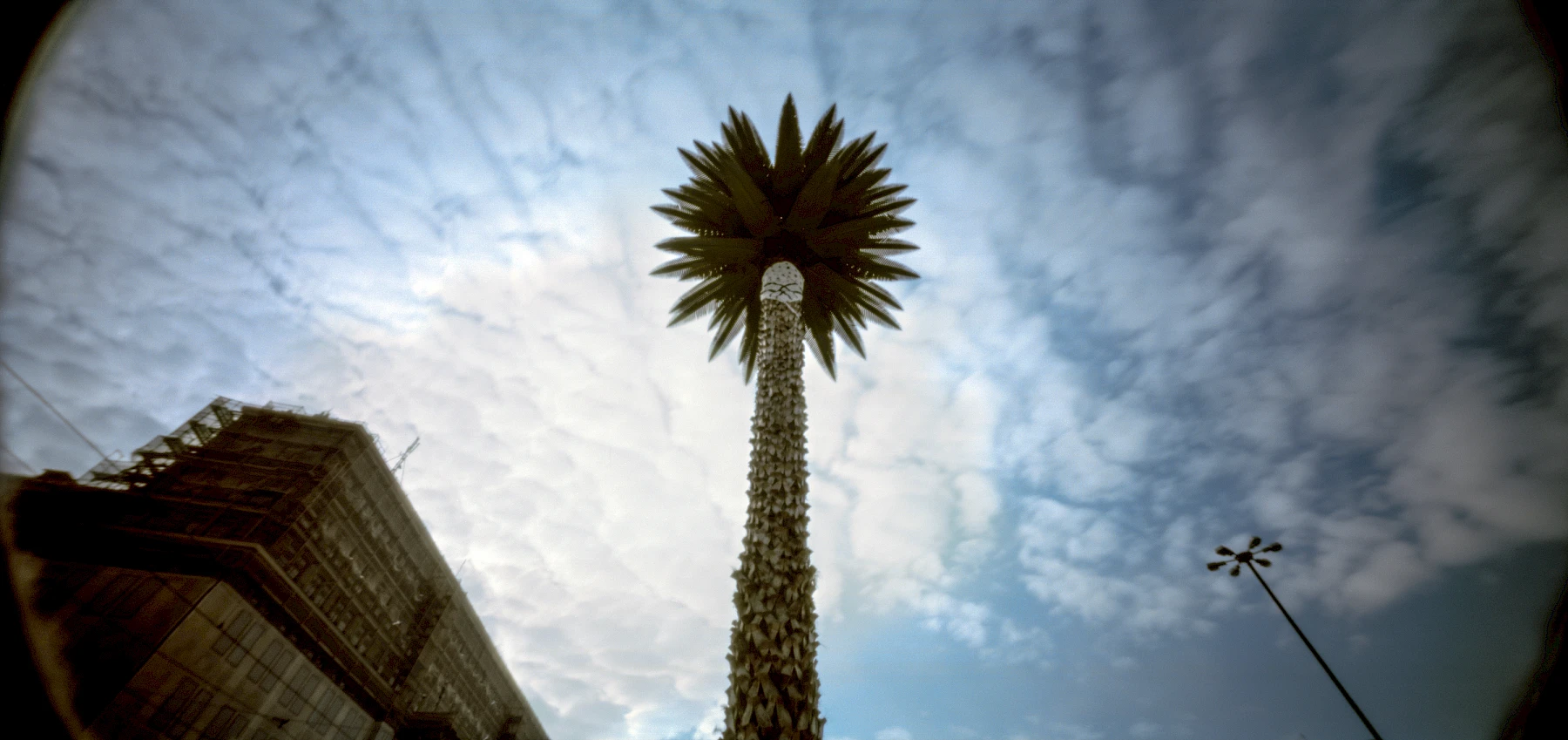
Joanna Rajkowska, Greetings from Jerusalem Avenue (2002) with keffiyeh, 2011. Photo: Joanna Rajkowska
On returning to Warsaw from Jerusalem, she recently reflected, this state of terror, I immediately detected, brought this, this dream, that this never happened … the Shoah never happened.38 Many will read and perhaps empathize with her statement as an impossible wish aimed at thwarting what must now definitively name a planetary cycle of genocide, population transfers, and persecution structures that if not stopped will destroy all of us and all our lands and all of our waters. But, I think, at that time, in her fear, youth, and confusion, the impossible sentiment arose for a reason that is perhaps even more familiar to many of us, that is from a primal ignorance and helpless means by which to try to make a home, as when Achille Mbembe, in offering an ethics to our ordeal of extreme vulnerability, writes, to inhabit a place … only by allowing oneself to be inhabited by it.39
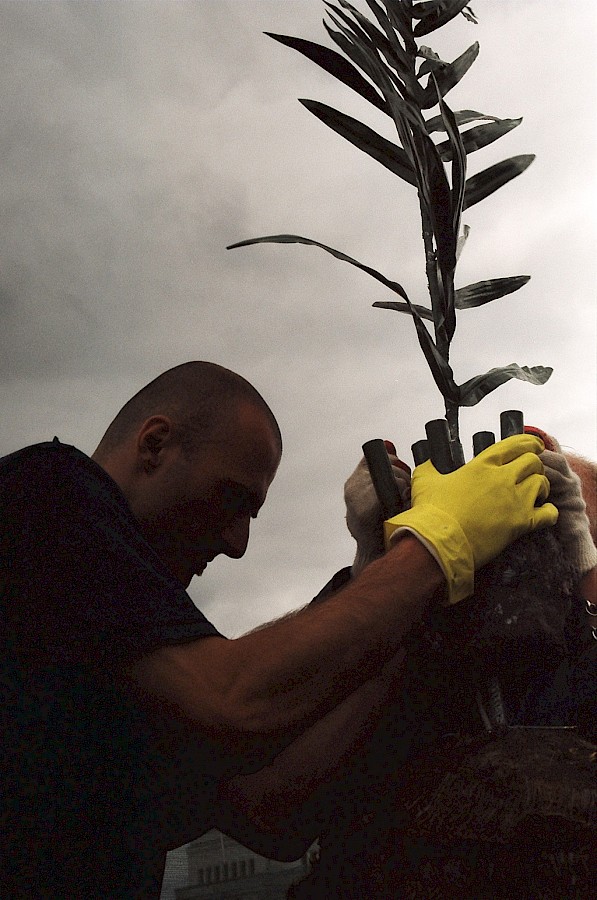
Greetings from Jerusalem Avenue (2022), installation of the fronds, 2003. Photo Joanna Rajkowska
Joanna and her travel partner, the artist Artur Żmijewski, wrote an article to say something on their time in Palestine-Israel during the Second Intifada. In struggling with the form, instead of writing the end, she suggested, they should plant date palms all along the main thoroughfare of Aleje Jerozolimskie. The date palm, cultivated in Palestine for millennia, symbolically powerful and polysemic as the date is a staple food across many cultures, local and diasporic, finds its way into an untranslatable Polish expression. A palm tree hit you signals a moment of loss of control, or logic, or madness, from the point of view of someone who has got both feet on the ground.40 Research in the Warsaw Public Library led Joanna to the inception of the street’s name: the 1774 eradication of Nowa Jerozolima (New Jerusalem), a Jewish settlement founded two years before, to which the road’s ancestor, Droga Jerozolimska (Jerusalem Road), originally led from the Vistula River. When I’ve walked toward, to then cross, the Vistula, on Aleje Jerozolimskie, my back has also faced the ruins of Nowa Jerozolima, filtered by Warsaw’s palm. She slips in, at once, an alien and clear chastising local utterance.
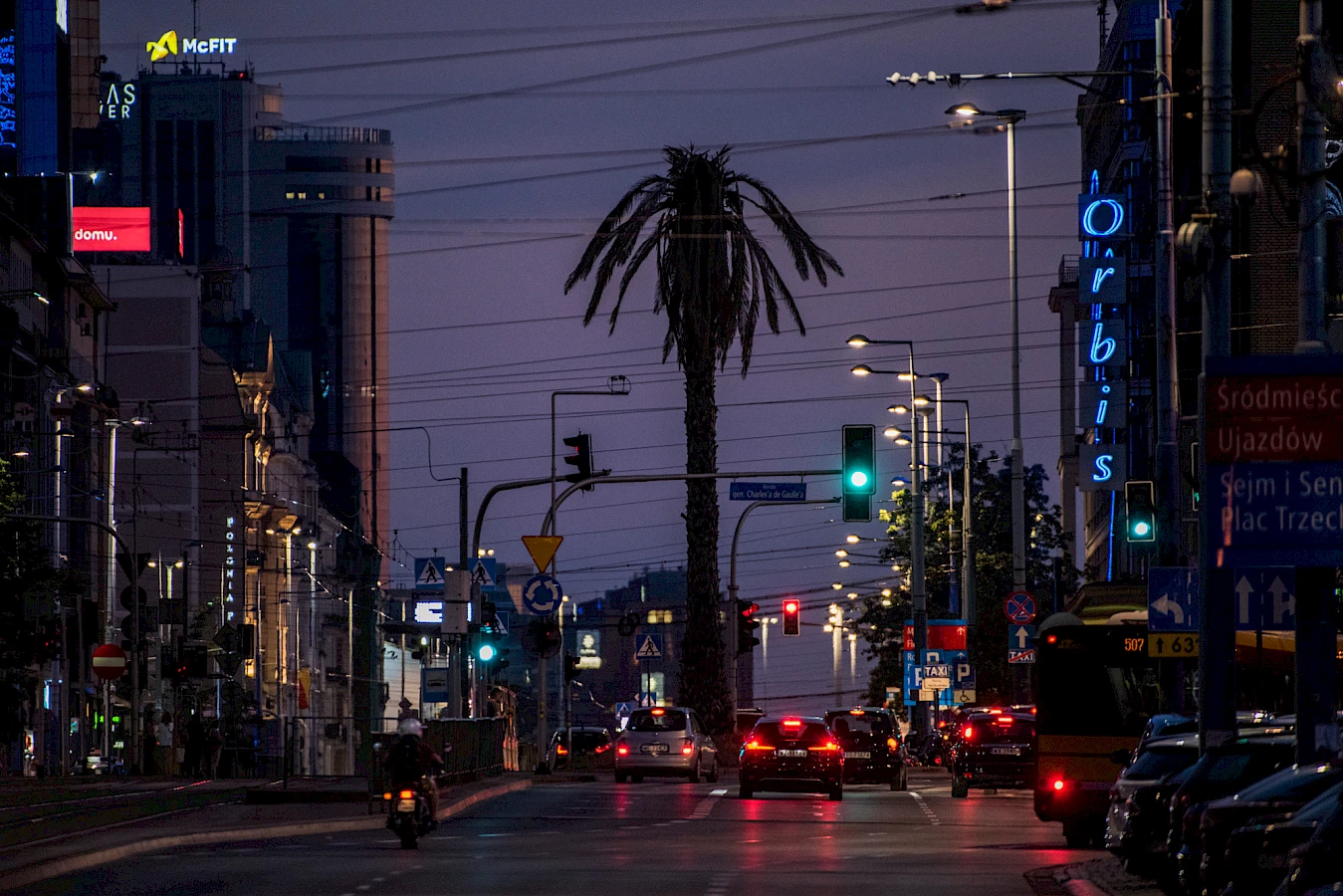
Joanna Rajkowska, Greetings from Jerusalem Avenue (2022), 17 June 2019, 10:30pm. Photo Marek Szczepański
On a formal level, Joanna’s entire attention to the work’s construction fixated upon the question of scale. The palm would be real to the eye from a distance. The map we have in our heads, particularly the map of the city, is a collection of images, she wrote on developing Greetings… . Turning onto a well-known street, we expect to see one of them. If a new element appears to substantially redefine it, we immediately make the effort to assimilate the new image. It involves the work of memory, emotions becoming engaged. I was interested in those few seconds of disbelief.41
Warsaw’s palm is surreal, intimate, refracting, ironic. She is artificial. Her sentience will outlive us. She is not my great-grandmother, nor Joanna’s, nor the gravestone of 375,000 genocided Jewish Warsawians, none of whom likely knew much of anything about date palm trees and should not be taken for a fake tree, because their roots in Poland were real and ancient. What is happening in Palestine-Israel is part of a specifically unresolved chain of statecraft. Europe depends upon the State of Israel as restitution. And it was not restitution. It was, and remains, a perpetuation of our persecution, the mere gift of their weapon. Warsaw’s palm is an exact citation and constructed illusion. She chastises and listens.
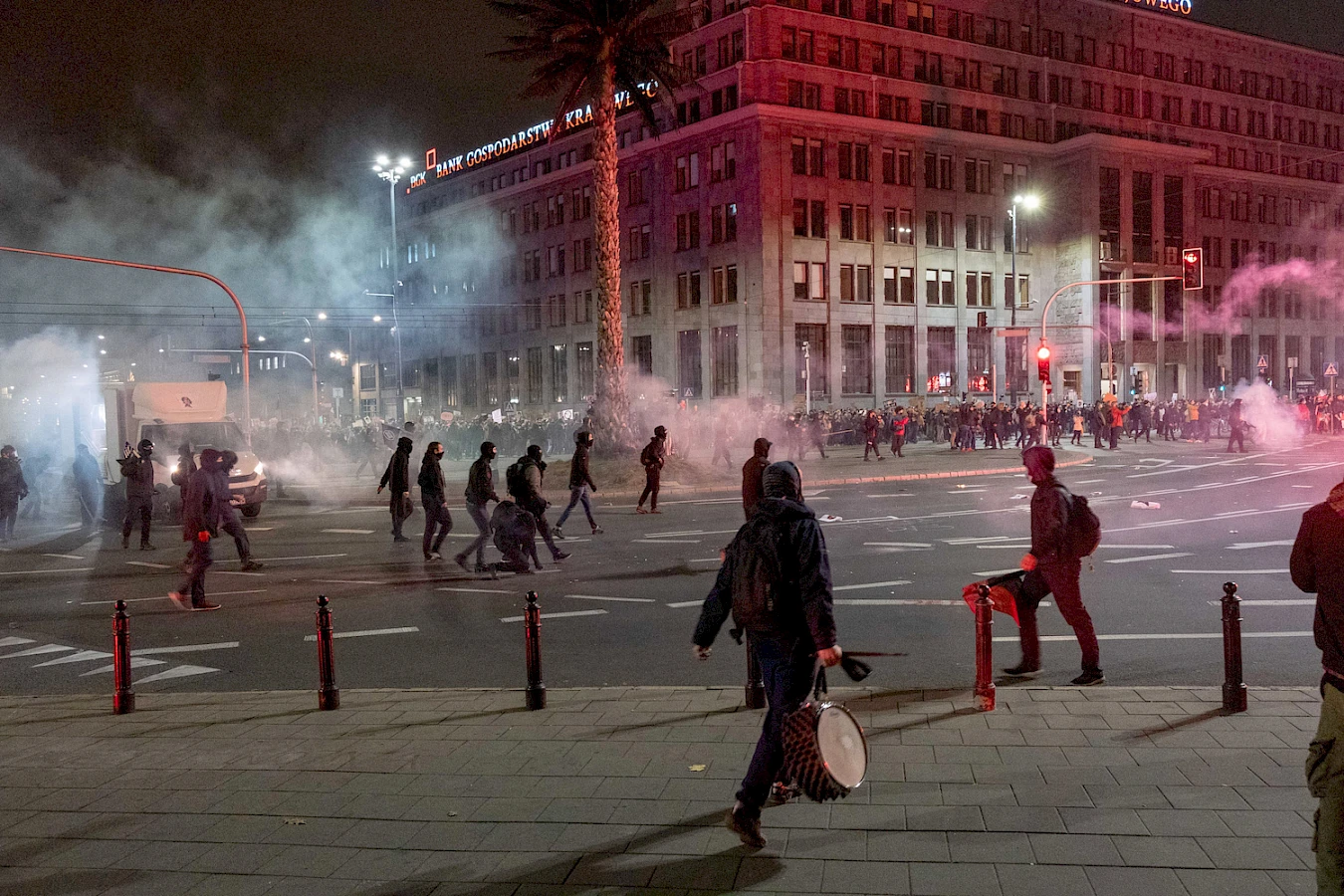
Women's Strike under the palm tree, 2020. Photo Robert Jaworski
Kurdish-Iranian thinker and activist Nastaran Saremy and I have worked on theorizing place as eruptions of particular moments in the land, by way of translocal imaginations and temporal sovereignties. We call such places imagined land. Territorial boundaries have nothing to do with these eruptions. Absolute borders do not mark place, but domination. The palm is a monument to such an eruption, which is why in the nation-state of Poland it is considered an anti-monument. Nastaran once said, It lives in imagined land.42
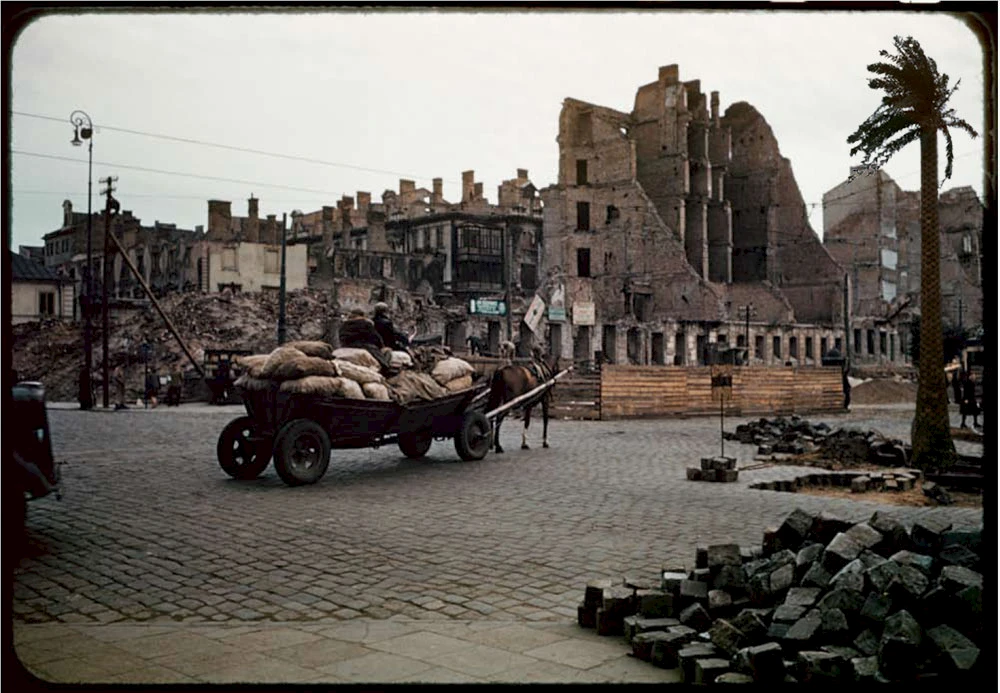
Henry N. Cobb, WARSAW, AUGUST 1947 with rendering of the palm tree by Joanna Rajkowska, 2022
4. the terrifying moon
X
A third resistance to, or force of, the English word draft does not soothe me. This third resistance or force troubles me. Draft is etymologically related to and meets draw in conscription. We draw water from a river to drink. We draft an architectural proposal from study to construct. We draw teenagers from their youth to kill life.
The contractions and construction of Greetings… first situated Warsaw’s built environment in Palestine, and Palestine’s earth in Warsaw by and in sensing, with confusion and fear, the structuring force of apartheid and ethnic cleansing exchanged, preceding and exceeding, too, the uncountable Shoah and the uncountable Nakba, if unto each forever distinctly, across both territories. Joanna’s organic, reflective acts worked both despite and because of the all but entirely razed, incinerated, incarcerated, and displaced legacy of her home, the home of her estranged father’s childhood, which the artist had to, and incidentally so, approach with her body in imagined land.
Greetings… ’ contractions and construction claims one fundament of responsibility, on behalf of Polish and European ontology, for both the ethnic cleansing of Palestine and Israeli fear, which, Joanna wrote, in defense of the unrealized Minaret project, heaves the shape of the Israeli state, its practices, its apartheid, its war crimes, and its relationship to its Others.43 And yet, monumentalization must be for the heterogenous present (Jetztzeit), otherwise it sanctifies irrelevance and moral abandon. Monumentalization must freeze and unfreeze, with the recurrence of winters, the rising sap.
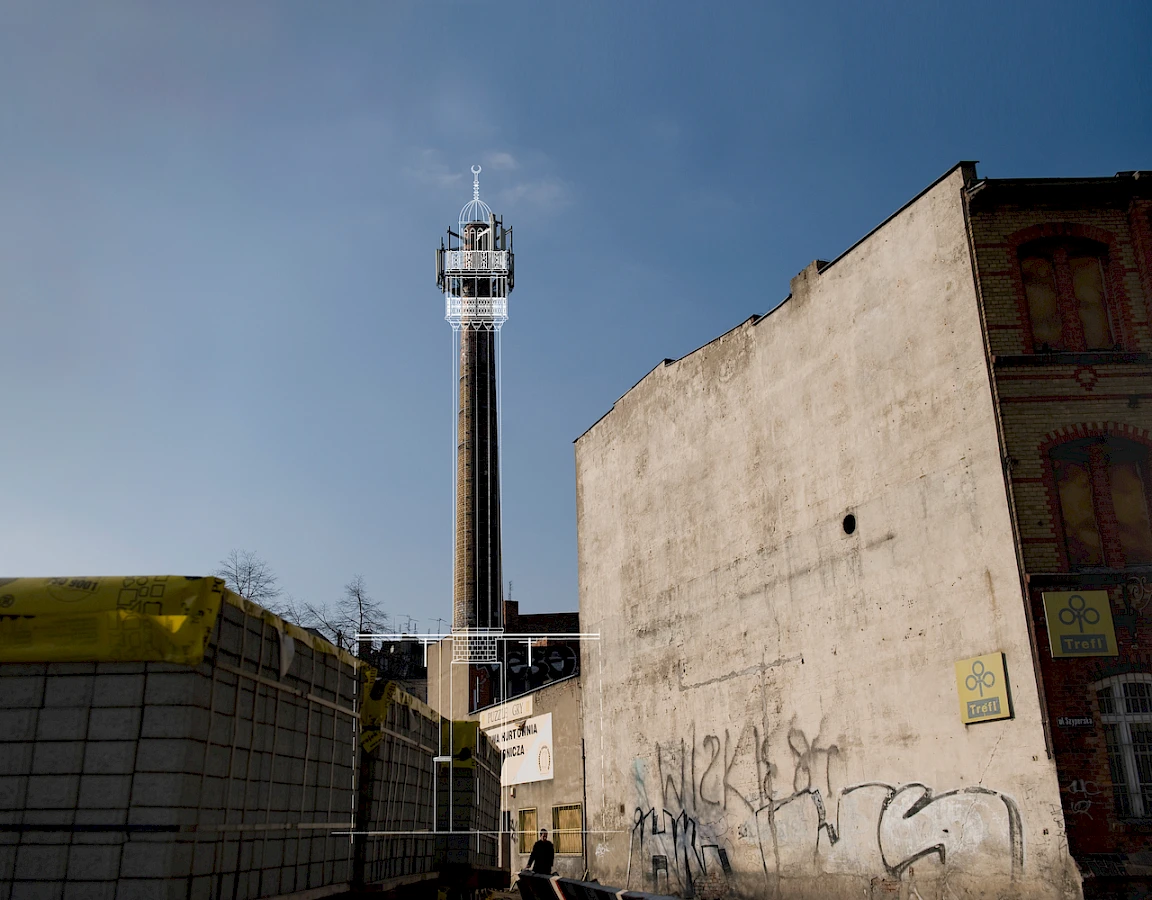
Joanna Rajkowska, rendering of Minaret, public project, 2010
In telling, this, again, I do what I might to be someone who still lives in Warsaw, though I do not live in Warsaw, Great-Grandmother Sarah bat Moshe, even if you wouldn’t want me there, even if you would want me there, even if it turns out you were never from there. And, in so doing, what I might, I do what Warsaw’s palm renders, in many of us, that is, quickly, quietly, to make us, all together, tell stories, at once, and distinctly, inside what Haviva Pedaya has called – on Reb Moshe Cordovero’s sixteenth-century cosmology, of falling and rising, in Palestine, in exile, from Spain, in Șafad – gigantic time.44 My telling, which is different from yours, is a parable and a debt. While the palm owes me nothing, I owe her something. At this hour, I owe her transcription, this guest, and refusal.
At this hour, one year into endless aimless collective retribution, a total and ever-expanding war (and not just that), by the State of Israel’s unhinged settler-fascist regime on drip-supply of weapons, theocratic consensus, and legal immunity from the United States, my nation, by birth and passport and great-grandparents’ refuge.
At this hour, one year into massacre after massacre after massacre after massacre after massacre, every day I bear to read, another massacre, of whole families, internal refugees, multiple times over, in the most vulnerable situations, multiple times over, waiting for food rations in the Flour Massacre, sleeping in the only demarcated safe zone in the Tent Massacres, treating the wounded and sick or being sick and wounded in the destruction of the al-Shifa Hospital Complex, praying in a school in the Al-Tabaeen Massacre.
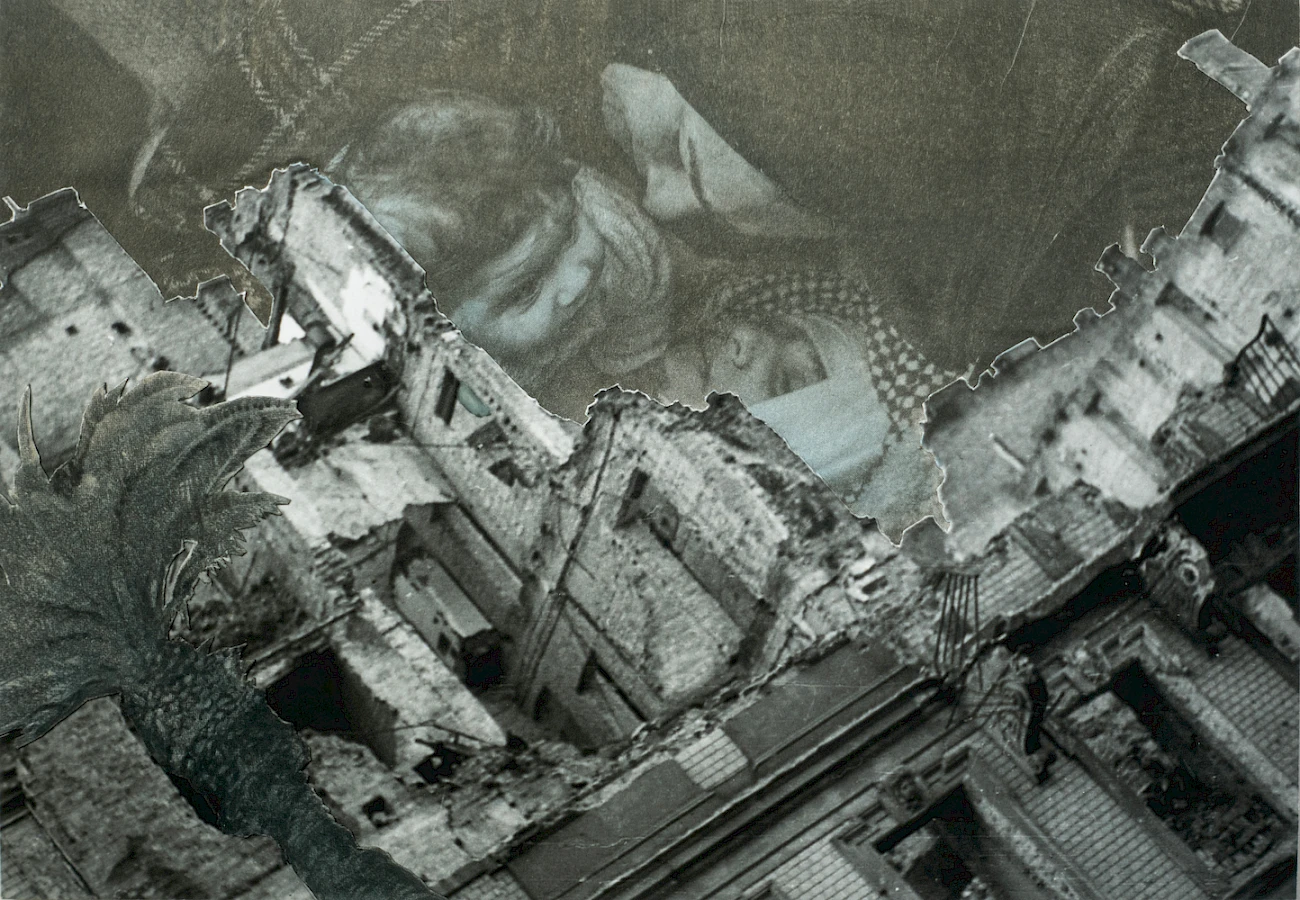
Joanna Rajkowska, Greetings from Gaza III, 2024
One year into the public execution of the names of our ancestors, of the names of our traditions, by a revisionist, anti-democratic regime that will radically overdetermine centuries and centuries to come of planetary anti-Judaism, I am certain, because to be us, those with a most perverse, naive, brief, and mercenary power tell the world, means to endorse, and unconditionally, such destruction
sixteen thousand seven hundred fifty-six children of blessed memory
nine hundred two whole families of blessed memory
ten thousand under rubble of blessed memory
one hundred fifty thousand homes of blessed memory
half of all trees and farms of blessed memory
seven hundred water wells and all desalination plants of blessed memory
one hundred fourteen hospitals and clinics of blessed memory
nine hundred eighty-six medical workers of blessed memory
one hundred twenty-three schools and universities of blessed memory
one hundred seventy-five journalists of blessed memory
thirty-five hostages of blessed memory
in holy Gaza.45
– Iyar 5784 - Tishrei 5785, Berlin (DE) + Bellingham (US)
Related activities
-
–Van Abbemuseum
The Soils Project
‘The Soils Project’ is part of an eponymous, long-term research initiative involving TarraWarra Museum of Art (Wurundjeri Country, Australia), the Van Abbemuseum (Eindhoven, Netherlands) and Struggles for Sovereignty, a collective based in Yogyakarta, Indonesia. It works through specific and situated practices that consider soil, as both metaphor and matter.
Seeking and facilitating opportunities to listen to diverse voices and perspectives around notions of caring for land, soil and sovereign territories, the project has been in development since 2018. An international collaboration between three organisations, and several artists, curators, writers and activists, it has manifested in various iterations over several years. The group exhibition ‘Soils’ at the Van Abbemuseum is part of Museum of the Commons. -
–VCRC
Kyiv Biennial 2023
L’Internationale Confederation is a proud partner of this year’s edition of Kyiv Biennial.
-
–MSN Warsaw
Multicultural Youth Center
The Museum of Modern Art in Warsaw, together with the confederation of museums L'Internationale, is establishing a Multicultural Youth Center. This is a unique space for 16-24 year olds to explore and develop their creativity, make new friends and hang out in a friendly and supportive environment.
-
–MACBA
Where are the Oases?
PEI OBERT seminar
with Kader Attia, Elvira Dyangani Ose, Max Jorge Hinderer Cruz, Emily Jacir, Achille Mbembe, Sarah Nuttall and Françoise VergèsAn oasis is the potential for life in an adverse environment.
-
MACBA
Anti-imperialism in the 20th century and anti-imperialism today: similarities and differences
PEI OBERT seminar
Lecture by Ramón GrosfoguelIn 1956, countries that were fighting colonialism by freeing themselves from both capitalism and communism dreamed of a third path, one that did not align with or bend to the politics dictated by Washington or Moscow. They held their first conference in Bandung, Indonesia.
-
–Van Abbemuseum
Maria Lugones Decolonial Summer School
Recalling Earth: Decoloniality and Demodernity
Course Directors: Prof. Walter Mignolo & Dr. Rolando VázquezRecalling Earth and learning worlds and worlds-making will be the topic of chapter 14th of the María Lugones Summer School that will take place at the Van Abbemuseum in Eindhoven.
-
–MSN Warsaw
Archive of the Conceptual Art of Odesa in the 1980s
The research project turns to the beginning of 1980s, when conceptual art circle emerged in Odesa, Ukraine. Artists worked independently and in collaborations creating the first examples of performances, paradoxical objects and drawings.
-
–Moderna galerijaZRC SAZU
Summer School: Our Many Easts
Our Many Easts summer school is organised by Moderna galerija in Ljubljana in partnership with ZRC SAZU (the Research Centre of the Slovenian Academy of Sciences and Arts) as part of the L’Internationale project Museum of the Commons.
-
–Moderna galerijaZRC SAZU
Open Call – Summer School: Our Many Easts
Our Many Easts summer school takes place in Ljubljana 24–30 August and the application deadline is 15 March. Courses will be held in English and cover topics such as the legacy of the Eastern European avant-gardes, archives as tools of emancipation, the new “non-aligned” networks, art in times of conflict and war, ecology and the environment.
-
–MACBA
Song for Many Movements: Scenes of Collective Creation
An ephemeral experiment in which the ground floor of MACBA becomes a stage for encounters, conversations and shared listening.
-
Museo Reina Sofia
Palestine Is Everywhere
‘Palestine Is Everywhere’ is an encounter and screening at Museo Reina Sofía organised together with Cinema as Assembly as part of Museum of the Commons. The conference starts at 18:30 pm (CET) and will also be streamed on the online platform linked below.
-
HDK-Valand
Book Launch: Collective Study in Times of Emergency, Gothenburg
with Nick Aikens (L'Internationale Online / HDK-Valand) and Mills Dray (HDK-Valand), 17h00, Glashuset
-
Moderna galerija
Book Launch: Collective Study in Times of Emergency, Ljubljana
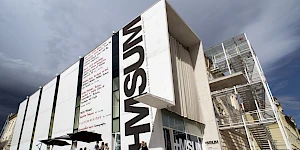
with Nick Aikens (L'Internationale Online / HDK-Valand), Bojana Piškur (MG+MSUM) and Martin Pogačar (ZRC SAZU)
-
WIELS
Book Launch: Collective Study in Times of Emergency, Brussels
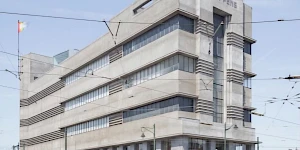
with Nick Aikens (L'Internationale Online / HDK-Valand), Subversive Film and Alex Reynolds, 19h00, Wiels Auditorium
-
–
Kyiv Biennial 2025
L’Internationale Confederation is proud to co-organise this years’ edition of the Kyiv Biennial.
-
–MACBA
Project a Black Planet: The Art and Culture of Panafrica
Curated by MACBA director Elvira Dyangani Ose, along with Antawan Byrd, Adom Getachew and Matthew S. Witkovsky, Project a Black Planet: The Art and Culture of Panafrica is the first major international exhibition to examine the cultural manifestations of Pan-Africanism from the 1920s to the present.
-
–M HKA
The Geopolitics of Infrastructure
The exhibition The Geopolitics of Infrastructure presents the work of a generation of artists bringing contemporary perspectives on the particular topicality of infrastructure in a transnational, geopolitical context.
-
–MACBAMuseo Reina Sofia
School of Common Knowledge 2025
The second iteration of the School of Common Knowledge will bring together international participants, faculty from the confederation and situated organizations in Barcelona and Madrid.
-
NCAD
Book Launch: Collective Study in Times of Emergency, Dublin
with Nick Aikens (L'Internationale Online / HDK-Valand) and members of the L'Internationale Online editorial board: Maria Berríos, Sheena Barrett, Sara Buraya Boned, Charles Esche, Sofia Dati, Sabel Gavaldon, Jasna Jaksic, Cathryn Klasto, Magda Lipska, Declan Long, Francisco Mateo Martínez Cabeza de Vaca, Bojana Piškur, Tove Posselt, Anne-Claire Schmitz, Ezgi Yurteri, Martin Pogacar, and Ovidiu Tichindeleanu, 18h00, Harry Clark Lecture Theatre, NCAD
-
–
Collective Study in Times of Emergency, Amsterdam
Within the context of ‘Every Act of Struggle’, the research project and exhibition at de appel in Amsterdam, L’Internationale Online has been invited to propose a programme of collective study.
-
Museo Reina Sofia
Poetry readings: Culture for Peace – Art and Poetry in Solidarity with Palestine
Casa de Campo, Madrid
-
WIELS
Collective Study in Times of Emergency, Brussels. Rana Issa and Shayma Nader
Join us at WIELS for an evening of fiction and poetry as part of L'Internationale Online's 'Collective Study in Times of Emergency' publishing series and public programmes. The series was launched in November 2023 in the wake of the onset of the genocide in Palestine and as a means to process its implications for the cultural sphere beyond the singular statement or utterance.
-
–Museo Reina Sofia
Study Group: Aesthetics of Peace and Desertion Tactics
In a present marked by rearmament, war, genocide, and the collapse of the social contract, this study group aims to equip itself with tools to, on one hand, map genealogies and aesthetics of peace – within and beyond the Spanish context – and, on the other, analyze strategies of pacification that have served to neutralize the critical power of peace struggles.
-
–MSN Warsaw
Near East, Far West. Kyiv Biennial 2025
The main exhibition of the 6th Kyiv Biennial 2025, titled Near East, Far West, is organized by a consortium of curators from L’Internationale. It features seven new artists’ commissions, alongside works from the collections of member institutions of L’Internationale and a number of other loans.
-
MACBA
PEI Obert: The Brighter Nations in Solidarity: Even in the Midst of a Genocide, a New World Is Being Born
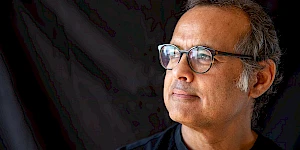
PEI Obert presents a lecture by Vijay Prashad. The Colonial West is in decay, losing its economic grip on the world and its control over our minds. The birth of a new world is neither clear nor easy. This talk envisions that horizon, forged through the solidarity of past and present anticolonial struggles, and heralds its inevitable arrival.
-
–M HKA
Homelands and Hinterlands. Kyiv Biennial 2025
Following the trans-national format of the 2023 edition, the Kyiv Biennial 2025 will again take place in multiple locations across Europe. Museum of Contemporary Art Antwerp (M HKA) presents a stand-alone exhibition that acts also as an extension of the main biennial exhibition held at the newly-opened Museum of Modern Art in Warsaw (MSN).
In reckoning with the injustices and atrocities committed by the imperialisms of today, Kyiv Biennial 2025 reflects with historical consciousness on failed solidarities and internationalisms. It does this across an axis that the curators describe as Middle-East-Europe, a term encompassing Central Eastern Europe, the former-Soviet East and the Middle East.
-
HDK-Valand
MA Forum in collaboration with LIO: Nour Shantout
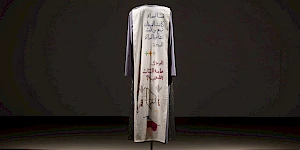
In this artist talk, Nour Shantout will present Searching for the New Dress, an ongoing artistic research project that looks at Palestinian embroidery in Shatila, a Palestinian refugee camp in Lebanon. Welcome!
-
MACBA
PEI Obert: Bodies of Evidence. A lecture by Ido Nahari and Adam Broomberg
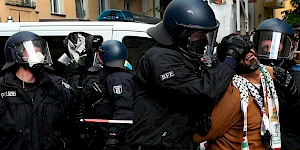
In the second day of Open PEI, writer and researcher Ido Nahari and artist, activist and educator Adam Broomberg bring us Bodies of Evidence, a lecture that analyses the circulation and functioning of violent images of past and present genocides. The debate revolves around the new fundamentalist grammar created for this documentation.
-
–
Everything for Everybody. Kyiv Biennial 2025
As one of five exhibitions comprising the 6th Kyiv Biennial 2025, ‘Everything for Everybody’ takes place in the Ukraine, at the Dnipro Center for Contemporary Culture.
-
–
In a Grandiose Sundance, in a Cosmic Clatter of Torture. Kyiv Biennial 2025
As one of five exhibitions comprising the 6th Kyiv Biennial 2025, ‘In a Grandiose Sundance, in a Cosmic Clatter of Torture’ takes place at the Dovzhenko Centre in Kyiv.
-
MACBA
School of Common Knowledge: Fred Moten
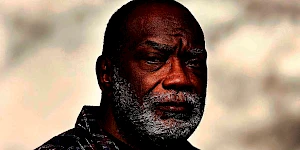
Fred Moten gives the lecture Some Prœposicions (On, To, For, Against, Towards, Around, Above, Below, Before, Beyond): the Work of Art. As part of the Project a Black Planet exhibition, MACBA presents this lecture on artworks and art institutions in relation to the challenge of blackness in the present day.
-
–MACBA
Visions of Panafrica. Film programme
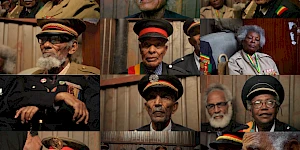
Visions of Panafrica is a film series that builds on the themes explored in the exhibition Project a Black Planet: The Art and Culture of Panafrica, bringing them to life through the medium of film. A cinema without a geographical centre that reaffirms the cultural and political relevance of Pan-Africanism.
-
MACBA
Farah Saleh. Balfour Reparations (2025–2045)
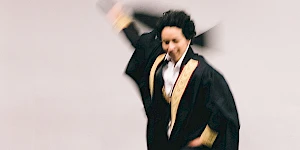
As part of the Project a Black Planet exhibition, MACBA is co-organising Balfour Reparations (2025–2045), a piece by Palestinian choreographer Farah Saleh included in Hacer Historia(s) VI (Making History(ies) VI), in collaboration with La Poderosa. This performance draws on archives, memories and future imaginaries in order to rethink the British colonial legacy in Palestine, raising questions about reparation, justice and historical responsibility.
-
MACBA
Project a Black Planet: The Art and Culture of Panafrica OPENING EVENT
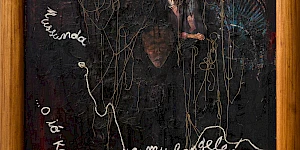
A conversation between Antawan I. Byrd, Adom Getachew, Matthew S. Witkovsky and Elvira Dyangani Ose. To mark the opening of Project a Black Planet: The Art and Culture of Panafrica, the curatorial team will delve into the exhibition’s main themes with the aim of exploring some of its most relevant aspects and sharing their research processes with the public.
-
MACBA
Palestine Cinema Days 2025: Al-makhdu’un (1972)
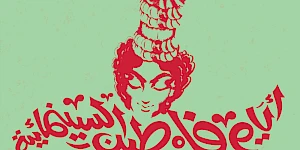
Since 2023, MACBA has been part of an international initiative in solidarity with the Palestine Cinema Days film festival, which cannot be held in Ramallah due to the ongoing genocide in Palestinian territory. During the first days of November, organizations from around the world have agreed to coordinate free screenings of a selection of films from the festival. MACBA will be screening the film Al-makhdu’un (The Dupes) from 1972.
-
Museo Reina Sofia
Cinema Commons #1: On the Art of Occupying Spaces and Curating Film Programmes
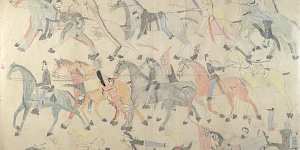
On the Art of Occupying Spaces and Curating Film Programmes is a Museo Reina Sofía film programme overseen by Miriam Martín and Ana Useros, and the first within the project The Cinema and Sound Commons. The activity includes a lecture and two films screened twice in two different sessions: John Ford’s Fort Apache (1948) and John Gianvito’s The Mad Songs of Fernanda Hussein (2001).
-
–
Vertical Horizon. Kyiv Biennial 2025
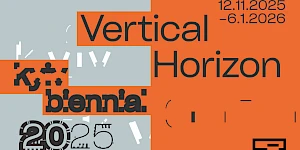
As one of five exhibitions comprising the 6th Kyiv Biennial 2025, ‘Vertical Horizon’ takes place at the Lentos Kunstmuseum in Linz, at the initiative of tranzit.at.
-
–
International Day of Solidarity with the Palestinian People: Activities
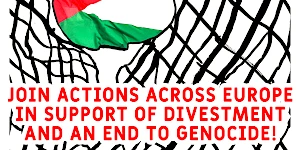
To mark International Day of Solidarity with the Palestinian People and in conjunction with our collective text, we, the cultural workers of L'Internationale have compiled a list of programmes, actions and marches taking place accross Europe. Below you will find programmes organized by partner institutions as well as activities initaited by unions and grass roots organisations which we will be joining.
This is a live document and will be updated regularly.
-
–SALT
Screening: A Bunch of Questions with No Answers
This screening is part of a series of programs and actions taking place across L’Internationale partners to mark International Day of Solidarity with the Palestinian People.
A Bunch of Questions with No Answers (2025)
Alex Reynolds, Robert Ochshorn
23 hours 10 minutes
English; Turkish subtitles -
HDK-Valand
MA Forum in collaboration with LIO: Adam Broomberg
In this MA Forum we welcome artist Adam Broomberg. In his lecture he will focus on two photographic projects made in Israel/Palestine twenty years apart. Both projects use the medium of photography to communicate the weaponization of nature.
-
MACBA
PEI Obert: Until Liberation: A Collective Reading and Listening Session by Learning Palestine
PEI Obert presents a collective session with Learning Palestine. At this historical juncture – amid the ongoing genocide in Gaza and the censorship and repression of all things Palestinian – Learning Palestine invites us to gather not only in refusal but also in affirmation.
Related contributions and publications
-
The Repressive Tendency within the European Public Sphere
Ovidiu ŢichindeleanuInternationalismsPast in the Present -
Siempre hemos estado aquí. Les poetas palestines contestan
Rana IssaEN es tr arInternationalismsPast in the Present -
Broadcast: Towards Collective Study in Times of Emergency (for 24 hrs/Palestine)
L’Internationale Online Editorial Board, Rana Issa, L’Internationale Confederation, Vijay PrashadInternationalismsSonic and Cinema Commons -
…and the Earth along. Tales about the making, remaking and unmaking of the world.
Martin PogačarLand RelationsClimatePast in the Present -
The Kitchen, an Introduction to Subversive Film with Nick Aikens, Reem Shilleh and Mohanad Yaqubi
Nick Aikens, Subversive FilmSonic and Cinema CommonslumbungPast in the PresentVan Abbemuseum -
Rewinding Internationalism
InternationalismsVan Abbemuseum -
Troubles with the East(s)
Bojana PiškurInternationalismsPast in the Present -
Right now, today, we must say that Palestine is the centre of the world
Françoise VergèsInternationalismsPast in the Present -
Body Counts, Balancing Acts and the Performativity of Statements
Mick WilsonInternationalismsPast in the Present -
Until Liberation I
Learning Palestine GroupInternationalismsPast in the Present -
Until Liberation II
Learning Palestine GroupInternationalismsPast in the Present -
The Veil of Peace
Ovidiu ŢichindeleanuPast in the Presenttranzit.ro -
Blyzkist Dialogues
Maria Beburia, Taras GembikMSN Warsaw -
Editorial: Towards Collective Study in Times of Emergency
L’Internationale Online Editorial BoardEN es sl tr arInternationalismsStatements and editorialsPast in the Present -
Your Maplet: Instructions
MSN Warsaw -
Opening Performance: Song for Many Movements, live on Radio Alhara
Jokkoo with/con Miramizu, Rasheed Jalloul & Sabine SalaméEN esInternationalismsSonic and Cinema CommonsPast in the PresentMACBA -
Indra's Web
Vandana SinghLand RelationsPast in the PresentClimate -
Diary of a Crossing
Baqiya and Yu’adInternationalismsPast in the Present -
The Silence Has Been Unfolding For Too Long
The Free Palestine Initiative CroatiaInternationalismsPast in the PresentSituated OrganizationsInstitute of Radical ImaginationMSU Zagreb -
En dag kommer friheten att finnas
Françoise Vergès, Maddalena FragnitoEN svInternationalismsLand RelationsClimateInstitute of Radical Imagination -
Everything will stay the same if we don’t speak up
L’Internationale ConfederationEN caInternationalismsStatements and editorials -
War, Peace and Image Politics: Part 1, Who Has a Right to These Images?
Jelena VesićInternationalismsPast in the PresentZRC SAZU -
Live set: Una carta de amor a la intifada global
PrecolumbianEN esInternationalismsSonic and Cinema CommonsPast in the PresentMACBA -
Cultivating Abundance
Åsa SonjasdotterLand RelationsClimatePast in the Present -
Rethinking Comradeship from a Feminist Position
Leonida KovačSchoolsInternationalismsSituated OrganizationsMSU ZagrebModerna galerijaZRC SAZU -
Reading list - Summer School: Our Many Easts
Summer School - Our Many EastsSchoolsPast in the PresentModerna galerija -
The Genocide War on Gaza: Palestinian Culture and the Existential Struggle
Rana AnaniInternationalismsPast in the Present -
Klei eten is geen eetstoornis
Zayaan KhanEN nl frLand RelationsClimatePast in the Present -
Dispatch: ‘I don't believe in revolution, but sometimes I get in the spirit.’
Megan HoetgerSchoolsPast in the Present -
Dispatch: Notes on (de)growth from the fragments of Yugoslavia's former alliances
Ava ZevopSchoolsPast in the Present -
Glöm ”aldrig mer”, det är alltid redan krig
Martin PogačarEN svLand RelationsPast in the Present -
Beyond Distorted Realities: Palestine, Magical Realism and Climate Fiction
Sanabel Abdel RahmanEN trInternationalismsPast in the PresentClimate -
Collective Study in Times of Emergency. A Roundtable
Nick Aikens, Sara Buraya Boned, Charles Esche, Martin Pogačar, Ovidiu Ţichindeleanu, Ezgi YurteriInternationalismsPast in the PresentSituated Organizations -
Present Present Present. On grounding the Mediateca and Sonotera spaces in Malafo, Guinea-Bissau
Filipa CésarSonic and Cinema CommonsPast in the Present -
Collective Study in Times of Emergency
InternationalismsPast in the Present -
S come Silenzio
Maddalena FragnitoEN itInternationalismsSituated Organizations -
ميلاد الحلم واستمراره
Sanaa SalamehEN hr arInternationalismsPast in the Present -
عن المكتبة والمقتلة: شهادة روائي على تدمير المكتبات في قطاع غزة
Yousri al-GhoulEN arInternationalismsPast in the Present -
Archivos negros: Episodio I. Internacionalismo radical y panafricanismo en el marco de la guerra civil española
Tania Safura AdamEN esInternationalismsPast in the Present -
Re-installing (Academic) Institutions: The Kabakovs’ Indirectness and Adjacency
Christa-Maria Lerm HayesInternationalismsPast in the Present -
Dispatch: A Faceless Future? A brief impression from MSN in its first days
Charles EscheMSN Warsaw -
Palma daktylowa przeciw redeportacji przypowieści, czyli europejski pomnik Palestyny
Robert Yerachmiel SnidermanEN plInternationalismsPast in the PresentMSN Warsaw -
Masovni studentski protesti u Srbiji: Mogućnost drugačijih društvenih odnosa
Marijana Cvetković, Vida KneževićEN rsInternationalismsPast in the Present -
No Doubt It Is a Culture War
Oleksiy Radinsky, Joanna ZielińskaInternationalismsPast in the Present -
Cinq pierres. Une suite de contes
Shayma NaderEN nl frInternationalisms -
Dispatch: As Matter Speaks
Yeongseo JeeInternationalismsPast in the Present -
Speaking in Times of Genocide: Censorship, ‘social cohesion’ and the case of Khaled Sabsabi
Alissar SeylaInternationalisms -
Reading List: Summer School, Landscape (post) Conflict
Summer School - Landscape (post) ConflictSchoolsLand RelationsPast in the PresentIMMANCAD -
Today, again, we must say that Palestine is the centre of the world
Françoise VergèsInternationalisms -
Isabella Hammad’ın icatları
Hazal ÖzvarışEN trInternationalisms -
To imagine a century on from the Nakba
Behçet ÇelikEN trInternationalisms -
Internationalisms: Editorial
L'Internationale Online Editorial BoardInternationalisms -
Dispatch: Institutional Critique in the Blurst of Times – On Refusal, Aesthetic Flattening, and the Politics of Looking Away
İrem GünaydınInternationalisms -
Until Liberation III
Learning Palestine GroupInternationalismsPast in the Present -
Archivos negros: Episodio II. Jazz sin un cuerpo político negro
Tania Safura AdamEN esInternationalismsPast in the Present -
Cultural Workers of L’Internationale mark International Day of Solidarity with the Palestinian People
Cultural Workers of L’InternationaleEN es pl roInternationalismsSituated OrganizationsPast in the PresentStatements and editorials -
Poetry Against Language Dioxide
Rana IssaInternationalisms -
The Object of Value
SlinkoInternationalismsLand Relations