Black Archives: Episode III. Pan-Africanism and the Black Diaspora in Spain
The final episode of the Black Archives series brings together traces, transitions and events of Pan-Africanism in Spain, rather than a continuous trajectory. As Tania Safura Adam makes clear, whilst these may not have consolidated into a stable movement, they nonetheless left their mark. The purpose of this archive is not to document a unified history, but rather to reveal the recurrent tensions and challenges of Black political presence within restrictive institutional frameworks. English translation is by Jennie Gant.
Black Angels
Around 1936, at the start of the Spanish Civil War, the Venezuelan poet Andrés Eloy Blanco’s poem ‘Píntame angelitos negros’ (Paint me Black Angels),1 a condemnation of racism rendered in religious imagery, appeared in print. Three centuries earlier, Sister Teresa Juliana de Santo Domingo (1676?–1748), known as Sor (Sister) Chikaba, an African woman enslaved in childhood who later became a nun in Salamanca, left us a similar lament to Blanco’s in her only surviving poem.2 Although it is unclear whether it was written in protest, written from her perspective as a Black woman in a seventeenth-century Spanish convent, her poem resonates with the voice of one who understands difference and exclusion. This is apparent when she asks for Jesus’s love and compares herself to the Gospel’s most beloved figures. Andrés Eloy Blanco could never have imagined that in 1947 Antonio Machín – the Cuban musician then living in Spain – would turn his poem into the song ‘Angelitos negros’, or that the song would become one of Machín’s greatest international hits.
Pintor de santos de alcoba,
pintor sin tierra en el pecho,
que cuando pintas tus santos
no te acuerdas de tu pueblo,
que cuando pintas tus Vírgenes
pintas angelitos bellos,
pero nunca te acordaste
de pintar un ángel negro.(Painter of alcove saints,
painter without land in your heart,
when you paint your saints
you forget your people,
when you paint your Virgins
you paint beautiful little angels,
but you never thought
to paint a black angel.)
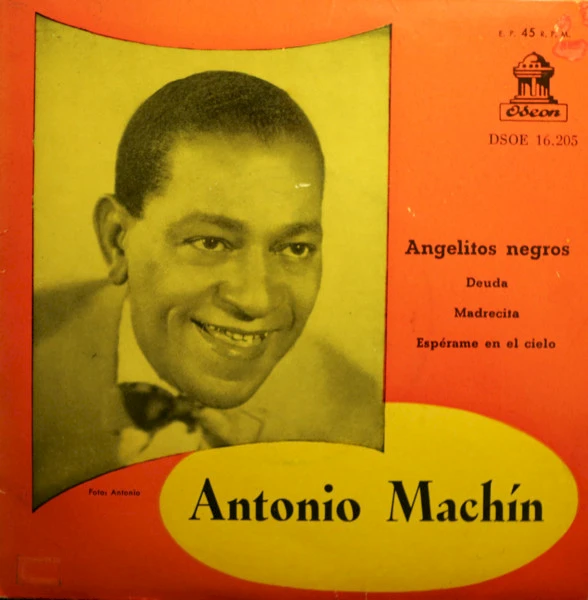
Cover of ‘Angelitos negros’ by Antonio Machín. Artist unknown. Source: Discogs
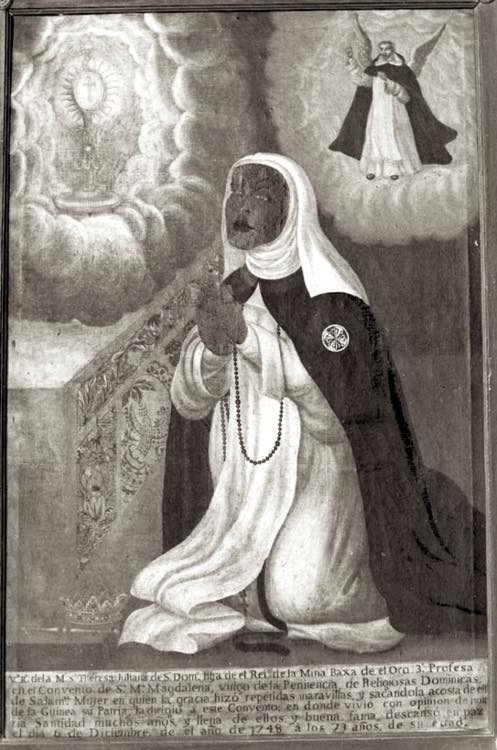
Image of Sister Chikaba. Artist unknown
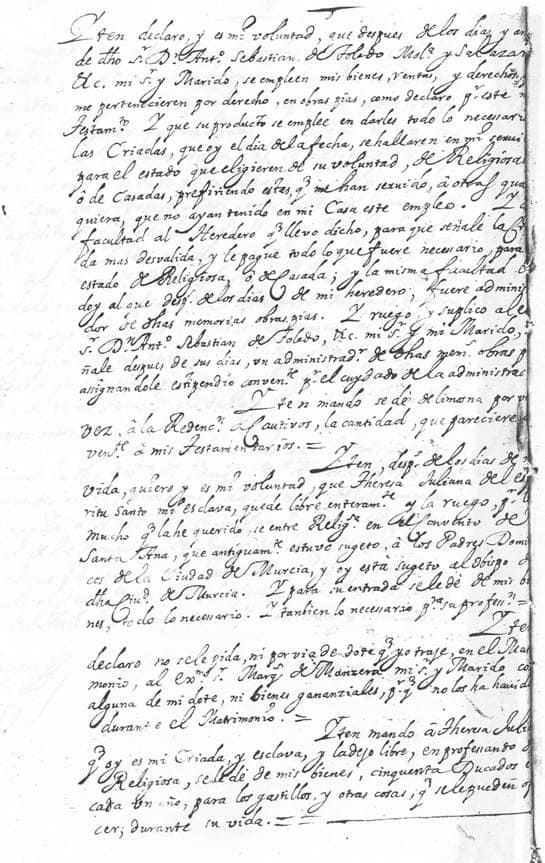
1703 will of Doña Juliana Teresa Portocarrero, legal owner of Teresa Juliana del Espíritu Santo (Sister Chikaba), in which she grants her her freedom so that she may pursue a religious vocation. Source: Real Archivo Histórico de Hispanoamérica y España (Royal Historical Archive of Hispanic America and Spain)
In a post-war atmosphere of spiritual and material poverty, this song became a touchstone, etched in the collective memory, albeit with some ambiguity. For some, it was a song about wounded love; for others, it was discomfiting but nevertheless tolerated. After all, it was said that racism did not exist in Spain – that that was an evil peculiar to other lands. The song’s tone was more pleading than confrontational, which, in an era marred by the fascist mythology and propaganda shaping the social imagination, meant that it could spread. It was also a time when jazz was censored, along with anything foreign that might ‘taint’ the Catholic morality imposed by the Generalissimo of the Spanish armed forces.3
While ‘Angelitos negros’ played on the radio and in dance halls, seeds of fascism were taking root, and the worst fears of the Black communists who had enlisted in the International Brigades were coming true. Many of them realized that fascism was not just a national movement, but a racial and global phenomenon. From their perspective, the Spanish Civil War was a battle against unjust human hierarchies. To them, the Jim Crow laws in the United States, European colonialism in Africa, and antisemitism in Europe were part of the same system of racial hierarchy.
During those dark years, the movement of African American artists and intellectuals to Europe, particularly Paris, continued – a trend that had begun in the 1920s. Spain was more of a place of passage than a destination, although some dared to stay. One such person was the writer Chester Himes. Suffering from health problems, Himes left France in search of a quieter life and settled in the Alicante town of Moraira in 1969. He died there in 1984.
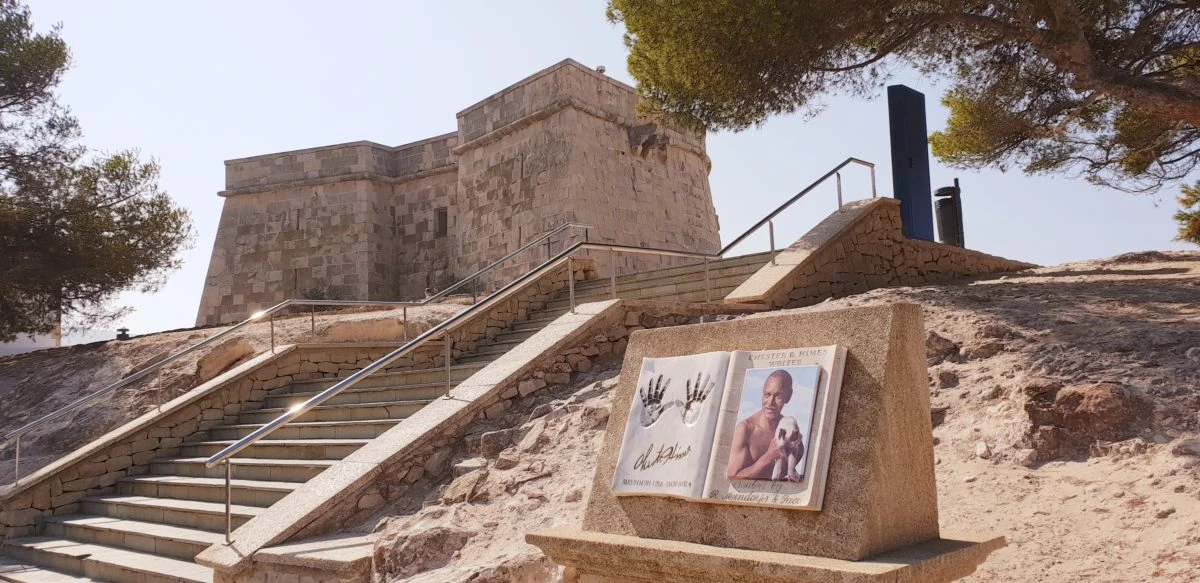
Monument to the American writer Chester Himes on the beach at Castillo de Moraira, Spain. Source: Valencia Plaza
In another episode that went largely unnoticed, writer James Baldwin made a lightning trip to Barcelona in May 1962. After participating as a Formentor Prize jury member in Mallorca, he travelled there to spend a few days with the poet Jaime Gil de Biedma, who would dedicate the poem ‘En una despedida’ (At a Farewell) (1966) to him.4 Little is known about the encounter, but it was an enjoyable occasion, not a political event, and very different from the contemplative, solitary Spanish journey made in 1954 by Baldwin’s one-time mentor Richard Wright. (By the time of Baldwin’s trip, his clash with Wright – precipitated by his critique of Wright’s Native Son [1940] in Everybody’s Protest Novel [1949] – had become a permanent rift.) Otherwise, throughout the post-war period, there was a steady influx of American and Cuban musicians and writers; Equatorial Guinean students; and the occasional political exile, such as Congolese Prime Minister Moïse Tshombé. Accused of ordering the death of Patrice Lumumba, he was welcomed by the Franco regime before later dying in controversial circumstances.5
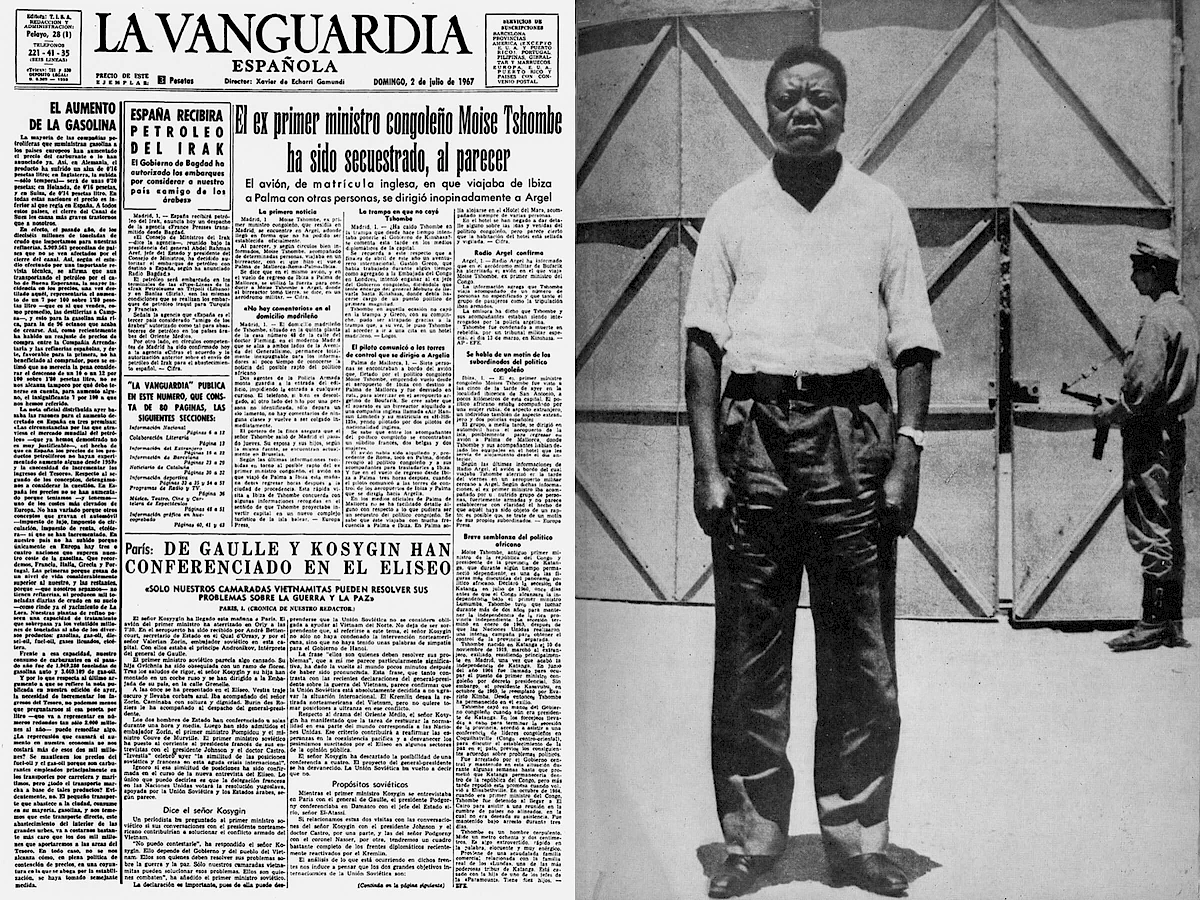
News item about the disappearance of Moïse Tshombé, La Vanguardia, 2 July 1967. Author unknown. Source: Archivos Negros
However, this diaspora was fragmented and marginalized and did not mobilize around a coherent Pan-Africanist movement. The same could be said of Spanish Guinea, the only territory in Black Africa under Spanish control, where the way Pan-Africanism took root was sporadic and lacklustre.
While Kwame Nkrumah participated in the Fifth Pan-African Congress in Manchester in 1945, going on to lead the Gold Coast to independence, after which it became Ghana in 1957, Spanish Guinea remained mired in cultural and religious colonialism under the tight control of the Franco regime. Political repression, censorship and a lack of international networks made it difficult for Equatorial Guinean activists to communicate with the outside world. As a result, the Spanish colony was largely absent from the surge in Pan-Africanism.
Consequently, when Ghanaians celebrated independence to the rhythm of E. T. Mensah’s highlife song ‘Ghana Freedom’, the sound and political impact barely reached the shores of Spain. Instead, Richard Wright published Pagan Spain (1957).6 The Spain that Wright depicted bore no resemblance to what he had described in Black Power (1954) after his return from the Gold Coast.7 Although, in Wright’s view, imperial structures, religion and political power persisted both in Spain and the land now called Ghana, the imaginaries and realities of each were markedly different.
Pan-African convergence
To better understand the global context, let us return to the beginning of the century. In July 1900, London hosted the first Pan-African Conference, organized by Henry Sylvester Williams. This was a seminal moment, one which symbolically moved mountains – taking up the legacy of maroon and anti-slavery struggles, the conference propelled new forms of Black resistance across the world.
Just as orogenesis transforms the surface of the Earth and reconfigures continents, the Pan-African Conference set in motion profound historical changes, ultimately reshaping the political, cultural and social landscape in ways responsible, in turn, for shaping the consciousness of African peoples and their diasporas. This geological analogy is appropriate to the depth, durability and intensity of such political processes – observe the force of their collisions, like mountain ranges that rise and fold – ideas, encounters and struggles of a kind that have pushed up against each other throughout history.
During the first half of the twentieth century, Pan-African conferences – held outside the continent – consolidated cultural, political and economic frameworks that influenced various leaders and connected disparate political projects, ultimately converging in African nationalisms. The climax came in Manchester, 1945, the last and most influential Pan-African Conference held on European soil. One of the central questions of that conference was the conditions faced by Black workers in colonial contexts that accompanied the call to organize and fight against imperialism.
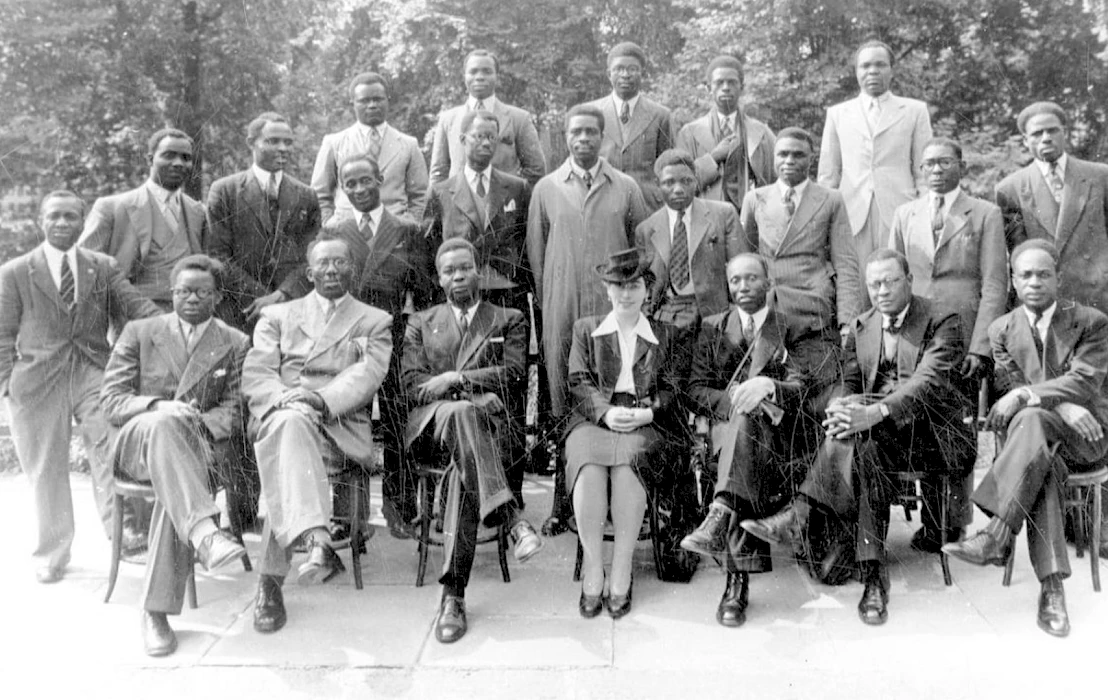
Delegates at the Pan-African Conference in Manchester, 1945. Photographer unknown. Courtesy the Working Class Movement Library
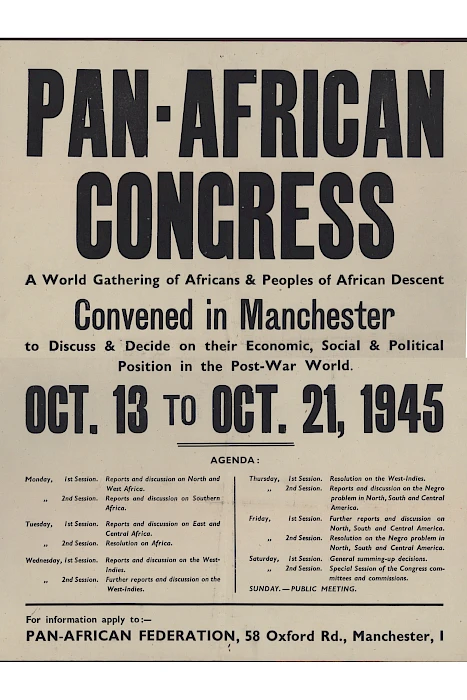
Poster for the Pan-African Conference in Manchester, 1945. Source: W. E. B. Du Bois Papers (MS 312), Special Collections and University Archives, UMass Amherst Libraries, University of Massachusetts
Labour was not a secondary issue, it was the driving force of change. Pan-Africanism was the means for dismantling a global regime of exploitation of Black bodies as a labour force, historically consigned to plantation work and relegated to a status of racial subordination.
But, as Jean Price-Mars has pointed out, before political Pan-Africanism developed, there was a cultural Pan-Africanism that regarded Africa as the land of ancestors, placing it at the centre rather than the periphery. In Ainsi parla l’oncle (So Spoke the Uncle), published in 1928, Price-Mars defended ‘voodoo’, oral tradition and popular practices as integral to the Haitian nation. His gesture was not folkloric, but epistemological. To rehabilitate the African legacy, in opposition to Haitian elites aspiring to an exclusively European identity, was to affirm that knowledge did not originate solely from Europe, and that memory of African knowledges had survived there in forms that had been labelled ‘superstition’.
In the United States, intellectuals such as W. E. B. Du Bois also viewed the Black experience as a shared historical narrative. While living in Paris, Aimé Césaire from Martinique in the French-speaking Caribbean, Léopold Sédar Senghor from Senegal and Léon-Gontran Damas from French Guiana developed this cultural intuition into the aesthetic and philosophical affirmation known as Negritude.
Guinea and Africa in Spain
In 1960s Spain, the racial situation in the then Province of Guinea was barely discussed. Meanwhile, Black artists were gaining recognition and jazz was becoming a popular part of Spanish culture, while certain progressive sectors devoted extensive press coverage to denouncing American racism and reporting on events such as the March on Washington (1963), the assassinations of Malcolm X (1965) and of Martin Luther King (1968). Meanwhile, the cultural and political subjugation of the population of Equatorial Guinea, along with the economic exploitation perpetuated there by the bracero system,8 remained concealed; a colonial reality of a harshness comparable to that experienced by Black communities in the United States being kept out of Spanish public debate by the projected externalization of racial conflict onto the American context.
However, the Guinean liberation movements continued to fight on. The National Liberation Movement of Equatorial Guinea (MONALIGE), the Popular Idea of Equatorial Guinea (IPGE), and the Movement for the National Unity of Equatorial Guinea (MUNGE) coordinated strategies with decolonized African countries and international anti-colonial networks, culminating in Guinea’s declaration of independence on 12 October 1968, also the 33rd Día de la Hispanidad (Hispanic Heritage Day), founded to commemorate the arrival of Christopher Columbus in the Americas.9 Francisco Macías Nguema then assumed presidency of the new state.
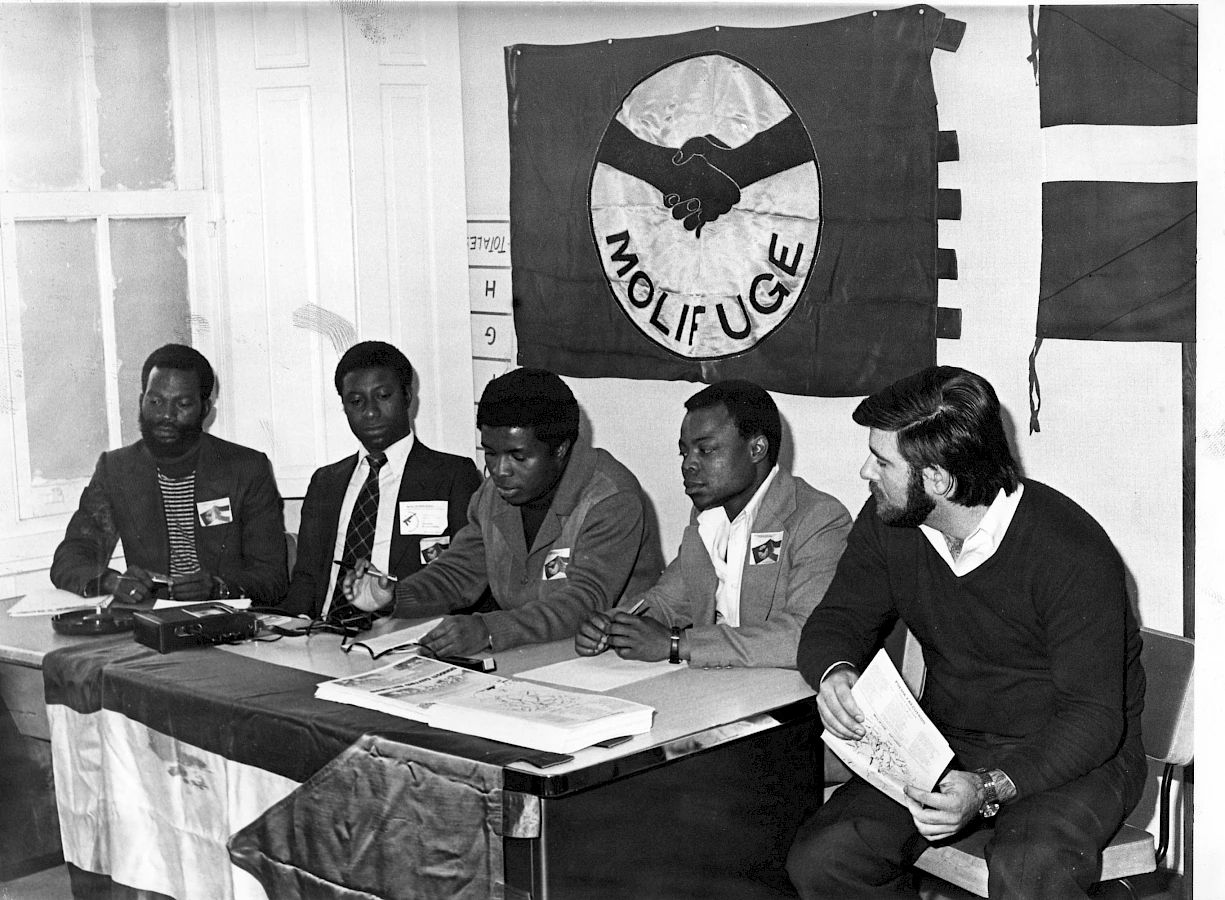
Conference in Usera, Madrid, upon the presentation of MOLIFUGE (Movement for the Liberation and Future of Equatorial Guinea) to Spanish political parties. Miguel Esono Eman, Narciso Ndjondjo Muadacucu, Miguel Rondo Belén and Teodoro María Bondyale Oko, accompanied by Joseba Goikoetxea. Photographer unknown. Source: Archivos Negros
The subsequent silence in Spain on Guinean history can partly be attributed to the classification of colonial documentation as materia reservada (classified material).10 The restriction of this information goes some way to explain why, even today, a significant portion of the Spanish population is unaware that this West African territory was run by Spain until 1968, as well as of its subsequent integration into Pan-African networks. Indeed, figures such as the exile Atanasio Ndongo Miyone, Marthe Moumié, or even Ahmed Ben Bella in Algiers – international hub of the 1960s liberation movements and host city to the 1969 Pan-African Festival – barely feature in Spanish public memory.
When Guineans in Spain became stateless, a shift occurred.11 Between Macías’s Guinea and the former metropole, they were left in an uncomfortable limbo – once Spanish provincial citizens, they became citizens of nowhere and subsequently Black African immigrants. Pan-Africanism quietly resurfaced in this context as a means for them to think about and construct a shared existence. From the 1970s onwards, gaining in intensity in the 1980s, Equatorial Guinean associations and political movements began to emerge in Spain, drawing to a greater or lesser extent on Pan-Africanist foundations. These included the Movement for Freedom and Future of Equatorial Guinea (MOLIFUGE), the Maleva and Riebapua cultural associations, and the Equatorial Guinean University Student Organisation (PSEUG). All began as spaces for expression and agency in a political and cultural environment that marginalized them.
From the mid-1970s onwards, immigrants began arriving in Spain from other parts of Africa. Many came from places where Pan-Africanism had a real effect on their lives, and they actively engaged in the life of Spanish cities. They self-organized, creating their own structures and engaging in dialogue with trade unions, social movements and institutions; they built communities while retaining their transnational and Pan-African connections. Between 1975 and 2010, they established dozens of African associations representing various countries, including Senegal, Gambia, Guinea, Congo and Angola, as well as associations of African descendants. The network constituted by these groups was not always visible, but it was persistent.
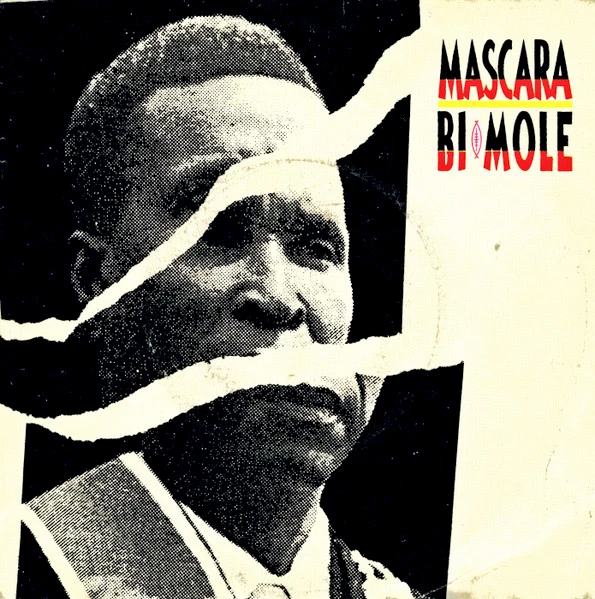
Image from the album Bi Mole by the Equatorial Guinean group Máscara, led by the Zamora brothers. Artist unknown. Source: Discogs
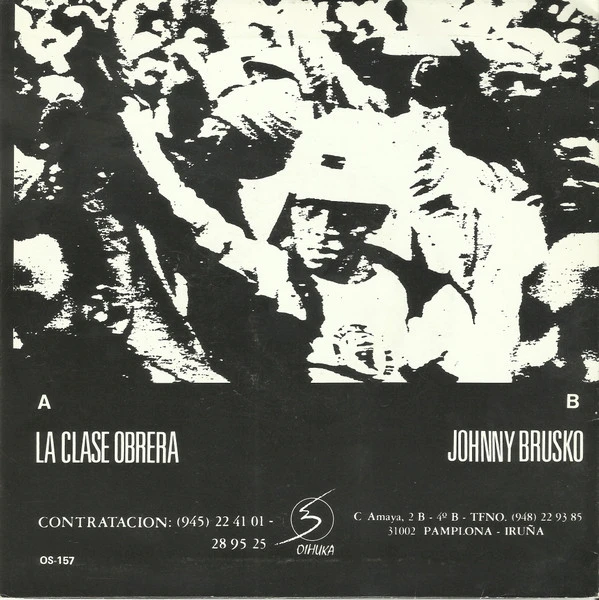
Album by Equatorial Guinean musician Johnny Brusko, member of the group Potato. Album artist unknown. Source: Discogs
Federations, local collectives, women’s associations, youth platforms, magazines and schools were engaged in defending rights, developing ideas, celebrating culture and mutual support. A number of surviving attendance registers document the names of those who chose to convene, to found and to make demands, and the moments at which, over decades, they repeatedly decided to do so. This record describes a collective history steeped in Pan-Africanism that rarely sits at the centre of conventional historical discourse.
Over the past twenty-five years, various events have brought international struggles to this territory. Youth movements inspired by American and global examples including the Free Mandela movement, the Black Panthers and Garveyism, have arisen in Spain and developed their own methods of collective action. Struggles against reforms to immigration law began in the 1990s, with hunger strikes in churches, rallies in 2001 and the slogan ‘No human being is illegal’. These were not isolated protests, but rather the defence of the basic right to exist without fear of expulsion. From international Black trade unionism to campaigns for regularization of citizenship status; from the condemnation of colonial labour conditions to that of the legal precarity of those in the diaspora, and from the perception of racial consciousness as an imposed stigma to its recognition as a political tool, a clear and consistent shift of trajectory is traceable.
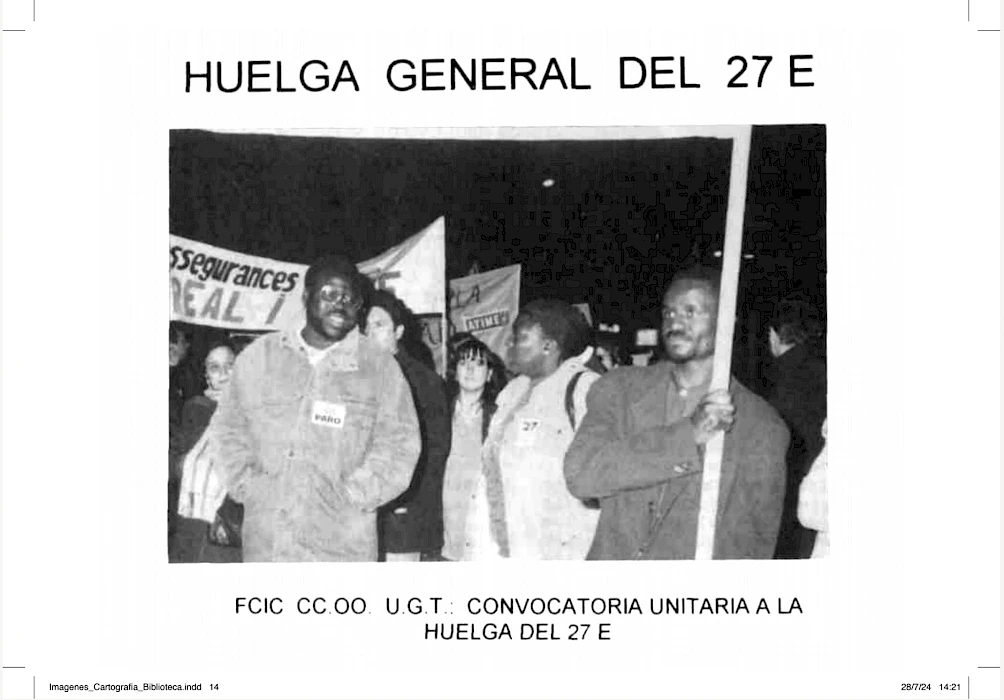
Poster announcing demonstration and united workers’ strike on 27 January 1994. Author unknown. Courtesy the Rafa Crespo Archive
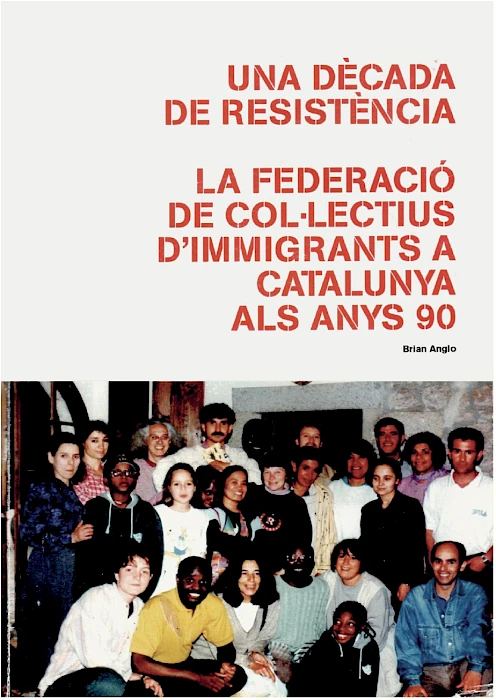
Image from Brian Anglo’s self-published book Una década de resistència (A Decade of Resistance), n.d. Courtesy the Rafa Crespo Archive
What is most interesting, though perhaps least apparent, is how these struggles draw on a broader Pan-African legacy that began in Hamburg in 1930 with the International Trade Union Committee of Negro Workers. The organization brought together disparate voices from across the colonial world under the simple yet radical idea that the labour struggle is a field of racial struggle, also recognizing that without organization there is no protection, and that without labour rights, there can be no real citizenship – a narrative of struggle that is ongoing today.
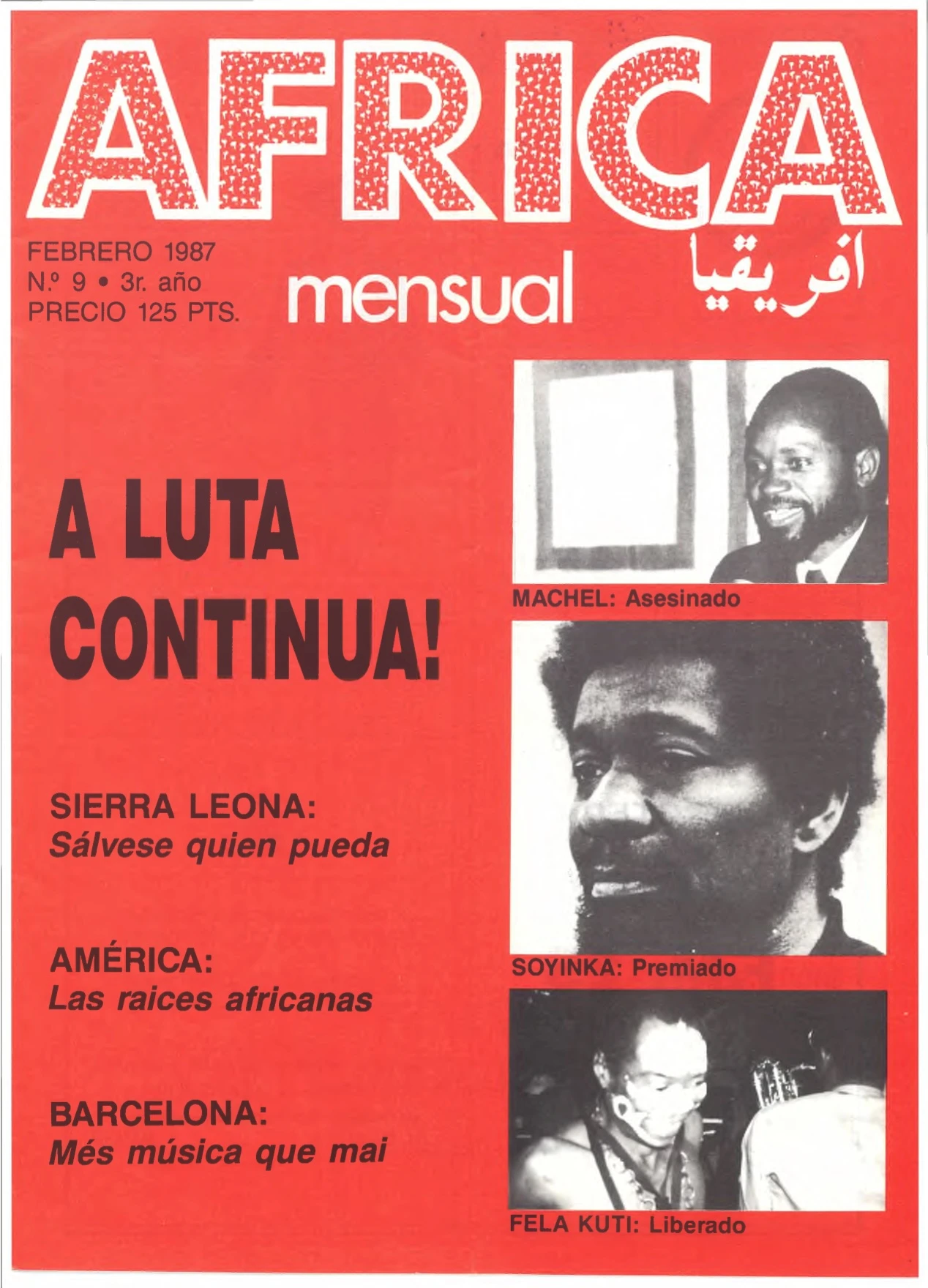
Founded on 1 September 1984 in Sabadell (Barcelona), the magazine Africa provides us with evidence of how this struggle was being documented and pursued in print during that decade. A Pan-Africanist project initiated by Gambian Foday Fofana in collaboration with Roser Canals, the publication showcased the cultural and political reality of the African population in Catalonia, connecting it with current events in Africa and with the diaspora in other European countries. Over the course of three years Africa evolved: the number of contributors increased, the frequency of publication changed, and the format was improved, becoming more elaborate. Where the first issues were photocopies of typed articles with images pasted alongside them, the cover of the February 1987 issue was red like the Pan-Africanist flag and bore the title ‘A luta continua!’ (The Fight Continues!). Announcing the death of Samora Machel, the award of the Nobel Prize to Wole Soyinka and the release of Fela Kuti, the editorial of that issue begins as follows:
The year 1987 is a year of struggle against all injustices and abuses committed against the peoples of Africa and the Third World as a whole.
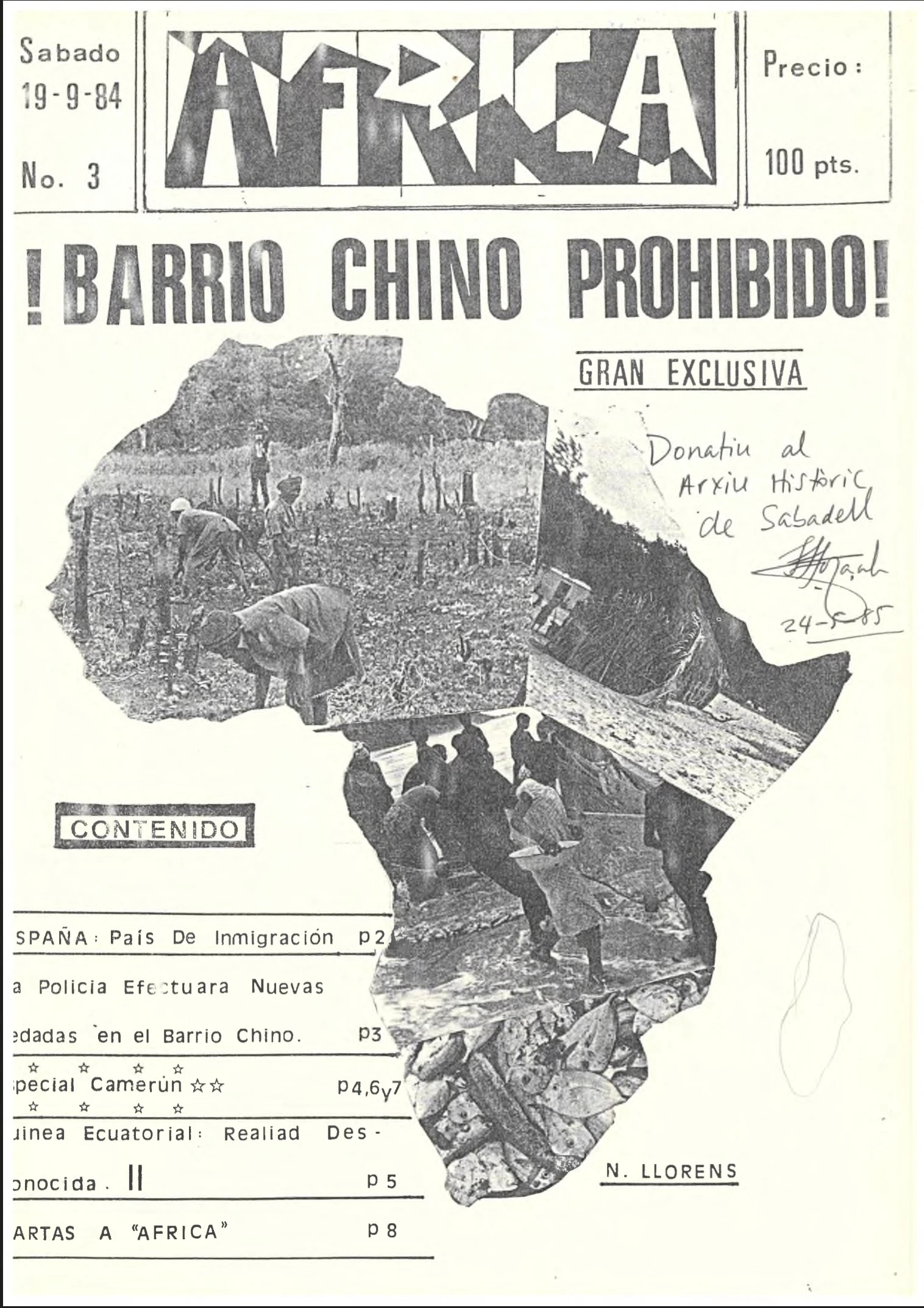
Covers of Africa/Africa mensual (Africa Monthly) magazine, from left to right: no. 3, 19 September 1984; no. 9, February 1987; no. 4, October 1985. Source: Archivos Negros
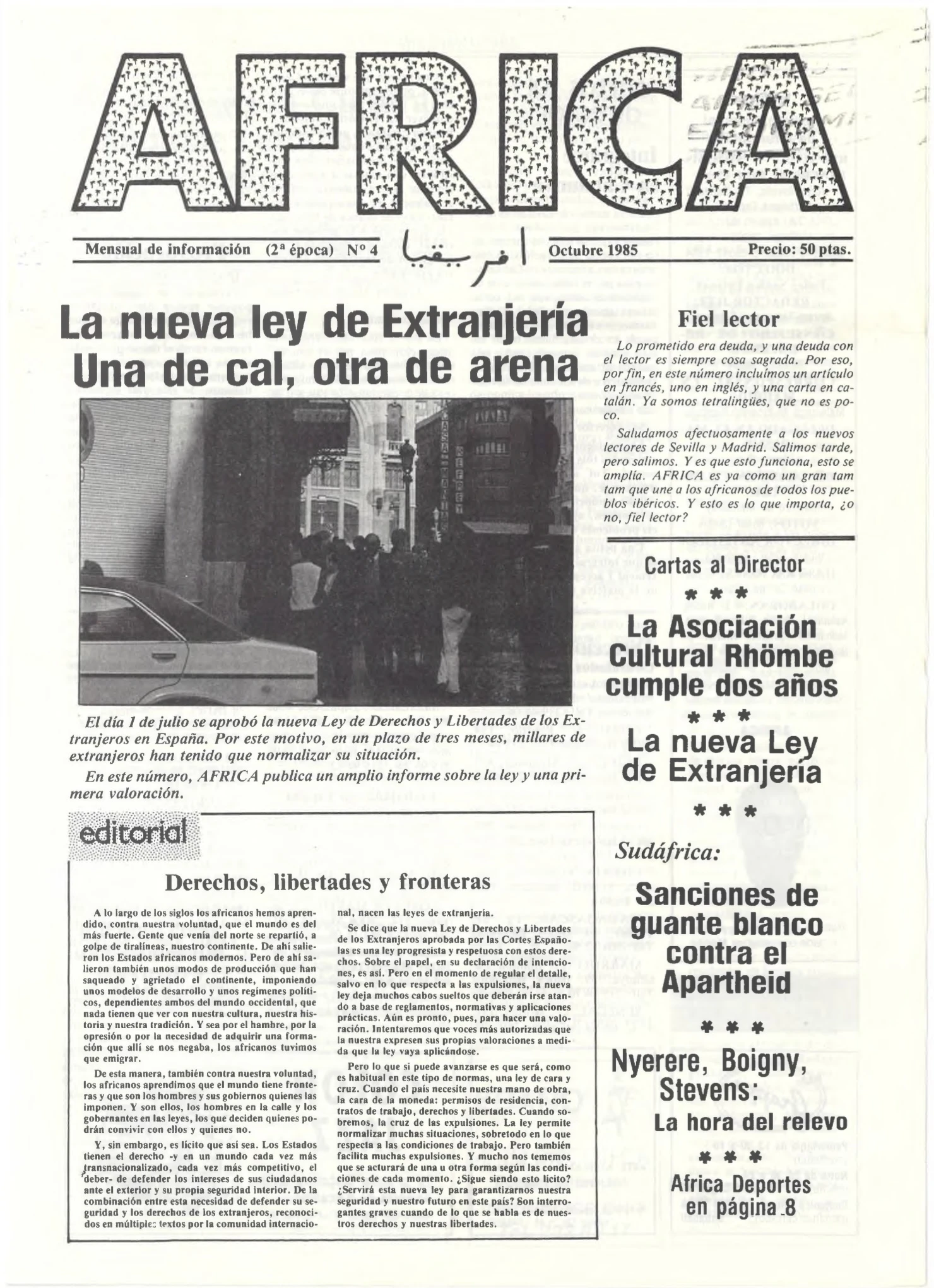
In issue 22, dated 6 June 1987, Foday announced a change in the frequency of publication due to financial difficulties. There is no record of any further issues in the Sabadell Historical Archive,12 so this was likely the last one published. As with so many other initiatives, the magazine gradually disappeared over time.
While the history of Pan-Africanism in Spain is itself comprised of various phases in response to changing circumstances, its historiography has largely comprised markedly militant narratives which, while effecting to raise its profile, have tended to present a false sense of linear continuity between processes belonging to different times in history. What to date has presented as a continuous genealogy is in reality an overlapping weave of moments – relatively modest instantiations when compared to the history and presence of Pan-Africanism in countries such as England, France and even Portugal. In the 1960s, the issue of Guinea was addressed in Spain in terms of decolonization and exile; in the 1970s, the language was that of the Third World; in the 1980s, the focus shifted to apartheid in South Africa; indeed, it was only in the 1990s that an Afro-descendant identity began to emerge within Spain itself.
In 1992, against this ever-shifting backdrop, three figures stood out for their involvement in activities that reached beyond the community framework described above as the otherwise largely exclusive ground for Pan-Africanist developments: Alphonce Arcelin, Paco Zamora and Rosalind Williams. This was the year Spain celebrated its status as a modern European country and revived its pride in its imperial past. The same year also saw the murder of Lucrecia Pérez – the first crime to be recognized as racist by the courts in Spain – and the first march against racism. The national narrative and the racialized experience now ceased running parallel to each other and collided in the public sphere: while the state was commemorating the ‘discovery’ of the ‘New World’, Spain’s Black population was condemning what was happening in the present: dehumanization, racial profiling and structural exclusion. The events of 1992 did not create this narrative and experiential conflict but rather forced it to the surface, marking the emergence of a Black political consciousness that not only critiqued but also interpreted, organized, and mobilized: If Arcelin questioned the visible legacy of colonialism and Zamora dismantled its historical genealogy, Rosalind Williams confronted its daily reproduction within institutional structures.
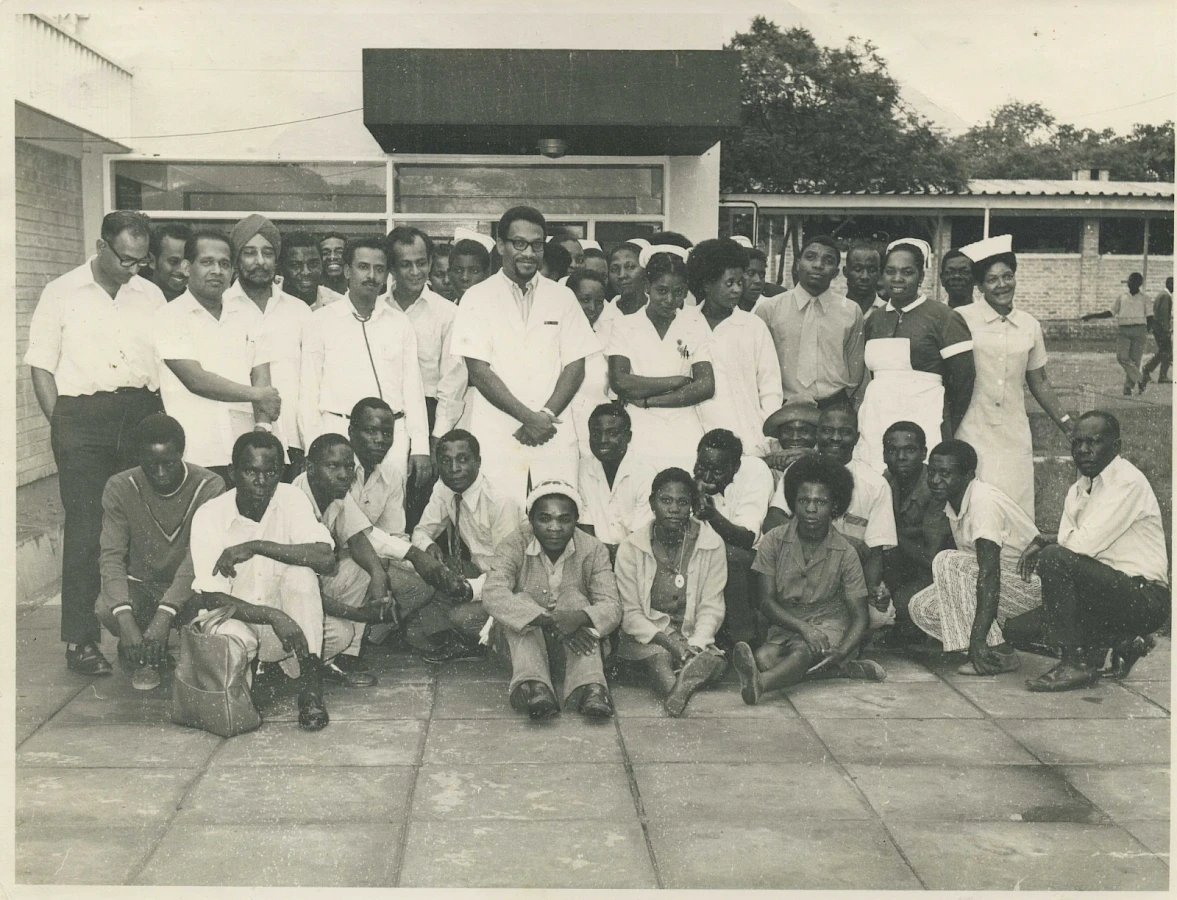
Alphonse Arcelin with a team of workers at Mbala General Hospital (Zambia), 1980–90. Photographer unknown. Courtesy the Arcelin family archive
Today, as reactionary forces once again occupy public spaces and fascism reappears in new forms, the question is not whether conflict exists, but rather what capacity we have to understand and confront it collectively. Almost a century ago, Black activists recognized that fascism was not only national, but also a racial and global phenomenon. It remains to be seen if Pan-Africanism, both as a political practice and as an epistemological framework, still has the power to destabilize it.
Related contributions and publications
-
Archivos negros: Episodio II. Jazz sin un cuerpo político negro
Tania Safura AdamEN esInternationalismsPast in the Present -
Archivos negros: Episodio I. Internacionalismo radical y panafricanismo en el marco de la guerra civil española
Tania Safura AdamEN esInternationalismsPast in the Present -
…and the Earth along. Tales about the making, remaking and unmaking of the world.
Martin PogačarLand RelationsClimatePast in the Present -
The Kitchen, an Introduction to Subversive Film with Nick Aikens, Reem Shilleh and Mohanad Yaqubi
Nick Aikens, Subversive FilmSonic and Cinema CommonslumbungPast in the PresentVan Abbemuseum -
The Repressive Tendency within the European Public Sphere
Ovidiu ŢichindeleanuInternationalismsPast in the Present -
Rewinding Internationalism
InternationalismsVan Abbemuseum -
Troubles with the East(s)
Bojana PiškurInternationalismsPast in the Present -
Right now, today, we must say that Palestine is the centre of the world
Françoise VergèsInternationalismsPast in the Present
Related activities
-
–MACBA
Project a Black Planet: The Art and Culture of Panafrica
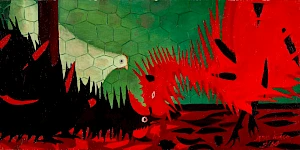
Curated by MACBA director Elvira Dyangani Ose, along with Antawan Byrd, Adom Getachew and Matthew S. Witkovsky, Project a Black Planet: The Art and Culture of Panafrica is the first major international exhibition to examine the cultural manifestations of Pan-Africanism from the 1920s to the present.
-
–Van Abbemuseum
The Soils Project
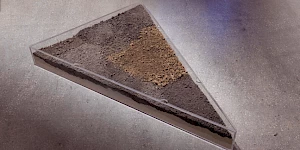
‘The Soils Project’ is part of an eponymous, long-term research initiative involving TarraWarra Museum of Art (Wurundjeri Country, Australia), the Van Abbemuseum (Eindhoven, Netherlands) and Struggles for Sovereignty, a collective based in Yogyakarta, Indonesia. It works through specific and situated practices that consider soil, as both metaphor and matter.
Seeking and facilitating opportunities to listen to diverse voices and perspectives around notions of caring for land, soil and sovereign territories, the project has been in development since 2018. An international collaboration between three organisations, and several artists, curators, writers and activists, it has manifested in various iterations over several years. The group exhibition ‘Soils’ at the Van Abbemuseum is part of Museum of the Commons. -
–VCRC
Kyiv Biennial 2023

L’Internationale Confederation is a proud partner of this year’s edition of Kyiv Biennial.
-
–MACBA
Where are the Oases?

PEI OBERT seminar
with Kader Attia, Elvira Dyangani Ose, Max Jorge Hinderer Cruz, Emily Jacir, Achille Mbembe, Sarah Nuttall and Françoise VergèsAn oasis is the potential for life in an adverse environment.
-
MACBA
Anti-imperialism in the 20th century and anti-imperialism today: similarities and differences
PEI OBERT seminar
Lecture by Ramón GrosfoguelIn 1956, countries that were fighting colonialism by freeing themselves from both capitalism and communism dreamed of a third path, one that did not align with or bend to the politics dictated by Washington or Moscow. They held their first conference in Bandung, Indonesia.
-
–Van Abbemuseum
Maria Lugones Decolonial Summer School
Recalling Earth: Decoloniality and Demodernity
Course Directors: Prof. Walter Mignolo & Dr. Rolando VázquezRecalling Earth and learning worlds and worlds-making will be the topic of chapter 14th of the María Lugones Summer School that will take place at the Van Abbemuseum in Eindhoven.
-
–MSN Warsaw
Archive of the Conceptual Art of Odesa in the 1980s
The research project turns to the beginning of 1980s, when conceptual art circle emerged in Odesa, Ukraine. Artists worked independently and in collaborations creating the first examples of performances, paradoxical objects and drawings.