Listening to Murmuration in the Moving Circle of Ahl El Hijra
In this rumination on listening writer and researcher Joachim Ben Yakoub revisits one image central to the story of Ahl El Hijra, the North African group of musicians, artists and organisers active in Brussels in the late 1970s and early 1980s in the struggle for workers’ rights, against racism, police brutality and the gentrification of the city.
A bull, a swallow
A silence gnawed away at a life,
A life veiled in non-existence
... murmurs of tears hum with bitterness.– Ahl El Hijra, 19781
The bitter, nostalgic poetics of ‘The Voice of Silence’ were joyfully rehearsed, repeated ad infinitum on different stages and during different mobilizations in the long 1970s in Brussels. Lamenting the loss of a grounded existence, the group Ahl El Hijra (People of The Journey) was looking for a line of flight, evading the atmospheric violence that characterized the times they were living. Hemmed in, uprooted and in a state of non-being, they uttered words of defiance. The repetition-through-rehearsal of this lamentation, reaching for infinity, allowed for a collective disavowal of their silencing; it facilitated movement during the turbulence of a new arrival in the capital city. The bitterness of their poetics, their conjuring of other possibilities was transmitted through murmuration, the rhythmic pulsating sound of collective always joyous movement emerging from the liminal space of the imaginal. But what if we would allow their silencing and not their musical compositions to resonate in our present? What if we would not only listen to their many improvisation sessions and performances, but also to the images that emerge out of what they called ‘The Voice of Silence’?
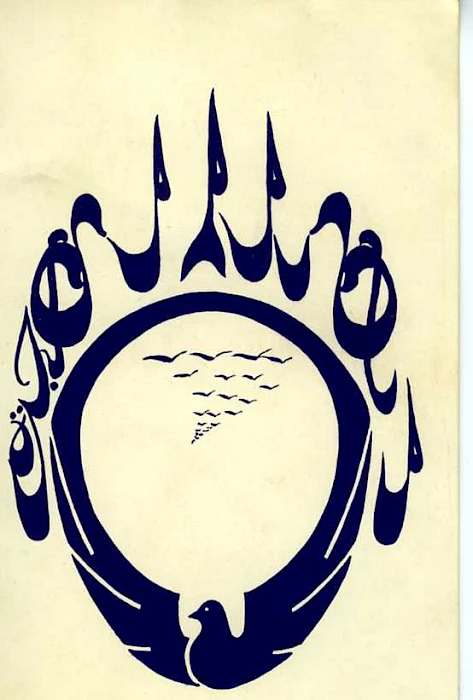
Postcard, recto, 1979, courtesy Mémoire et Historie and firstwaves.be
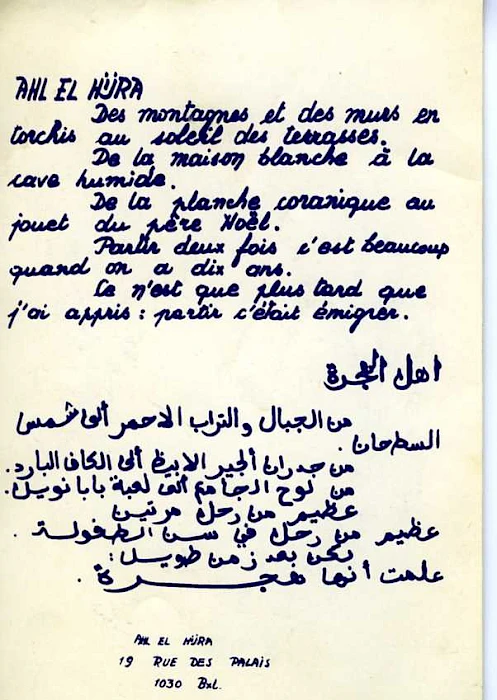
Postcard, verso, 1979, courtesy Mémoire et Historie et firstwaves.be
Ahl El Hijra was a group of young Maghrebi artists at the heart of cultural action in Brussels during the 1970s. Listening to their bitter, nostalgic poetics, we gesture towards the different partially connected movements within the movement the group was part of and facilitated. Listening to the sound of a hand-drawn image of a dove constituted of a thousand doves, central to the way the group presented their movement, we can already sense the shadows of an assembly of swallows forming. We can already hear an improvised murmuration, the silenced stories of our parents and their parents, spiralling in an expanding loop over time.
Ahl El Hijra operated, first and foremost, as a musical group. From the outset, the possibility of transformation was deeply entangled in their collective practice, moving on the rhythm of the popular percussion of Gnaoua, Jilala, Aissaou and Souassa. Next to singing their joys, anxieties and aspirations, Ahl El Hijra also held space for homework support and study. They set up exhibitions and reinvented new forms of ceremonial theatre and performance to mirror their unique situation as second-generation Moroccans in Brussels. They were in continuous movement, but always in relation and solidarity with various other movements, such as those forming against racism, police violence, and the hunger strike for the regularization of Arab workers, as well as the movement against urban development in the Quartier Nord. Their movement resonated deeply with the people’s struggle for the defence of fundamental freedoms in Morocco as well as the liberation of Palestine.
Ahl El Hijra, 'Qui Suis-Je?' ('Who Am I?'), 1982
In the late 1960s, the City of Brussels partnered with property developers to transform the Quartier Nord into a modern business district, expropriating residents with little consideration. The space cleared was destined for luxury high-rises, hotels, and corporate complexes like the World Trade Center, a cornerstone of the so-called Manhattan Project. In response to this powerful alliance serving private capital over public need, a group of residents formed the Comité d’Action Quartier Nord. The youth of Ahl El Hijra witnessed, with their teenage eyes, left-wing militants from Flanders disembarking to gather in public squares and felt the contagious will to claim back the neighbourhood. Together, they refurbished dilapidated houses and set up blockades against bulldozers. Ahl El Hijra also played alongside a group of musicians at the Gaucheret square. Together with the Musical Action Group (GAM), they sang the song ‘Nous, on Rèste la!’, a testimony to the Quartier Nord’s resistance to evictions.
The rousing of multitudes against urban development led to the creation of long-lasting infrastructures in different spaces in the Quartier Nord, where Ahl El Hijra could find refuge. First, there was the vault of a house located at 66 Rue Rogier, which served as a kind of central nest for different social and political initiatives that converged around the movement against evictions. Later on, they moved to another basement, this time in the cellar of the headquarters of a Christian charity on 82 Rue Gaucheret which offered social services to residents but also ended up joining the urban struggle. This gave the young artists and their friends the opportunity to organize before they swarmed out of the neighbourhood on the other side of the railway line when new premises were found at 19 Rue des Palais, near Place Liedts. But it was there in the first two basements that Ahl El Hijra were confronted with the brutality of the world, and there they forged their political consciousness. Their engagement in different movements and their informal schooling by, among others, Farid Mellah and Mohamed Baroudi, two of the founding members of the Regroupement Democratique Marocain, enabled them to get a grip on the conditions and structures of immigration, racism and lethal transnational politics.
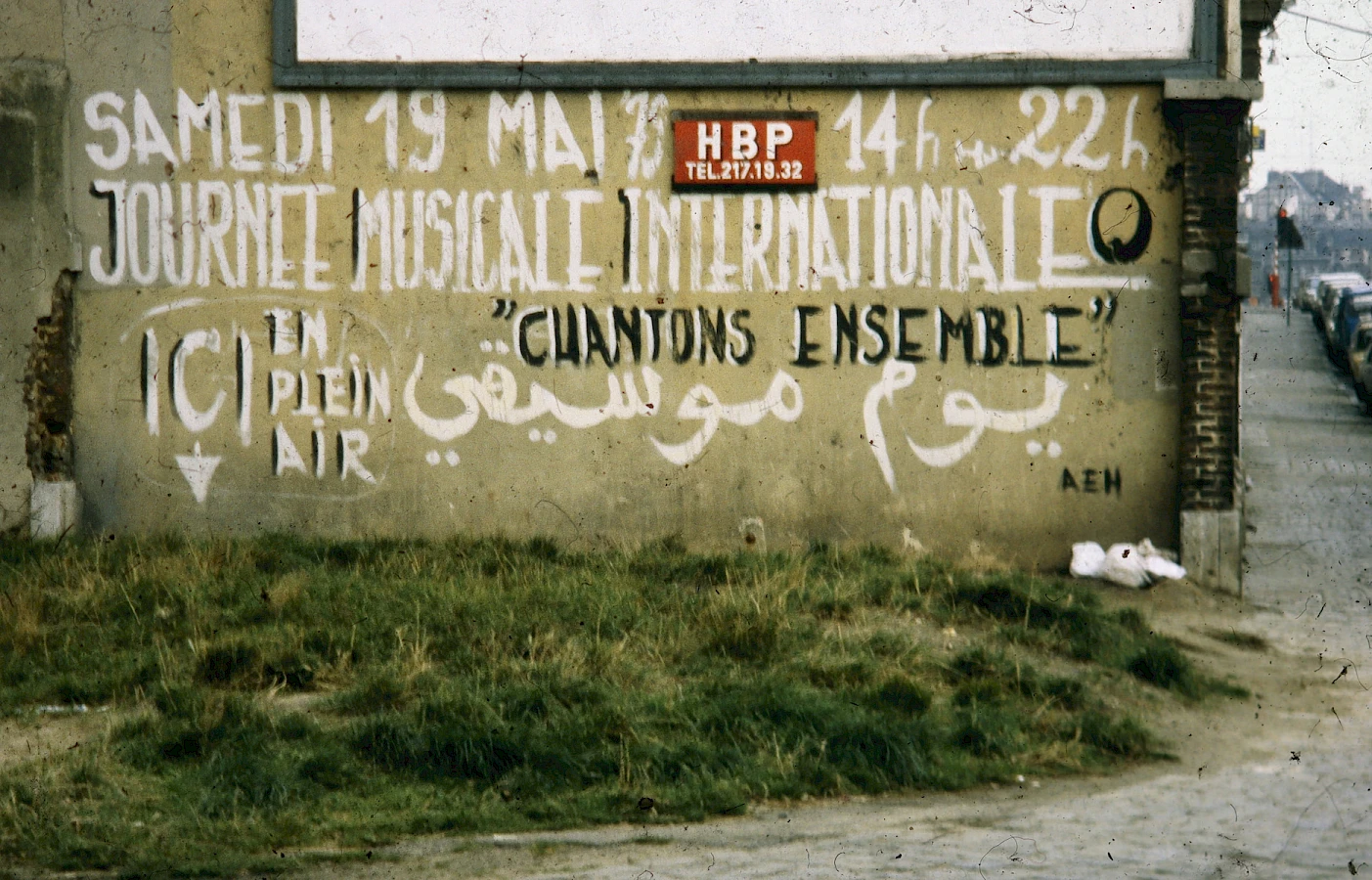
Mural announcing the International Musical Day ‘Chantons Ensemble’, 1979, courtesy Mémoire et Historie and firstwaves.be
It was in the hustle and bustle of the first shared bower, where they occupied the basement at 66 Rue Rogier, that Ahl El Hijra forged their internationalist political consciousness, as they also shared space with groups engaged in solidarity work for the liberation of Palestine. More than an aside, Palestine played a central and prominent role in the politicization and self-organization for Ahl El Hijra. A turning point in this process of politicization was the convergence of protests by various Arab student movements on Sunday, 14 October 1973, when thousands swarmed in the streets to show their solidarity with the Palestinian liberation struggle.2 That day in October can in hindsight be considered the first massive protest led by Arab and Maghrebi workers in Brussels. The movement for solidarity with Palestine also allowed for pockets of indignation to be vented over the protesters’ own deplorable living and working conditions, the burial of Mohammed Ghanam, shot dead by the police three months earlier on Leopold III Boulevard, still freshly in their minds.
Earlier that year, a protest had set off, demanding the truth about Ghanam’s death. He was only 22 when he was shot dead by a local police officer on a night in late June. His death provoked anger and indignation among Maghrebi workers and their families, who felt increasingly threatened in public spaces. Can a policeman kill a boy just because he suspects him of stealing a car? Can a policeman feel threatened from a 25-metre distance? Can he claim self-defence? Why would the press cover this up? The Ghanam Truth Committee tackled these unanswered questions, expressing the growing anger and rage culminating in what would become the first mobilization carried out by the Maghrebi community in Brussels to denounce the prevailing racism, an unprecedented mobilization from which the trade unions and traditional antiracist structures were largely absent. A decade later, the persistent intensity of their engagement could not prevent the shooting of yet another of their kin. Hamou Baroudi lost his life on 5 December 1980, when a Front de la Jeunesse sympathizer shot him down after being driven out of a bar in Laeken. This tragic incident gave rise to a vast protest in the streets of Brussels as Maghrebi workers and their families took the streets to demand Truth for Ghanam and Justice for Baroudi, 3 motivating Ahl El Hijra to engage in a form of deep collective study on the phenomenon of racism in Quartier Nord during Roger Nols’s term in office. This led to the creation of an exhibition entitled ‘What is happening in Schaerbeek?’, held for a month at 19 Rue des Palais. The basis of the exhibition was a collage of news, documents and critical argumentation, poetry dismantling racist ideology and denouncing increased forms of police harassment.
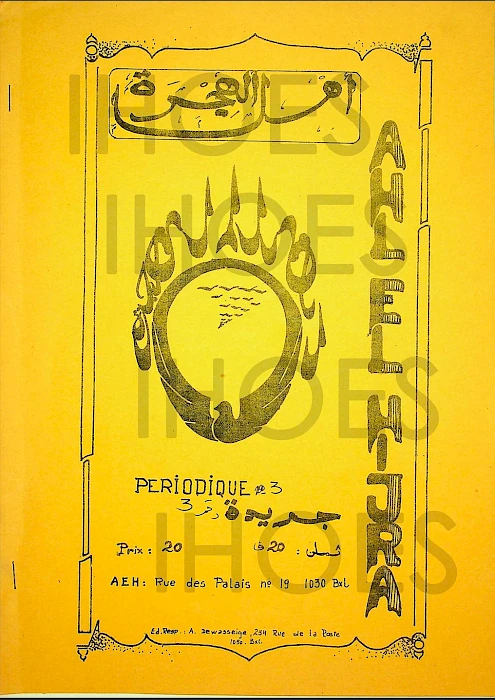
Periodical, No. 3, Institute for Social, Economic and Labour History (IHOES - Institut d’histoire ouvrière, économique et sociale), 1979
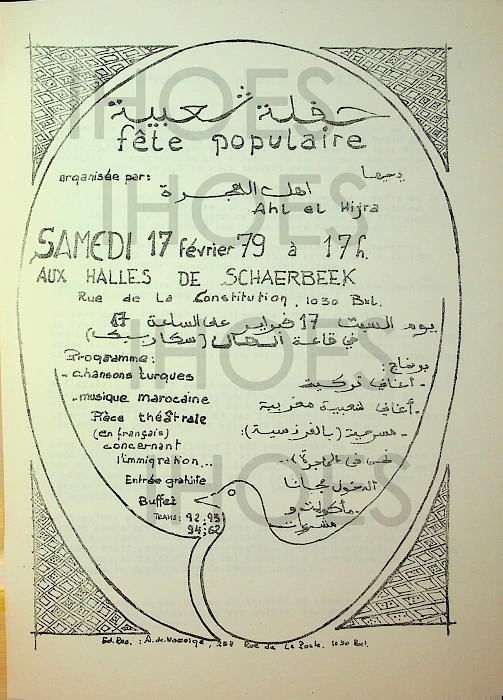
Poster, ‘Fête Populaire’, 1979, Institute for Social, Economic and Labour History (IHOES - Institut d’histoire ouvrière, économique et sociale)
Almost simultaneously with the emergence of Ahl El Hijra, the Regroupement Démocratique Marocain (RDM) saw the light of day as it congregated in the same neighbourhood. Propelled by Mohamed Baroudi, Farid Mellah, Abdelwahid Fargaoui and Aziz Zouadi, the RDM emerged as a confluence of different movements that assembled around the will to create the conditions conducive to a return to their native land. In the meantime, they have mobilized to defend Moroccans in Brussels by combatting racism and denouncing the exploitation of workers, as well as around their growing solidarity with the struggle of the Moroccans and by extension all oppressed people, in particular those in Palestine.4 The RDM and Ahl El Hijra joined forces in support of the regularization of Arab workers. At the end of March 1974, twelve workers went on a hunger strike in the Saints-Jean-et-Nicolas church to demand the right to work and residence.5 Despite the formation of a support committee, on the orders of the Minister of Justice the police arrested the hunger strikers and sent them back to Morocco and Tunisia by charter plane. The Committee denounced the inhumanity of the decision and called for the formation of a front, brought thousands together on the streets to protest.6
Guided by collective force, hundreds can move as one, tracing a rhythmic sonic landscape of solidarity. Revisiting the three movements and one hunger strike that allowed for the emergence of Ahl El Hijra shows that a vast, living whole can be formed, constantly transforming into different organic shapes, like a single, conscious tapestry. Weaving the urban struggle against the Manhattan Project in the northern district of Schaerbeek together with the then-ongoing protest in solidarity with Palestine, and knitting together the protest against racism after the murder by the police of Mohamed Ghanam with the hunger strike for the regularizations of Arab workers speaks to the power of movements within decentralized, self-organized and resistant movements. Through these murmurations and the ties of solidarity they bind together in their pentatonic scales, the singular image of sovereign leaders transforms into a mere mirror of our collective multitudes. The flock is not merely heading towards a destination but becoming a fractal form that renders audible the constant movement within solidarity movements.
In Farid ud-Din Attar’s The Conference of the Birds (1177), the ultimate truth, the sovereign or the beloved, is always already a resonance of our own collective force. The vocation of the journey, the process of becoming-while-in-movement, is not all that is implied in the name of Ahl (People [of]) El Hijra (The Journey). The journey without, as itself a source of outward guidance, appears at once to be a movement within as well as a movement with a certain purpose, a movement allowing a community facing persecution and erasure to find a refuge where a life of freedom and dignity can be envisioned. For Louisa Yousfi it is in the imaginal, in this liminal space between the sensible and the interior depth of being, that the sounds of images and the images of stories emerge.7
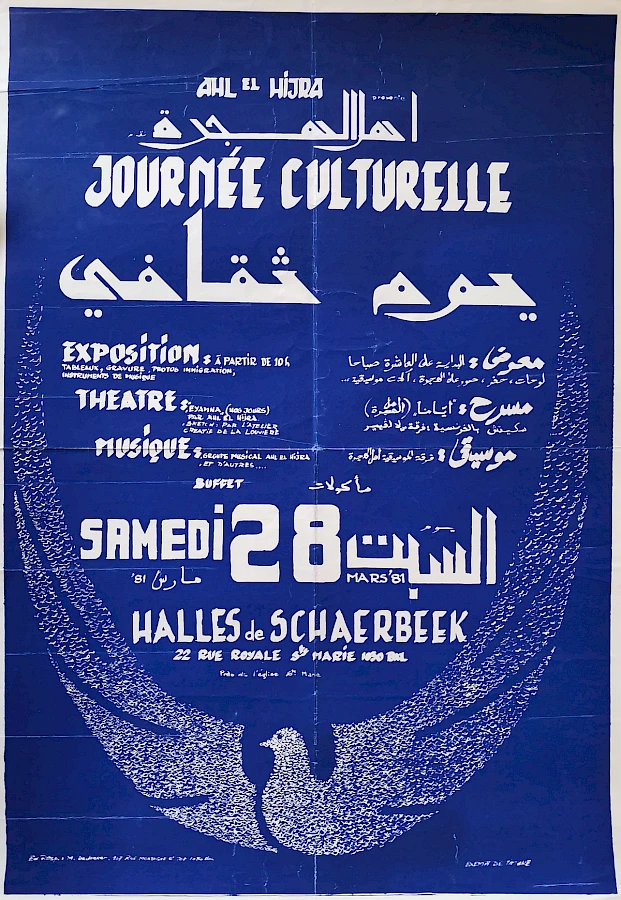
Poster, ‘Journée Culturelle’, 1981, courtesy Mémoire et Historie and firstwaves.be, 1979
It was out of the imaginal that Ahl El Hijra could emerge and take the shape of one of the many celestial bodies that constituted what Omar Jabary Salamanca calls the ‘solidarity constellations’ of Brussels in the 1970s.8 To make sense of how all these movements could flow through the movement of Ahl El Hijra in the imaginal, or how they formed what María Lugones would call a ‘coalition of differences’,9 the image of a dove hand-drawn for a poster promoting a cultural day in the Halles de Schaerbeek the group had organized on a Saturday in March of 1981 starts to vibrate and reverberate in our present moment. From the still-life of an exhibition to the living theatre of Eyamna (Our Days), the group wove together performance, paintings, prints and photography into a proposition that ended in rhythmic and deeply resonant musical improvisation. Here, it is not to this musical improvisation, nor the song of birds that we are listening, but to what Tina Campt would call the affective frequency of the image announcing it, prefiguring an assembly of birds.10
The hand-drawn image of a dove, screen-printed in white on dark cobalt blue paper beneath a stunning calligraphic composition and its translation, resonates in a murmuration. The dove, with its imperfect shape, closing its wing to form a circle, is central to the way Ahl El Hijra presented their movement. This image, that seems to pulse with the same emergent rhythm as a swarm, appears on most of their posters and postcards, as well as on the music album they released in 1982. For the cultural day they set up in the Halles, however, the dove had more depth, as the drawing of a dove was made up of dozens of smaller doves. When we asked Abid Bahri he told us this dove-of-doves could invoke the movement of migration as much as it could invoke peace, freedom or even the sacred: its purity, its lament, or its longing for return. The bird closing its wing forms a circle like the group formed a circle: to assemble, improvise, play and sing; to grieve, to congregate and to lament; to tell the story of their precarious living conditions.
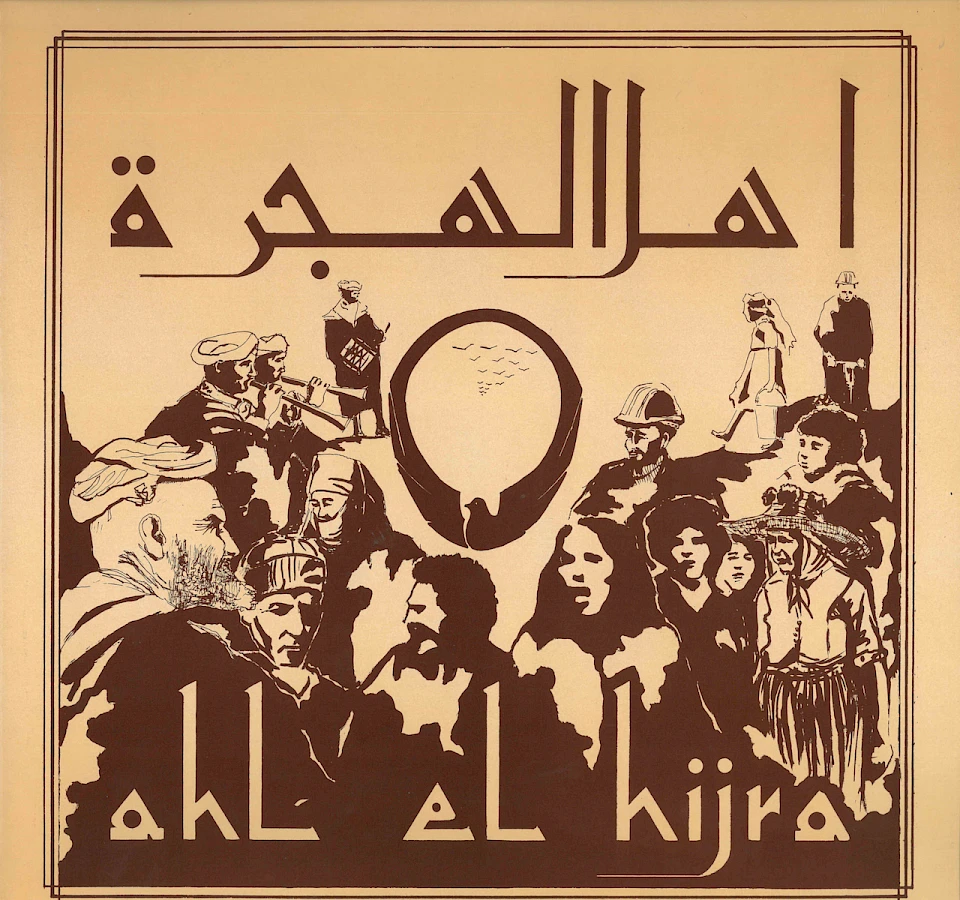
Vinyl Album Cover, 1982, courtesy Mémoire et Historie and firstwaves.be
The closing of the wings is reminiscent of the circular form of al-halqa (literally ‘the circle’), where the storyteller does not have the authority of the author as conveyor of historical discourse. Here, the circular form is animated, inherently unstable, nomadic, always moving in different directions, so stories are told and memories are passed on without ever fully crystallizing. The swarm of stories overflowing from Maghrebi oral traditions immemorial, within and around the bittersweet poetics of Ahl El Hijra, remain in a permanent state of suspension as they are carried by their audience and by those who may be absent, preceding them. Like in a murmuration, no single person in the halqa really holds the story.11 It emerges in the collective, in the gregarious space between the storyteller, their audience and those who came before, on the threshold of the imaginal.
In hindsight, it is not only the deeply layered frequency of the dove hand-drawn by Abid Bahri, one of the founding members of the group, that resonates in our present, but the deeper, often unheard fractal murmur pattern of the drawing, pointing to the possibility of movement-within-movement, the humming of swarm intelligence and the emergence of collective formations into our histories. The flock of doves that constitutes the single dove in the dark cobalt blue poster reveals a form of self-organization that emerged through the collective praxis of Ahl El Hijra, moving not through a shared ideology or grand narrative but through murmuring forms of swarm intelligence, telling stories while staying in a multiplicity of movements, whispering public secrets, forging solidarities along the way. It speaks to forms of decentralized self-organizing where structures emerge from a groundswell of improvised interactions, without central leadership. The non-totalitarian – always moving – totality that is then formed is robust and resistant, relational, adaptable, enabling difference and true transformation. As it is acephalous there is no single head to be cut off, only the sound of what Marisol de la Cadena would call a multiplicity of intra-related and partially connected movements. At any moment, any singular part of the movement can transform the movement of the whole.12
Learning from the movement of birds, Adrienne Maree Brown shares her dream to ‘move as a murmuration, the way groups of starlings billow, dive, spin, dance collectively through the air’ and ‘responding to destiny together’.13 Even though it is first and foremost a deeply embodied collective movement, a murmuration is a response to a calling that can only be collectively addressed on the basis of trust. It is also truly an art, as each part of the whole, each singular dove allowing the collective dove to emerge has to respond to each other part of the whole, each flying in a certain direction at the exact right distance that allows for relationality as if weaving a living tapestry from individual threads, yet all are pulled by the same current, drawn to intertwine in a collective movement of birds that is beyond what the sum of each individual bird constituting that movement could ever imagine moving towards alone.
In the deepest frequency of the white dove drawn in Ahl El Hijra’s dark blue poster, a form of self-similarity vibrates as the large white dove echoes the thousands of small ones that together reproduce and repeat their own shape on a larger scale as a swarm. In this way, the drawing evokes the fractal composition of the movement, pointing to various movements-within-a-movement in a never-ending, echoing pattern. This movement, then, seems to be formed through repetitions of a simple movement in an ongoing feedback loop, or what Adrienne Brown calls a structural echo, reverberations from the smallest to the largest scale and back, created through cyclical breaths that spiral upwards and outwards as well as downwards and inwards.
When listening for differentiation within such spiralling murmurations over time, we can hear the always moving aspirations of a people, as Fred Moten reminds us.[[fifteen]] Like in The Conference of Birds, there is no harmonic resolution in the self-dissolution of representativity, only movement: movement to find refuge in flight, rest in unrest, through a restless motion of becoming in the messiness of the everyday. The pentatonic irresolution of the halqa of Ahl El Hijra, then, did not emerge as a separate and thus comparable movement, but as a movement within various movements, seemingly external but partially connected in a relational whole. They emerged, as a halqa, from the relations between different, intra-related movements that are already integrally and mutually implied. This inherently relational formation of movements helps them resist being divided into parts and wholes, as the parts always bring the whole that includes the parts that bring in the whole that includes the parts, and so on, constellating in patterns that self-replicate endlessly. For such infinite permutations no cartography may be undertaken, as nothing holds their configurations at the centre, like in constellations; zooming in or out results in similar, structural echoes, recurring, in infinite motion, through a kaleidoscopic simultaneity of similarity and difference.
Ahl El Hijra, 'Son Ombre Prisonnière' ('Her Captive Shadow), 1982
I wish to thank Abid Bahri, Jamal Amézian, Ahmed Driouech, Jamila El Oueriaghli, Mustapha Bentaleb and all the elders that still constitute Ahl El Hijra today as an ever-moving murmuration, for their testimonies and always gentle and sweet feedback. Also, Azoor and Sofyann Ben Youssef for the many conversations around the legacy of Ahl El Hijra and how we can make it resonate in the conundrums of our present.
Related contributions and publications
-
Housing Music
Onkar Singh KularSonic and Cinema Commons -
Live set: Una carta de amor a la intifada global
PrecolumbianEN esInternationalismsSonic and Cinema CommonsPast in the PresentMACBA -
The Kitchen, an Introduction to Subversive Film with Nick Aikens, Reem Shilleh and Mohanad Yaqubi
Nick Aikens, Subversive FilmSonic and Cinema CommonslumbungPast in the PresentVan Abbemuseum -
Le Théâtre des Opérations. Rapport d’Infilitration et d’Écoute d’une conversation entre Yasmina Reggad et Nadine Atallah
AmmarEN frSonic and Cinema Commons -
Live set: Apotome
Khyam AllamiSonic and Cinema Commons -
Opening Performance: Song for Many Movements, live on Radio Alhara
Jokkoo with/con Miramizu, Rasheed Jalloul & Sabine SalaméEN esInternationalismsSonic and Cinema CommonsPast in the PresentMACBA -
Mix tape: Let's funk up all genders!
Materia Hache / Others to the FrontEN esSonic and Cinema CommonsSituated OrganizationsMuseo Reina Sofia -
Broadcast: Towards Collective Study in Times of Emergency (for 24 hrs/Palestine)
L’Internationale Online Editorial Board, Rana Issa, L’Internationale Confederation, Vijay PrashadInternationalismsSonic and Cinema Commons
Related activities
-
–MACBA
Song for Many Movements: Scenes of Collective Creation
An ephemeral experiment in which the ground floor of MACBA becomes a stage for encounters, conversations and shared listening.
-
–MACBA
Visions of Panafrica. Film programme
Visions of Panafrica is a film series that builds on the themes explored in the exhibition Project a Black Planet: The Art and Culture of Panafrica, bringing them to life through the medium of film. A cinema without a geographical centre that reaffirms the cultural and political relevance of Pan-Africanism.
-
Museo Reina Sofia
Cinema Commons #1: On the Art of Occupying Spaces and Curating Film Programmes
On the Art of Occupying Spaces and Curating Film Programmes is a Museo Reina Sofía film programme overseen by Miriam Martín and Ana Useros, and the first within the project The Cinema and Sound Commons. The activity includes a lecture and two films screened twice in two different sessions: John Ford’s Fort Apache (1948) and John Gianvito’s The Mad Songs of Fernanda Hussein (2001).
-
Museo Reina Sofia
Sonic and Cinema Commons
Sonic and Cinema Commons is a research, programming and publishing project that explores how cinema and sonic experiences generate spaces for the formation of interpretive communities, foster collective debate and prefigure proposals for the commons. Co-organised with L’Internationale Online, 2025 and 2026.
-
–SALT
This Porous Earth: Screening, Talk, and Workshop Program
This Porous Earth is a screening, talk, and workshop program at Salt Beyoğlu exploring the relationships between cinema and the natural world through the material properties of film itself.