Today, again, we must say that Palestine is the centre of the world
In her powerful analysis of the present conjuncture Françoise Vergès, decolonial feminist and longtime contributor to L’Internationale Online, argues that Palestine is now ‘a planetary synonym for the worldwide anti-colonial struggle; for decolonization, for the abolition of settler colonialism everywhere’. The text is an edited version of a lecture given as part of the public programme ‘Collective Study in Times of Emergency’ at de Appel Amsterdam, May 2025.
When I wrote ‘Right now, today, we must say that Palestine is the centre of the world’,1 we were still at the beginning of the war that the State of Israel launched after the attack on 7 October 2023 that left many dead in Israel.2 The ideological campaign to justify the brutality and indiscriminate bombing and killing by Israeli forces began straight away. But also, right then and there, a counter-narrative was deployed by Palestinian groups and online media,3 reminding the world of the original Nakba, of colonial occupation, of the State of Israel’s contempt of international law, of the long history of dispossession, humiliation, arbitrary arrest, torture.
It is now 8 May 2025. Today, Europe celebrates the Allies’ victory over the Nazis, heralding the return of liberty and the triumph of democracy, marking the end of Nazi aggression and occupation, the slaughter of a generation and the horrors of the Holocaust. Speeches about sacrifice and peace are uttered in the context of Trump’s challenge to US support of NATO, leading Ursula von der Leyen, the president of the European Commission, to declare: ‘the West, as we knew it, no longer exists’,4 and Friedrich Mertz, the German chancellor, to state that, ‘given the threats to freedom and peace on our Continent, we must also say about our defense: whatever it takes’.5 Sixteen European Union states have since confirmed they will trigger a budget exemption for significantly higher defence spending.
In the context of genocides in Palestine and in Sudan, of massacres in Congo, of India’s bombing of Pakistan-administered Kashmir, of the Russian invasion of Ukraine, the celebration of peace rings hollow. In a case brought by South Africa, the State of Israel has had to answer allegations of genocide at the International Court of Justice (ICJ),6 and the Hind Rajab Foundation has been identifying Israeli soldiers guilty of crimes to indict them in a court of law.7 However, Israeli ministers – including the prime minister, who faces an arrest warrant issued by the International Criminal Court (ICC) – still travel freely. The US is still sending weapons to Israel, kidnapping pro-Palestinian students, green card holders, in broad daylight, and temporarily disappearing them; European governments are criminalizing pro-Palestinian solidarity and timidly warning the Israeli government against abuses; around the world, authoritarian regimes are giving their entire support to Israeli policies; China remains mostly silent.
Let’s recapitulate the most recent decisions of the State of Israel. On 2 March 2025, two weeks before resuming its offensive, Israel imposed a blockade on all humanitarian aid and other supplies entering Gaza. On 18 March, Netanyahu said Israel would return to operations with ‘full force’, adding: ‘From now on, negotiations will only take place under fire.’8 The government, he said, would continue to promote the plan set out by President Donald Trump ‘to enable the voluntary departure of Gazans’ from the strip.9 On 23 March, Israeli Defense Minister Israel Katz announced the creation of an Israel Defense Forces (IDF) bureau dedicated to the relocation of the Palestinians from Gaza, which would oversee their ‘departure to third countries, including securing their movement, establishing movement routes, checking pedestrians at designated crossings in the Gaza Strip, as well as coordinating the provision of infrastructure that will enable passage by land, sea and air to the destination countries.’10 On Monday of this week (5 May 2025), we learned that Israeli Prime Minister Benjamin Netanyahu’s Security Cabinet approved an operational plan for the expansion of the war in Gaza and called back all reservists. The plan is to permanently occupy the Gaza Strip, internally displace its population into camps where entry and exit will be monitored by facial recognition and enforce a military monopoly on the distribution of food. Netanyahu has confirmed that Israeli forces will not withdraw from territories they occupy. Israeli military spokesperson Effie Defrin has declared that the plan would involve ‘moving most of Gaza’s population’ to ‘clean’ areas.11 International humanitarian operations in Gaza will be replaced by ‘hubs’ controlled by Israel and operated by private US military contractors (who never miss a chance to make a profit). ‘We are finally going to occupy the Gaza Strip. We will stop being afraid of the word “occupation”’, Israeli Finance Minister Bezalel Smotrich told Israel’s Channel 12.12 He added that there would be ‘no retreat from the territories we have conquered, not even in exchange for hostages’.13 That same day, Israel bombed Yemen, Lebanon and Syria.
Two days ago, India launched missile strikes into Pakistan and Pakistan-administered Kashmir, hitting civilians and mosques and killing twenty-six people, including children; the Modi government accused Pakistan of being involved in the attack in Indian-administered Kashmir last month that killed twenty-five Indians and one Nepali national. It is important to remember that since 2019, when the Indian government stripped Kashmir’s semi-autonomous status, the region has seen a decades-long insurgency. In Sudan and Congo, proxy wars are leading to rapes, massacres and accusations of genocide.14 On 4 May 2025, the Hamas-run Health Ministry declared that Israeli military action in Gaza had killed 52,535 people and had injured another 118,491. Industrial and agricultural fields have been wiped out; schools, universities, museums, libraries, archaeological and historical sites are in ruins.
One thing is sure: Palestine is now a planetary synonym for the worldwide anti-colonial struggle; for decolonization, for the abolition of settler colonialism everywhere. Double standards, distortions, erasures, lies have been revealed for what they are. In the ‘land of the free and the home of the brave’, the links between liberal democracy and settler colonialism are now exposed to all who want to see – the United States, a republic founded on dispossession, genocide, massacres and slavery. But is this not the case for all the states which claim to defend the ‘humanist values’ of peace, liberty and justice for all? France, Spain, England, Portugal, Holland, Germany, Canada, Australia and New Zealand got rich off colonial empires, genocide, dispossession.
When in a cultural institution, we are prompted to reflect on the roles in all of this of art, culture and the museum. The Western model of the museum has never been so strong: states compete to build one that will put them on tourist itineraries, among the ‘top ten sites to visit’ in a city, a place whose prestige (via its star architect and collection) should reflect that of their nation. The demand for museums is also felt by communities under threat (climate catastrophe, capitalism, racism, poverty, migration) of the disappearance of their art and culture. So where do museums feature in the current conjuncture?
Conjuncture, as Stuart Hall has argued, is a moment both of danger and of opportunity: in intellectual, cultural and political terms, it is a call to action. In ethnographer Melissa Gregg’s words, Hall’s conjunctural politics is a ‘method of describing the unique circumstances a particular moment poses – typically disheartening in terms of his own socialist ideals – while at the same time providing the grounds for a potential route out of such circumstances.’15 Or, in cultural theorist Jeremy Gilbert’s words, it means being aware of ‘the importance of mapping the specificity of the present, of situating current developments historically, of looking out for political threats and opportunities’.16 The present moment is marked by fascism, ethno-nationalism and the instrumentalization of regressive religious forces; by the militarization of public space, the criminalization of dissent; by AI for the dominant classes and an intensification of global counter-revolution; and by anti-fascist, anti-imperialist, revolutionary feminist, queer and trans movements; by radical environmentalist movements, by pro-Palestinian solidarity, and by struggles for land and water.
According to the Palestinian Ministry of Culture, in Gaza, as of 24 February 2024 (more than a year ago), 207 archaeological sites and buildings of cultural and historical significance had been reduced to rubble or severely damaged, out of a total of 320. Today, none of the 320 may be left standing. A Ministry of Tourism and Antiquities warehouse containing more than 4,000 archaeological objects was seized by the Israeli army, and its fate remains unknown. The fifth-century Byzantine Church was turned into a base for the Israeli military. Old mosques, churches, cemeteries, museums, libraries and archives; archaeological sites such as Tell es-Sakan, Tell Ruqaish, Tell al-‘Ajul, Tell al-Mintar, Tell Rafah and also that of Deir al-Balah, including the remains of a Philistine cemetery dating to the Late Bronze period (1550–1200 BCE), as well as Gaza’s ancient seaport, dating from 800–1100 BCE, have been (at the least) badly damaged by airstrikes and military activities. And on, and on: the Great Omari Mosque, originally the Cathedral of Saint John the Baptist, built by Crusaders in the twelfth century; the renovated Pasha’s Palace; the Al-Qarara Cultural Museum, which housed a pottery collection from the Byzantine period; the Rafah Museum.17
Unlike when the Taliban destroyed the Buddhas of Bamiyan in Afghanistan in March 2001, there has been no firm global condemnation of the destruction of Palestinian museums and historical sites. None – not a word from any major universal museum. Soon after 7 October 2023, the directors of every major museum in Israel sent an open letter to UNESCO asking the institution to condemn ‘Hamas’s activities [which] amount to nothing less than the heinous murder, rape, torture, and detention of defenceless civilians.’18 The letter added: ‘Israel is a liberal democracy that protects freedom of expression, diversity, and the arts—values that the ICOM community shares, as shown by the most recent revisions to the definition of a Museum. These exact ideals are being attacked by Hamas in their assault on our cities and communities.’19 UNESCO released a statement declaring that it:
thus expects an immediate ceasefire in respect of international humanitarian law in order to prevent further loss of human life and safeguard cultural heritage – which is essential to our collective humanity – and reaffirms its commitment to the principles of peace, understanding, and unity through the preservation and protection of cultural heritage.20
UNESCO’s response was qualitatively different when it responded to the destruction of cultural heritage in Ukraine, where, since the start of the Russian invasion, it has offered urgent repair and protection measures, as well as support with digitization to museums.21 My point is not to claim that Ukraine’s museums and historical sites should not be protected, but rather to stress the root causes of an inequality. The muted response of UNESCO, and of ‘universal’ museums worldwide, to the systemic destruction of museums and historical sites in Gaza shows which ‘cultural heritages’ matter, and which do not. The situation in Gaza reveals the lie of the so-called neutrality of ‘the museum’. Last December, the national museum of Khartoum was looted by a militia supported by the United Arab Emirates, and again there were no protests from Western museums.22 In the United States, Trump is asking museums to sanitize history (less racism, more white history); in India, Modi’s Bharatiya Janata Party (BJP) is erasing the Muslim past; in China, museums are asked to glorify ‘Chinese history’.23 The museum remains a battlefield.
Neither the systematic destruction of museums, libraries, archaeological and historical sites in Gaza, nor the looting of Khartoum’s Museum is surprising. Colonial wars have never been only about massacres, genocides, land dispossession, extraction and exploitation, the renaming of rivers, mountains and cities; they always also have been about the destruction of temples, palaces, cities and monuments and the looting of art, archives and documents. As the authors of Fifteen Colonial Thefts: A Guide to Looted African Heritage in Museums (2024) have shown, the ceremonies of rendition organized by colonial officers required that anti-colonial leaders not only bow to them but also that they surrender the symbols of their rule: banners, flags, sceptres, rifles and swords.24 The officers would then sell these to the highest bidder. Yet, if the looting of art belongs to the long history of wars of conquest, not just those waged by the West, what distinguishes art looted in Western colonial and imperialist wars is that extermination was coupled with speculation, with art and archives ending up in the museum. Indeed, if colonial Europeans were certainly not the first to exterminate a species or a people, they were the first to invest so much in preserving a trace of what or whom they had exterminated – which often found its way into the museum. One can still find traces of exterminated peoples and nonhuman species in Western museums.
Let me go back to last Monday (5 May 2025). The German foreign ministry released a short documentary film by Wim Wenders, The Keys to Freedom, which stands, Wenders says, as a reminder ‘that peace cannot be taken for granted’.25 In it, Wenders visits the French school in Reims where the Nazi army’s chief of staff, General Alfred Jodl, signed Nazi Germany’s total surrender during the night of 8 March 1945, ‘at 2.41 a.m. exactly’. At the insistence of the Soviet Union, the decree was ratified in Berlin the following day: not only were they the first to enter Berlin, the Soviet forces’ contribution to the victory could not be ignored. This is why the end of the war was commemorated on 9 May in the Soviet Union, and why it remains Victory Day in Russia. Wenders’s choice of France and of 8 May makes sense of what follows: It is the West’s victory that carries a message for today. Wenders made the film for free, we learn, the ministry paying only for travel and some equipment.26 In it, archival footage is combined with images of Wenders wandering through the French school that ‘became the centre of the world’, says Wenders’s voiceover. Dramatic music accompanies the entry of Nazi generals in the school. Again, the voice of Wenders: ‘Twelve years of terror, six years of war, the Holocaust, the worst crimes the world has ever known, end here, in a school in Reims.’
The ‘worst crimes the world has ever known’, ‘a school’, a regional town becoming ‘the centre of the world’ – all the features of a narrative that centres the West are here. In the school’s museum, a set of keys are on display that the US commander-in-chief returned to Reims’ mayor after the ceremony of surrender, saying: ‘These are the keys to the freedom of the world.’ ‘I was very touched by the sight of these keys’, Wenders continues, as we see him walking out of the school surrounded by teenagers. But these peaceful images should not deceive us; the peace brokered in that schoolhouse is now under threat. ‘I have lived eighty years in peace, a peace the night in this school brought us all. Today, in its fourth year, there is war in Europe again. It is also a war against Europe. It is now up to us to take the keys to freedom into our own hands’, Wenders concludes.
I don’t know if Wenders is aware of the significance of the key as a symbol among Palestinian refugees, but whether he is or not, his choice to situate The Keys to Freedom in Europe says a lot. Apparently, he has learned nothing in his eighty years of life: His is a Eurocentric history, as if this history ended in that European ‘centre’, with not a single word about the nuclear bombing of Hiroshima and Nagasaki. He speaks of Ukraine but not of Gaza, nor Sudan, Congo, Kashmir or any other place in the world that does not belong to the white West. His ‘peace for all’ was peace in western Europe, not peace for everyone: not even in Eastern Europe, and certainly not in Madagascar, Algeria, Vietnam, Cameroon, South Africa, Palestine, or for many other places in the Global South. Wenders even ignores the dictatorships which lasted until the mid-1970s in the heart of western Europe, in Spain, Portugal and Greece. And Wenders’s blissful ignorance is not an exception: It is the dominant narrative in Europe that the end of World War II and the victory over Nazism brought peace and progress for everyone.
Are we witnessing one of those moments when we can see the proximity between events that are usually separated from each other? Victory over the Nazis in the West and over eighteen months of the bombing, starvation, drone-killing, arrest and incarceration of children, women and men in Gaza by a state whose justification rests on ‘never again’? But, just as the universal declaration that ‘all humans are created equal’ was selectively affirmed, ‘never again’ is not for everyone. The European narrative of liberation from Nazism continues to stubbornly ignore that what Europe has called ‘peace’ has been at the expense of wars waged against peoples around the world. The Pax Americana instituted after World War II (and, according to media and politicians, currently under threat by Trump) was the systemic organization of a militarized world under US leadership. The new institutions of the World Bank, the International Monetary Fund (IMF), the World Trade Organization (WTO) and NATO were created therein, charged with enforcing the domination of the US dollar and preserving the interests of multinationals. True, there was ‘peace’ in western Europe and social progress, though it was not always peaceful for the working class, for anti-fascist, anti-militarist, anti-imperialist movements. But, yes, most people could go about their daily lives without fearing bombs or military occupation. So it continues, this narrative of ‘peace’: Islamophobia helps societies of the European Union to justify their support for the genocide in Gaza, while the occupation of public space by armed police and soldiers and the criminalization of protest are justified in the name of protecting ‘peace’. This is what Rosa Luxembourg called ‘armed peace’ – the other face of militarism, a ‘peace’ enforced by the police.27
In fact, there has been no peace, but continuous wars against peoples’ aspirations for freedom, abolition and decolonization. According to the Uppsala Conflict Data Program (UCDP), between 1989 (the first year for which data is available) and 2023, armed conflicts have caused the death of 3.8 million people, both combatants and civilians, and more than half of these deaths have occurred in Africa.28 The Middle East and Asia have been the next most affected regions, with approximately 680,000 and 580,000 deaths respectively. Europe and the Americas have seen the fewest deaths. In 2023, the number of conflicts involving states totalled 59, the highest number since records began in 1946, says the UCDP. According to The Watson School’s ‘Costs of War Project’, US spending on aid for Israeli military operations in Gaza and elsewhere between 7 October 2023 and 7 October 2024 was over 17.9 billion US dollars.29 The Watson School also reported that US-backed Israeli military operations since 7 October 2023 will lead to far higher ‘indirect’ than direct death rates.30
160 million people died in wars during the twentieth century.31 These direct and ‘indirect’ deaths were the result of CIA-supported coups, military dictatorships, French military interventions in Africa and the afterlives of nuclear tests, chemical weapons and chemical contamination by all the great imperial powers.
As Rony Brauman, former president of Doctors Without Borders, recently reported, in Ukraine:
The precise human toll of the war is not known as the numbers of military dead and wounded are kept secret on both sides. In August 2024, The Office of the United Nations High Commissioner for Human Rights published a report on civilian casualties since February 2022: more than 11,000 dead and 22,000 injured. The number of combatants killed is, according to conservative estimates, between 42,000 and 80,000 on the Ukrainian side and double that for the Russian army.32
Gwynne Dyer compares these figures with those of Gaza:
The number of civilians killed in Ukraine in three years of war – most of them from rockets, bombs and shells, but a small proportion by bullets – was 12,605. Ukraine’s current population, not counting 10 million people living under Russian military occupation or as refugees abroad, is about 29 million. … About four times as many civilians have been killed in Gaza, in half the time, out of a population less than one-tenth as big.33
This is, of course, not to say that Ukrainian or Russian deaths do not matter but to remark that ‘empathy’ is not spontaneous, that double standards are at play. Brauman continues, for Gaza, there ‘is nothing like the humanitarian consensus regarding the war in Ukraine. In a study on this subject, the Danish Institute for International Studies (DIIS) notes that “A number of experienced humanitarians reported that they had never worked in a situation where geopolitical interests, donor preferences and funding mechanisms were so explicitly aligned.”’34
To which, Brauman adds:
In fact, with the exception of Israel, no State practising apartheid and colonisation and engaged in blatant acts of genocide is rewarded with the title of democracy or receives the kind of military, diplomatic or economic support that makes it possible to pursue its policy of crushing others. In no other comparable situation do those who denounce major crimes and call for an end to them find themselves suspected, even accused, of incitement to racial hatred.35
But was it ever otherwise? Western liberal democratic states have always practiced double standards. We also know that wars contribute ‘significantly to climate change’, and that the US ‘Military-Industrial Complex’ is ‘deeply enmeshed with Silicon Valley.’36
The current genocide in Gaza is not an exceptional event, it is a repetition – or, as Palestinians say, an episode in the long Nakba. In the West Bank, settlers, with the support of the police and the army, are beating and killing Palestinians, chasing families from their homes, stealing property. Israeli ministers are travelling with total impunity. In the USA, students are being kidnapped in broad daylight and disappeared into prisons; solidarity with Palestine is heavily criminalized in the West. Saying ‘Free Palestine’, ‘from the river to the sea’ or even ‘settler colonialism’ is seen as antisemitic; holding the Palestinian flag will get you prosecuted, and media talk of the ‘Palestinian dead’ as if they are victims of a mysterious force.
In 1950, Aimé Césaire wrote ‘Europe is indefensible.’37 Today we could say ‘the West is indefensible’. To live in Europe is to live on a continent drowning in its own insignificance and arrogance while having to endure the insane mediocrity of its defence of the State of Israel. In November 2023, as I was reading the diary of a Palestinian psychotherapist in the French journal Libération, I came upon the following exchange. A psychotherapist asked a colleague ‘How are you doing?’, to which the latter answered:
No, I am not well. How can I be okay when I live in a tent, battling sand, sun, heat, cold, lack of water and food? Am I okay? I’m not hurt, I’m not dead, but no, I’m not okay. I have lost my past and my present. My past is buried under the rubble or scattered along the paths of exile. I live in a present that no longer belongs to me.38
‘I live in a present that no longer belongs to me.’ To whom it does belong, then? If the present can no longer be owned, how can a future be imagined? Is it possible to imagine a future without owning the present? Is that unavoidable? Have the natives, the colonized, the oppressed, ever owned their present? What should we hear in the words of this Palestinian woman? What is she telling us?
When Isaac Herzog, president of Israel, declared on MSNBC, ‘This war is not only a war between Israel and Hamas, it’s a war that is intended, really, truly, to save Western civilization. To save the values of Western civilization’, he was repeating words that have been said again and again to justify colonial wars.39 They are always wars fought in the name of civilization, always in the name of a mission to bring peace in a chaotic world. The messianic vocabulary of this discourse is easily identifiable. Yet, despite the repetition, despite a total lack of imagination in the legitimation of military intervention – which is simply maiming, torturing, raping, destroying – in the name of bringing freedom, it is still done. Evidently, natives, the colonized, are ‘monsters’ ‘unable to understand peace’, ‘raising their children to become terrorists’: no proof needs to be given, it’s the repetition of these words that matters, not their truth.
When Israeli ministers say that Palestinians are ‘animal’, they don’t mean that they will treat Palestinians as they treat their animals, who in Israel are protected by a series of laws, but that they don’t fully belong to the human species. This is the work of dehumanization that is at the heart of colonialism. The process of humanizing the dehumanized usually rests on making them worthy of the title ‘human’, which means, as Mohammed El-Kurd has argued, ‘the willingness to forgive. An unassuming gaze and an unthreatening demeanor.’40
Western wars have long been waged to impose, enforce and ‘save’ Western ‘values’. These values just are: immediately comprehensible and recognizable, evidently principled, moral and noble. Herzog’s understanding of the necessity of waging war to save Western civilization against an essentialist threat belongs to the long history of the fiction that sustains settler nation-states. The United States, Canada and Australia have been able to claim to defend freedom and human rights while their cities were built on the corpses and villages of the peoples they exterminated, while they stole Indigenous children from their families and took them to horrendous boarding schools where they were harassed, beaten, tortured, killed and subjected to forced assimilation. These nation states possess internationally acclaimed museums with prestigious collections of stolen objects from colonized or exterminated peoples. They have a veto right at the United Nations Security Council. Their decisions about climate disaster and militarism affect the whole world. They launch devastating wars with total impunity. But their declared love of liberty, of women’s rights, of children, of freedom of expression, they claim, is limitless. They love children more than any other people.
Why would the State of Israel not feel entitled to follow their example? If these states have succeeded in hiding their crimes, if they have been able to protect each of their criminals from being tried, why not Israel? These countries are the embodiment of a benevolent and civilized order, while the crimes of other states have tainted their reputation. Colonial occupation inevitably contaminates liberal democracy, laws must be adopted to protect property rights over stolen land, to distinguish between citizens, to militarize society, and a feeling of being under constant threat must be nurtured. That sentiment is not wrong: settlers know that those whom they discriminate against, humiliate, criminalize, hold dreams of revenge. But they also entertain a sense of omnipotence that, when it is shattered, pushes them to terrorism and violence.
The liberation of Palestine (and this has nothing to do with deciding for the Palestinians which political movements they choose to follow) strikes at the heart of a Western modernity built on racialization and colonization. What is at stake is the abolition of the colonial as an ideological, economic and visual regime of oppression, extraction, dispossession and exploitation. In the words of June Jordan, the phenomenal Black feminist poet, recalled to me by Angela Davis: ‘Palestine serves as a measure of what we are capable of doing with respect to changing the entire world.’41
Related activities
-
Museo Reina Sofia
Palestine Is Everywhere
‘Palestine Is Everywhere’ is an encounter and screening at Museo Reina Sofía organised together with Cinema as Assembly as part of Museum of the Commons. The conference starts at 18:30 pm (CET) and will also be streamed on the online platform linked below.
-
HDK-Valand
Book Launch: Collective Study in Times of Emergency, Gothenburg
with Nick Aikens (L'Internationale Online / HDK-Valand) and Mills Dray (HDK-Valand), 17h00, Glashuset
-
Moderna galerija
Book Launch: Collective Study in Times of Emergency, Ljubljana
with Nick Aikens (L'Internationale Online / HDK-Valand), Bojana Piškur (MG+MSUM) and Martin Pogačar (ZRC SAZU)
-
WIELS
Book Launch: Collective Study in Times of Emergency, Brussels
with Nick Aikens (L'Internationale Online / HDK-Valand), Subversive Film and Alex Reynolds, 19h00, Wiels Auditorium
-
NCAD
Book Launch: Collective Study in Times of Emergency, Dublin

with Nick Aikens (L'Internationale Online / HDK-Valand) and members of the L'Internationale Online editorial board: Maria Berríos, Sheena Barrett, Sara Buraya Boned, Charles Esche, Sofia Dati, Sabel Gavaldon, Jasna Jaksic, Cathryn Klasto, Magda Lipska, Declan Long, Francisco Mateo Martínez Cabeza de Vaca, Bojana Piškur, Tove Posselt, Anne-Claire Schmitz, Ezgi Yurteri, Martin Pogacar, and Ovidiu Tichindeleanu, 18h00, Harry Clark Lecture Theatre, NCAD
-
–
Collective Study in Times of Emergency, Amsterdam
Within the context of ‘Every Act of Struggle’, the research project and exhibition at de appel in Amsterdam, L’Internationale Online has been invited to propose a programme of collective study.
-
Museo Reina Sofia
Poetry readings: Culture for Peace – Art and Poetry in Solidarity with Palestine
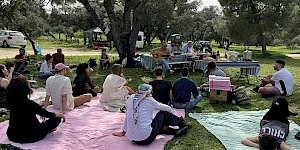
Casa de Campo, Madrid
-
WIELS
Collective Study in Times of Emergency, Brussels. Rana Issa and Shayma Nader
Join us at WIELS for an evening of fiction and poetry as part of L'Internationale Online's 'Collective Study in Times of Emergency' publishing series and public programmes. The series was launched in November 2023 in the wake of the onset of the genocide in Palestine and as a means to process its implications for the cultural sphere beyond the singular statement or utterance.
-
HDK-Valand
MA Forum in collaboration with LIO: Nour Shantout
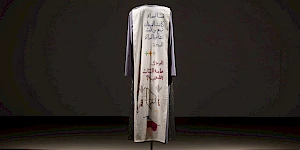
In this artist talk, Nour Shantout will present Searching for the New Dress, an ongoing artistic research project that looks at Palestinian embroidery in Shatila, a Palestinian refugee camp in Lebanon. Welcome!
-
–
International Day of Solidarity with the Palestinian People: Activities
To mark International Day of Solidarity with the Palestinian People and in conjunction with our collective text, we, the cultural workers of L'Internationale have compiled a list of programmes, actions and marches taking place accross Europe. Below you will find programmes organized by partner institutions as well as activities initaited by unions and grass roots organisations which we will be joining.
This is a live document and will be updated regularly.
-
–SALT
Screening: A Bunch of Questions with No Answers
This screening is part of a series of programs and actions taking place across L’Internationale partners to mark International Day of Solidarity with the Palestinian People.
A Bunch of Questions with No Answers (2025)
Alex Reynolds, Robert Ochshorn
23 hours 10 minutes
English; Turkish subtitles
Related contributions and publications
-
Right now, today, we must say that Palestine is the centre of the world
Françoise VergèsInternationalismsPast in the Present -
The Repressive Tendency within the European Public Sphere
Ovidiu ŢichindeleanuInternationalismsPast in the Present -
Rewinding Internationalism
InternationalismsVan Abbemuseum -
Troubles with the East(s)
Bojana PiškurInternationalismsPast in the Present -
Body Counts, Balancing Acts and the Performativity of Statements
Mick WilsonInternationalismsPast in the Present -
Until Liberation I
Learning Palestine GroupInternationalismsPast in the Present -
Until Liberation II
Learning Palestine GroupInternationalismsPast in the Present -
Editorial: Towards Collective Study in Times of Emergency
L’Internationale Online Editorial BoardEN es sl tr arInternationalismsStatements and editorialsPast in the Present -
Opening Performance: Song for Many Movements, live on Radio Alhara
Jokkoo with/con Miramizu, Rasheed Jalloul & Sabine SalaméEN esInternationalismsSonic and Cinema CommonsPast in the PresentMACBA -
Siempre hemos estado aquí. Les poetas palestines contestan
Rana IssaEN es tr arInternationalismsPast in the Present -
Diary of a Crossing
Baqiya and Yu’adInternationalismsPast in the Present -
The Silence Has Been Unfolding For Too Long
The Free Palestine Initiative CroatiaInternationalismsPast in the PresentSituated OrganizationsInstitute of Radical ImaginationMSU Zagreb -
En dag kommer friheten att finnas
Françoise Vergès, Maddalena FragnitoEN svInternationalismsLand RelationsClimateInstitute of Radical Imagination -
Everything will stay the same if we don’t speak up
L’Internationale ConfederationEN caInternationalismsStatements and editorials -
War, Peace and Image Politics: Part 1, Who Has a Right to These Images?
Jelena VesićInternationalismsPast in the PresentZRC SAZU -
Live set: Una carta de amor a la intifada global
PrecolumbianEN esInternationalismsSonic and Cinema CommonsPast in the PresentMACBA -
Rethinking Comradeship from a Feminist Position
Leonida KovačSchoolsInternationalismsSituated OrganizationsMSU ZagrebModerna galerijaZRC SAZU -
The Genocide War on Gaza: Palestinian Culture and the Existential Struggle
Rana AnaniInternationalismsPast in the Present -
Broadcast: Towards Collective Study in Times of Emergency (for 24 hrs/Palestine)
L’Internationale Online Editorial Board, Rana Issa, L’Internationale Confederation, Vijay PrashadInternationalismsSonic and Cinema Commons -
Beyond Distorted Realities: Palestine, Magical Realism and Climate Fiction
Sanabel Abdel RahmanEN trInternationalismsPast in the PresentClimate -
Collective Study in Times of Emergency. A Roundtable
Nick Aikens, Sara Buraya Boned, Charles Esche, Martin Pogačar, Ovidiu Ţichindeleanu, Ezgi YurteriInternationalismsPast in the PresentSituated Organizations -
Collective Study in Times of Emergency
InternationalismsPast in the Present -
S come Silenzio
Maddalena FragnitoEN itInternationalismsSituated Organizations -
ميلاد الحلم واستمراره
Sanaa SalamehEN hr arInternationalismsPast in the Present -
عن المكتبة والمقتلة: شهادة روائي على تدمير المكتبات في قطاع غزة
Yousri al-GhoulEN arInternationalismsPast in the Present -
Archivos negros: Episodio I. Internacionalismo radical y panafricanismo en el marco de la guerra civil española
Tania Safura AdamEN esInternationalismsPast in the Present -
Re-installing (Academic) Institutions: The Kabakovs’ Indirectness and Adjacency
Christa-Maria Lerm HayesInternationalismsPast in the Present -
Palma daktylowa przeciw redeportacji przypowieści, czyli europejski pomnik Palestyny
Robert Yerachmiel SnidermanEN plInternationalismsPast in the PresentMSN Warsaw -
Masovni studentski protesti u Srbiji: Mogućnost drugačijih društvenih odnosa
Marijana Cvetković, Vida KneževićEN rsInternationalismsPast in the Present -
No Doubt It Is a Culture War
Oleksiy Radinsky, Joanna ZielińskaInternationalismsPast in the Present -
Cinq pierres. Une suite de contes
Shayma NaderEN nl frInternationalisms -
Dispatch: As Matter Speaks
Yeongseo JeeInternationalismsPast in the Present -
Speaking in Times of Genocide: Censorship, ‘social cohesion’ and the case of Khaled Sabsabi
Alissar SeylaInternationalisms -
Today, again, we must say that Palestine is the centre of the world
Françoise VergèsInternationalisms -
Isabella Hammad’ın icatları
Hazal ÖzvarışEN trInternationalisms -

To imagine a century on from the Nakba
Behçet ÇelikEN trInternationalisms -
Internationalisms: Editorial
L'Internationale Online Editorial BoardInternationalisms -
Dispatch: Institutional Critique in the Blurst of Times – On Refusal, Aesthetic Flattening, and the Politics of Looking Away
İrem GünaydınInternationalisms -

Until Liberation III
Learning Palestine GroupInternationalismsPast in the Present -
Archivos negros: Episodio II. Jazz sin un cuerpo político negro
Tania Safura AdamEN esInternationalismsPast in the Present -
Cultural Workers of L’Internationale mark International Day of Solidarity with the Palestinian People
Cultural Workers of L’InternationaleEN es pl roInternationalismsSituated OrganizationsPast in the PresentStatements and editorials -
Poetry Against Language Dioxide
Rana IssaInternationalisms -
The Object of Value
SlinkoInternationalismsLand Relations