Glossary of Common Knowledge
Edited by Zdenka Badovinac, Bojana Piškur, and Jesús Carrillo
Graphic Design: New Collectivism
Contents
-
Curatorial Statement
-
Referential Fields
-
Historicisation
-
Introduction: Interrupted Histories – Ten Years Later
-
Archive
-
Constellation
-
Contemporary, The
-
Emancipation
-
Temporally Embodied Sound
-
Estrangement
-
Heterochronia
-
Humanism
-
Intuition
-
Pathological Fracture
-
Phantom (Pain)
-
Reconstruction
-
Self-historicisation
-
Temporalities
-
Tendencies in Art
-
Can the Meta-narrator Speak?
-
Subjectivisation
-
Introduction: Time-specific Exhibitions. The Rise of Lecture Performances, Precarious Text, Concert Economy, and Other News from the World of Art
-
Creleasure
-
Dancing as Insurrectional Practice
-
Decolonise
-
Evidence
-
Fragility
-
Interest
-
Kapwa
-
Loser
-
Over-identification
-
Radical Imagination
-
Self-determination
-
Self-representation
-
Subject
-
Travesti
-
Unrest
-
Geopolitics
-
Introduction: Alignment: An Attempt at Refusal
-
Agitational Visual Language
-
Catastrophe
-
Eurasia
-
Event
-
Global Resistance
-
Institutional Geopolitical Strategies
-
Migrancy
-
Non-Aligned Movement
-
Pandemic
-
Postsocialism
-
South
-
Tudigong, God of the Land
-
White Space
-
Constituencies
-
Introduction: The Rest is Missing
-
Agency
-
Autonomy
-
Biotope
-
Bureaucratisation
-
Collaboration / Co-labour
-
Construction
-
Continuity-form and Counter-continuity, The
-
De-professionalisation
-
Intervenor
-
Ñande / Ore
-
The Eternal Network / La fête permanente
-
The Rest is Missing
-
Commons
-
Introduction: Will You Stay Here? The Common and the Blue Brain
-
Baffle, To
-
Basic Income
-
Brotherhood and Unity Highway, The
-
Constituent Power of the Common
-
Corrected Slogans
-
Data Asymmetry
-
Friendship
-
Heterotopian Homonymy
-
Institution
-
Noosphere
-
Palimpsest
-
Rog
-
Self-management
-
Solidarity
-
Theft
-
Other Institutionality
-
Introduction: Institutionality “After” the Institution
-
Alternating
-
Art Hypothesis, The
-
Conspiratory Institutions?
-
Dark Room
-
Deviant
-
Family
-
Interdependence
-
Lobbying
-
Minor Universalisms
-
Reflexive / Reflexivity
-
Residual, A
-
Stultifera Navis
-
The Sustainable Museum or Repetition
-
Translation
-
On the Method of Making the Glossary
-
L’Internationale Confederation
-
Biographies
-
Index of Terms
-
Index of Names
-
List of Figures
-
Colophon
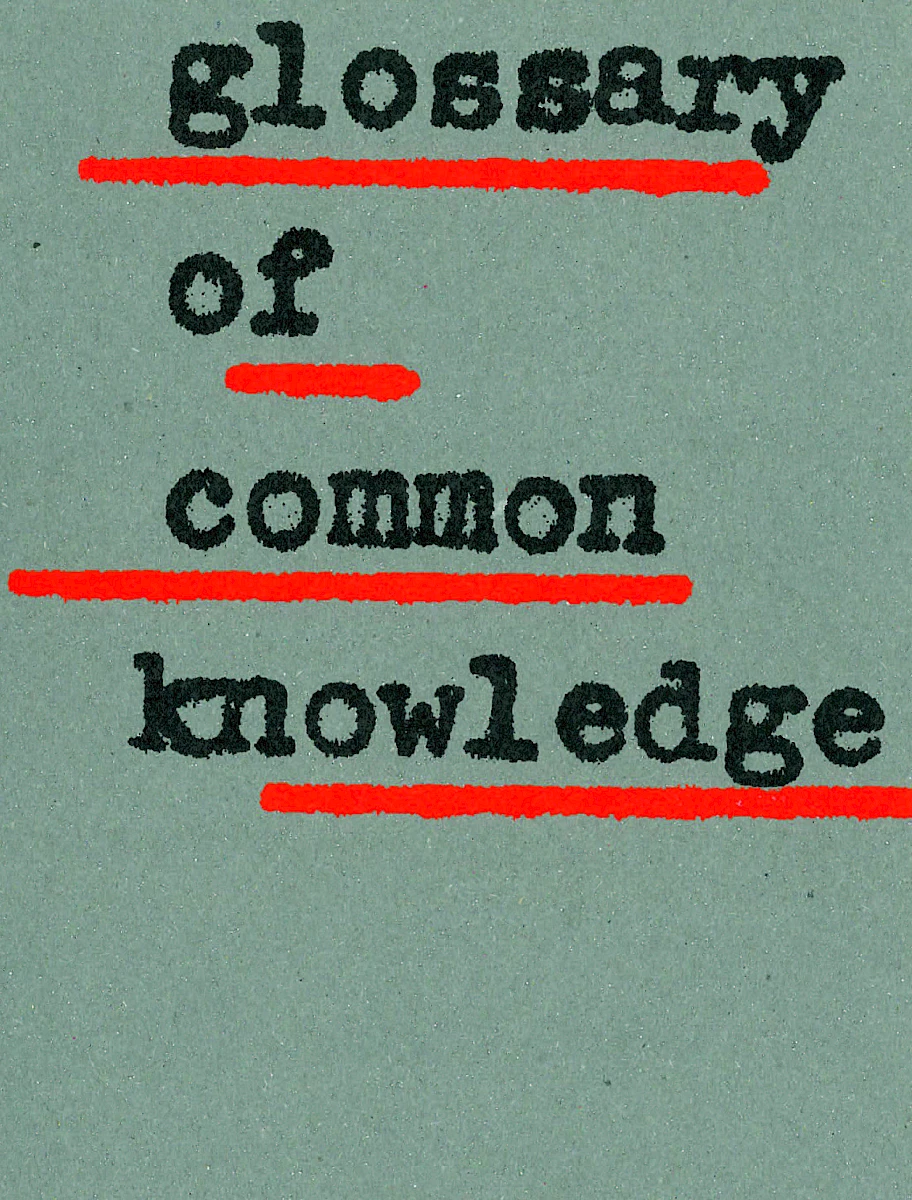
The Glossary of Common Knowledge (GCK) is a compilation of art terminology that differs substantially from what is found in the existing literature on art, and constitutes a five-year research project conducted by Moderna galerija (MG+MSUM), in the framework of L'Internationale's programme The Uses of Art.
In collaboration with institutions and individuals from Europe and other parts of the world, 66 contributors/narrators proposed terms relating to their own practices and contexts, to historical references, political or social situations, or L'Internationale projects. The terms were discussed and defined in six seminars dealing with six referential fields (historicisation, subjectivisation, geopolitics, constituencies, commons and their institutionality) and the book follows these topics across six chapters. Narrators created a plurality of voices and narratives which examine the proposed terms and add their different viewpoints, bringing with them overlooked, suppressed knowledge and also non-Western categories of thought and memories. This method gave rise to different ways of participating, sharing and using knowledge, as well as working together trans-globally.
The book contains 86 terms proposed by 66 contributors: Nick Aikens, Azra Akšamija, Burak Arıkan, Marwa Arsanios, Zdenka Badovinac, Sezgin Boynik, Boris Buden, Zoe Butt, John Byrne, Jesús Carrillo, Colin Chinnery, Keti Chukhrov, Anyely Marín Cisneros, Rebecca Close, Lia Colombino, Bart De Baere, Carlos Prieto del Campo, Marta Malo de Molina, Ekaterina Degot, Galit Eilat, Róza El-Hassan, Patrick D. Flores, Kate Fowle, Cristina Freire, Anthony Gardner, Chema González, Alenka Gregorič, Dušan Grlja, Khwezi Gule, Aigul Hakimova, Vít Havránek, Beatriz Herráez, Ida Hiršenfelder, Marianna Hovhannisyan, Manray Hsu, Marko Jenko, Anej Korsika, Vasıf Kortun, Anders Kreuger, Lisette Lagnado, Thomas Lange, Miguel A. López, Manos Invisibles, Sohrab Mohebbi, Gabi Ngcobo, Miglena Nikolchina, Ahmet Öğüt, Meriç Öner, November Paynter, Alexei Penzin, Jabulani Chen Pereira, Bojana Piškur, Paul B. Preciado, Tzortzis Rallis, pantxo ramas, Suely Rolnik, Rasha Salti, Raúl Sánchez Cedillo, Aida Sánchez de Serdio Martín, Ania Szremski, Igor Španjol, Mabel Tapia, Francisco Godoy Vega, Jelena Vesić, Stephen Wright, Darij Zadnikar, Adela Železnik.
The Glossary of Common Knowledge was curated by Zdenka Badovinac (Moderna galerija, Ljubljana), Bojana Piškur (Moderna galerija, Ljubljana) and Jesús Carrillo (Museo Reina Sofia, Madrid, 2012–2016), and the book was edited by Ida Hiršenfelder, and published by Moderna galerija.
To purchase the publication, please contact the bookstores in the Museum of Modern Art, Ljubljana, or the Museum of Contemporary Art Metelkova, Ljubljana.