Collective Study in Times of Emergency, volume 2. An introductory roundtable
The following roundtable, by members of L'Internationale Online's editorial board and which took place online in October this year, serves as the introduction to the digital publication Collective Study in Times of Emergency. Volume 2: 2025–2026.
Nick Aikens: It’s 15 October 2026. It was two years ago that we recorded the roundtable for the publication Collective Study in Times of Emergency. This roundtable is an introduction – an orientation, if you like – for volume 2 of Collective Study in Times of Emergency. This book is the work of many, a constellation of seventeen contributions published by L’Internationale Online since January 2025. Like other recent LIO publications, we didn’t start with a contents page that we then commissioned and realized. It has been a process of responding to what we feel is the urgency of the present conjuncture – a conjuncture defined by genocide and the need to rethink what it means to practise, articulate and claim internationalisms. Indeed, it comes out of a publishing strand which we renamed a couple of years ago from ‘Collective Study in Times of Emergency’ to ‘Internationalisms’ – precisely because we recognized the need to articulate the moment of genocide in Palestine with other struggles and contexts, both contemporary and historical. When we came to think about formulating this book, we had a long discussion about whether to use the frame of ‘Internationalisms’ or to revert to ‘Collective Study’.
Bojana Piškur: I think naming Collective Study is important. ‘Internationalisms’, in a way, describes what we study, while ‘collective study’ describes how we work. It’s also about what happens when we think together. So it’s an important distinction. I am reminded of Spinoza and Deleuze and their philosophies of affect. I think this theory of affect is quite helpful here, because affects are the way that we are changed by what we encounter – by people, ideas, images, events. And they also shape how we act and how we relate to one another. So we have joy, which is a positive affect: it’s an encounter that increases our power to act. And then we have the affect of sadness, which is just the opposite. Why am I saying this? Because it also helps me think about the present. Much of what we have been processing since October 2023 pulls us towards grief, towards rage, and puts us into some kind of paralysis. And this is, of course, sadness, the affect of an encounter which diminishes our power to act. Every political power knows this, because it feeds on fear, resentment and despair to keep established hierarchies in place. But solidarity, on the contrary, is the counter-movement. It’s a joy – the joy of connection and shared commitment. And our collective study, study done with others, can be one such way. So it’s a political practice that can be joyful in this difficult sense, without denying what we are facing.
Ezgi Yurteri: In her article, ‘Today, again, we must say that Palestine is the centre of the world’, Françoise Vergès cited data from the Uppsala Conflict Data Program, saying that ‘in 2023, the number of conflicts involving states totalled 59, the highest number since records began in 1946’. The same website registered 65 conflicts involving states in 2025, yet another record high. And the number of interstate conflicts doubled for the second year in a row, from two in 2023 to eight in 2025.1 What does it mean to invoke internationalism at a moment of global disintegration? How can we address its promises and its failures? Are we in a position to do so? These were some of the questions we felt we couldn’t articulate comprehensively enough within the scope of this publication. But there’s also a methodological reason for the decision. This thread, or this publication, was not conceived as a book from the outset. It brings together material that accumulated over time, in response to both urgencies on the ground and the need to situate the present within a broader horizon, both historical and future-facing. It was also about being attentive to the conditions under which we operate: to whom and for whom we speak, how we allocate our resources, and what we can meaningfully take responsibility for. The conjuncture in which we published the first volume has been ongoing, so it made sense to return to a method that had already informed and shaped our work. Echoing Bojana, Collective Study in Times of Emergency is not only about what we study together but how we work together, how we produce knowledge, and how we build practices of solidarity and allyship.
Martin Pogačar: This morning I read through Yousri al-Ghoul’s piece ‘The Library and the Massacre: A Novelist’s Testimony on the Destruction of Libraries in the Gaza Strip’. Thinking about collective study as method, what struck me was the metaphor of the library: having an open approach to a library as a living archive. In shaping this publication, there was a question of how to make it coherent. But its value lies precisely in its openness, in its being an unfinished project, which learning always is. In that way, the method of collective study resonates with the idea of a library – especially in the present situation, where books are being both burned and digitized, often hand in hand.
Bojana mentioned affect. Relatedly, we can also speak of resonance in relation to collective study. Resonance is something that comes upon us unprepared, haphazardly, and it always has to do with being affected: it’s always related to effectuating a relation and becoming aware of our response in the process. It’s always an adaptive transformation. Hartmut Rosa, the German sociologist, writes about this a lot. All the systems of surveillance, the systems of control, the systems of government try to suppress and exert ultimate control. But life is uncontrollable precisely in its unexpected resonances, just as in how we as listeners and readers come in contact with others as readers and listeners. And this is also enacted through collective study, because it is open and does not submit to a firm structure. I think this is something that we should really cherish and value, and move along those paths.
Sheena Barrett: The richness and variety of textures and the restlessness that live in these texts are a response to this time of emergency and grief. It feels important to have this range of writing in the publication, also at a time when so much of what we’re reading reflects a general banalization through the excessive use of AI. Moving between these different modes of writing both situates and aligns you with different forms of solidarity in a hyperlocal way.
Sofia Dati: It’s important to underscore the shift from internationalisms as a framework to collective study as a methodology which implies forms of attunement to each other and to parallel, interconnected contexts of political struggle. The publication is a gathering of multiple ways in which solidarity is manifested, and translated, through words, language, poetry, images and sound. Collective study is about process: it is ongoing, allowing us to sediment moments of reflection – and of joy, to echo Bojana – instead of advancing a comprehensive story of internationalisms today. This volume of Collective Study in Times of Emergency shifts that axis and points to how we have been attuning to several contexts of struggle in the past years.
NA: Stuart Hall, the esteemed cultural theorist, famously talked of moments of ‘arbitrary closure’ where meaning and knowledge are temporarily fixed before reforming as the conjuncture changes. This publication is a moment of arbitrary closure which allows the expression of political and cultural positions.
Palestine and the genocide frame Collective Study, sit at its core. I both appreciate and grapple with how our address to other struggles and contexts sits in relation to the genocide. When we pivot to Manijeh Moradian’s ‘To Measure the Emotions of Others: Collective Mourning and Solidarity Politics in the Iranian Diaspora’, to Ukraine through Slinko’s ‘The Object of Value’ or to ‘Mass Student Protests in Serbia: The possibility of different social relations’ by Marijana Cvetković and Vida Knežević, it’s not to draw comparisons, and it’s certainly not to mark these as exceptional cases – as Ezgi said, there are tens and tens of ongoing conflicts that we’re not engaging. But it is an attempt to bring contexts into relation, even if it is always and necessarily inadequate.
Many contributions were developed over time, through collaborations and programming. The project ‘Critical Media Practices’, where we partner with non-English publications, enabled a series of collaborations with the Journal of Palestine Studies: Yousri al-Ghoul’s aforementioned piece (‘The Library and the Massacre’) and the deeply moving ‘The Birth of a Dream and its continuation’ by Sanaa Salameh, which celebrates the life and work of political prisoner Waalid Daqqa. On another occasion, Rana Issa was invited to the ‘Collective Study in Times of Emergency’ programme at De Appel, Amsterdam in 2025. There, she developed the work she had begun in ‘We Have Been Here Forever. Palestinian Poets Write Back’, which she subsequently delivered as a lecture at WIELS, as part of a ‘Collective Study’ programme that Sofia and I organized together. It was then reworked and published under the title ‘Poetry Against Language Dioxide’ – a hugely significant and substantial analysis of Palestinian poetry. We also co-commissioned Shayma Nader’s ‘Five Rocks: A Collection of Tales’ as part of the WIELS exhibition project ‘Magical Realism: Imagining Natural Dis/Order’. Many of these texts figured in different reading groups and classes. All this to highlight what ‘Collective Study’, as an intertwining strand of study, programming and publishing, entailed.
Organizing the material was a challenge. We settled on three groupings, or sections, each titled with a quote borrowed from a text. We begin with ‘A Wish for a Year of Collective Liberation’, a quote from Maddalena Fragnito’s ‘S Is for Silence’, a beautiful letter written at the beginning of 2025 and the first piece that was published in this series. The section’s subtitle is ‘Bearing Witness, Testimony and Speaking in Times of Genocide’. These texts concern the genocide, the lived experience of destruction in Palestine, the protests in Serbia, and questions of censorship in the cultural field that have been so prevalent since October 2023. The section marks the conjuncture in which these texts have been produced, and it does so in very particular tones: tones of testimony, of personal experience, of encounter.
SD: This section connects back to Françoise Vergès’s invitation to think Palestine as the centre of the world. It also speaks to a context marked by institutional disavowal and faces us with the question of how we, collectively, take responsibility for bearing witness. One of the throughlines in the section is censorship. Contributions like ‘Dispatch: Institutional Critique in the Blurst of Times – On Refusal, Aesthetic Flattening, and the Politics of Looking Away’ by İrem Günaydın, and ‘Speaking in Times of Genocide: Censorship, “social cohesion” and the case of Khaled Sabsabi’ by Alissar Seyla address the limits of what can be uttered where and in what context, and asks what the consequences of our utterances are.
Back in 2023, the gatherings titled ‘Collective Study in Times of Emergency’ started from a desire, or a sense of responsibility – to refuse to look away. How do you bring that gesture into being in contexts where utterance is subject to scrutiny, control and restriction? That was how the reading group was approached when Nick started it with Helena Kritis at WIELS.
NA: For me, it’s incredibly important that the first text is Maddalena’s letter. This was a letter that she wrote to her ‘dearest ones’. It was written in Italian and originally published on an Italian platform, Effimera, a kind of New Year or end-of-year letter which we subsequently translated into English. In the letter she implores her colleagues, fellow cultural workers, to make themselves heard. In terms of addressing the cultural field – our allies, our friends – at the beginning of 2025, it set the tone for how we thought we needed to carry on this work. Methodologically, it’s also important to say that this is a text that came sideways to L’Internationale, one written by a colleague, and that through this we also formed an alliance we didn’t have before with an Italian publishing platform.
SD: Moving on to ‘Trying to Read the Dead’, for me, this section is significant in how it opens up space for the search for languages of commemoration and memory: reconnecting to the dead, reconnecting to the past and reinventing languages in which to grieve, to refuse amnesia. This is perhaps most explicit in Philip Rizk’s ‘Reading the Dead of Gaza: Musha’ as mentality’, from which the second section takes its title. In ‘Poetry Against Language Dioxide’, Rana Issa speaks of poetry and language as potential remedies: How, she asks, can we imagine and practise poetry as a tool to foster political imagination? Because when we’re stuck in this space with no space for the past and no space for the future, what is also being atrophied is our capacity to imagine otherwise. Refusing the banalization not only of how we regard our context and our surroundings is also deeply connected to the practice of collective study, part of how we tap into our collective imaginations in order to see beyond the confines of the eternal present.
There is a through line here with Shayma Nader’s short-story collection ‘Five Rocks’ (co-commissioned by WIELS and L’Internationale), in which Nader adopts the form of the tale set in an imagined space to think through the force of resistance and of refusal in the context of enclosure, referring to the West Bank and Palestine.
SB: The pieces in this section do push back against the constant feelings of chaos and overwhelm that we inhabit, and which suppress the possibility of imagining a future. I think they also situate us in an archive. I’m thinking of Slinko’s ‘The Object of Value’, where she looks to the history of Malevych’s Black Square, threading a personal history through interrogative readings of understandings of the value of an object. Her text takes us on a journey across nations and states, from her deep family roots in the Donbas region to the visceral impact of her chance encounter with a map drawing by Kathy Prendergast in IMMA’s collection, while on residency there. The relationship between the history of this artifact and the ownership of cultural memory in state museums in Moscow and St. Petersburg, and the possibility that our transnational collections of artworks might support the holding of memory and meaning in more decolonial ways is threaded through this chapter. Our collective study too provides a space for this level of engagement across deep personal histories, large cultural movements: we can take a deep dive into the history of an object, our relationships to it, and its relationships – to place for example – as, in Slinko’s text, to Donbas.
NA: Forms of grief, remembering and memorials are all here in this section. In ‘A Date Palm Against the Re-Deportation of Parables, or Europe’s Palestine Monument’, Robert Yerachmiel Sniderman engages, through this very intricate, grief-laden writing, with Joanna Rajkowska’s palm tree sculpture in Warsaw, Greetings from Jerusalem Avenue (2002). It was the first time a substantial piece of writing had been done on this work, which is amazing considering it’s been in Warsaw for more than twenty years. I’m also thinking of Rizk’s ‘Reading the Dead’, of his precise yet poetic, moving use of words as a way to read, process and remember; but also, as his text points to, to think about the vitality of life and what it means to be alive: to have hope, to have politics.
SB: Particularly amid the proliferation of imagery and the overwhelming, massive weight of the genocide, there’s a strength that comes through the solidarity of holding on to memories and experiences, traced through (personal) histories, with that linguistic precision and depth of feeling, collectively.
SD: That’s what I find striking about this section: how all these different contributions think about what creative, poetic, sonic and collective forms can do. ‘Until Liberation III’, a twelve-hour listening session by the Learning Palestine Group, is a piece that invites activation; comprising diverse sonic archives to be listened to collectively, it offers the potential for collective attunement.
BP: I could say a little about the final section; I like that it refuses a triumphant story of internationalism. Even the title says it plainly: ‘There Has Been No Peace’. So the question is not whether internationalism has succeeded, but what has made it possible historically and where it has failed. Françoise Vergès’s text is, of course, key here: ‘Today, again, we must say that Palestine is the centre of the world’. It’s important because it inverts the map: if we start from Palestine, then our institutions, our alliances and even our ideas of internationalism have to be reorganized around it. We have mentioned before that there are so many wars and conflicts. Palestine has become central to collective study not because it is the only site of injustice that deserves attention, but because it is the site where the gap between what institutions claim to stand for and what they actually do has become most acute.
Elsewhere in this section is ‘Translated into Socialism: An experiment in internationalism’ by Merve Elveren, Tevfik Rada and Sezgin Boynik. Referring to an exhibition we presented in Ljubljana after it was first shown at Salt, Istanbul, the text approaches internationalism as something practiced, rather than only declared, and treats translation as an experiment. I found this hopeful, because it reminds us that solidarity is made of concrete, patient work.
EY: ‘Translated into Socialism’ looks at the ‘translation’ of a Turkish-speaking community into the conditions of socialist Yugoslavia, as Sezgin, Tevfik and Merve put it. What does looking at these particular histories make possible for us in the present, at a time when present urgencies can so easily constrain our thinking, when apathy or cynicism can so easily take hold? That’s exactly what the constant state of emergency does to our capacity to act, and I think this is why it matters to return to other times, other contexts: to remind ourselves that political orders and borders are historically constructed and that they are not inevitable. Not just to reckon with what’s coming, with what’s probable, but to envision what’s possible, and try to cultivate those possibilities. This also feels crucial, simply to keep doing what we do: sometimes remembering or discovering other contexts can give us much-needed fuel or renew our sense of agency.
NA: I appreciate that we point out this refusal to champion or celebrate internationalisms.. This is also in the subtitle, ‘The Enduring Promise and Failures of Internationalism’. What these five texts point to, in very different ways, are the continuing contradictions that are at play. Manijeh’s piece does this beautifully, addressing what it means to have coexisting sympathies, alliances and histories that need to be thought together, and how we constantly live with and have to negotiate contradictions. In the conversation ‘Near East Far West and the Proposition of Middle East Europe’, the curators of the Kyiv Biennial identify the need to think the full-scale invasion of Ukraine and the genocide in Palestine as part of the same conjuncture. And in the recent conversation ‘How the Atomic Bomb Changed the World: A discussion on the geopolitical, philosophical and societal transformations of the nuclear era around the atomic bomb’, which Bojana proposed, Martin, Igor Bijuklič, Gal Krizmanič and Alja Zore ask why this weapon of mass destruction, of planetary-scale ecocide, is not an urgent international concern.
MP: I’d like to linger on what Ezgi said about the constraints on our thinking today. It is crucial to allow ourselves to continue to think across ever-more strictly imposed, even if so-far invisible borders; but also, I would say, in relation to shame, which seems to be completely gone from political discourse. Although it is a constraint, it is a productive one as it forces one to reflect, to humble oneself in the face of the other. If in the past, after the Second World War, there was at least a pretence of saving face, of doing diplomacy, now that’s just off the table. I think this holds for how politics is done in most of the world now. Thus, in a way, public discourse appears unconstrained, but it is so limited, precisely because it is unbounded. This appears to be an integral part of the contemporary technology of governmentality.
Recently I came across the work of French political scientist Asma Mhalla, who speaks about ‘fluxocracy’: we’re drowning in information, it’s coming all the time, so we don’t really have the time to respond. We don’t really have the time or space to think, which is crucial to how power operates. Merge that with digital technologies and artificial intelligence (in its current state of development), and this is utter devaluation of thought and knowledge. ‘How the Atomic Bomb Changed the World’ explicates this: that we should not really be talking about it as a ‘weapon’, because a weapon has a target, whereas nuclear weapons offer indiscriminate destruction. But ‘we’ cannot think the nuclear apocalypse anymore, the possible destruction that comes with the proliferation of nuclear (or automated) weapons. When we’re not given time to think, we cannot really think about the past. And thinking about the future is affected as well. The constraint on thinking forecloses the horizon. So we’re stuck in this perpetual present which is just a massive pile-up of everything that happens, regurgitated, reframed and remediated through news feeds and so on. When you live in fluxocracy, you don’t have the time to think. You just have to survive.
EY: Putting these texts into groups retrospectively helped me, at least, make sense of what we are marking at this specific moment. I can see how they speak to one another and how they came to form certain assemblages, in ways that reflect shared hopes and fears. This also relates to publishing as practice, and to Martin’s address on resonance – collective resonance, or intuitions, if you will.
SB: When you put it like that, Ezgi, I can see how it mirrors our curatorial practices of speculative exhibition-making: bringing together works from different contexts, some commissioned, some on loan, to sit alongside each other and create new resonances. This book does not need to be read in a linear fashion, and the reader can make connections as they see them, adding resonance to the rich textures already there.
BP: The important question for me is: what can a person reading this publication do after reading it that they could not do before? How did it change their ways of seeing the world and doing things?
Related contributions and publications
-
…and the Earth along. Tales about the making, remaking and unmaking of the world.
Martin PogačarLand RelationsClimatePast in the Present -
The Kitchen, an Introduction to Subversive Film with Nick Aikens, Reem Shilleh and Mohanad Yaqubi
Nick Aikens, Subversive FilmSonic and Cinema CommonslumbungPast in the PresentVan Abbemuseum -
The Repressive Tendency within the European Public Sphere
Ovidiu ŢichindeleanuInternationalismsPast in the Present -
Rewinding Internationalism
InternationalismsVan Abbemuseum -
Troubles with the East(s)
Bojana PiškurInternationalismsPast in the Present -
Right now, today, we must say that Palestine is the centre of the world
Françoise VergèsInternationalismsPast in the Present
Related activities
-
–Van Abbemuseum
The Soils Project
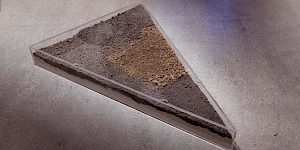
‘The Soils Project’ is part of an eponymous, long-term research initiative involving TarraWarra Museum of Art (Wurundjeri Country, Australia), the Van Abbemuseum (Eindhoven, Netherlands) and Struggles for Sovereignty, a collective based in Yogyakarta, Indonesia. It works through specific and situated practices that consider soil, as both metaphor and matter.
Seeking and facilitating opportunities to listen to diverse voices and perspectives around notions of caring for land, soil and sovereign territories, the project has been in development since 2018. An international collaboration between three organisations, and several artists, curators, writers and activists, it has manifested in various iterations over several years. The group exhibition ‘Soils’ at the Van Abbemuseum is part of Museum of the Commons. -
–VCRC
Kyiv Biennial 2023
L’Internationale Confederation is a proud partner of this year’s edition of Kyiv Biennial.
-
–MACBA
The Open Kitchen. The fermented seed, colonialism and extractivism
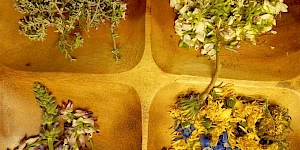
The MACBA Kitchen is a working group situated against the backdrop of ecosocial crisis. Participants in the group aim to highlight the importance of intuitively imagining an ecofeminist kitchen, and take a particular interest in the wisdom of individuals, projects and experiences that work with dislocated knowledge in relation to food sovereignty.
-
MACBA
The Kitchen: Workshop by Marina Monsonís
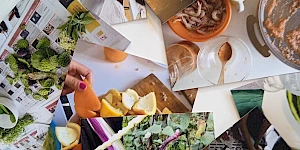
The Kitchen is a meeting place open to the participation of all, especially people and organizations that want to share their knowledge and experiences around the kitchen.
-
–MSN Warsaw
Multicultural Youth Center
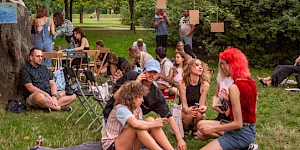
The Museum of Modern Art in Warsaw, together with the confederation of museums L'Internationale, is establishing a Multicultural Youth Center. This is a unique space for 16-24 year olds to explore and develop their creativity, make new friends and hang out in a friendly and supportive environment.
-
–MACBA
Where are the Oases?
PEI OBERT seminar
with Kader Attia, Elvira Dyangani Ose, Max Jorge Hinderer Cruz, Emily Jacir, Achille Mbembe, Sarah Nuttall and Françoise VergèsAn oasis is the potential for life in an adverse environment.