Anchor in the Landscape
‘Anchor in the Landscape’ is a photographic survey of olive trees in Occupied Palestine by Adam Broomberg and Rafael Gonzalez (MACK, 2023). In this contribution for LIO, which follows his MA Forum lecture, Broomberg combines a selection of images with text describing the significance of the trees and their ongoing destruction.
The Holocaust and the pogroms of nineteenth-century Eastern Europe are constantly invoked to justify Israel’s existence, and this has often gone hand in hand with efforts to erase any memory of Arab life before 1948.1 Maps, land deeds, place names and documents have been systematically destroyed. Landscape itself takes part in this erasure. Since 1901 the Jewish National Fund has planted more than 250 million pine trees in Israel/Palestine. The pine became the emblem of the Zionist claim of ‘making the desert bloom’, while at once giving the Holy Land a distinctly European look.
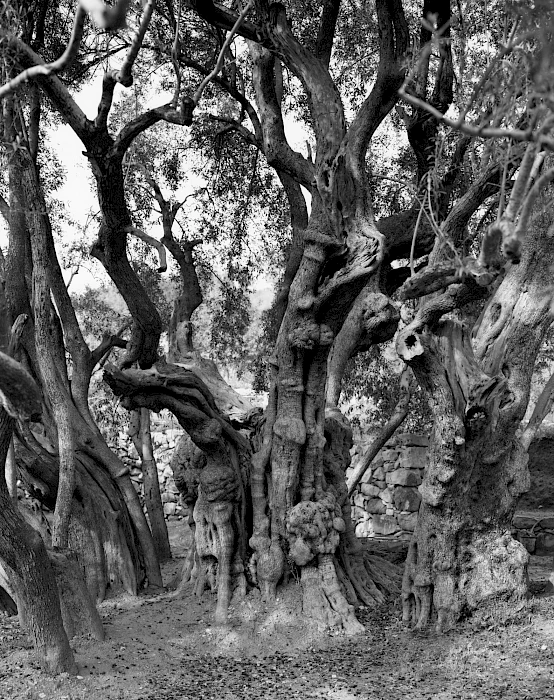
N31°44.3416’ E035°09.4615’
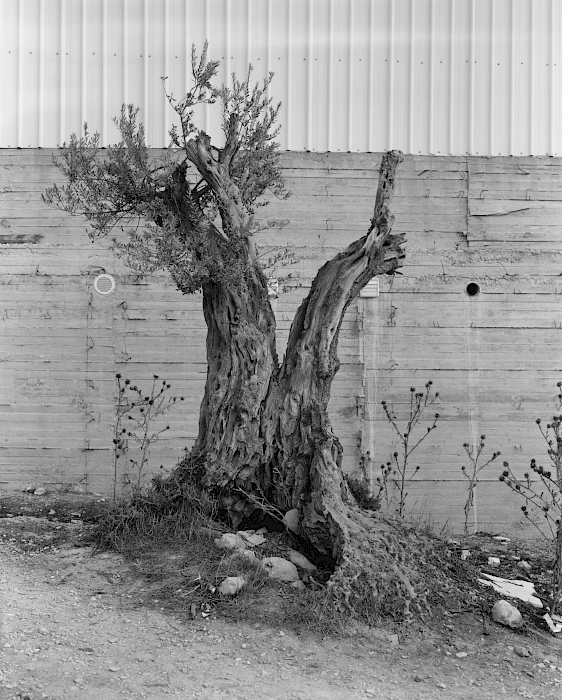
N31°31.4165’ E035°06.1153’
Around Jerusalem, pine forests serve as family picnic spots, crowded with cars, barbecues and pets at weekends and silent and serene at dawn. They give the impression of timeless woods that have always stood there. Among those trees lie the faint remains of more than 400 Arab communities destroyed in the Nakba: a wall’s skeleton, an almond tree from a former garden, an animal pen fenced with cactus. In this apparent wilderness they read as ancient ruins rather than demolition rubble. They are places of erasure and amnesia.
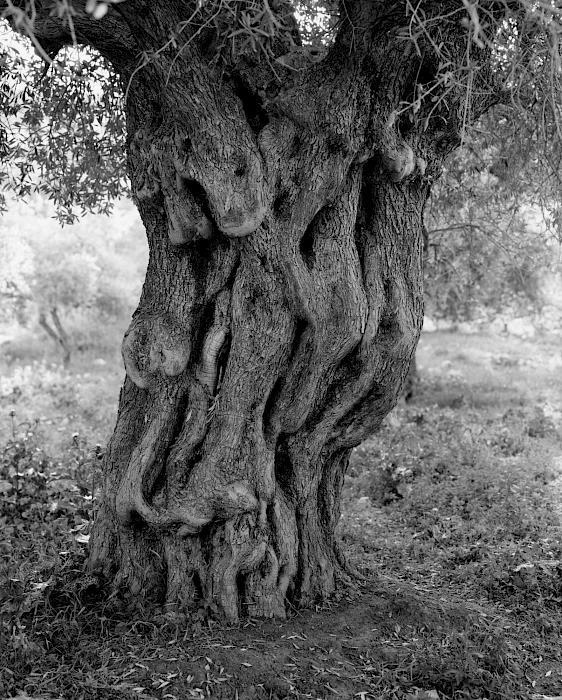
N31°42.6640’ E035°13.1423’
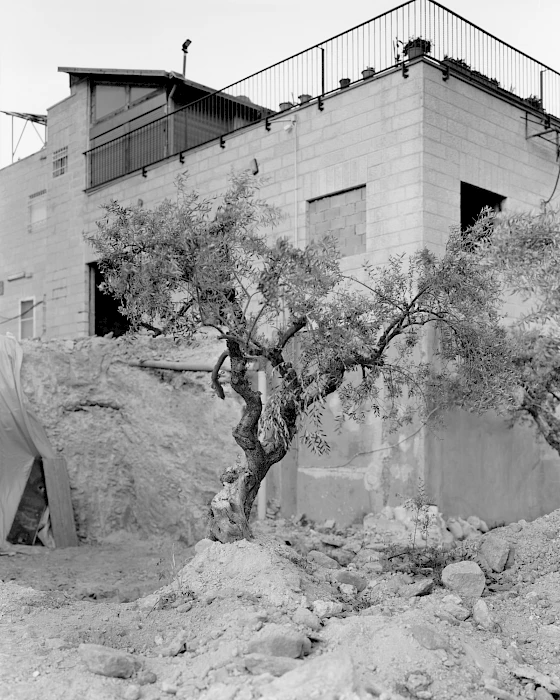
N31°42.6326’ E035°13.3298’
The indigenous olive, by contrast, stands for Palestinian sumud, or steadfast attachment to the land. Olive trees are of cultural, material and juridical importance to the Palestinian people. The occupied West Bank has an estimated ten million olive trees, making olives its largest agricultural product. About 100,000 families depend directly on the harvest; including those who work in processing, roughly a quarter to a third of the West Bank’s population relies on the trees.
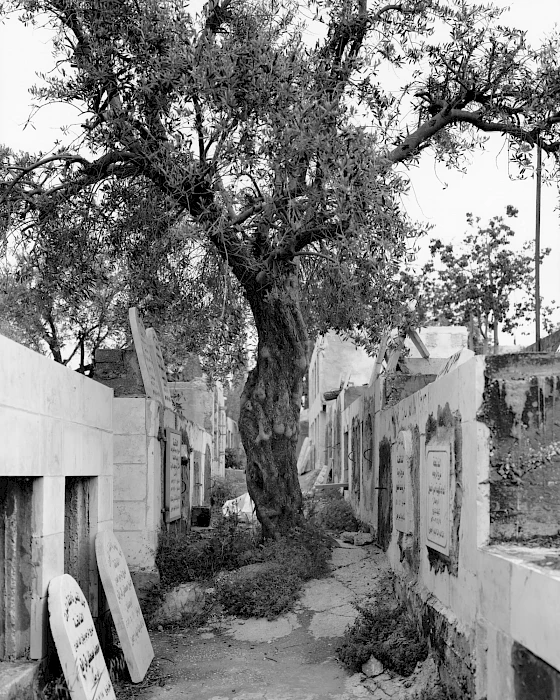
N31°43.1489’ E035°12.0569’
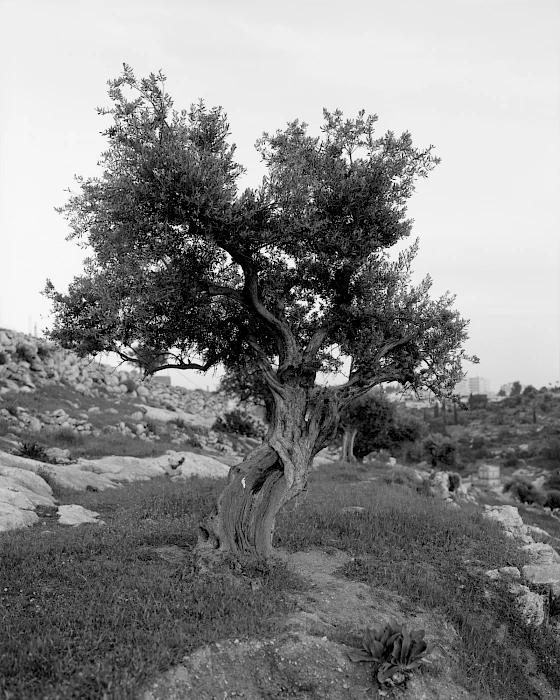
N31°42.7068’ E035°13.1920’
Despite the biblical prohibition on destroying fruit trees, even an enemy’s, tree-burning has since 1967 become a form of modern national ritual. Israeli authorities have uprooted an estimated 800,000 Palestinian olive trees since 1967.2 During the 2020 olive harvest alone, the UN recorded more than 1,700 olive trees vandalized – cut down, sawn through or set on fire – by Israeli settlers.3 Israel’s main stated rationale is security: clearing land for the Separation Wall, roads, watchtowers, checkpoints and settlement fences. A second rationale is environmental. Authorities have argued in court that planting ‘non-wild’ olives in nature reserves harms native flora and fauna, a line of argument that casts Palestinians as inherently hostile to the environment. There is also a legal motivation: if an olive tree more than ten years old stands on the land, the land is deemed Palestinian; if the tree is younger, ownership can be contested.
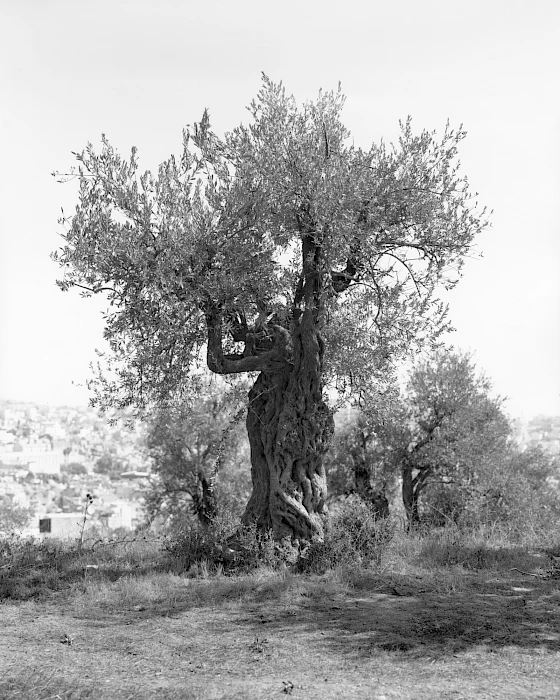
N31°31.4678’ E035°06.2140’
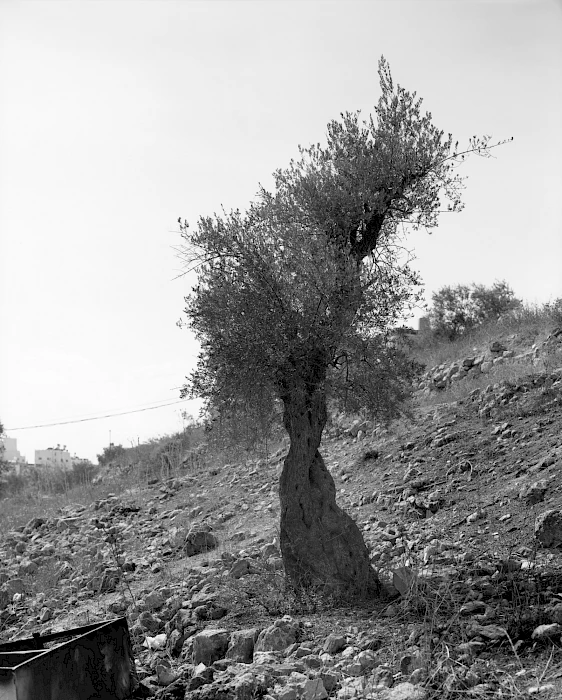
N31°31.4634’ E035°06.2059’
The olive has come to be treated as an ‘enemy soldier’, a stand-in for the adversary that must be removed from the landscape. The more it is attacked, the more power it gains as a symbol. It becomes both an anchor and an archive: it endures, and it bears witness to what has disappeared. Planting and tending olives is therefore a form of resistance. In 2021 the Jewish National Fund named the olive Israel’s national tree, calling it a symbol of peace – a move that can be read as another form of appropriation.4
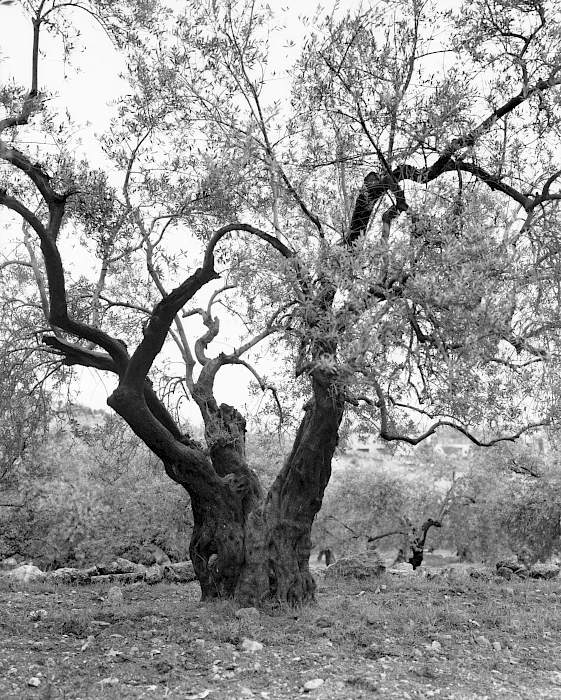
N31°42.5696’ E035°13.1748’
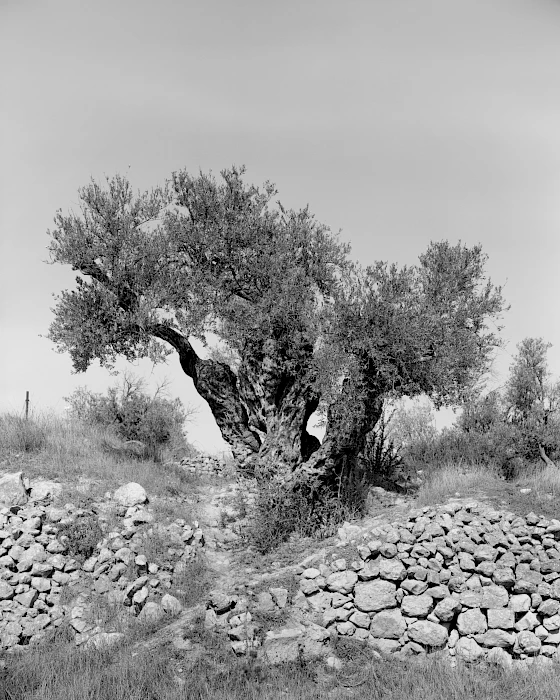
N31°31.4323’ E035°06.1471’
Produced during several residencies at Dar Yusuf Nasri Jacir for Art and Research in Bethlehem (run by the Palestinian artist Emily Jacir), these 8 × 10 inch analogue portraits of olive trees appear as totems, survivors in a landscape of attrition. One photograph depicts the Al-Badawi tree, estimated by researchers to be between 4,000 and 5,000 years old and believed to be the oldest living olive tree in the world.5
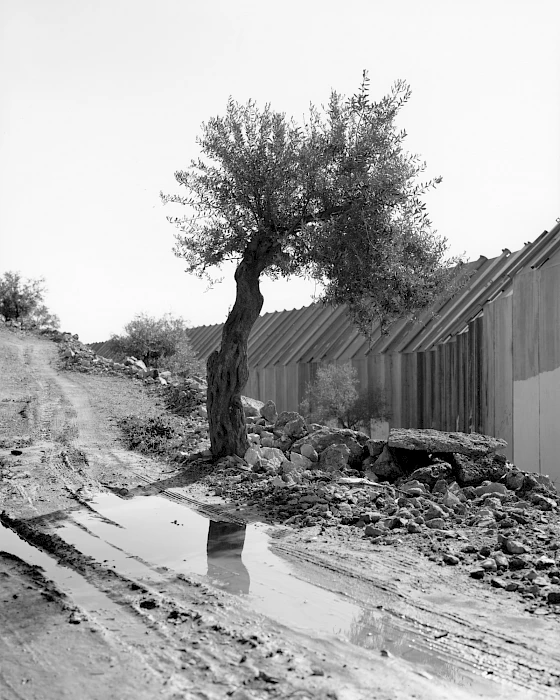
N31°43.1239’ E035°10.8734’
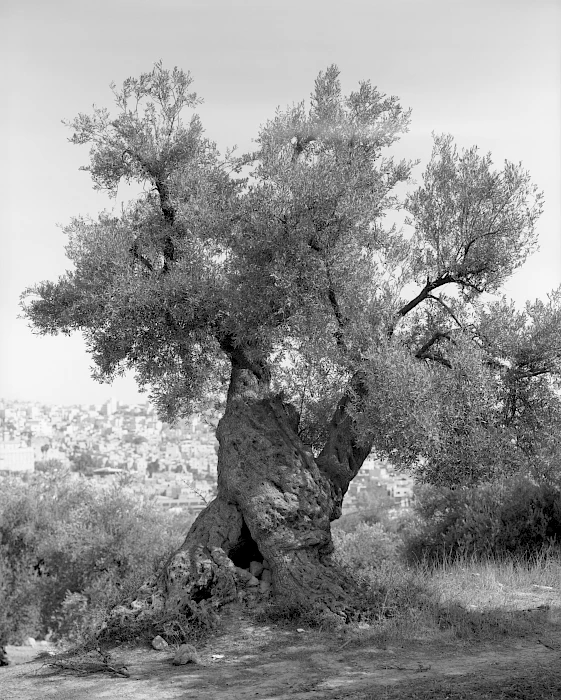
N31°31.5043’ E035°06.2358’
Related contributions and publications
-
Reading the Dead of Gaza: Musha’ as mentality
Philip RizkInternationalismsLand RelationsPast in the Present -
Cinq pierres. Une suite de contes
Shayma NaderEN nl frInternationalisms -
عن المكتبة والمقتلة: شهادة روائي على تدمير المكتبات في قطاع غزة
Yousri al-GhoulEN arInternationalismsPast in the Present -
I Call Out to You
Zena CumpstonLand RelationsClimateSituated OrganizationsPast in the PresentVan Abbemuseum -
Klei eten is geen eetstoornis
Zayaan KhanEN nl frLand RelationsClimatePast in the Present -
Decolonial aesthesis: weaving each other
Charles Esche, Rolando Vázquez, Teresa Cos RebolloLand RelationsClimate -
Climate Forum I – Readings
Nkule MabasoEN esLand RelationsClimateHDK-Valand -
…and the Earth along. Tales about the making, remaking and unmaking of the world.
Martin PogačarLand RelationsClimatePast in the Present -
Art for Radical Ecologies Manifesto
Institute of Radical ImaginationLand RelationsClimateInstitute of Radical Imagination -
The Kitchen, an Introduction to Subversive Film with Nick Aikens, Reem Shilleh and Mohanad Yaqubi
Nick Aikens, Subversive FilmSonic and Cinema CommonslumbungPast in the PresentVan Abbemuseum -
The Repressive Tendency within the European Public Sphere
Ovidiu ŢichindeleanuInternationalismsPast in the Present
Related activities
-
HDK-Valand
Climate Forum I
The Climate Forum is a space of dialogue and exchange with respect to the concrete operational practices being implemented within the art field in response to climate change and ecological degradation. This is the first in a series of meetings hosted by HDK-Valand within L'Internationale's Museum of the Commons programme.
-
–Van Abbemuseum
The Soils Project
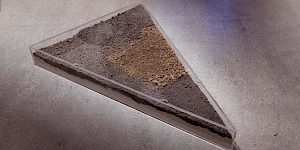
‘The Soils Project’ is part of an eponymous, long-term research initiative involving TarraWarra Museum of Art (Wurundjeri Country, Australia), the Van Abbemuseum (Eindhoven, Netherlands) and Struggles for Sovereignty, a collective based in Yogyakarta, Indonesia. It works through specific and situated practices that consider soil, as both metaphor and matter.
Seeking and facilitating opportunities to listen to diverse voices and perspectives around notions of caring for land, soil and sovereign territories, the project has been in development since 2018. An international collaboration between three organisations, and several artists, curators, writers and activists, it has manifested in various iterations over several years. The group exhibition ‘Soils’ at the Van Abbemuseum is part of Museum of the Commons. -
–VCRC
Kyiv Biennial 2023
L’Internationale Confederation is a proud partner of this year’s edition of Kyiv Biennial.
-
–MACBA
Where are the Oases?
PEI OBERT seminar
with Kader Attia, Elvira Dyangani Ose, Max Jorge Hinderer Cruz, Emily Jacir, Achille Mbembe, Sarah Nuttall and Françoise VergèsAn oasis is the potential for life in an adverse environment.
-
MACBA
Anti-imperialism in the 20th century and anti-imperialism today: similarities and differences
PEI OBERT seminar
Lecture by Ramón GrosfoguelIn 1956, countries that were fighting colonialism by freeing themselves from both capitalism and communism dreamed of a third path, one that did not align with or bend to the politics dictated by Washington or Moscow. They held their first conference in Bandung, Indonesia.
-
–Van Abbemuseum
Maria Lugones Decolonial Summer School
Recalling Earth: Decoloniality and Demodernity
Course Directors: Prof. Walter Mignolo & Dr. Rolando VázquezRecalling Earth and learning worlds and worlds-making will be the topic of chapter 14th of the María Lugones Summer School that will take place at the Van Abbemuseum in Eindhoven.