‘To Measure the Emotions of Others’: Collective Mourning and Solidarity Politics in the Iranian Diaspora
Scholar Manijeh Moradian takes a recent exhibition by Golnar Adili in New York as a prompt to consider what she names ‘affects of solidarity’ within the context of the ongoing genocide in Gaza, the Israeli war on Lebanon and the US–Israeli war against Iran. Moradian traces and disentangles different affiliations and political alignments both within Iran and the Iranian diaspora over the past decades. In the present call for justice, she says, 'affects of solidarity' might entail holding space to mourn across multiple sites, communities and causes.
The Brooklyn-based artist Golnar Adili has been working with an archive of separation and longing for many years, immersing herself in the letters her leftist Iranian parents wrote back and forth to each other throughout the 1980s. Her parents had been studying in the United States in the 1970s, where they became involved in the student opposition to the US-backed Shah and joined one of several Marxist organizations operating within the broader movement. They spent their college years educating and agitating against US support for the Shah’s dictatorship and also participating in joint organizing with others on the receiving end of US imperial violence. My book, This Flame Within: Iranian Revolutionaries in the United States, documents a remarkable record of Iranian student solidarity with Black, Vietnamese and Palestinian liberation movements, among others.1 I argue that Iranian student activists were drawn to the militancy and righteous indignation of these movements not because they had experienced the same forms of racism or colonization, but rather as a manifestation of what I call ‘affects of solidarity’, an embodied orientation towards the liberation of others generated from the affective remains of one’s own lived experiences of repression and resistance.
Affects of solidarity infused and facilitated the Third World project of decolonization, mediating across differences in history, location, language and strategy to animate affiliations and sacrifices that cannot be explained by shared ideology alone. From at least the late 1960s until the 1979 revolution in Iran, leftist Iranian students understood themselves to be part of an ascendant global movement of the oppressed, supporting non-aligned states and exposing the Shah’s treacherous role in subduing anti-colonial uprisings across West Asia and Southern Africa. While Iran was a nominally sovereign state and the Shah had even sent a representative to the famous Bandung Conference of newly independent African and Asian nations in 1955, he was nonetheless beholden to the United States for the 1953 CIA coup that crushed the pro-democracy movement of the late 1940s and early 1950s, and that reinstalled him on the throne. Exposing these largely hidden machinations, and the ensuing contradictions of Iran’s neocolonial or semi-colonial status, to non-Iranians constituted a major ongoing educational campaign among Iranian foreign student activists.
Like so many Iranian leftists who were active abroad, Adili’s parents returned home during the 1979 revolution, hopeful about the possibilities for socialism that might emerge once Iran was liberated from US imperial influence. Adili was four when they moved from Washington DC to Tehran, but within a year the Islamic Republic’s persecution of dissidents had forced many leftists, including her father, to flee. He eventually ended up back in the US, now the arch enemy of Iran, and the American government rejected her mother’s visa application. Through the eight years of the Iran–Iraq War, Mohammad pined for his little girl, while Giti raised Adili alone, under aerial bombardment, US-imposed economic sanctions, and the new forms of gendered authoritarianism instituted by the post-revolutionary state. Adili was separated from her father for thirteen years and their eventual reunion in the US was cut tragically short. Mohammad died of cancer in 2002.
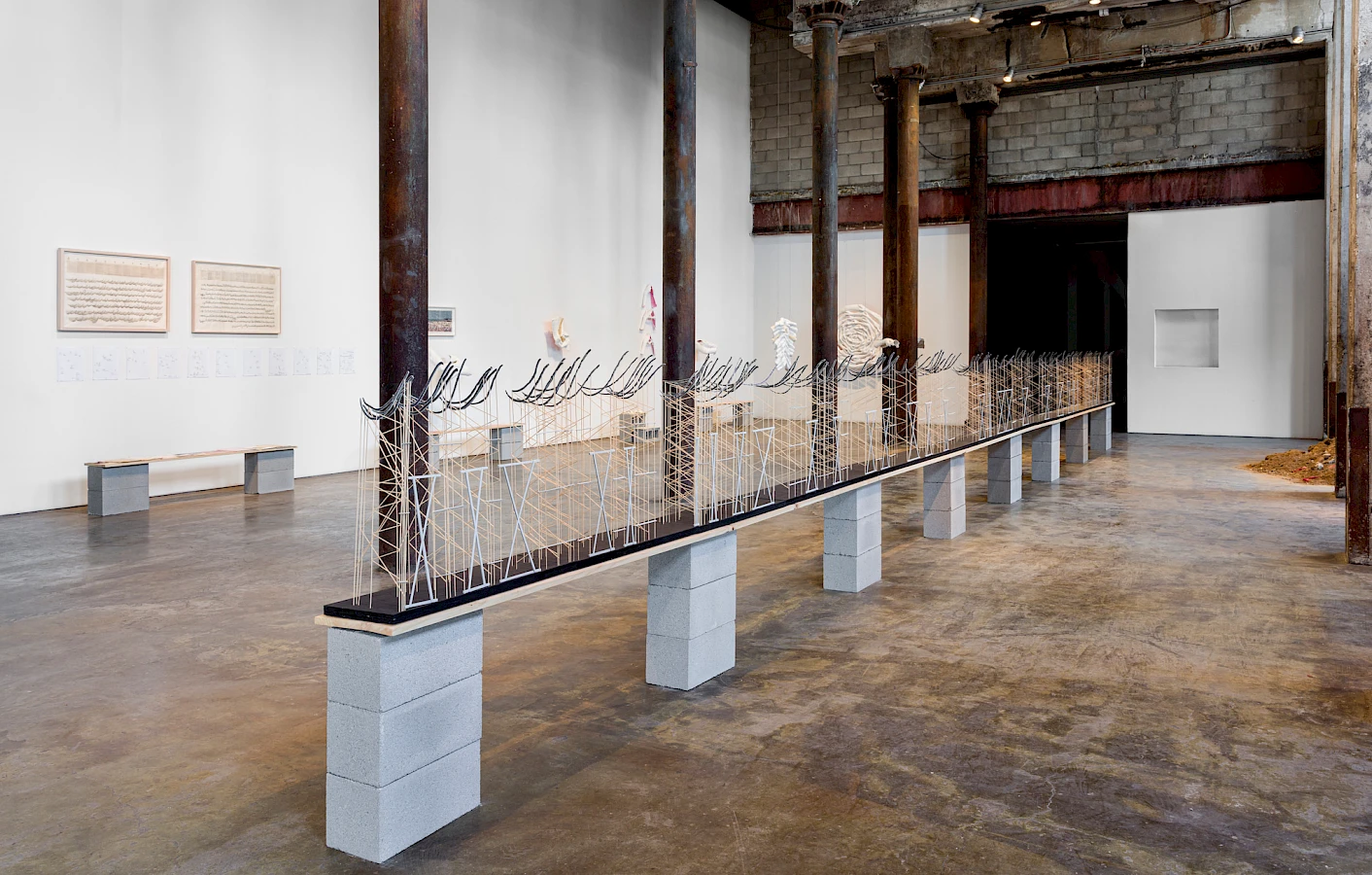
Golnar Adili, Ye Harvest from the Eleven-Page Letter Installation, 2026, transfer print on Japanese paper, archival blue board, beeswax, dowels. Installation shot, ‘To Measure the Emotions of Others’, Smack Mellon gallery, Brooklyn, 2026. Photo: Etienne Frossard
Adili’s visual installations dwell in the pain of the distance imposed by discriminatory US immigration policies against Iranians and the crackdown on dissent unleashed by the Iranian state. Her story troubles the dominant narratives of the Iranian diaspora, which have demonized the Islamic Republic and embraced US exceptionalism, rarely taking into account the repressive role the US played in propping up the Shah’s dictatorship, training the secret police force to torture dissidents, and driving Iran’s unequal economic development. Diasporic hostility to the post-1979 Iranian government has generally been coupled with the adoption of neoliberal multicultural strategies for belonging in the United States, and the assertion of a pre-Islamic Persian ‘Aryan’ identity that eschews affiliations with other Muslims or racialized populations.2 In sharp contrast to the solidarity politics of the anti-Shah Iranian diaspora I studied in my book, and of which Adili’s parents were a part, the mainstream contemporary Iranian diaspora takes a cynical view of Palestine, viewing this ongoing site of injustice as little more than a talking point of the Islamic Republic.
Decades of dominant diasporic strategy that has aligned with US hegemony, as the US has waged war on Iran’s neighbours in Afghanistan and Iraq, has unleashed domestic surveillance and repression against Muslim populations within the US, and has armed and abetted Israel’s genocide against Palestinians, reached its apogee in January 2026. The massive uprising against intolerable economic conditions that began in Iran in late December ended in the unprecedented large-scale massacre of protesters by the Iranian state in early January. Calls for the US and Israel to launch a military assault on Iran blared relentlessly from Iranian diasporic media outlets, captured social media feeds, and mobilized thousands of Iranians onto the streets of major cities in North America and Europe. For much of the mainstream of the Iranian diaspora, which had long hoped to see the Islamic Republic overthrown, the monarchy reinstated, and Iran returned to the US sphere of influence, this nostalgic fantasy reached its fullest articulation as a form of fascist demand: to unleash destruction so that the true Iran could be ‘restored’. The slogan ‘Make Iran Great Again’ appeared at many pro-war Iranian diaspora rallies, along with the American flag, the Israeli flag, and the old monarchist flag of Iran, illustrating the affective and political resonance between these loudest expressions of Iranian diasporic politics and the right-wing ethno-nationalism of Trump’s America and Netanyahu’s Israel.
It was in late January 2026, amid this polarizing, devastating and dangerous situation, that Adili’s solo show, ‘To Measure the Emotions of Others’, opened at the Smack Mellon gallery in Brooklyn. Incorporating sculptures, textual installations and original archival materials from her parents’ papers, the exhibition engaged with the multiplicity of loss and the overlapping forms of state violence that tear loved ones apart geographically, emotionally and physically. The title was taken from a letter Giti wrote to Mohammad in 1981, in which she grappled with the family’s fragmentation, the impact of prolonged separation, and the loneliness that comes from not being able to truly convey the feelings that animate and consume us as we go about the routines of daily life. ‘If only one could measure the emotions of others,’ she wrote, expressing a desire as much as a lament. This phrase illustrates what Asian Americanist Sharon Luk calls ‘the imaginative space that correspondence opens at the interstices of mind, body, and feeling, and the dialogical or intersubjective condition of existence that the letter lays bare’.3 ‘If only’ represents that leap into imagination, into a world where intimacy might flourish without borders and hierarchies.
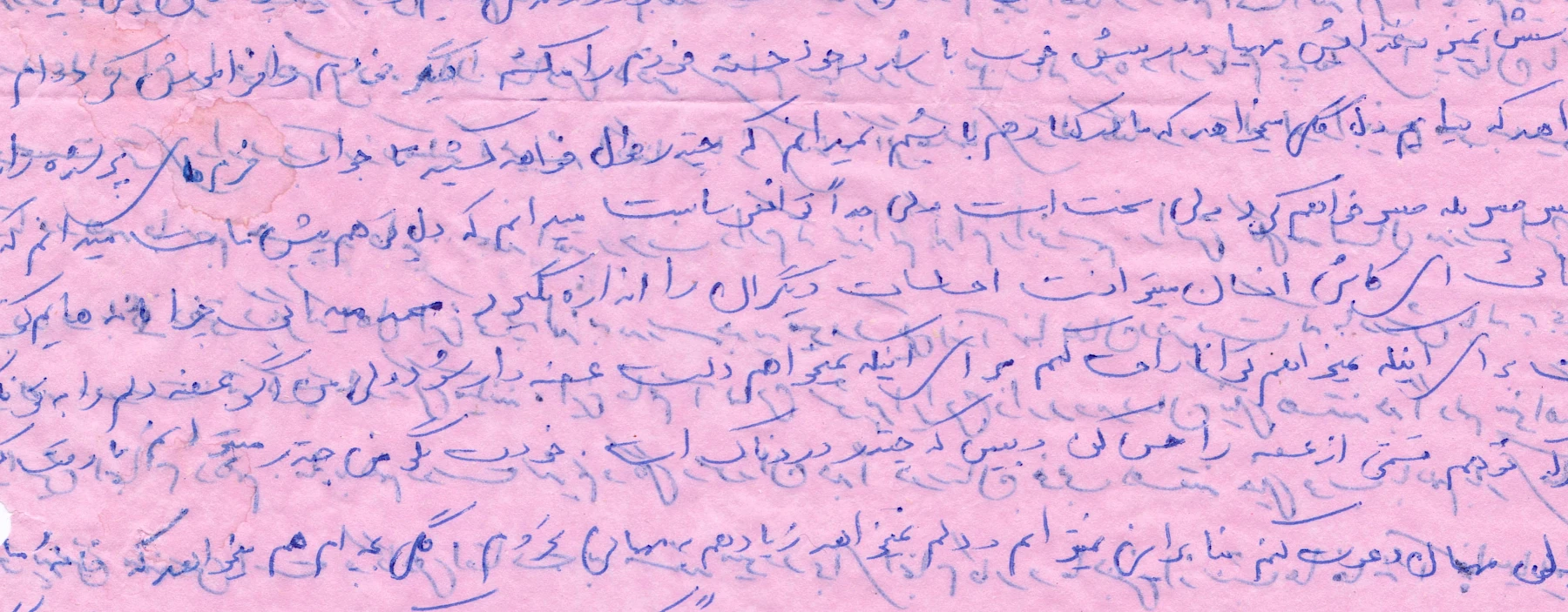
Letter from Giti to Mohamad Adili in 1981 from which the line ‘If only we could measure the emotions of others’ was taken. It is labeled ‘Ey Kash’, which can be translated as ‘if only’. Courtesy Golnar Adili
In Adili’s art, her mother’s wish anchors an ethical practice of empathy, of refusing geopolitical and affective forms of distancing. ‘To measure’ here does not imply quantification, but rather an attunement or receptivity to the emotions of others. Adili, having only read these letters between her parents long after they were written, has turned them into the material for her own exploration of intimacy and language, of memory and loss, and of an approach to mourning that can enable affective modes of solidarity currently marginalized within the Iranian diaspora. She has studied the nuances of handwriting, the specificity of word combinations that lose their full meaning when translated into English, the inclusion of poetic stanzas and popular song lyrics scribbled into the margins, the questions that are left unanswered, and the feeling imbued in each letter that not only the fate of the family, but of history itself, had gone terribly awry.
At the centre of Smack Mellon’s large industrial gallery, Adili placed A Spatial Study of the ‘Ye’ Harvest from the Eleven-Page Letter, a textual installation stretching more than 15 metres, composed of reproductions of the phoneme ye in Persian as it appeared in her father’s handwriting across the eleven pages of a single letter. Ye, which functions as a consonant and a vowel in Persian, curves down and across from right to left when it occurs at the end of a word. Adili meticulously excerpted each ye and rendered it as a three-dimensional object held aloft by a dowel scaffolding. The approximately 137 yes are displayed in a line in the order they appear in Mohammad’s letter. The effect is a mesmerizing, undulating and repetitive motion that invokes waves of grief, while the scaffolding hints at Adili’s prior architectural training and evokes the complex, often contradictory relationship between grief and structure. What are the structures that allow some losses to be grieved while others are disavowed? What structures support us as we grieve and what structures are the cause of our grief?
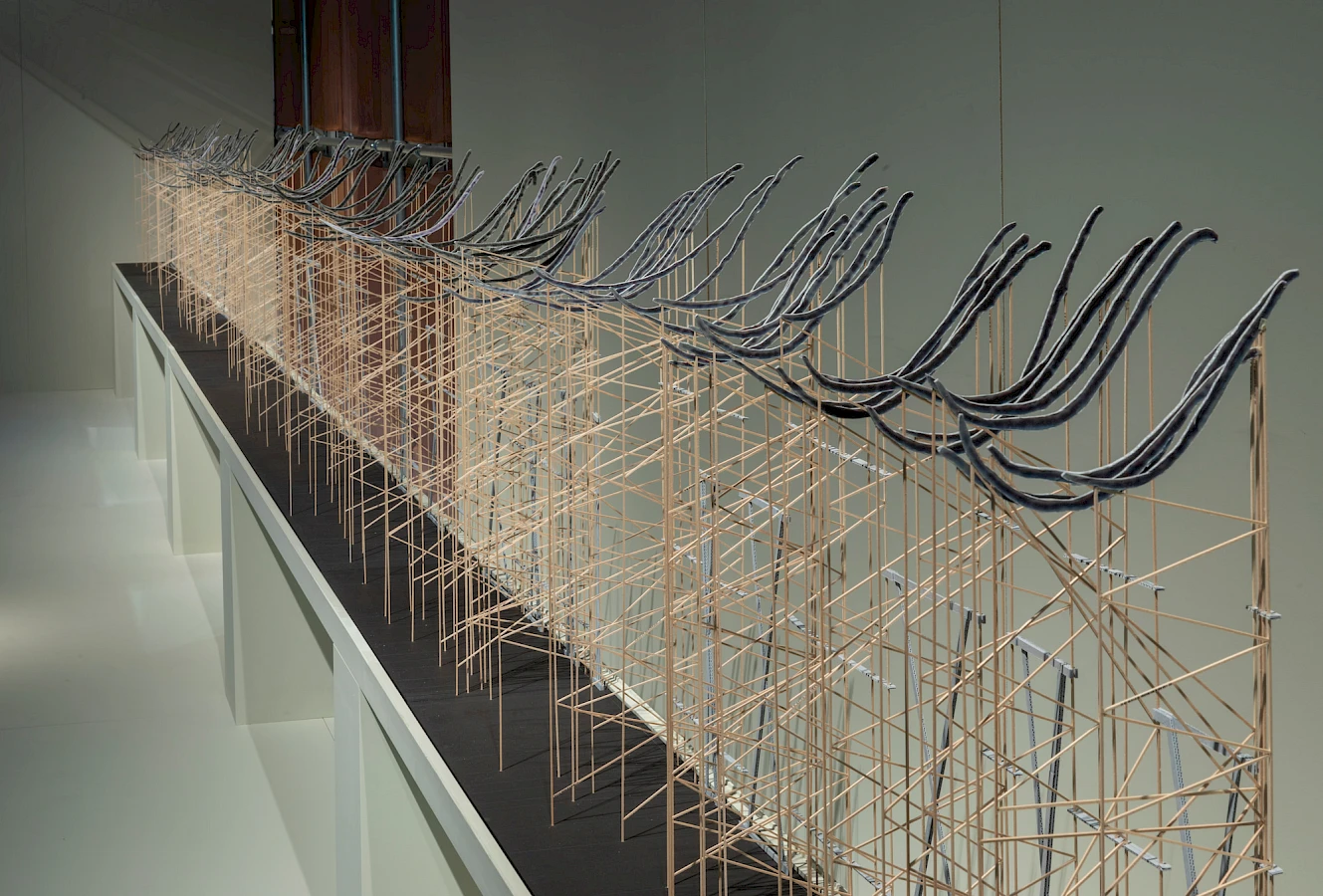
Golnar Adili, Ye Harvest from the Eleven-Page Letter Installation, 2026 (detail), transfer print on Japanese paper, archival blue board, beeswax, dowels. Installation shot, ‘To Measure the Emotions of Others’, Smack Mellon gallery, Brooklyn, 2026. Photo: Etienne Frossard
The meticulous, laborious fabrication by hand of more than one hundred yes can itself be understood as an embodied grieving practice, a ritualistic enactment of the repetitive, physically consuming process of mourning which, like the rippling line of yes, appears to carry on without a clear end-point. This melancholic approach to loss, which queer studies scholars have theorized as loaded with the subversive potential to disrupt heteronormative and nationalist frameworks governing who and what we are allowed to grieve, also makes possible a receptivity to the losses of others.4
In the context of the ongoing genocide in Gaza, the aftermath of the January massacre in Iran, and the start of a new US–Israeli war against Iran, the notion of mourning as capacious and transgressive, rather than private and regulated, has acquired political urgency as a mode of ethical accountability and affective solidarity. This approach infused a series of gauzy sculptures Adili cast from her own arms, as well as those of her mother and her daughter, creating a disturbing entanglement of limbs. All at once the viewer was confronted with disparate and disturbing associations, from the shock and horror of searching for loved ones rendered lifeless by bombs or bulldozers, to the desperate embrace of unbearable sorrow, to the loving gesture of comfort that nurtures across generations. The delicate, gossamer texture of the sculptures, juxtaposed with the unadorned solidity of the cast plaster, conveyed the fragility of life and of solidarity, even as these are, ultimately, all we have to hold on to.
Adili’s exhibition brought the solidarities that animated her parents’ activism and life trajectories into the present by assembling distinct elements of the family’s archive – the records of their separation resonating with the losses and separations caused by the Israeli genocide in Gaza. Arranged around a column, just off-centre from A Spatial Study of the ‘Ye’ Harvest, was a pile of rocks, dirt, bricks and other detritus intended to bring the destruction of Gaza into the gallery space as an unavoidable aspect of contemporary consciousness no matter where we are located, no matter what ethnic, religious or national backgrounds we claim. Adili refused any separation between the losses of state repression and war with which Iranians were consumed and the genocide in Palestine, not because they are the same but because they are deeply intertwined geopolitically and affectively. ‘To Measure the Emotions of Others’ asked viewers to engage with the entanglements of settler colonialism, imperialism and authoritarianism, a conceptual realignment askew from simplistic US/Israel vs. Iran binaries. Such a move, even at the affective level of who and what we count as ‘our’ losses, might just be a prerequisite for a regional vision of self-determination and liberation that is beyond what most of us dare to imagine.
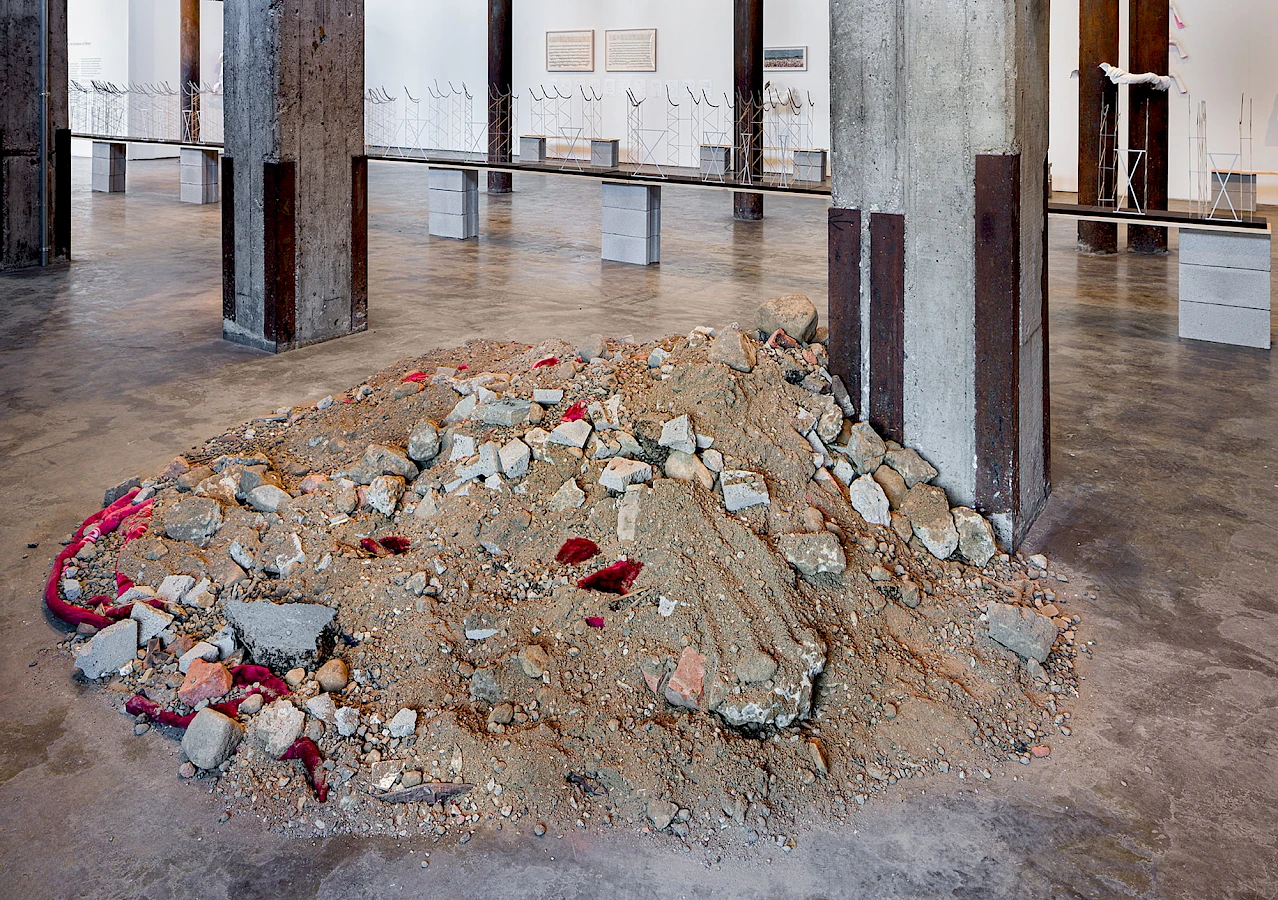
Golnar Adili, Ministry of Utmost Happiness, 2026, rubble, blanket. Installation shot, ‘To Measure the Emotions of Others’, Smack Mellon gallery, Brooklyn, 2026. Photo: Etienne Frossard
Such an act of imagination not only challenges US-Israeli hegemony but also bristles against the constrained logics of the ‘axis of resistance’, that unwieldy formation that includes the Palestinian people, Hamas, Hezbollah, the Houthis and the Islamic Republic of Iran. When Palestinians have been abandoned and betrayed by the world’s most powerful nations and the institutions of international law, it is not hard to understand the popularity Iran enjoys among many who oppose Israel’s expansionist and genocidal actions. Of course, the rise of Islamism as the major idiom of anti-imperialist resistance in the region was not inevitable and emerged as a result of the defeat of the Marxist left, which had successfully spread anti-colonial nationalism as a dominant opposition framework across the region in the 1960s and 1970s. The victory of Ayatollah Khomeini’s factions in the course of the 1979 revolution, and the subsequent liquidation of the Iranian left, is a key part of this story. While Iran under the Shah had been a staunch supporter of Israel, the new revolutionary government officially joined the Non-Aligned Movement in 1979 and welcomed the Palestinian Liberation Organization chairman, Yasser Arafat, as the first foreign leader to visit post-Shah Iran.
Palestine became central to the revolutionary identity of the Islamic Republic.5 Over the course of several decades during which internal struggles for reform in Iran were suppressed by state violence, large swathes of the population have come to reject an identification with the state and have also become alienated from Palestine. This dynamic should not be conflated with the diasporic support for monarchism and US-Israeli hegemony discussed earlier; it is tied to a particular material experience of authoritarianism and economic decline, in which working- and middle-class Iranians have paid a heavy price for Iran’s isolation on the world stage. Alienation from Palestine did not generally result in support for the US and Israel or for the monarchy among Iranians living in Iran until the levels of state violence, and of outside propaganda, reached new heights in January 2026.
The genocide in Gaza, which began one year after the Women, Life, Freedom uprising in Iran, galvanized the entire world, creating conditions of moral and ethical outrage that have generated new expressions of solidarity among Iranians critical of the Islamic Republic. Because the Women, Life, Freedom movement initiated a feminist revisioning of society against all forms of domination and violence, it also created a new context for Iranian expressions of solidarity with Palestine outside the ‘axis of resistance’ framework. A full exploration of feminist efforts to reclaim Palestine from the Iranian state and enact affects of solidarity linking Iranian and Palestinian desires for freedom is beyond the scope of this essay. However, this grassroots, anti-statist mode of affiliation, while still marginalized within Iran and within the Iranian diaspora, holds the potential to challenge divisive logics that cast the butchers of grassroots Iranian movements for equal rights, democracy and a livable future as the champions of Palestine.
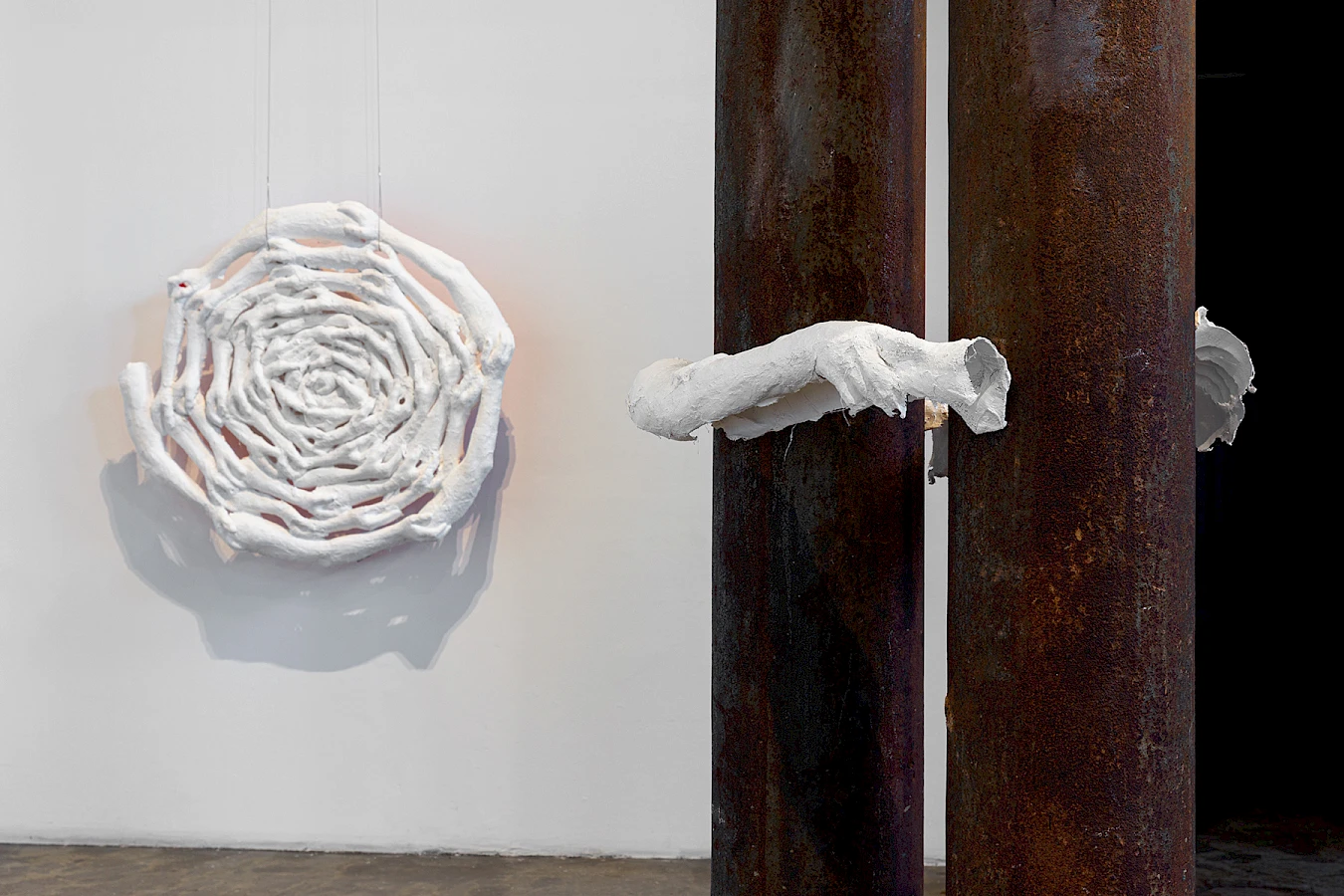
Left: Golnar Adili, Falak, 2026, plaster, gauze, paper, metal mesh. Right: Golnar Adili, Khoda Hafez, 2026, plaster, gauze, paper, magnets. Installation shot, ‘To Measure the Emotions of Others’, Smack Mellon gallery, Brooklyn, 2026. Photo: Etienne Frossard
If there is any hope of Iranians inside Iran shifting away from the recent popularity of pro-monarchist, pro-Zionist orientations, affective alienation from the Islamic Republic needs to be channelled differently. Leftists will have to offer alternatives for approaching the compound crises gripping Iranian society that are more compelling than right-wing pro-war voices, without minimizing the pain and loss Iranians have experienced at the hands of their own government in the name of anti-imperialism. Perhaps a new iteration of anti-imperialism that includes a critical account of ethno-nationalism, heteropatriarchy and capitalist modes of development will be theorized and circulated out of sheer necessity, to respond to the material conditions Iranians are facing and in order to imagine a future in which Palestinians and Iranians can be free. I have tried to sketch the contours of such a stance with the concept of ‘intersectional anti-imperialism’, borrowing and adapting the insights of radical Black feminists, including the members of the Combahee River Collective, Angela Davis and Patricia Hill Collins, to show how multiple structural forces of oppression – from the Iranian state, to US and Israeli bombs and sanctions – intersect on the bodies and in the lives of ordinary Iranian people.6 Rather than picking one form of domination over another, an intersectional anti-imperialism offers a vocabulary for redefining self-determination as a liberatory project against empires and nation-states alike. This is, after all, how some Iranians, including artists like Adili, already feel and how they situate their work. In this current moment of authoritarianism and fascism, when the internationalist left remains weak, it may be at the level of affect rather than ideology, through an embodied response to the injustice, the suffering and the steadfastness that shapes Palestinian experience, that grassroots Iranian affiliations with Palestine become possible today.
For the exhibition’s closing event, which occurred in late March 2026 as US and Israeli bombs were still falling on Iran, Lebanon and Gaza, Adili wanted to create a space of interaction and reckoning, where members of different communities could connect through a shared emotional register of grief. She asked me to facilitate the event, ‘Finding Solidarity and Resistance in Collective Mourning’, partly because of my work on the Iranian diaspora and the politics of solidarity, but also because the geopolitical upheavals that separated her from her father also took her from me. Our parents had been friends and comrades in Washington DC in the 1970s, and she and I had been toddler playmates, gleefully unaware of the changes that were coming. Our fathers travelled back to Iran together in 1979 to witness for themselves the revolutionary transformation under way. When Adili moved to Iran with her parents, no one explained to me where my friend had gone or why. From my perspective, she had disappeared, leaving a sadness that would take years for me to name. When Adili and I met again in New York in 2009, it was amid the pro-democracy ‘green’ movement in Iran, and the diaspora was galvanized around the hope for meaningful reform, not ‘regime change’ by foreign powers. Our friendship was rekindled in the midst of this rising tide of optimism, and we have since shared a diasporic experience of the many ups and downs of internal struggles over the future of Iranian society. We inherited the anti-imperialist Third Worldist perspectives of our parents’ generation and reconfigured them through our own distinct experiences of the ravages of twenty-first-century US empire and the brutalities of the Islamic Republic. Our affective attachment to a free Palestine resides in our bodies because of how we were raised, and we have had to find the words to articulate this feeling alongside and with the embodied refusal to accept anything less than freedom for Iranians.
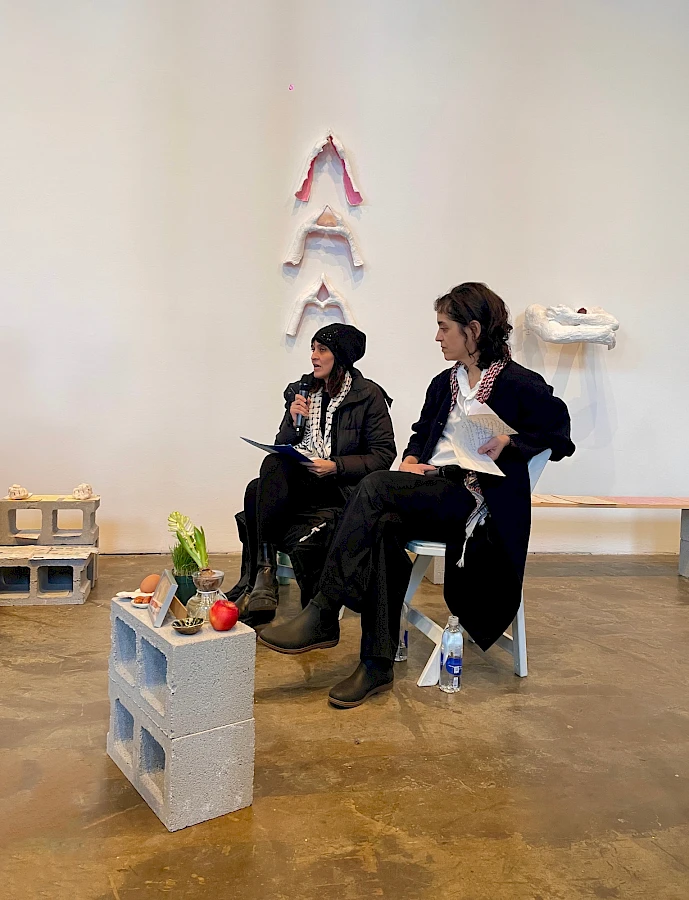
Manijeh Moradian (left) and Golnar Adili speak at the closing event, Smack Mellon gallery, Brooklyn, 28 March, 2026. Photo: Melika Abikenari
‘Finding Solidarity and Resistance in Collective Mourning’ was Adili’s effort to create a space where Iranians, Palestinians and everyone horrified by genocide and war could sit together surrounded by the exhibition’s aesthetic and material engagements with loss. Collective mourning became a vehicle for potential transformation and action, an antidote to the censorship, fear and numbness that can lead to paralysis and despair. The audience was encouraged to notice the connections between war and genocide in West Asia and the assaults on immigrants, trans people, people of colour, activists and so many others in the United States. After engaging with particular aspects of the archive and the artwork, the musician and vocalist Mani Nilchiani performed a rendition of ‘To Ey Pari Kojayee’, by the twentieth-century Iranian classical composer Homayoun Khorram, made popular by the master of modern classical Persian singing, Hossein Ghavâmi. The plaintive beauty of Mani’s voice and the notes of the traditional tar string instrument reverberated through the gathering, their melancholic affects moving people to tears even if they could not understand the Persian lyrics. Adili found these lyrics, which describe an endless wandering, a desperate search for an elusive beloved who can neither be possessed nor forgotten, in her father’s handwriting in the margins of a letter, not once but twice, and she remembers he used to sing it to her after she returned from Iran, ending their long separation. Like melancholia itself, the song expresses the desire for a lost love object, which could be a lover, a friend, a daughter, a country, or even an idea of a future that might have been.
The refusal to relinquish that which has been lost can animate an ethical practice of searching for justice, an inability to make peace with the world as it is. The tears on the faces of friends and strangers gathered in the gallery space showed the strain of living in an unjust world while pursuing the elusive desire for things to be otherwise. If we could mourn for Palestine, Lebanon and Iran at the same time, if we could let the rage and grief and despair wash over us, perhaps these shared affects could also sustain the solidarities necessary for a different kind of politics.
‘Finding Solidarity and Resistance in Collective Mourning’ occurred in the midst of the Iranian new year holiday, Nowruz, which begins at the moment of the Spring Equinox and lasts for thirteen days. The holiday centers around rituals of renewal and hope, feelings that were difficult to sustain in the midst of war. Adili created a novel Nowruz ritual to end the event, inviting each person to write down a wish for the year ahead and add it to the rubble. The ‘if only’ of her mother’s words and the exhibition’s title became a jumping off point for each of us to imagine a more just future emerging from the destruction of the present.
Related contributions and publications
-
Poetry Against Language Dioxide
Rana IssaInternationalisms -
Reading the Dead of Gaza: Musha’ as mentality
Philip RizkInternationalismsLand RelationsPast in the Present -
Right now, today, we must say that Palestine is the centre of the world
Françoise VergèsInternationalismsPast in the Present -
…and the Earth along. Tales about the making, remaking and unmaking of the world.
Martin PogačarLand RelationsClimatePast in the Present -
The Kitchen, an Introduction to Subversive Film with Nick Aikens, Reem Shilleh and Mohanad Yaqubi
Nick Aikens, Subversive FilmSonic and Cinema CommonslumbungPast in the PresentVan Abbemuseum -
The Repressive Tendency within the European Public Sphere
Ovidiu ŢichindeleanuInternationalismsPast in the Present -
Rewinding Internationalism
InternationalismsVan Abbemuseum -
Troubles with the East(s)
Bojana PiškurInternationalismsPast in the Present
Related activities
-
–MACBA
Song for Many Movements: Scenes of Collective Creation
An ephemeral experiment in which the ground floor of MACBA becomes a stage for encounters, conversations and shared listening.
-
–Van Abbemuseum
The Soils Project
‘The Soils Project’ is part of an eponymous, long-term research initiative involving TarraWarra Museum of Art (Wurundjeri Country, Australia), the Van Abbemuseum (Eindhoven, Netherlands) and Struggles for Sovereignty, a collective based in Yogyakarta, Indonesia. It works through specific and situated practices that consider soil, as both metaphor and matter.
Seeking and facilitating opportunities to listen to diverse voices and perspectives around notions of caring for land, soil and sovereign territories, the project has been in development since 2018. An international collaboration between three organisations, and several artists, curators, writers and activists, it has manifested in various iterations over several years. The group exhibition ‘Soils’ at the Van Abbemuseum is part of Museum of the Commons. -
–VCRC
Kyiv Biennial 2023
L’Internationale Confederation is a proud partner of this year’s edition of Kyiv Biennial.
-
–MACBA
Where are the Oases?
PEI OBERT seminar
with Kader Attia, Elvira Dyangani Ose, Max Jorge Hinderer Cruz, Emily Jacir, Achille Mbembe, Sarah Nuttall and Françoise VergèsAn oasis is the potential for life in an adverse environment.
-
MACBA
Anti-imperialism in the 20th century and anti-imperialism today: similarities and differences

PEI OBERT seminar
Lecture by Ramón GrosfoguelIn 1956, countries that were fighting colonialism by freeing themselves from both capitalism and communism dreamed of a third path, one that did not align with or bend to the politics dictated by Washington or Moscow. They held their first conference in Bandung, Indonesia.
-
–Van Abbemuseum
Maria Lugones Decolonial Summer School
Recalling Earth: Decoloniality and Demodernity
Course Directors: Prof. Walter Mignolo & Dr. Rolando VázquezRecalling Earth and learning worlds and worlds-making will be the topic of chapter 14th of the María Lugones Summer School that will take place at the Van Abbemuseum in Eindhoven.
-
–MSN Warsaw
Archive of the Conceptual Art of Odesa in the 1980s
The research project turns to the beginning of 1980s, when conceptual art circle emerged in Odesa, Ukraine. Artists worked independently and in collaborations creating the first examples of performances, paradoxical objects and drawings.