Reading the Dead of Gaza: Musha’ as mentality
Filmmaker and writer Philip Rizk takes the title and inspiration for his essay from philosopher Denise Ferreira da Silva. By reading and listening to the dead in Palestine, Rizk argues we might come to understand the ‘radical potential for life’ – a potential that would necessarily entail reclaiming liberatory relationships across land and bodies. The text was commissioned as part of Usufructuaries of Earth, a project in three chapters (an exhibition, reading groups and an online publication, and a convention) convened by Marwa Arsanios and Wietske Maas, BAK, basis voor actuele kunst, Utrecht, May-June 2024. It was completed in February 2025 and a postscript added in May 2026.
I am trying to read the Dead during the ongoing sought-after annihilation of Life in Palestine’s so-called Gaza Strip. Accompanying me is Denise Ferreira da Silva’s essay ‘Reading the Dead: A Black Feminist Poethical Reading of Global Capital’.1 There the philosopher writes, ‘the wounded flesh exposes total violence as a means that ensures profit and its accumulation through the appropriation of total value, that is, that global capital consists in nothing more than the expropriated productive capacity of slave bodies and Native lands’.2 I keep in mind that no two contexts are the same – Palestine’s ongoing genocide, unfolding over two centuries, is not the same as the long pasts of the Indigenous communities of the Americas, of over 500 years of genocide and slavery. In Palestine, I focus on Native lands, where vital recovery of land can only be liberatory if the relationship humans once had to that land is critically reclaimed. While holding space for the material and psychological consequences of Israel’s attempted annihilation of Life in Palestine, most especially in Gaza, I want to identify the radical potential for Life, through the act of listening to the Dead who lie inside its lands.
In her essay, Da Silva builds on critical theoretical categories introduced by the literary critic Hortense Spillers in her essay ‘Mama’s Baby, Papa’s Maybe’ written in the summer of 1987, months before the Palestinian Intifada shook the Zionist colonization project to its core:
But I would make a distinction in this case between ‘body’ and ‘flesh’ and impose that distinction as the central one between captive and liberated subject-positions. In that sense, before the ‘body’ there is the ‘flesh,’ that zero degree of social conceptualization that does not escape concealment under the brush of discourse, or the reflexes of iconography … If we think of the ‘flesh’ as a primary narrative, then we mean its seared, divided, ripped-apartness, riveted to the ship’s hole, fallen, or ‘escaped’ overboard.3
Spillers created the category of the ‘flesh’ because she had found herself unable to theorize the horror of lived colonized, enslaved, murdered Black lives – a moment where, as she writes, ‘the language broke down’.4
Today, again, the language has broken down.
After spending weeks in the Gaza Strip as a volunteer, surgeon Ghassan Abu Sitta asks, ‘Where do you bury a little boy’s leg?’5 He maps out the workings of one of Israel’s illegal weapons: ‘Phosphorous burns drill their way through until they have reached a very deep part of the body because as a chemical it continues to burn until it is no longer exposed to oxygen.’6 In January 2024, someone in Gaza City said: ‘They follow us to our graves even after we are dead.’7 Reports detail the invading soldiers opening graves to steal warm bodies; elsewhere Israeli military bulldozers destroy graves, leaving tracks identifiable on footage from space.8 ‘For the past 435 days, I’ve seen a dead body every single day. I’ve heard the screams of parents every single day. I’ve seen the flesh of children every single day’ – journalist Hossam Shabat.9 ‘The dogs took out a body from one of the graves and were eating it’, says Rehab Abu Daqqa, living with her children in a tent near a cemetery in Rafah.10 While Israel’s blatant theft of Palestinian land in the West Bank has increased exponentially since 7 October 2023, its collaborator, the Palestinian Authority, sends its security forces to crush Palestinian resistance, killing both fighters and bystanders.11 ‘They embezzle us with some of our own flesh’, one Jenin resident says referring to the local authorities.12 Mohamed al-Kurd begins a talk with the disclaimer, ‘no debate while flesh is still burning’.13
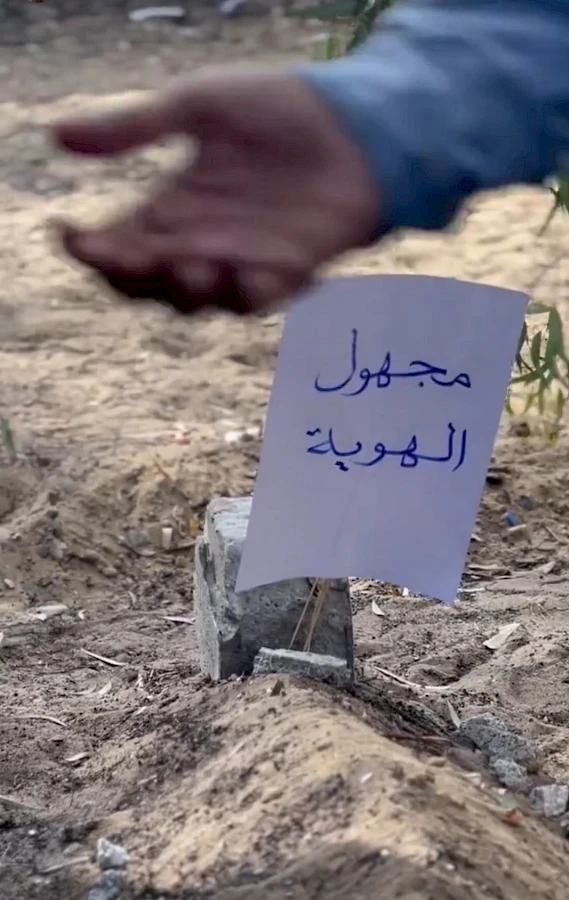
‘Unknown identity’ marked on a grave in the Gaza Strip, 2025. Photo: Unknown photographer
How to speak – how to write – of the grief, the agony, the fear, the despair, the loneliness, the shock, the hunger, the pain, the pain, the pain, the disdain of the world’s centres of power in their full approval of all this? What to do in the face of their excusing, defending, whitewashing, funding, and arming the perpetrator?
For if the flesh holds, as a mark/sign, colonial violence, the Dead’s rotting flesh returns this marking to the soil, and the Dead then remain in the very compositions of anything, yes, as matter, raw material, that nourishes the instruments of production, labor, and capital itself. That is how the dead slave/Native lives in/as capital.14
The flesh of Palestinians marks the open wound of the ongoing sought-after annihilation of Life in Palestine – persisting even during a ceasefire – binding it not only to a settler colonialism, but to global capital. Such processes of indiscriminate murder, mutilation and theft of flesh – of kidnapping and torture of bodies – are permitted because it serves global capital. The eradication of Life in Palestine profits the global weapons industry and simultaneously is an unabashed testing ground for its newest technologies.15 Almost an afterthought are Gaza’s yet-unexploited gas fields, which multinationals are ready to devour off its shores – likely already siphoned off for years by Israel’s nearby drilling – to keep sustaining the gluttonous industries of capital in the centres of power complicit in the annihilation.16
دون أن يودّع أحداً
ولا حتى لحمهAnd bid no one farewell
not even to his flesh
writes Refaat Alareer.17 The Israeli military assassinated the poet and educator in his home alongside his family, likely because, days earlier on live TV, he had made the comparison between the Warsaw Ghetto uprising and al-Aqsa Flood, what some have called ‘the Great Intifada’18 – breaking through an imposed colonial boundary and opening the imaginary for the possibility of Return.19 Alareer echoes the argument of the militant psychiatrist Frantz Fanon on the legitimacy of revolutionary violence in response to relentless colonial brutality. That argument, by now a cliché, is only still urgent in the echo chambers of neocolonial self-righteousness.20 Yet, the act of resistance and ultimately liberation is not limited to the initial breach of the colonial barrier and Palestinians crossing back into their stolen lands, but since the outpouring of absolute destruction on Gazans, it is the ongoing daily radical will of people to live, to breathe, to forage for food, to cook, to study, to dig for the living and the dead beneath the rubble, of mothers to nurse the babies of other murdered mothers, of doctors to operate on the injured without vital supplies, to tend to the sick; every single act heroic, and the heroes, protagonists in a narrative of liberation across all of Palestine and along the still-expanding borders of Israel.21
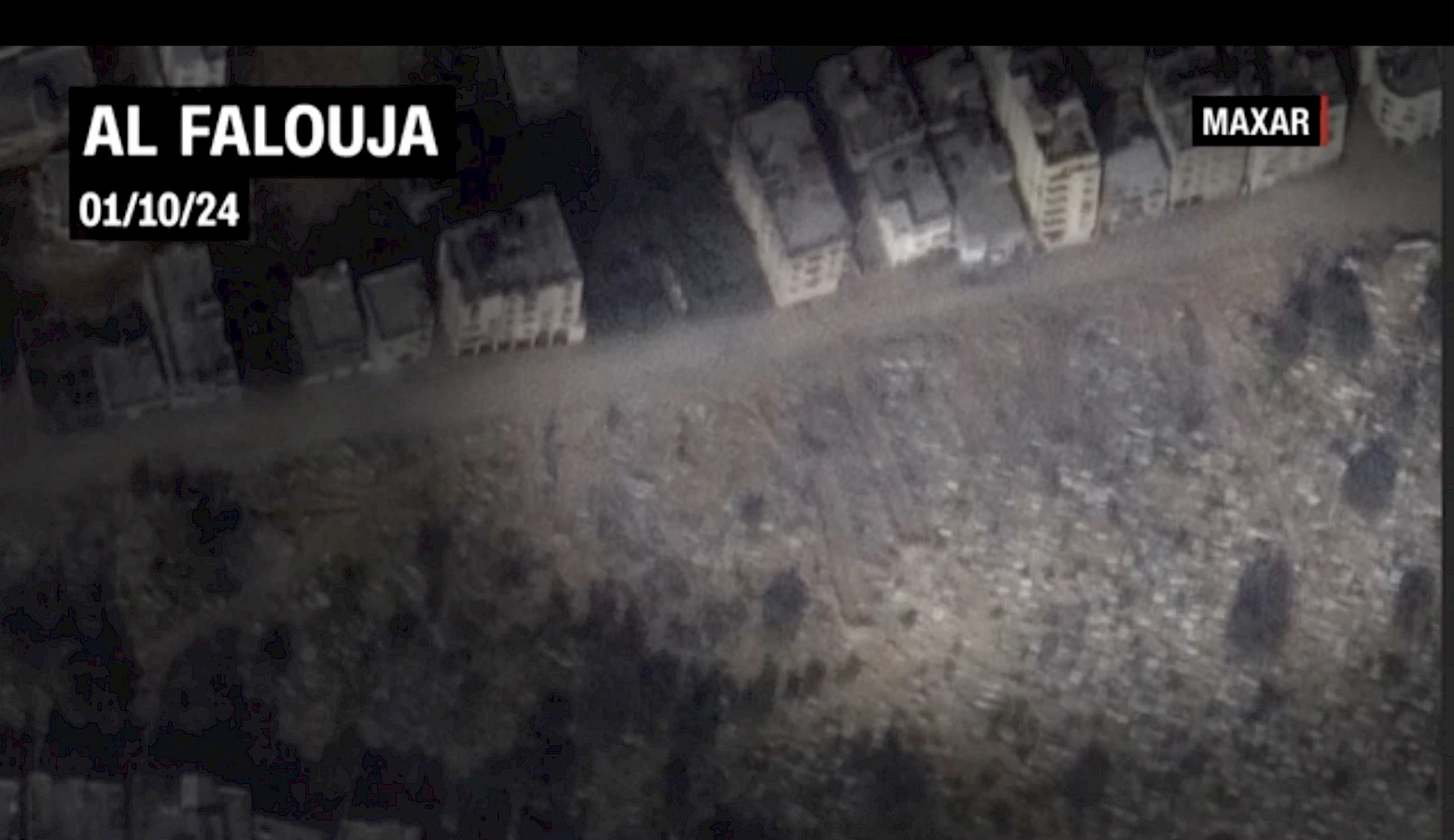
Bulldozer tracks visible on graves in Falouja Cemetery, Jabalya, North Gaza, 1 October 2024. Photo: Maxar
Nadera Shaloub-Kevorkian identifies the wounded flesh as exposing something more, a liberatory tendency in the act of searching for ashlaa’ – the flesh of the shredded body – of strangers and loved ones. For the Palestinian criminologist, ashlaa’ is ‘both a sign of extreme violence and terror, as well as a refusal of such genocidal dehumanization’, while those who search for and speak of ashlaa’ are powerfully ‘using their own language and Arabic syntax, producing their own morphology’.22 These acts of resistance stage ‘the architecture of the shredded body as a source of power against the violence of anti-Palestinian racism and Zionist supremacy’, by which, she writes, ‘Gazans are refusing physical and social dismemberment, instead choosing the path of actual and epistemic reunification through collecting and unifying the ashlaa’ … [and thereby] connect the past and the present, the living and the dead’.23
Such a reading challenges and breaks with certain norms of common reason. In the face of unspeakable brutality of the genocide, a reading of the Dead must entail a ‘refusal to engage, to maintain thinking within the limits … of modern thought’.24
Death is not defeat in revolutionary struggle.25
Musha’ as mentality
Once we break from our own commitments to the liberal paradigm – once we stop being occupied by its ludicrous claims – only then can we ask: What do the Dead of Gaza, the ashlaa’ of Palestinians, mean for the coming liberation – all of ours?26 In order to venerate the Dead there must be a radical break with modernity’s present, sincerely seeking ‘the destruction of pre-existing institutions’ – guerrilla warfare’s raison d’être, a striving for ‘the end of the world as we know it, which entails listening to the Dead’.27 Those who stand with Palestinians while living outside Palestine must take advantage of the luxury of not being consumed by the eye of the storm, and act on the premonition that ‘the enemy never withdraws sincerely’.28
What have the Dead of Gaza been saying?
The act of refusal in the face of the genocidal killing machine, the act of persistence, the streaming of inhabitants of Gaza back to their mostly obliterated homes in the North – is an act of defiance, and devotion to the land. The living and the Dead of Gaza embody the cosmology of sumoud, a cleaving to the land. The priority of colonizers on the other hand, has always been the taking of land, which by necessity entailed the violent transformation of peoples’ communal relations to the land, into one of ownership.29 The jurist and Nazi Carl Schmitt wrote of that colonial act: ‘In every case, land-appropriation, both internally and externally, is the primary legal title that underlies all subsequent law.’30 As elsewhere, it applies in Palestine, where the ‘transformation of ‘Palestine’ into the ‘Land of Israel’ by colonial default entailed the expropriation of land’, since the Zionists believed that ‘after the Arabs are transferred, the country will be wide open for us … . Not a single village or a single tribe must be left’.31 If the founding principle of the colonial enterprise is the expropriation of land – as Schmitt laid bare – one that is still ongoing today in Israel’s expansion everywhere it can, be it Northern Gaza, the West Bank, Southern Lebanon, or Southwestern Syria, then decolonization must certainly include the undoing of that expropriation, and vitally entail the dismantling of the mentality which that expropriation imposes.
If one listens closely enough, they might make out ancestors everywhere speaking of the necessity of undoing the relationship to land that the colonizers enforced in order to make possible the expropriation: private property, which causes the separation between humans and the land through the destruction of land commons, in Palestine and its environs أرض مشاع.
The term ard musha’ is used differently from region to region within the former Ottoman Empire, referencing a variety of systems of land distribution, it is the dominant understanding of it that I will be referring to here.32 For many people in the region ard musha’ once identified ‘the community … as a custodian of the right to produce (i.e., to subsist) to which each member is entitled by virtue of kinship or residence’, it is a system of collective stewardship outside the liberal rights regime.33 Musha’ land demarcated a social relation within the community and with the land itself, reverberating across the Earth, ‘for everyone, everything’. Al-ard al-musha’ is critically anti-capitalist as our struggles must be, while realigning human relations with the Earth by countering capital’s drive of infinite expansion, certainly a proponent of the sought-after annihilation of Life in Palestine.34 Al-ard al-musha’ was a critical obstacle to the colonizing mission and its claim to progress. Colonialism’s end must entail the return of stolen land, yet fully putting out colonialism’s flame requires the undoing of its enforced ideology of private property.35
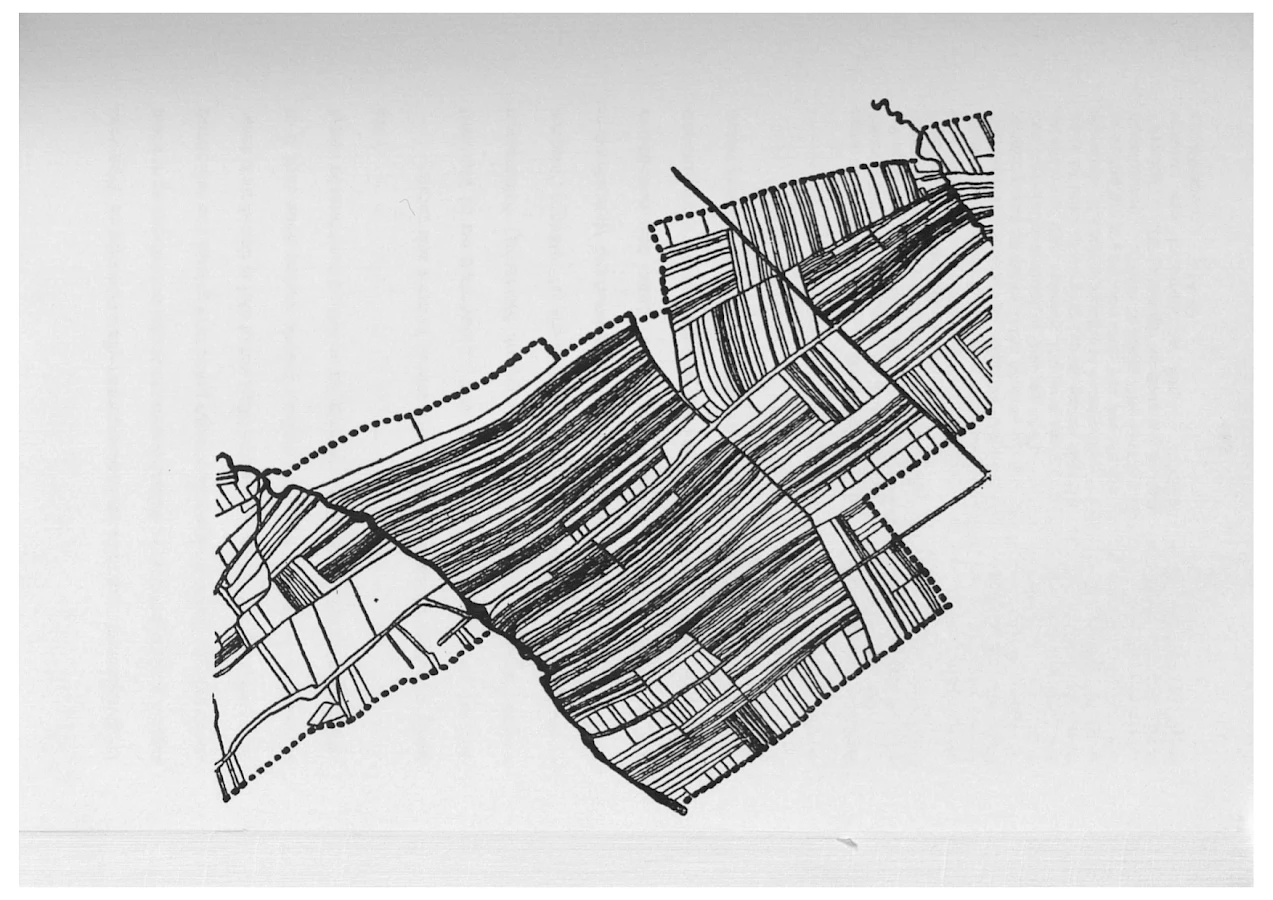
On 1 January 1994, the Zapatista Army of National Liberation (Ejército Zapatista de Liberación Nacional, EZLN) stormed onto the Mexican political scene in response to the ultimate attempt to break up their communal lands (ejido), an ongoing struggle that started with the arrival of the Spanish conquistadors in 1519 but only reached its apex with the neocolonial Mexican government’s privatization of the remaining ejido, as a prerequisite for Mexico signing onto the North American Free Trade Agreement (NAFTA), which would come into effect on that New Year’s Day.36 And so it was on 1 January 1994, that the EZLN occupied towns in the south of Mexico, and burned papers in the state’s land registry. The first political act of the EZLN was to return the ejido to the stewardship of communities, recovering it from capital that sought to finish the job of turning communal land into private property. Later that year, the EZLN published the ‘Second Declaration of the Lacandon Jungle’, which included the words with which Da Silva grapples in her essay:
Facing the mountain we speak with our dead so that they will reveal to us in their word the path down which our veiled faces should turn. The drums rang out and in the voice of the earth our pain spoke and our history spoke.
’For everyone, everything’, say our dead. ’Until it is so, there will be nothing for us’.37
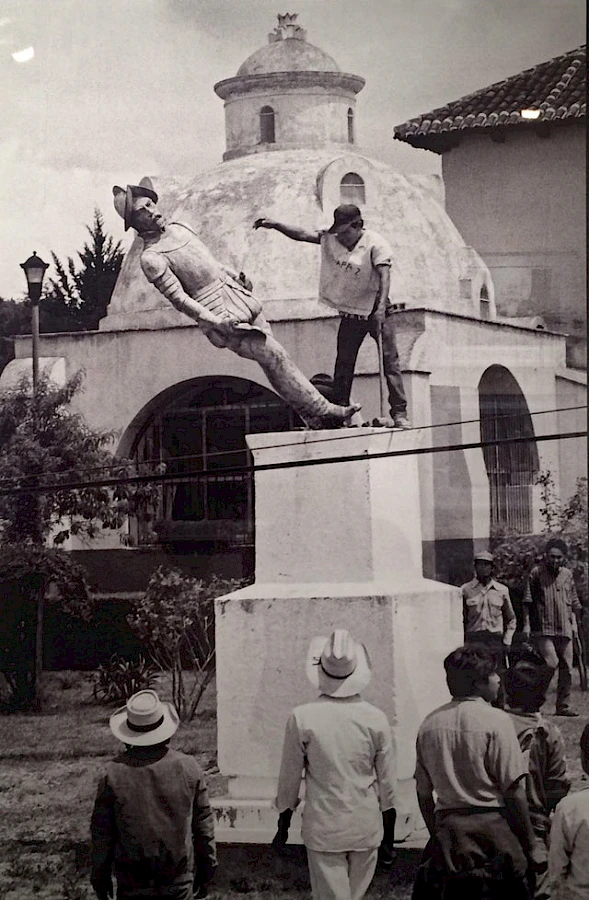
On the 500th anniversary of the arrival of Columbus in the Americas – prompting centuries further of European colonisation and exploitation, a man topples the statue of the inquisitor Diego de Mazariegos in San Cristobal, Mexico. Photo: Antonio Turok
Thirty years later, after ongoing struggles with the state over land, as well as reflection and consultation with their elders, the Zapatistas have come to the realization that despite its communal nature, the ejido remains within the logic of the state, because ‘communal property … only existed if it was registered and that, with the same laws … [the state can] diminish it until it disappears’.38 Consequently, the EZLN called for the critical category of ‘non-property’ outside the purview of the state. While the Ottoman Empire in its final years sought to eliminate property held in common, it was too weak to implement the decision and contrary to the officials’ desires, musha’ lands expanded, reaching an estimated 70 percent of land in Palestine at the moment of its occupation by the British.39 Under Ottoman rule, the land that fell under the musha’ category was considered the ownership of God, who in the Empire was represented by the Sultan, and who in turn conferred it to communities as its collective stewards. Until the failed attempt of the Ottoman Empire and the arrival of colonizers, ard musha’ existed outside the liberal regime of property of the modern nation-state. ‘We should be wary of reifying the notion of al-musha’, writes the anthropologist Martha Mundy, ‘at issue is not a uniform system of tenure but an idiom of cultivators for thinking relations within the village, to the fisc and to land, in terms of shares’.40 This might weaken the term’s applicability as a fixed concept with which to oppose colonialism’s logic, yet this is the case only if we continue to operate within the chokehold of modernity’s workings. Al-ard al-musha’ offers a relationship to land, and a set of strategies, not a totalizing concept, precisely because it didn’t appease the juridical categories of the modern state, thus further strengthening its applicability as a mentality with which to counter the making private, the separation of humans and the land, as well as the state itself, the custodian of this separation. When musha’ becomes a mentality, it allows our ‘political imagination to learn to do without’ the rules of modern thought, one critical step towards decolonization, arguing not for an implementation of ard musha’ as a fixed system in an archaic return to the past, but rather than an embracing of spiral of time by re-assessing past practices for the present.41 In Palestine, this entails retaining the land materially from the Zionist occupation, conceptually from the British colonial project before it, and critically also keeping it from the elites / ruling class of a sought- after Palestinian state.42 What the Zapatistas teach, is that this collectivization of land outside of the purview of the state is ‘necessary to be able to face the storm – nature[’s] … way of protesting, increasingly louder and increasingly terrible’ against modernity’s sowing of ‘darkness, death, destruction’.43 The Zionist occupier’s onslaught continues to annihilate Life, beings of all kind, humans, animals, plants, trees, and finally the soil.44 Israel has imbued the colonial act of ‘scorched earth’ new meaning, including the destruction even of the colonial demarcation of land made private – in areas of its deepest incursions removing every proof of the Carob tree that was the border – Gaza thus demarcates a reset.45 A destruction with a mission of: ‘Everything for us’.
Against this, ‘everything for everyone’ asserted by a musha’ mentality, is the unthinkable transformation from destruction into radical possibility. For what should be done with the land that was once owned by families, the entirety of which the Zionist occupier has brutally wiped out? As of 21 January 2025, the number of these families is estimated at 2092.46 ‘Everything for everyone’ – make it common. The land for the community as musha’, is an affront to the colonization effort of all types, the martyrs’ decomposing flesh bringing about the land’s renewal. In Mexico, the struggle for land commons has ebbed and flowed for over 500 years and since 1994, communities are once again making lands communal. Making the land musha’, is a place to begin to prepare for the end of the colonization of Palestine, because end it will, as all colonialisms do: it is only a matter of time.47 Under the tyranny of modern thought, decolonization in Palestine is incomprehensible. Yet after Palestinians broke through the colonial walls and returned to their ancestral land – even if temporarily – on the day of 7 October 2023, decolonization is more imaginable than ever.
‘From the river to the sea’, the Dead of Gaza insistently whisper, ‘for everyone, everything’. Prior to the establishment of a Jewish supremacist state in 1948, residents of Palestine, irrelevant of faith, lived side by side; prior to British occupation in 1914, a majority of the inhabitants of the land, and the land itself lived free of the myth of private property.48 ‘From the river to the sea’ expresses a notion that is not national, but decolonial. ‘From the river to the sea’ articulates radical relations between all beings, including humans to the land. ‘From the river to the sea’ relays the necessity to re-set our compasses – all of them.
Postscript, May 2026
This text was completed during a short ceasefire in Gaza in the winter of 2025. In spite of the latest ceasefire agreement, Israeli state and non-state actors continue to annihilate life in Palestine. On Monday, 11 May 2026, the Israeli parliament passed a law determining that all Palestinians deemed to have participated in the 7 October attacks will be put on trial before a military tribunal, which determines the public execution by hanging of anyone found guilty.49 This manifests yet another level to the ongoing murder of Palestinian life by systematic, state-sanctioned judicial means.
Meanwhile, another shift is taking place in the blowback to the recent brutal and illegal attacks by the US and Israel on Iran. By the day, by the hour, a geopolitical realignment is taking shape that will continue to affect realities in Palestine and the region around it, with significant threat to Western narratives of supremacy. The impending show trials of Palestinians will not save the Zionist project in the face of the haughtiness of its leaders and its people.50 The breaking of old systems entails an opening. A vision is necessary for Palestinian life that builds on the past, but is enlivened for the present. A vision that sets an example for the world.
Glory to the martyrs
المجد للشهداء
The author thanks Linda Quiquivix, Denise Ferreira da Silva, and Marwa Arsanios for their feedback on earlier drafts. Notes: The author has chosen to link archive.is for online sources where possible. However, the original url is listed in the link.
Denise Ferreira da Silva, ‘Reading the Dead: A Black Feminist Poethical Reading of Global Capital’, in Tiffany Lethabo King, Jenell Navarro and Andrea Smith (ed.), Otherwise Worlds: Against Settler Colonialism and Anti-Blackness, Durham: Duke University Press, 2020, p. 43. As I finalize this text, a shaky ceasefire has come into effect. The bombing might stop, or at least be significantly reduced, but all the elements for the ongoing elimination of Palestinian life have been put into effect: the destruction of 92 percent of homes; the destruction of most hospitals, spreading disease; and, critically unaccounted for, the destruction of sources of potable water and agricultural land in the Gaza Strip – the annihilation of Life has been set in motion for years to come. The effect of 85,000 tons of bombs on a 365 km2 space doesn’t stop when the bombing stops. Regarding the number of deaths, The Lancet journal has provided a much more likely estimate than either that made by the Health Ministry in Gaza or any numbers claimed by the aggressor, stating that by 19 June 2024 the Israeli war machine had killed 186,000 Palestinians in Gaza. This number is far higher than most current accounts, in part because it takes into account deaths caused not only by direct ammunition, but also those caused by the (entirely intentional) destruction of infrastructure or unavailability of food. The numbers continue to rise much higher still (see Rasha Khatib, Martin McKee and Salim Yusuf, ‘Counting the Dead in Gaza: Difficult But Essential’, The Lancet, 5 July 2024, thelancet.com). I have chosen to avoid relying on the terminology of genocide, not because I don’t think that Israel alongside its global allies are deliberately killing in Palestine ‘a large number of people from a particular nation or ethnic group with the aim of destroying that nation or group’ (the Oxford Dictionary’s definition of the term genocide), but because even the debate around such acts of impunity within the language of genocide maintains a Eurocentric vision on the world, where all elimination of Life and attempts thereof are measured only against those admitted to have been perpetrated by European actors. Europe’s past crimes are not limited to, nor have found their apex in, the genocide of the Shoah – thus, debating whether mass murder and intent to annihilate Life fits into the category of genocide only maintains the myth of the Holocaust’s singularity. The anti-fascist Jewish intellectual Franco Fortini wrote during the 1967 war: ‘Many spokesmen for the so-called ‘culture’ of the West sought extra-historical and metapolitical interpretations and quickly ended up placing the massacre of the Nazis in the register of the ‘sacred’, considering them to be the work of Evil in Itself, basically accepting, while inverting its content, one of the central myths of Nazi mysticism – purity or purification through holocaust … a ‘fixation’ of Nazism in mythological forms … [and] have benefited, in the end, its atypical forms, that is, the equally ferocious ones of modern imperialism’ (Franco Fortini, The Dogs of the Sinai [trans. Alberto Toscano], London/New York/Calcutta: Seagull Books, 2013 [1967], p. 56). On the construction of the category of the ‘Gaza Strip’ see Salman Abu Sitta, ‘I Could Have Been One of Those Who Broke Through the Siege on October 7’, Mondoweiss, 4 January 2024, mondoweiss.net.
Hortense Spillers, ‘Mama’s Baby, Papa’s Maybe: An American Grammar Book’, in Diacritics, vol. 17, issue 2, 1987, p. 67.
Hortense Spillers in Spillers, Hartman et al., ‘Whatcha Gonna Do?’ – Revisiting “Mama’s Baby, Papa’s Maybe: An American Grammar Book”’, Women's Studies Quarterly, vol. 35, issue 1/2, Spring–Summer 2007, pp. 299–309.
Ghassan Abu Sitta, in Mohamed Hashem, ‘Ghassan Abu Sitta: This Is What I Saw in Gaza’ (Part 1) | Real Talk, Middle East Eye, 21 December 2023, middleeasteye.net.
Ghassan Abu Sitta, in Mohamed Hashem, ‘Ghassan Abu Sitta: I'd return to Gaza in a heartbeat’ (Part 2) | Real Talk, Middle East Eye, 28 December 2023, middleeasteye.net.
‘Unearthing the Dead: Israeli Forces Destroy Cemetery in Gaza City’, Al Jazeera, 6 January 2024, youtube.com.
See Noga Klein, ‘Israel Became Hub in International Organ Trade Over Past Decade’, Haaretz, 20 September 2018, haaretz.com This article also appeared in Human Trafficking Search in 2018, humantraffickingsearch.org. See also ‘Bodies Uncovered in Gaza Mass Graves Raise Suspicions of Organ Theft - Paramedics and Rescue Teams’, WAFA News Agency, 26 April 2024, english.wafa.ps; ‘Israeli Army Defiles Hundreds of Graves in the Gaza Strip, Steals Dead Bodies’, Euro-Med Human Rights Organization, 7 January 2024, euromedmonitor.org.
‘For the past 435 days, I’ve seen a dead body every single day. I’ve heard the screams of parents every single day. I’ve seen the flesh of children every single day. All this horror will change you, and I will never be the same.’ Hossam Shabat, X, 15 December 2024, x.com. On 24 March 2025, the Israeli military killed the twenty-three-year-old Shabat after having placed him on a ‘hit list’. Shabat was the 206th documented journalist the Israeli military killed since the start of the genocide.
Fergal Keane, ‘Israel-Gaza War: ’My Children Cling to Me as Dogs Raid Rafah Graves Near our Shelter’, BBC News, 5 May 2024, bbc.com.
Lorenzo Tondo and Peter Beaumont, ‘Israel Has Approved “Largest West Bank Land Grab in 30 Years”, Watchdog Says’, The Guardian, 4 July 2024, theguardian.com. On the problematics of the Palestinian Authority, see fn. 40.
Abdaljawad Omar, ‘The Politics of Betrayal: Jenin, Abbas, and the Hellscape of Gaza’, Mondoweiss, 24 December 2024, mondoweiss.net.
Mohamed al-Kurd, ‘This House Believes Israel Is an Apartheid State Responsible for Genocide’, 5 December 2024, youtube.com.
See ‘European money for the war in Gaza: How EU research funding supports the Israeli Arms industry’, Statewatch, 22 March 2024, statewatch.org; ‘Companies Profiting from the Gaza Genocide’, American Friends Service Committee, 6 June 2024, afsc.org; Yuval Azulay, ‘Small Defense Firms See Big Gains as War Drives Massive Investments’, CTECH, 23 May 2024, calcalistech.com; finally, see Salman Abu Sitta’s rebuttal of President of the European Commission Ursula von der Leyen’s speech on the 75th anniversary of the establishment of the state of Israel, Palestine Land Society, 16 May 2023, plands.org.
‘U.S. to Push Israel on Allowing Gaza Offshore Gas Reserves to Revitalize Palestinian Economy’, Haaretz, 20 November 2023, haaretz.com; Walid Abuhelal, ‘The War on Gaza Is Also an Israeli Drive to Seize Palestinian Gas Reserves’, Middle East Eye, 20 February 2024, middleeasteye.net.
Refaat Alareer, ‘If I must die’, 14 December 2023, Gaza City (see e.g. Adi Callai, ‘The Gaza Ghetto Uprising’, The Brooklyn Rail, May 2024, brooklynrail.org).
‘Great Intifada’ is a reference to historian Abdelqadir Yassin, cited in Fahmi Howeidi, ,فهمي هويدي ما جرى في 7 أكتوبر، الجزيرة، ٢٩ ١ ٢٠٢٤ (What Happened on 7 October), Al Jazeera, 29 January 2024, aljazeera.net.
See Adam HajYahia, ‘The Principle of Return’, Parapraxis Magazine, 7 April 2024, parapraxismagazine.com; and Salman Abu Sitta, ‘I Could Have Been One of Those Who Broke Through the Siege on October 7’ (see fn. 1). It is also Abu Sitta – enemy of the state number one in Germany because he undermines the unstated contract (that of Germany in particular and of ‘the Christian West’ in general) of making good for Germany’s crimes of the past by supporting without question Israel’s crimes of the present – who has mapped out how such a return can be possible (Dr Salman Abu Sitta, ‘RETURN PLAN 2023’, speech delivered at Palestine Writes, Philadelphia, 23 September 2023, Palestine Land Society, plands.org). In order to counter the threat to the Zionist colonial project of the possibility of the Return, the discourse of Palestinian men, in particular Hamas members, as sexual predators was created and amplified in order to justify all the murder that has followed – this is not an assessment on the actual occurrence of rape on October 7 but reflects on the discourse that emerged – mirroring the weathered colonial trope of the black-man-as-rapist, guilty or not; see also Philip Rizk, Terror Tales (2024), filfilfilm.com. This trope is that much more insidious as report after report has emerged of the systematic use of sexual violence used against Palestinian prisoners as a form of torture in Israeli prisons. See for example B’tselem, ‘Welcome to Hell: The Israeli Prison Network as a Network of Torture Camps’, August 2024, btselem.org, where sexual violence is reported on as one of various documented forms of systematic torture against Palestinian inmates in Israeli prisons, or the Independent International Commission of Inquiry on the Occupied Palestinian Territory, including East Jerusalem, and Israel, ‘More than a human can bear: Israel's systematic use of sexual, reproductive and other forms of gender-based violence since 7 October 2023’, UNHRC, 13 March 2025, p. 46, ohchr.org. Here too I return to Hortense Spillers as she reflects on her 1987 essay: ‘I was trying … to find a vocabulary that would make it possible, and not all by myself … and didn’t find one that was immediately available … . Or the language broke down … . That the history of black people was something you could use as a note of inspiration but it was never anything that had anything to do with you—you could never use it to explain something in theoretical terms’ (Spillers et al., ‘Whatcha Gonna Do?’). It is in such a moment that we again find ourselves today, and so it is critical that we lay bare the tropes used to legitimize the ongoing Zionist attempt at the annihilation of Life in Palestine, while finding a language to speak in theoretical terms of the legitimate Palestinian resistance to it. (This footnote was updated in May 2026.)
See Frantz Fanon, The Wretched of the Earth (trans. Constance Farrington) New York: Grove Press, 1963, Chapter 1. On this basic equation which Jean-Paul Sartre could not admit to himself because of the egocentrism of Europe, see Houria Bouteldja, Whites, Jews, and Us, South Pasadena: Semiotext(e), 2017, Chapter 1. See also Abdeljawad Omar, ‘Hopeful Pathologies in the War for Palestine: A Reply to Adam Shatz’, Mondoweiss, 8 November 2023, mondoweiss.net; Nasser Abourahme, ‘In tune with their time’, in Radical Philosophy vol. 2, issue 16, Summer 2024. On revolutionary violence against colonial violence, see also Jean Genet’s critical articulation in ‘Violence and Brutality’, Le Monde, 2 September 1977, here as translated for Amygdala journal by Aiden Farrell, n.d. amygdalajournal.com.
See the video published on the Al-Quds Al-Bawsala (القدس البوصلة) Instagram and Telegram accounts, 7 October 2023, Internet Archive, archive.org, cited by HajYahia, ‘The Principle of Return’. Patrick Taylor identifies the importance of ‘human actors coming to consciousness of their creative involvement in history’ as an affront to the dehumanization that excuses the acts of the perpetrators, as the mythical tale that seeks to keep the colonized under the order of the colonizer (Patrick Taylor, The Narrative of Liberation Perspectives on Afro-Caribbean Literature, Popular Culture, and Politics, Ithaca and London: Cornell University Press, 2006, p. 6). A powerful example of the everyday form of resistance is the farmer Yousef Abu Sagger; in one post he shared, Youssef is visiting his friends Salah and Nasr who are preparing to plant in a field which the Israelis have bombed with an F-16 missile. Lacking access to heavy machinery to plough the land, they use a Palestinian method called bazouk in which they prepare a path along the sides of the crater left in the ground by the missile. Two weeks earlier, the Israeli military specifically targeted his family’s land once more, bombing and bulldozing it, and two weeks after that video was shot, the Israeli military sent a drone after Yousef who was tending to his land, assassinating the farmer in cold blood. After his murder, his family recalled a phrase he often repeated: ‘Planting seeds is not just an act; it’s a declaration of resilience.’ (See ‘Palestinian Food Sovereignty: Support Yousef's Legacy Work’, Givebutter, givebutter.com.) Here, it’s important to listen to the everyday protagonists; on the day of the announcement of a ceasefire, this woman from Gaza says: ‘Gaza is within us, we are the ones who endured: we are the ones who persevered. No achievements are owed to anyone, no leader, no official, no country’ (see palestinianyouthmovement, Instagram, 15 January 2025, instagram.com). On expanding borders, see Jessica Buxbaum, ‘Israel Isn’t Leaving Syria: Settlement Plans Signal a Permanent Land Grab’, Mint Press News, 22 January 2025, mintpressnews.com; Tom Perry, ‘Israel Orders Thousands of Lebanese Not to Return to Border Area’, Reuters, 25 January 2025, reuters.com – though the communities of Southern Lebanon too keep resisting: see e.g. publicworkstudio, Instagram, 27 January 2025, instagram.com; see also ‘West Bank: record amount of land stolen by Israel. More acres annexed since Oct. 7 than in 30 years’, International Solidarity Movement, palsolidarity.org.
Nadera Shaloub-Kevorkian, ‘Ashlaa’ and the Genocide in Gaza: Livability Against Fragmented Flesh’, Fieldsights, Society for Cultural Anthropology, 31 October 2024, culanth.org. Thanks to Denise Ferreira da Silva for the reference to this crucial text.
Da Silva, ‘Reading the Dead’, p. 42. Elsewhere Da Silva identifies how ‘the pillars of modern thought that sustain reason’s ruling render the Dead’s words incomprehensible ... that incomprehensibility also exposes how transcendental reason has not been able to comprehend everything’ (Ibid., pp. 43–44). And so she comes to the conclusion that ‘unfortunately, my claim is incomprehensible’, and here too we should celebrate that incomprehensibility in an act of defying the pillars of modernity (Ibid., p. 45).
See Ruth Wilson Gilmore’s contribution to the panel ‘Life and Death Beyond the Boundary’ with Brenna Bhandar and Yvonne Phyllis, moderated by Layal Ftouni as part of ‘Usufructuaries of Earth: Chapter three, convention’, BAK, basis voor actuele kunst, Utrecht, 24 May 2024, BAK Basecamp for Tactical Imaginaries, YouTube, youtube.com. This is a form of reasoning that is found again in the popular chant of Sudanese revolutionaries: ‘شهدائنا ما ماتوا … عايشين مع الثوار’ (Our martyrs did not die … they live within the revolutionaries.)
Da Silva, ‘Reading the Dead’, p. 42. This entails the recognition of the Palestinian narrative ‘as a drama of defiance, persistence and self-determination’ – as Edward Said wrote in the foreword to The Question of Palestine, as recently cited by Budour Hassan, who added – ‘in order to form their radical subjectivity’ (Budour Hassan, ‘Edward Said & The Question of Palestine at the Southbank Centre’, 13 December 2024, Soundcloud, soundcloud.com, 53:00 onwards). For why Palestine is necessary for all peoples’ liberation see Linda Quiquivix, Palestine 1492: A Report Back, Occupied Chumash Lands: Wild Ox Books, 2024.
Vladimir Dedijer, ‘The poor man’s power’, in Nigel Calder (ed.), Unless Peace Comes: Scientific forecast of weapons to come, New York: The Viking Press, 1968; see also Da Silva, ‘Reading the Dead’, p. 48.
Frantz Fanon, ‘Lumumba’s Death: Could We Do Otherwise?’, Toward an African Revolution (trans. Haakon Chevalier), New York: Grove Press, 1967 [1961], p. 196. Fanon wrote this article days after the murder of his friend Patrice Lumumba, an event that marked the founding moment of neocolonial violence. See Rizk, Neocolonialism and its Dismantling, forthcoming, 2027.
This dynamic is by no means unique to Palestine, or the region. For other critical examples, see Leigh Brownhill, Land, Food, Freedom: Struggles for the Gendered Commons in Kenya: 1870–2007, Trenton, NJ and Asmara: Africa World Press, 2009; see also Simón Ventura Trujillo, Land Uprising: Native Story Power and the Insurgent Horizons of Latinx Indigeneity, Tucson: University of Arizona Press, 2020.
Carl Schmitt, The Nomos of the Earth: in the International Law of the Jus Publicum Europaeum (trans. G. L. Ulmen), New York: Telos Press Publishing, 2006 [1950], p. 46.
See Ze’ev Jabotinsky, ‘The Iron Wall’, 4 November 1923 (it is important to note that Jabotinsky is the ideological forefather of current Israeli minister Bezalel Smotrich and former minister Itamar Ben-Gvir); see also Yosef Weitz, director of the Jewish National Fund, diary entry of 19 December 1940, referenced in David Koff’s film Occupied Palestine (1991).
The Arabic term ard musha’ is not a universal or uniform one and much research remains to be done. See Martha Mundy and Richard Saumarez Smith, Governing Property, Making the Modern State: Law, Administration and Production in Ottoman Syria, London: I.B. Taurus, 2007. The seemingly dominant form of such land commons entailed rules of land distribution that could differ from village to neighbouring village, with land rotations taking place every one to five years, but implemented differently across the former Ottoman Empire. The flexible form of musha’ al-ard was meant to prevent land alienation to strangers, and to foster village cooperation (see Roza I. M. El-Eini, Mandated Landscape: British Imperial Rule in Palestine, 1929–1948, New York: Routledge, 2006, p. 289; see also Linda Quiquivix, ‘When the Carob Tree Was the Border: On Autonomy and Palestinian Practices of Figuring it Out’, Capitalism Nature Socialism vol. 24, issue 3, 2013, pp.170–89; and see Shukri Arraf, al-Qaryah al-’Arabīyah al-Filastīnīyah: mabná wa-isti’mālāt Arād, al-Quds: Jam’iyat al-Dirāsāt al-'Arabīyah, 1996, pp. 91–96). It is critical to identify a common tendency of the urban revolutionaries’ distance from the countryside. One example is Ghassan Kanafani, who, while identifying the importance of the peasants in resisting colonization in the 1936 revolution, makes no mention of the critical role that privatization played in the taking of their land (see Ghassan Kanafani, The Revolution of 1936–1939 in Palestine: Background, Details, & Analysis [trans. Hazem Jamjoum], New York: 1804 Books, 2023 [1972]). It is vital to remember that this separation between human and Earth was a strategy before colonization, and following the success of national liberation movements continues to be carried out by local neocolonial regimes (see Denise Ferreira da Silva, ‘On Difference Without Separability’, Incerteza viva 32nd Bienal de São Paulo, Fundação Bienal de São Paulo, 2016). Consider neighbouring examples like Tunisia, where the state reigned supreme, whether in the early ‘postcolonial’ era, or more recently after the 2011 revolution, in the experience of the oasis of Jifna (see Fouad Ghorbali, ‘Tunisia: The State and Its Nationalized Lands’, As-Safir Al-Arabi, 3 October 2022, assafirarabi.com). Here we must learn to develop a new language that can accompany such a radical reimagination.
Ya’akov Firestone, ‘The Land-Equalizing Musha’ Village: A Reassessment’, G. Gilbar (ed.), Ottoman Palestine, 1800–1914: Studies in Economic and Social History, Leiden: Brill, 1990, pp. 109–10.
See Vanessa Machado de Oliveira, Hospicing Modernity: Facing Humanity's Wrongs and the Implications for Social Activism, Berkeley: North Atlantic Books, 2021, p. 6. Listen also to Ruth Wilson Gilmore, ‘Make no mistake, it’s capitalism that we’re after’, warscapes, Instagram, 30 April 2025, instagram.com.
See Alvaro Reyes, ‘Zapatismo: Other Geographies Circa ‘the End of the World’, Environment and Planning D: Society and Space, vol. 33, 2015, p. 413; James J. Kelly, ‘Article 27 and Mexican Land Reform: The Legacy of Zapata’s Dream’, Columbia Human Rights Law Review, vol. 25, issue 2, 1994, cited in Quiquivix, Palestine 1492, p. 41.
EZLN, ‘Second Declaration of the Lacandon Jungle’, June 1994, Radio Zapatista, 25 December 2005, radiozapatista.org.
EZLN, ‘Twentieth and Last Part: The Common and Non-Property’, 23 December 2023, enlacezapatista.ezln.org. Thus responds one peasant to the question of whose land it is: ‘The government owns the land, we just borrow it to sustain ourselves’. Raymundo Gleyzer, Mexico: The Frozen Revolution (1971), 19:16, youtube.com; see also Quiquivix, Palestine 1492, p. 80.
El-Eini, Mandated Landscape, p. 291, cited in Noura Alkhalili, ‘Enclosures from Below: The Mushaa’ in Contemporary Palestine’, Antipode vol. 49, issue 5, 21 March 2017, p. 6.
Martha Mundy, ‘Qada ‘Ajlun in the Late Nineteenth Century: Interpreting a Region from the Ottoman Land Registry’, Levant, vol. 28, 1996, pp. 84, 87. Elsewhere Mundy identifies ard musha’ as ‘systems [that] block imposition of agricultural tax and as strategies for the minimization of risk in agricultural production by equitable distribution and rotation of land’, systems that are ‘resources as well as social relations’. Martha Mundy, ‘Village Land and Individual Title: Musha’ and Ottoman Land Registration in the ‘Ajlun District, in Eugene L. Rogan and Tariq Tell (ed.), Village, Steppe and State: Social Origins of Modern Jordan, London: I.B. Tauris, 1994, p. 79. See also Quiquivix, ‘When the Carob Tree Was the Border’, p. 8. On ‘separation’ see Da Silva, ‘On Difference Without Separability’.
This attempts a ‘Black feminist poethical reading’ that ‘images the World as having always already been otherwise than its modern picturing’ (Da Silva, ‘Reading the Dead’, p. 48). On ‘spiral time’ see Marx and, more importantly, Leda Martins, Performances of Spiral Time, Durham: Duke University Press, 2026. Such a move towards land as musha’, though, does not fulfil decolonization as ‘the demand for nothing less than the return of the total value expropriated from and yielded by the productive capacity of Native lands and slave bodies’ (Da Silva, ‘Reading the Dead’, pp. 40–41).
Here, the Palestinian elites have identified more closely with the capitalist drive of the Zionist project from the start, ‘folding its interests into the class of the Jewish bourgeoisie’ (Ghassan Kanafani, The Revolution of 1936–1939 in Palestine, p. 3). In the negotiations for the Oslo Accords, the Palestinian elites traitorously traded in the right to return in exchange for their pseudo-state authority; later, some of them profited off the sale of subsidized cement from Egypt to Israel for the making of the dividing wall which de facto stole more lands (see Noura Erakat, Darryl Li and John Reynolds, ‘Race, Palestine, and International Law’, AJIL Unbound, vol. 117, 2023, pp. 77–81, cambridge.org). During the ongoing genocide in the Gaza Strip, that same pseudo-state authority called the Palestinian Authority has partnered with the genocidaires to arrest and kill Palestinian resistance forces in cities under its jurisdiction (see Lubna Masarwa, ‘How the Palestinian Authority Became Israel’s Enforcer in the West Bank’, Middle East Eye, 8 January 2025, middleeasteye.net. Here, Da Silva‘s further reflection on decolonization is insightful: ‘Because global capital is postcolonial capital, that is, it lives off the value yielded by the productive capacity of Native lands and slave bodies, so that the end of the anticolonial struggles, decolonization, will only be accomplished if the line separating the colonial present from the colonial past is erased because this is the only way to seize the colonial future’ (Da Silva, ’Reading the Dead’, p. 47). Or, more simply put, as the Zapatistas ask: ‘What use is a house like this?’, EZLN, Critical Thought in the Face of the Capitalist Hydra I, Durham: Paper Boat Press, 2016, p. 3. As the case of Mexico has definitively proven, building on a colonial legacy, it is the Mexican government that attempts to give communal land its final death blow. Similarly, South Africa offers a case study for national liberation, but not for decolonization – colonialism replaced with neocolonialism. While during Apartheid 80 percent of the land was owned by white settlers, in a 2017 census, 72 percent was owned by white male owners. In contrast, 92 percent of Palestine has been seized by Zionist settlers. Both struggles for liberation are still ongoing until ‘the line separating the colonial present from the colonial past is erased’. Or the demand is met: ‘Land for us to plant food and to live on. So we can forget about the past’ (Lifa Jacob Phyllis, The Nyarha FarmWorkers Documentary, The Forge, YouTube, youtube.com). Part of honouring the Dead is not waiting for the indigenous elites to determine the form of liberation, once it has been fought for by everyone. On the pitfalls of neocolonialism, as Fanon identified it, a shared system between outside and inside forces see Rizk et al., Neocolonialism and its Dismantling, forthcoming.
EZLN, ‘Twentieth and Last Part: The Common and Non-Property’, Enlace Zapatista, 23 December 2023, enlacezapatista.ezln.org.
In a June 2024 report, Forensic Architecture found that between October 2023 and June 2024, approximately 83 percent of all plant life in Gaza was destroyed; approximately 70 percent of Gaza’s agricultural land, 104 km2 (out of 150 km2) of fields and orchards were destroyed; more than 47 percent of groundwater wells and 65 percent of water tanks were destroyed or damaged; and none of the wastewater treatment facilities in Gaza remained intact or functional (Forensic Architecture, forensic-architecture.org). So the judge judges, in order to end the dispute between the two women claiming to be the child’s mother, that the child will be cut in half, with each mother to receive one half. The actual mother immediately relents and says the child is to be given to the other woman in order to spare its life. And so the judge concludes that woman to be the actual mother, for no mother would agree to the ending of her child’s life – see 1 Kings 3:16-27. And so it is with the land of Palestine in Gaza; only one party lays waste to the land, an attempted annihilation of all forms of Life on and in it, revealing its true colours: it is not the caretaker of the land.
‘Gaza War Toll Surpasses 61,000 as Bodies Continue to be Recovered’, The New Arab, 22 January 2025, newarab.com
On the end of Israel, listen to Khaled Odetallah (نهاية ‘إسرائيل’: متلازمة القلق الوجوديّ في المشروع الصهيونيّ | خالد عودة الله |11.9.2019) soundcloud.com; Shir Hever, ‘SHOCKING Israel Economy TRUTH You Won't Hear Elsewhere’, India & Global Left, YouTube, 9 October 2024, youtube.com; read Ilan Pappé, ‘The Collapse of Zionism’, Sidecar, 21 June 2024, newleftreview.org; Shir Hever, ‘The End of Israel’s Economy’, Mondoweiss, 19 July 2023, mondoweiss.net; and Mtanes Shihadeh, ‘The Estimated Cost of the Gaza War on the Israeli Economy’, Arab Center Washington DC, 27 January 2025, arabcenterdc.org. Thinking past the collapse is critical to try and prevent a return to the status quo, heeding the warning, ‘Zionism is encountering an impasse but there is no guarantee that that will constitute a victory for us’ (Hashem Abushama, ‘Zionism's Impending Defeat’, Antipode, 20 June 2025, antipodeonline.org.
See Maha Nassar, ‘From the River to the Sea’ Doesn’t Mean What You Think it Means’, The Forward, 3 December 2018, forward.com.
Peter Beaumont and agencies, ‘Israeli MPs back special tribunal with death penalty powers for alleged 7 October attackers’, The Guardian, 12 May 2026, theguardian.com. Mohammad Mansour, ‘Israel pushes for hangings and ‘show trials’ for ‘October 7 detainees,’ 11 May 2026, Al Jazeera, aljazeera.com.
Hannah Arendt reminds us, “A show trial needs even more urgently than an ordinary trial a limited and well-defined outline of what was done and how it was done. In the center of a trial can only be the one who did—in this respect, he is like the hero in the play—and if he suffers, he must suffer for what he has done, not for what he has caused others to suffer” (Hannah Arendt, Eichmann in Jerusalem, New York: Penguin Books 1994 [1963], p. 9).
Related contributions and publications
-
Decolonial aesthesis: weaving each other
Charles Esche, Rolando Vázquez, Teresa Cos RebolloLand RelationsClimate -

Climate Forum I – Readings
Nkule MabasoEN esLand RelationsClimateHDK-Valand -
…and the Earth along. Tales about the making, remaking and unmaking of the world.
Martin PogačarLand RelationsClimatePast in the Present -
Art for Radical Ecologies Manifesto
Institute of Radical ImaginationLand RelationsClimateInstitute of Radical Imagination -
The Kitchen, an Introduction to Subversive Film with Nick Aikens, Reem Shilleh and Mohanad Yaqubi
Nick Aikens, Subversive FilmSonic and Cinema CommonslumbungPast in the PresentVan Abbemuseum -
The Repressive Tendency within the European Public Sphere
Ovidiu ŢichindeleanuInternationalismsPast in the Present
Related activities
-
HDK-Valand
Climate Forum I
The Climate Forum is a space of dialogue and exchange with respect to the concrete operational practices being implemented within the art field in response to climate change and ecological degradation. This is the first in a series of meetings hosted by HDK-Valand within L'Internationale's Museum of the Commons programme.
-
–Van Abbemuseum
The Soils Project
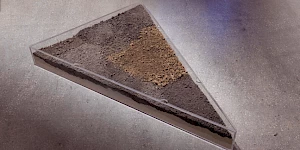
‘The Soils Project’ is part of an eponymous, long-term research initiative involving TarraWarra Museum of Art (Wurundjeri Country, Australia), the Van Abbemuseum (Eindhoven, Netherlands) and Struggles for Sovereignty, a collective based in Yogyakarta, Indonesia. It works through specific and situated practices that consider soil, as both metaphor and matter.
Seeking and facilitating opportunities to listen to diverse voices and perspectives around notions of caring for land, soil and sovereign territories, the project has been in development since 2018. An international collaboration between three organisations, and several artists, curators, writers and activists, it has manifested in various iterations over several years. The group exhibition ‘Soils’ at the Van Abbemuseum is part of Museum of the Commons. -
–VCRC
Kyiv Biennial 2023
L’Internationale Confederation is a proud partner of this year’s edition of Kyiv Biennial.
-
–MACBA
Where are the Oases?
PEI OBERT seminar
with Kader Attia, Elvira Dyangani Ose, Max Jorge Hinderer Cruz, Emily Jacir, Achille Mbembe, Sarah Nuttall and Françoise VergèsAn oasis is the potential for life in an adverse environment.
-
MACBA
Anti-imperialism in the 20th century and anti-imperialism today: similarities and differences
PEI OBERT seminar
Lecture by Ramón GrosfoguelIn 1956, countries that were fighting colonialism by freeing themselves from both capitalism and communism dreamed of a third path, one that did not align with or bend to the politics dictated by Washington or Moscow. They held their first conference in Bandung, Indonesia.
-
–Van Abbemuseum
Maria Lugones Decolonial Summer School
Recalling Earth: Decoloniality and Demodernity
Course Directors: Prof. Walter Mignolo & Dr. Rolando VázquezRecalling Earth and learning worlds and worlds-making will be the topic of chapter 14th of the María Lugones Summer School that will take place at the Van Abbemuseum in Eindhoven.