Zapatista Cinema and Obedient Aesthetics: The poetics of community resistance
Over New Year 2025 Natalia Arcos Salvo and Louis Henderson visited Chiapas, conducting interviews with film makers as part of their research into Zapatista cinema and its methods of working with and through the community, a project organized with the Department of Film and New Media of the Reina Sofía Museum. The following contribution combines a text written by Arcos, excerpts from the interviews, filmed and edited by Henderson, and photographs taken during their trip.
I. Introduction, or the night of 31 December of any year
It is 11.30 p.m. on the night of 31 December 2024. We are at Caracol Oventik to celebrate the Zapatista New Year – another anniversary of the 1 January 1994 armed uprising, which took Mexico and the world by surprise. We were dancing to live ranchera music when we saw the EZLN commanders,1 more than twenty women and men, take the stage and stand solemnly staring at the horizon. The music cut off. The hundreds of revellers fell silent. Someone whispered timidly, ‘I can hear something far off.’ So we turned and were just able to make out, barely visible in the darkness, the silhouettes of Zapatista militia marching down the hill, beating their wooden batons. All else was silence. We visitors had to move back to make way. The militia marched past us and formed a column. Without delay, as the first fireworks started, Subcomandante Moisés began to read out a statement about the eve of the uprising. In that context, the fireworks sounded like gunfire. He ended his speech – with the names of the dead combatants who still live among us – at midnight exactly. Fireworks exploded across the sky while we turned, all goose bumps and teary-eyed, arms open for anonymous New Year’s embraces. Thus began 2025 and this journey through ‘impossible cinema’ in Chiapas.
New Year’s Eve 2024. International Meetings of Rebellions and Resistance 2024-2025, Caracol Oventik. Courtesy Natalia Arcos Salvo and Louis Henderson
Zapatista cinema provides an excellent opportunity for examining the interplay between art, politics and community in Latin America. Its history cannot be reduced to a corpus of films or of records, but rather presents itself as an aesthetic practice extending across time and communities and which, in the words of Enrique Dussel, emerges from a ‘potentia aesthetica’: the creative capacity of the community that displaces the individual from the centre of the artistic act.2 Accordingly, for Dussel, ‘obedient aesthetics’ does not imply passive subordination,3 but describes an ethical recognition of the collective as the origin of all creative processes.4
In this context, Zapatista audiovisual production constitutes a poetics of resistance that challenges both hegemonic modes of representation and Western notions of authorship and authenticity. As Silvia Rivera Cusicanqui has pointed out, any decolonizing gesture must avoid falling into the ‘trap of authenticity’, that is, the demand to produce a ‘pure’ image of the Indigenous person that satisfies the gaze of the other.5 Zapatista cinema is part of this struggle; it does not seek to validate a folklorized identity, but rather to generate images that are obedient, useful and necessary for community life.
II. From clandestinity to autonomous audiovisual production
During the EZLN’s years in clandestinity, between 1983 and 1993, their experience of cinema was linked more to oral tradition than to projection. Militants told each other about Bruce Lee films and Vietnamese films, such as one they called Punto de enlace (‘The Abandoned Field: Free Fire Zone’, 1979). They rearticulated scenes without following a narrative thread. Evidently, there was a precarious relationship with cinema in those early years. In addition to oral accounts of martial arts films, there were improvised screenings on sheets, and fragments of films like Battle of Moscow (1985) were passed around. This early practice shows us how cinema was experienced in the manner of sbaljtel’ kinal. These are never-ending stories, not exhausted in linear retelling, but prolonged in the collective memory, more as shared experiences than as finished works.6
The second significant moment in the story of cinema in rebel territory was from 1998 to 2008, when the community gained access to cameras and technical training for Zapatista grassroots activists from the US based Promedios agency. This binational US-Mexican collective trained young Zapatistas in the use of cameras, audio and editing. In this context, the struggle was not just against the army and the Mexican state, but also against the coloniality of audiovisual language. How can the teaching of technique take place without this meaning the imposition of narrative and aesthetic canons from the Global North? The challenge was to build a form of cinema that was ya jmulan – useful, necessary – without sacrificing the autonomy of Indigenous ways of seeing and feeling.
From 2008, following the closure of the territory to NGOs, which went along with the EZLN’s move to protect its autonomy, a third phase began – that of the Tercios Compas (Third Comrades) or, as they call themselves in English, ‘The Odd Ones Out’. These are community producers who today film, edit and distribute footage of Zapatista life. Their productions, created with limited resources but a clear political vision, embody obedient aesthetics. Rather than being the work of some Kantian ‘genius’, these are collective narratives that respond to the vital rhythms of the community. With a shared ethic, the cinema articulates what we might call a ‘zero degree’ language; a process of audiovisual decolonization that dismantles previous external narratives and refuses to conform to the culture industry.
To speak of Zapatista cinema is to enter a territory where the image ceases to belong to the individual author and becomes the voice and gaze of the community. The aesthetic of obedience – that guiding mandate of ‘commanding by obeying’ – unfolds in the audiovisual realm as an ethic that subordinates the creative gesture to the community.7 Within this, loj’tabanel (the creation of images and text) is not the work of an isolated subject, rather a collective endeavour where what matters is not the identity of the creator but the resonance it creates.
From the patched-together screenings in the Lacandon Jungle – with sheets for cinema screens, and martial arts videos retold from memory – to the current recordings of the Tercios Compas, Zapatista cinema has traced a poetics of resistance that shuns spectacle in order to affirm another temporality, a sbaljtel’ kinal of the image: stories that do not end, linked to everyday life and extending beyond the theatre and the screen.
Extracts from an interview with Paco Vasquez, Chiapas, January 2025. Courtesy Natalia Arcos Salvo and Louis Henderson
III. Contemporary film-makers: memory, ritual and the poetic
It is Saturday 4 January. We have returned to the city of San Cristóbal de las Casas. The young Tsotsil film-maker Ana Ts'uyeb picks us up in her van to take us along winding mountain roads to the village of Chenalhó, an hour away. There, at her home, another Tsotsil film-maker, Maria Sojob and her husband are waiting for us to discuss the Bolomchom community film project. That night, Ts'uyeb, Sojob, and Henderson will hold an audiovisual film jam.
Zapatista cinema is not only a visual archive of the Chiapas insurgency, but also an evolving poetics: a sbaljtel’ kinal that insists on narrating without closure, on remaining open. In the work of film-makers such as Delmar Penka, Liliana K'an, Maria Sojob and Ana Ts’uyeb, various interpretations of the obedient aesthetic unfold: the useful, the sinister, the moving and the ceremonial.
By situating the community as the origin of all creation, contemporary Mayan cinema is decolonizing the very notion of art. It proposes a model in which the author obeys, the work is shared, and the image becomes a vital instrument for autonomy. This, for Dussel, is where the individual ‘genius’ gives way to the creative community.8 Further, as Cusicanqui suggests, the image is neither folklore nor an imposed authenticity, but a living crack that will not close even under pressure from regimes of power and representation.9
Against this backdrop, the works of film-makers such as Penka, K'an, Sojob and Ts'uyeb are landmarks as they engage with, and push the boundaries of, the aesthetics of obedience.
In this creative field, film-makers such as Delmar Penka have reflected the pulse of the community with recordings that eschew exoticism, offering a camera that obeys the rhythms of the land and of coffee, of dialogue and silence. His work falls within what we might call jmulan, ‘the useful and necessary’, where the image serves life and not the other way around. An academic, Penka has conducted extensive research on the history of cinema in Chiapas and on Indigenous representation and self-representation. His own return to his linguistic roots forms the central theme of this work. His film Ayinel ta Ko’tan / Habitar los recuerdos (‘Inhabiting Memories’, 2021) is a poetic document of his reunion with his Tzeltal grandmother, from whom Delmar’s matrilineage originates. After his parents’ migration to the city, the son returns to the countryside to recover and learn not only the Mayan language, but also the concepts that encompass a different worldview.
Meanwhile, in the village of Zinacantán, Liliana K'an explores the margins of what is visible, working with a visual style which oscillates between testimony and reverie. Her films evoke xitik, that sense of awe and fear handed down from night-time stories, in which the memory of the people mixes with the fantastic, shattering narrative linearity. As an Indigenous Tsotsil – that is, coming from the People of the Bat – K'an has been accustomed to watching the night since childhood, just like all her warrior ancestors. In her films U Madre Luna (‘Mother Moon’, 2016) and AK’Riox, guiadora de caminos (‘Road Guide’, 2014), she contrasts the origin of life through the wisdom of midwives with the beginning of that other path that signifies death and is accompanied by the women prayer leaders.
On 8 January, we move to Zinacantán, the village where Liliana K'an lives. We learn about her film workshop project for children and join them in the improvised – and valuable in that it is entirely local – premiere of her film Vientre de luna (Moon Belly), an ode to motherhood itself. We are amazed by the value that the children place in the presence of their community, their landscapes and their myths in the film. Together, we conclude that myths are not fantasies, but other realities in which we live every day. Then we take a walk, visit the church full of flower murals, and return to San Cristóbal de las Casas. Vientre de luna has recently been nominated for Mexico’s prestigious Ariel Awards.
María Sojob’s film-making was among the earliest to establish that the camera can also create an intimate space for listening, learning and caring. Her films evoke ya snitbenjo’tan, the feeling of being tugged at the heartstrings when a word or image touches us at the core and resonates deeply. In her work, the female face emerges as a site of its own, decolonized enunciation, challenging both tradition and globalized modernity. Sojob is a Tsotsil woman who left her first husband to pursue film studies, against all odds. This personal act of breaking away from conservative family traditions demonstrates her courage on many levels. However, this does not mean she is disobeying ancestral customs. On the contrary, her films Tote (2019, ‘Grandfather’) and Bankilal, el hermano mayor (2014, ‘Bankilal, the Elder Brother’) are a tribute to the wisdom of the elders, both in the family and in the community. Recently, she herself has held traditional positions within her village.
Extracts from an interview with Delmar Penka, Chiapas, January 2025. Courtesy Natalia Arcos Salvo and Louis Henderson
Finally, Ana Ts'uyeb brings a ritual dimension to audiovisual media, linking film-making with the notion of ixon, ‘ceremony’. Her film-making explores what the Zapatistas see as life itself: a fabric woven from dreams, legacies and collective gifts. In her case, screenings are acts that not only document but also reactivate ancestral memory in sme’intesel, ‘the resurgence of the fire that never dies’. Ana is the daughter of Zapatistas and grew up within the movement. She has not been part of the movement since her adolescence. However, her award-winning film Li Cham, Morí (2024, ‘Li Cham, I Died to be Reborn’) can be seen as a profound feminist manifesto. It recognizes the value of Zapatista empowerment for Indigenous women in Chiapas, something which implies a profound and radical cultural change.
The contribution of these film-makers cannot be understood outside the context of Zapatista aesthetic praxis. Rather than seeking to produce ‘masterpieces’ for the international circuit – although they do achieve this – they participate in a community culture that redefines notions of authorship, beauty and utility. In contrast to the Western search for authenticity and exoticism, Mayan and Zapatista film-making puts forward an aesthetic measured by its own standards: t’ujbil (material beauty in relation to the author’s heart), lek (the goodness of the author’s heart) and mul lanel (that which pleases and stirs emotions).
In this vein, contemporary cinema in Chiapas puts forward and embodies an obedient aesthetic – images that do not belong to a creative I, but rather respond to an insurgent us. This is a rebellious poetics that, like Zapatista autonomy itself, is in a constant state of gestation; a cinema that shuns closure, insists on retaining a state of perpetual openness, projecting itself as a sbaljtel’ kinal (a story without end).
Interview with Liliana Kan, Chiapas, January 2025. Courtesy Natalia Arcos Salvo and Louis Henderson
IV. Obedient aesthetics and decolonizing the image
Zapatista cinema, in all its stages, challenges Western categories of ‘political cinema’. Rather than denouncing, it proposes its own way of seeing and feeling. Faced with the Western obsession with t’ujbil (material beauty) and Indigenous authenticity, the Zapatistas reaffirm different criteria: lek (the goodness of the author’s heart), mul lanel (that which pleases and stirs emotions) and ya jmulan (what is useful). These categories allow us to understand that the value of Mayan and Zapatista cinema does not lie in its formal finish, but in its community power.
According to Cusicanqui, the resistant image should not become a new fetish; its strength lies in opening cracks in the dominant regime of visibility. In this sense, Zapatista cinema embodies what she calls ‘ch’ixi’, a practice that does not allow itself to be absorbed by hegemonic modernity, but neither does it retreat into Indigenous essentialism.10 It is obedient film-making because it sits on the border of modernity and ancestry, of technique and ritual.
The history of Zapatista cinema, then, cannot be read solely as an archive of the insurgency, but as t’ujbil: the beauty that emerges when the form and heart of the author coincide with the power of the community. It is, in short, a poetics in gestation that challenges Western expectations of authenticity and linearity. It asserts a cinematic form not for consumption, but to be shared, listened to and obeyed.
The history of Zapatista cinema offers a unique place of insight into the relationship between aesthetics, politics and community from a paradigm that goes beyond the conventional frameworks of Western art and critical theory. If, as Enrique Dussel has pointed out, obedient aesthetics emerges where ‘the community is the creative seat of all aesthetics’, then Zapatista cinema is one of the clearest examples of this potentia aesthetica – a space where the artistic gesture is conceived not as an individual manifestation but an act of obedience to the collective.11 It is a place where loj’tabanel (the creation of image and text) finds its purpose.
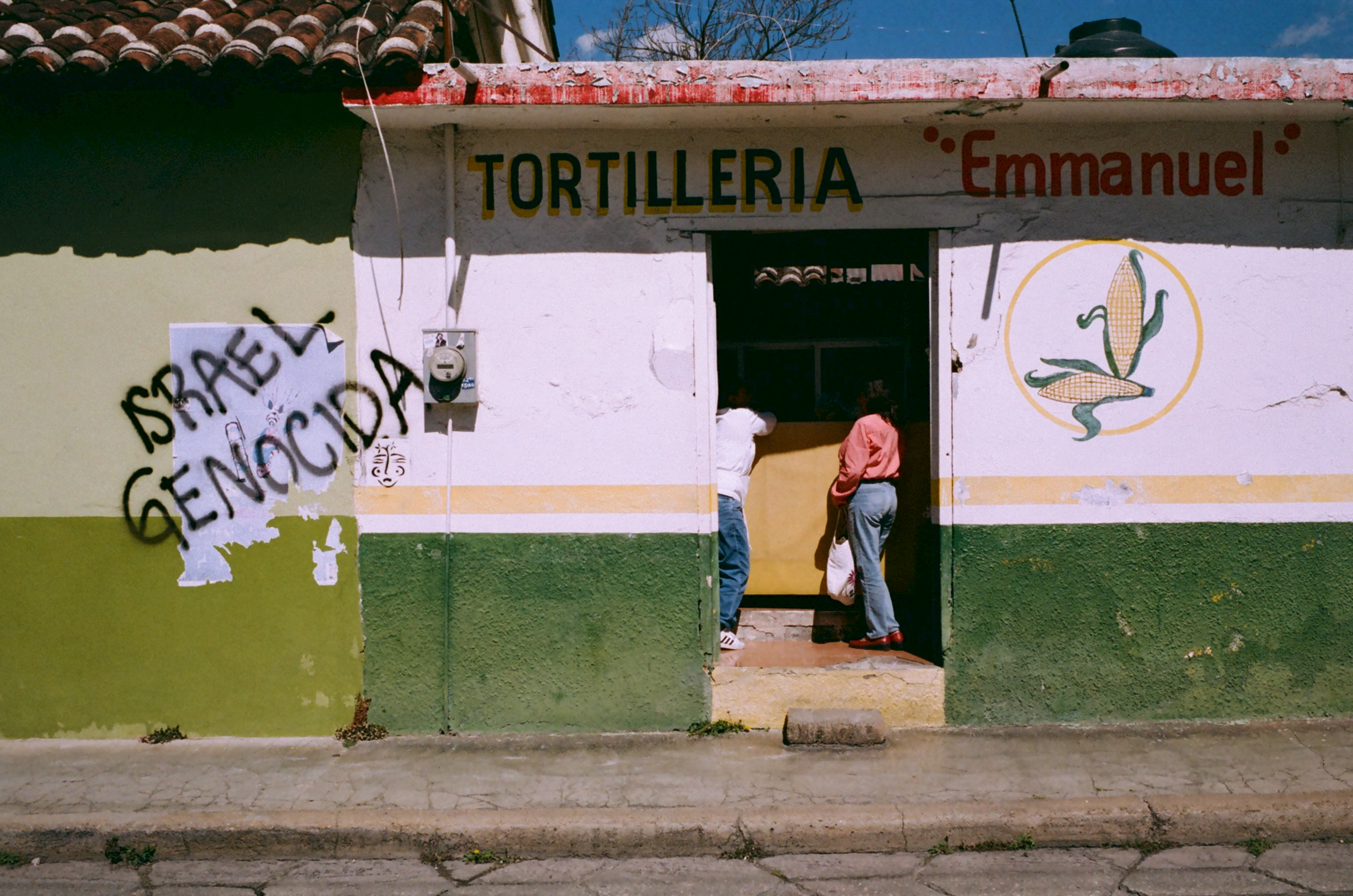
San Cristóbal de las Casas. Photo Louis Henderson, December 2024
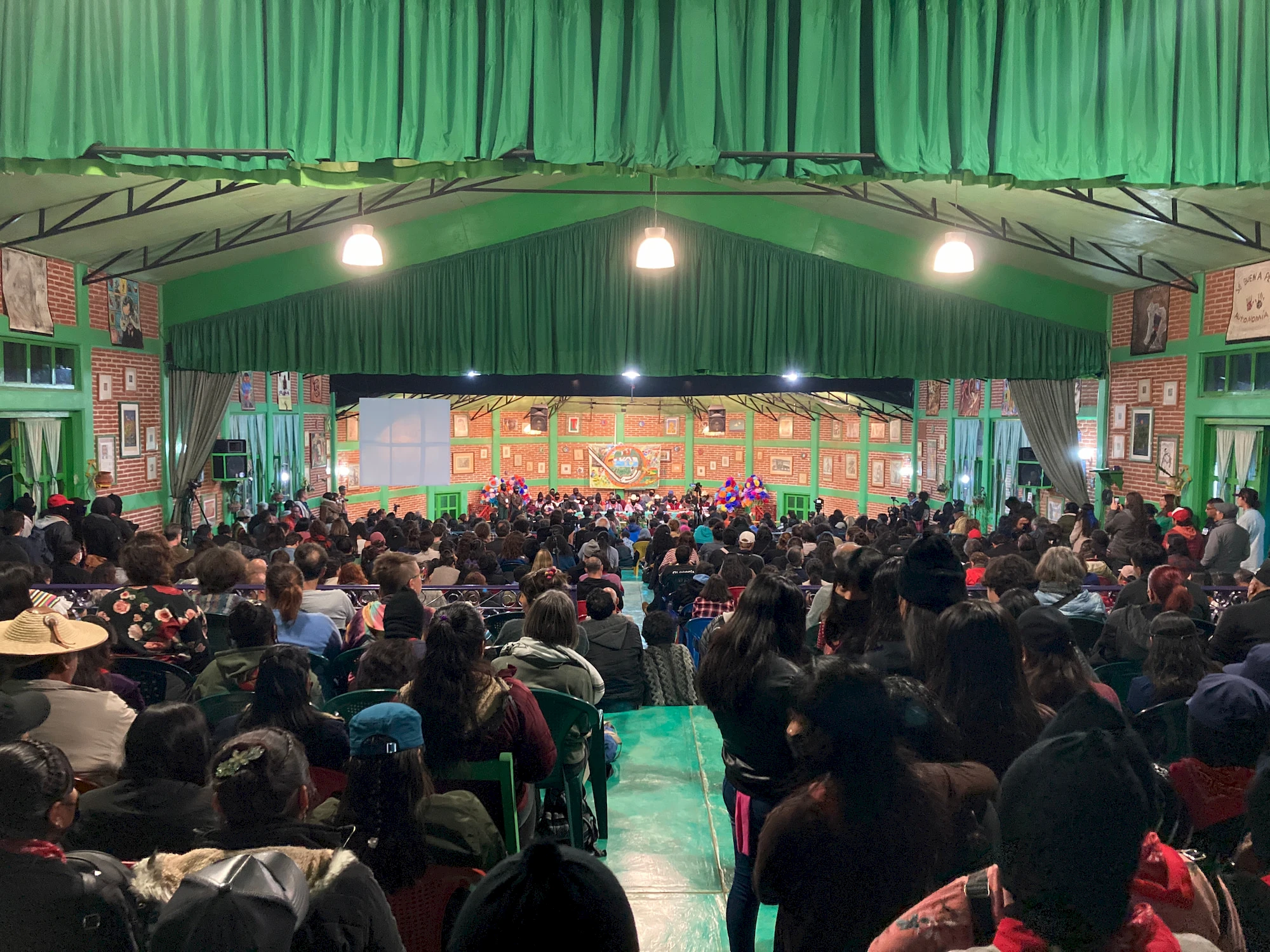
‘Encounters of Resistance and Rebellion’, Caracol Jacinto Canek. Photo Louis Henderson, December 2024
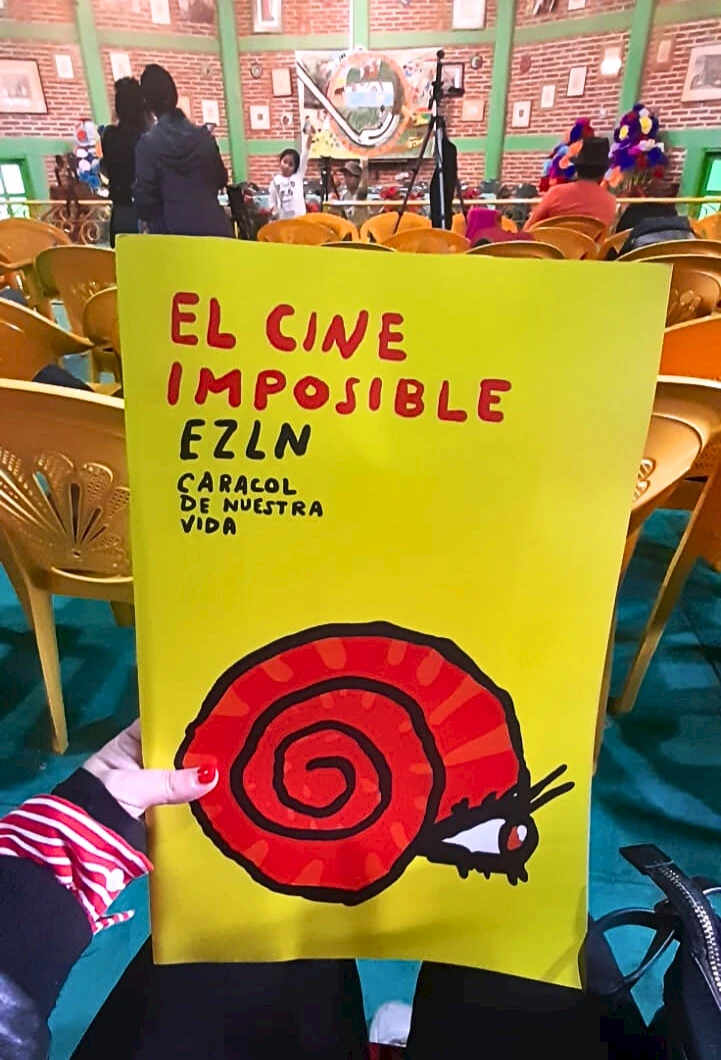
Dossier for ‘Impossible Cinema’, Caracol Jacinto Canek. Photo Natalia Arcos Salvo, December 2024
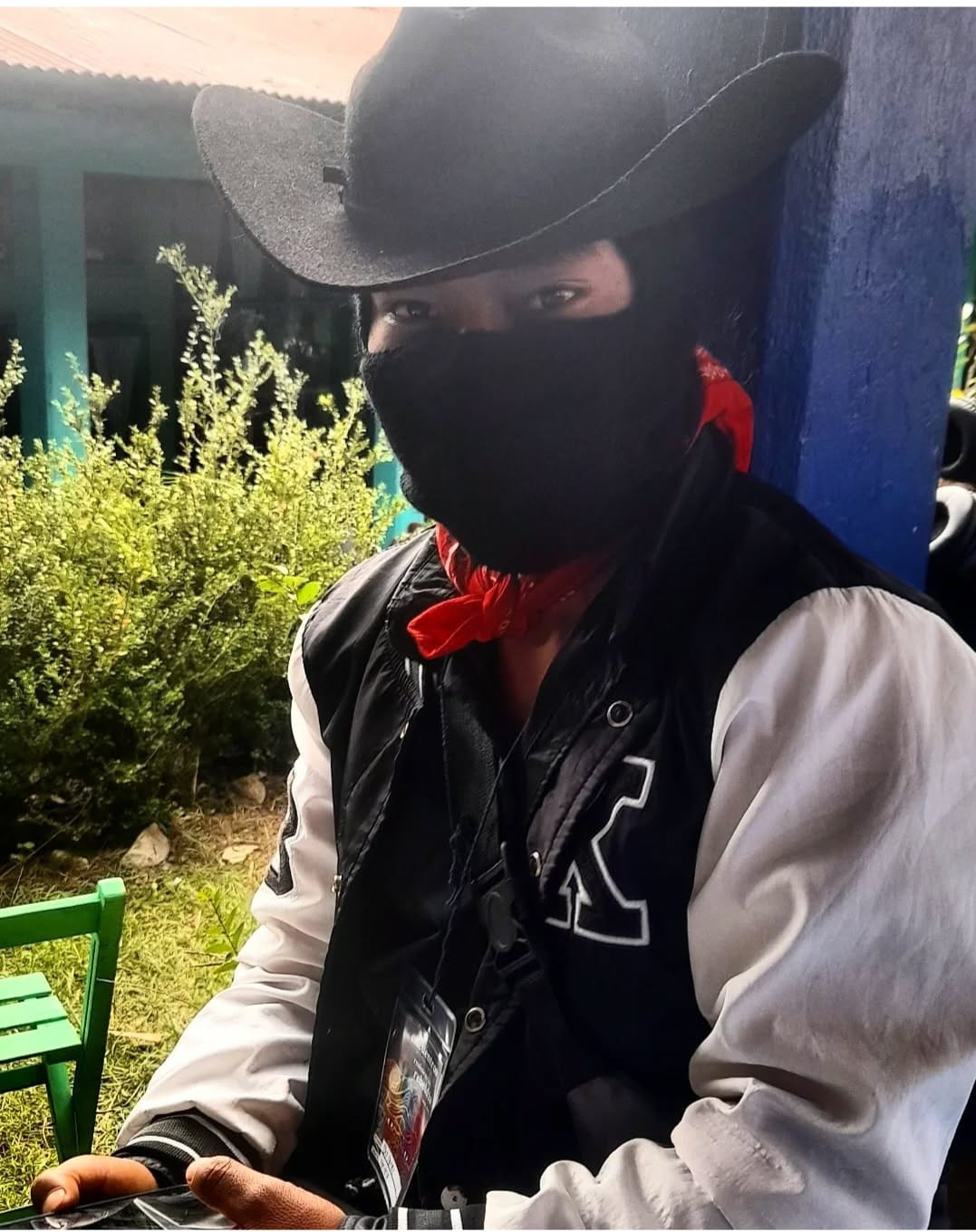
Zapatista child, San Cristóbal de las Casas. Photo Natalia Arcos Salvo, December 2024
Caracol Oventik Chiapas mountains, Photo Louis Henderson, December 2024
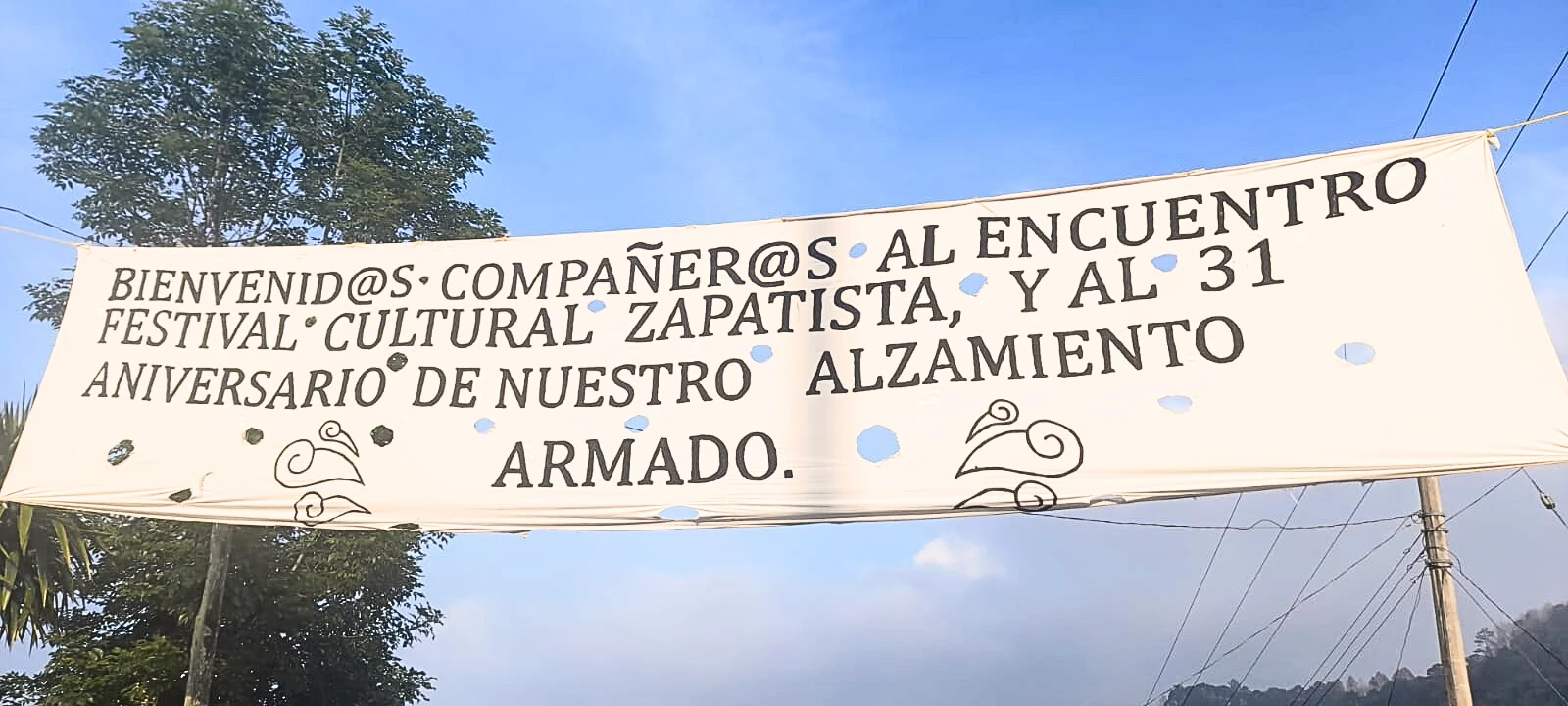
Banner, ‘Welcome to Caracol Oventik’. Photo Natalia Arcos Salvo, December 2024
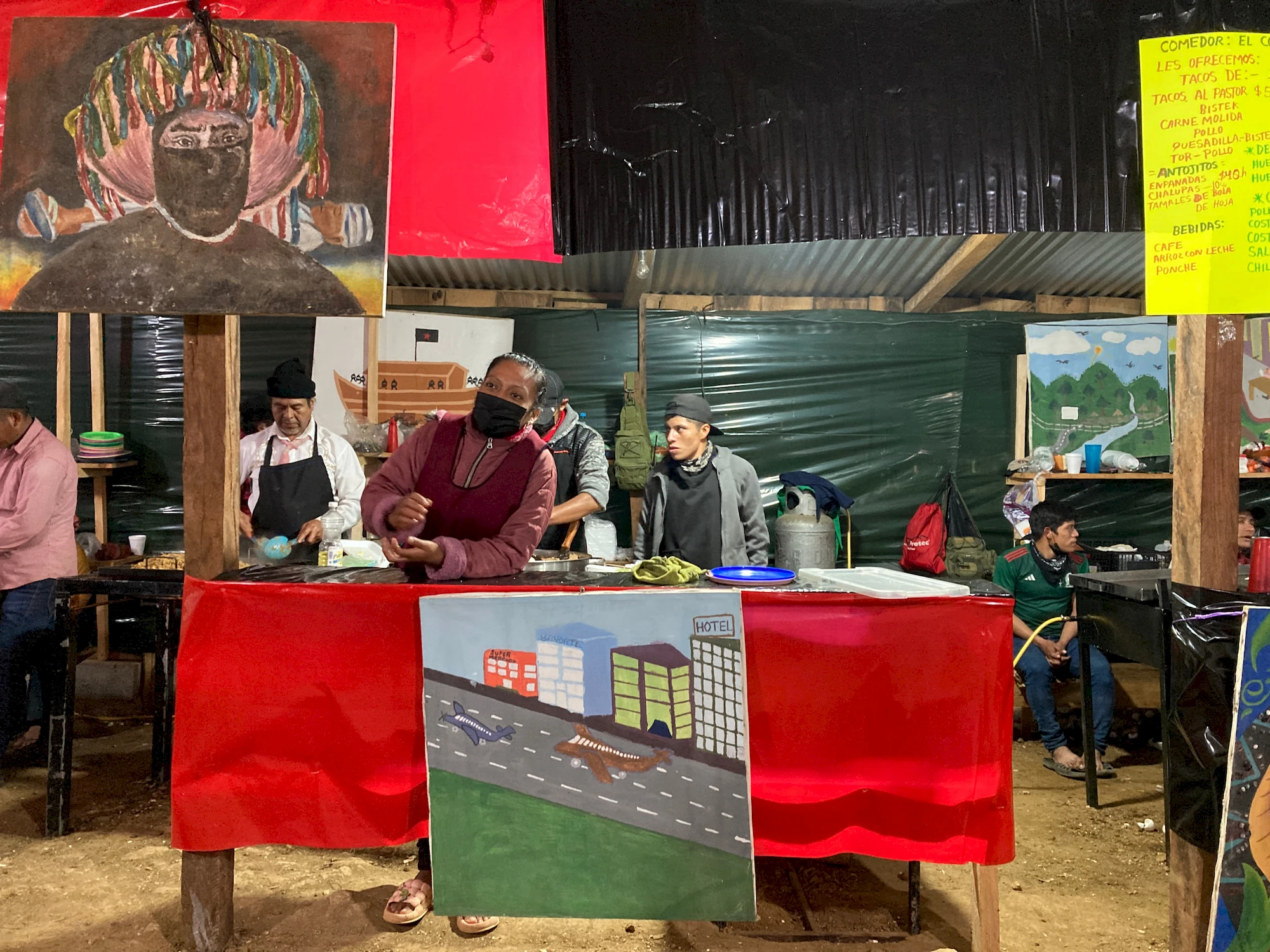
Community kitchen, Oventik. Photo Louis Henderson, December 2024
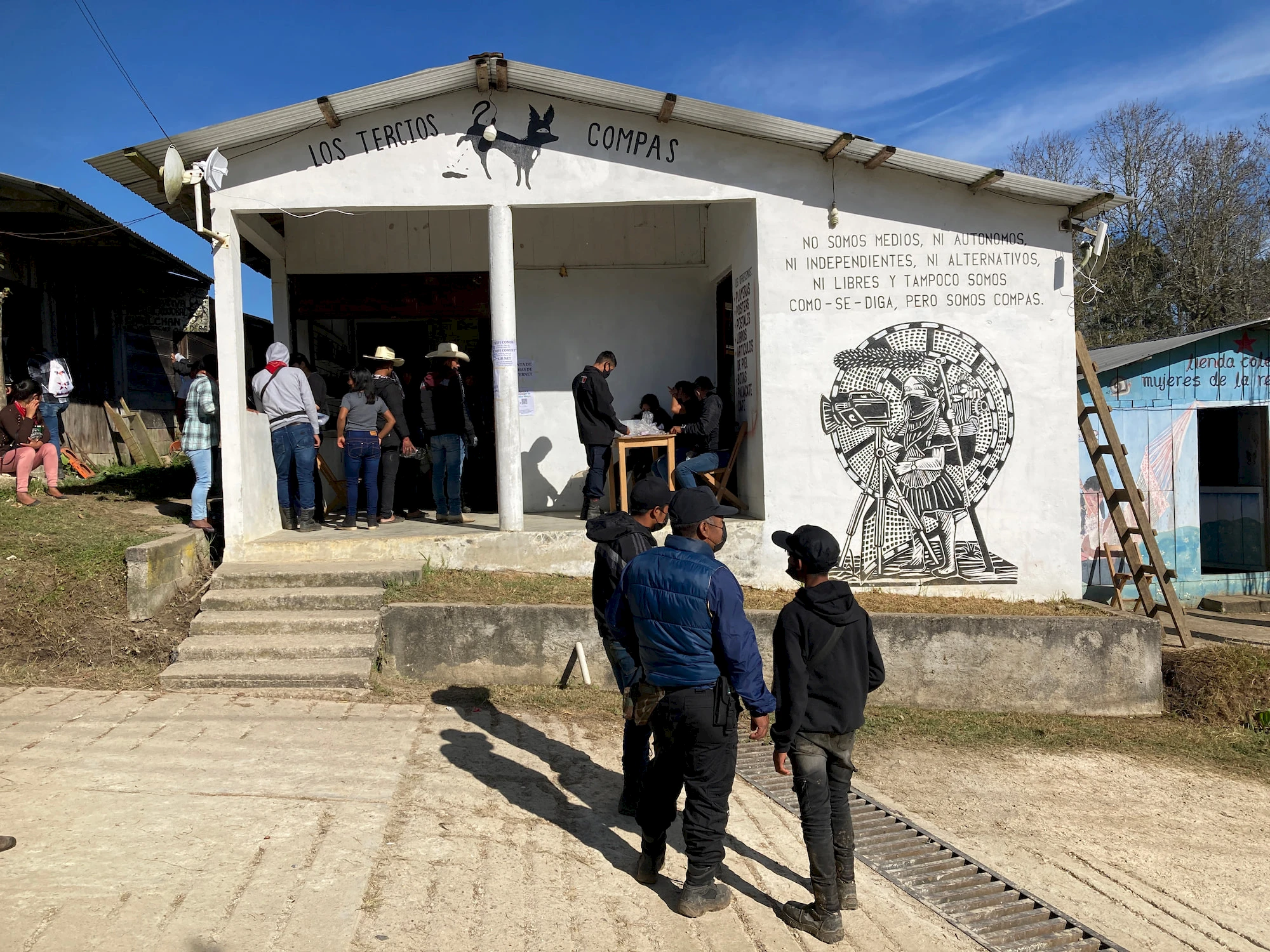
Tercio Compas Media Zapatista Agency Office. Photo Louis Henderson, December 2024
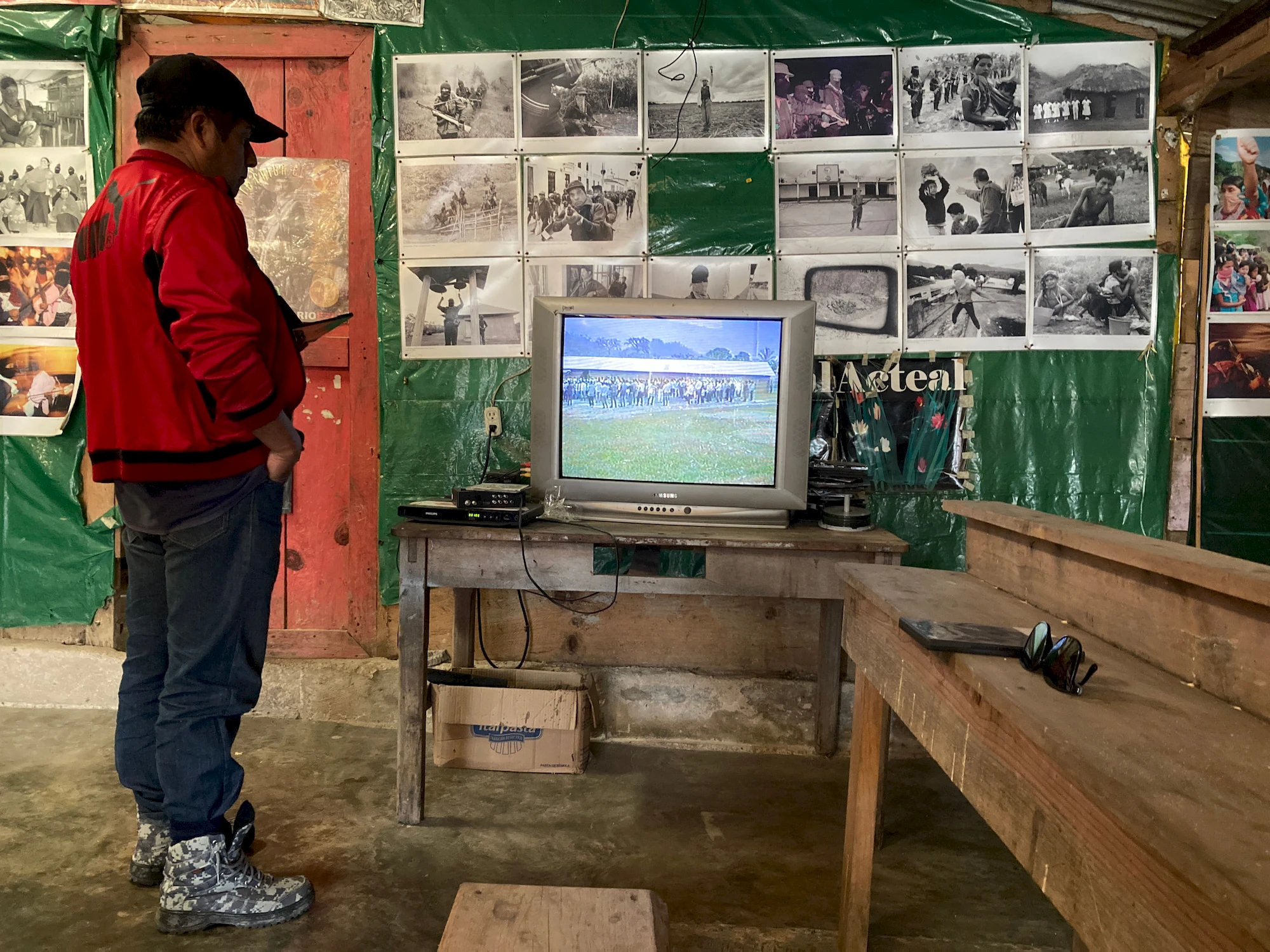
Watching Zapatista films. Photo Louis Henderson, December 2024
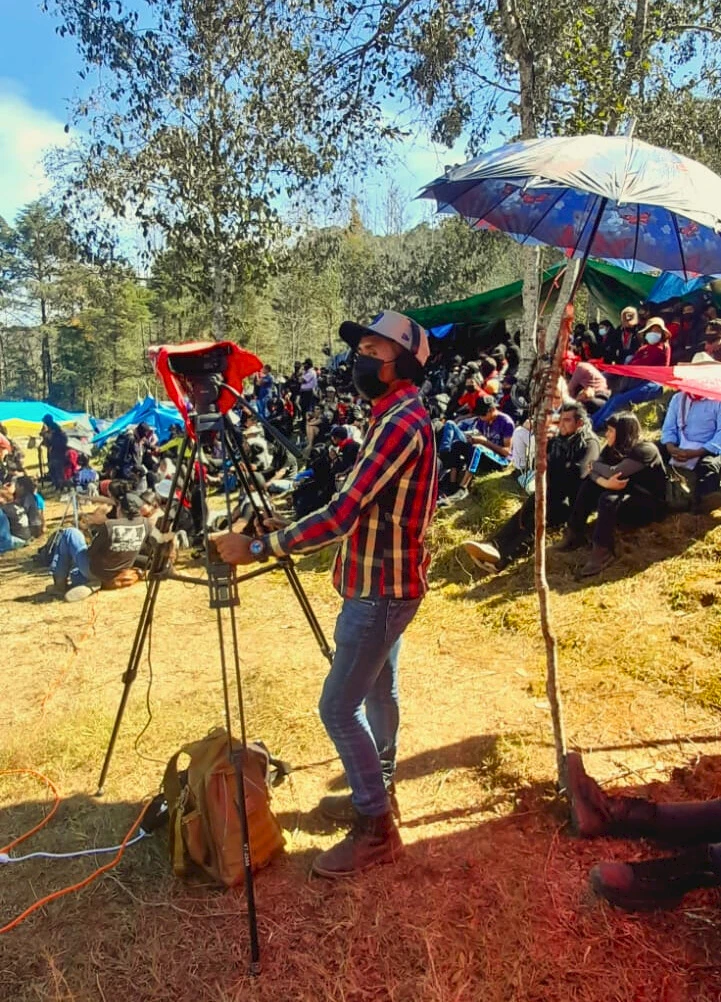
Zapatista Cameraman. Photo Natalia Arcos Salvo, December 2024
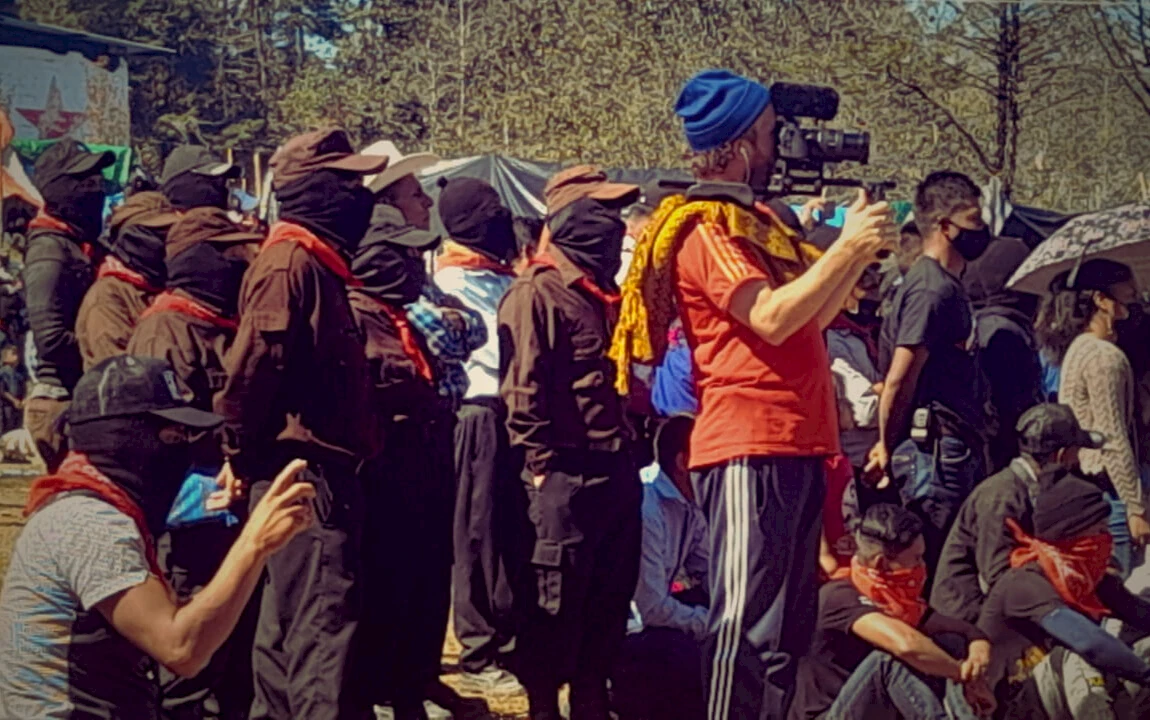
Louis Henderson filming in Oventik. Photo Natalia Arcos Salvo, December 2024
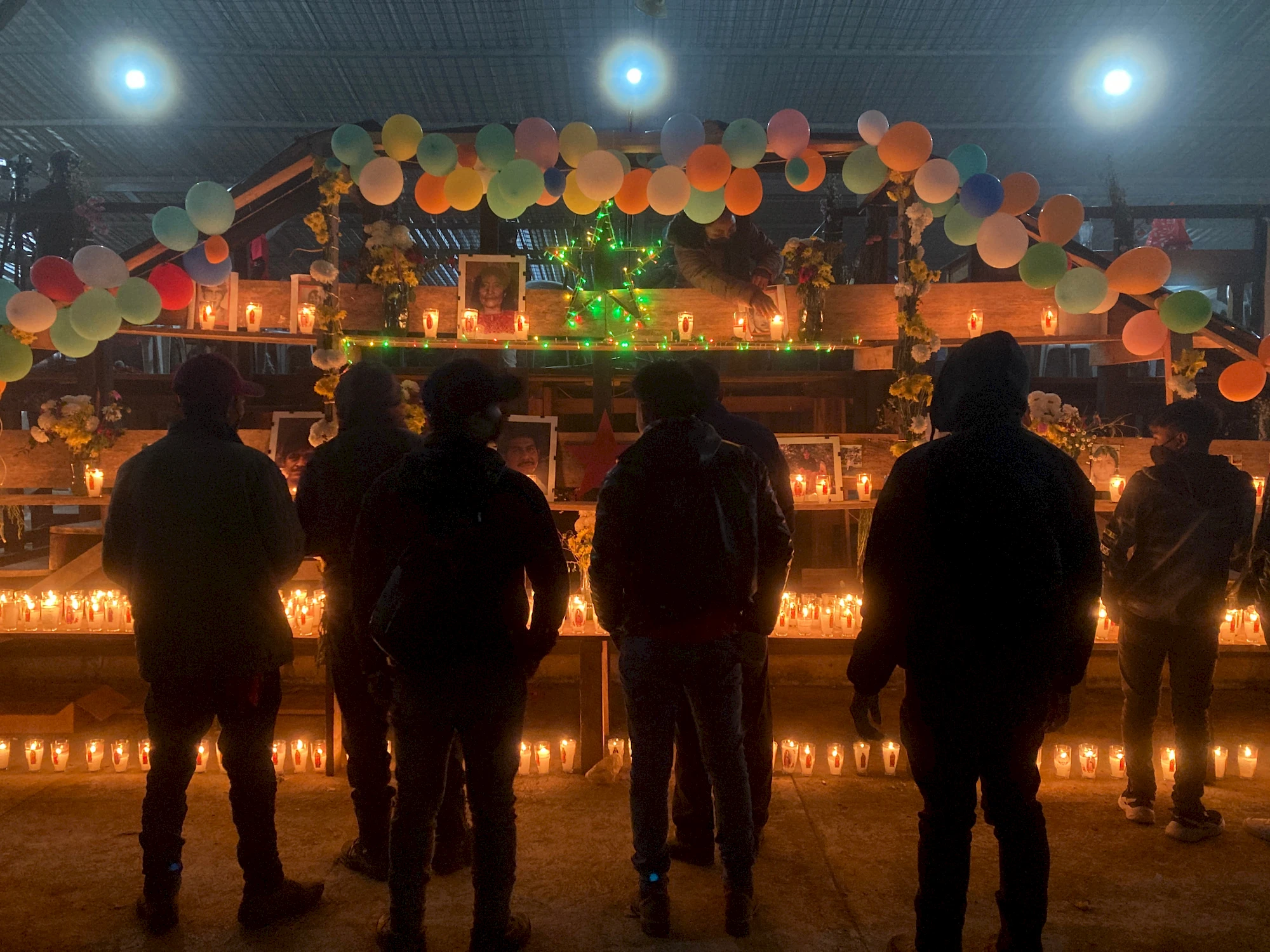
Zapatista New Year’s Eve Vigil. Photo Louis Henderson, December 2024

New Year’s dawn in rebel territory. Photo Louis Henderson, December 2024
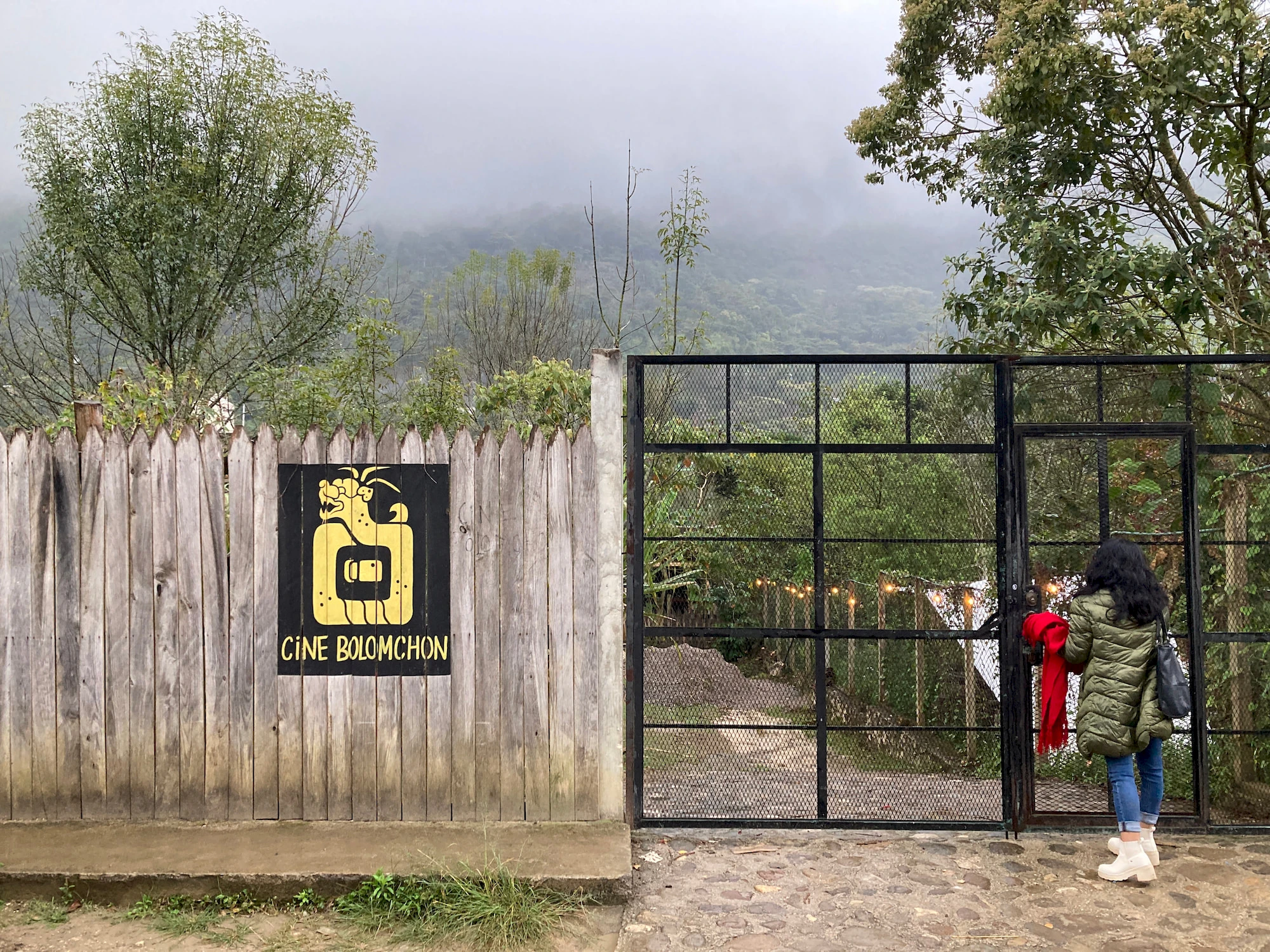
Cine Bolomchon, Chenalhó town. Photo Louis Henderson, December 2024
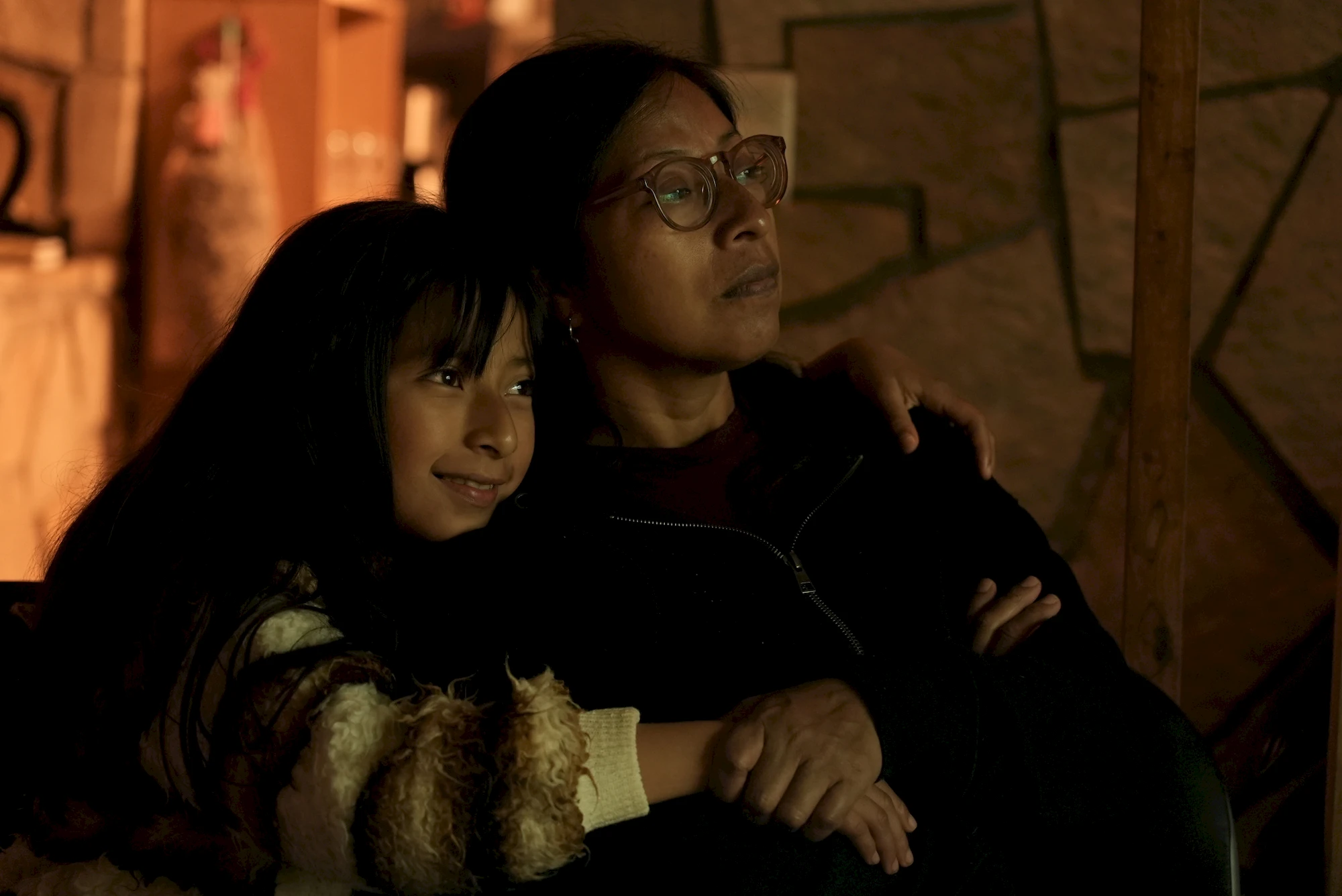
María Sojob and her daughter. Photo Louis Henderson, December 2024

Filmmaker Ana Ts’uyeb. Photo Louis Henderson, December 2024
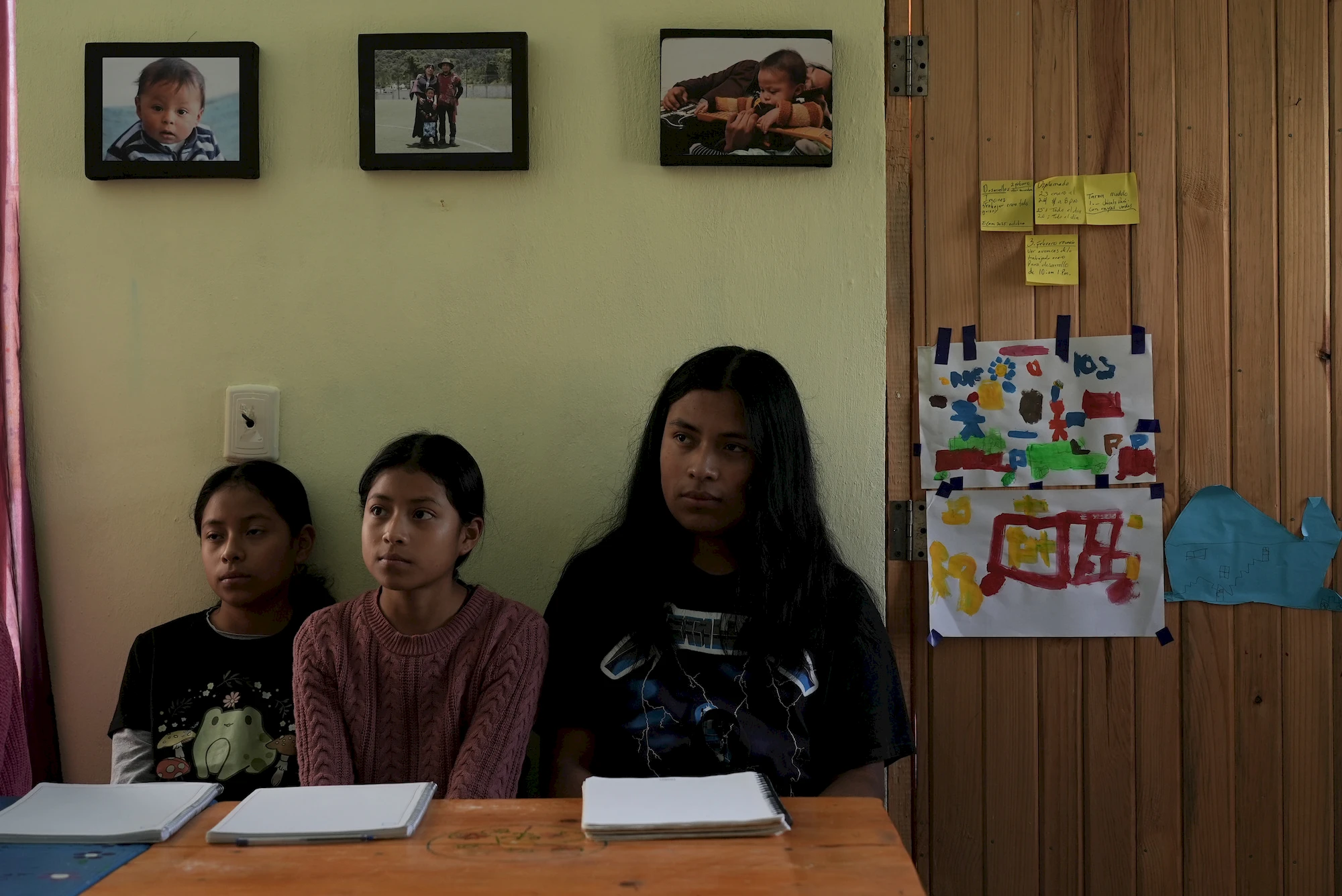
Children of the cinema school, Zinacantan. Photo Louis Henderson, December 2024
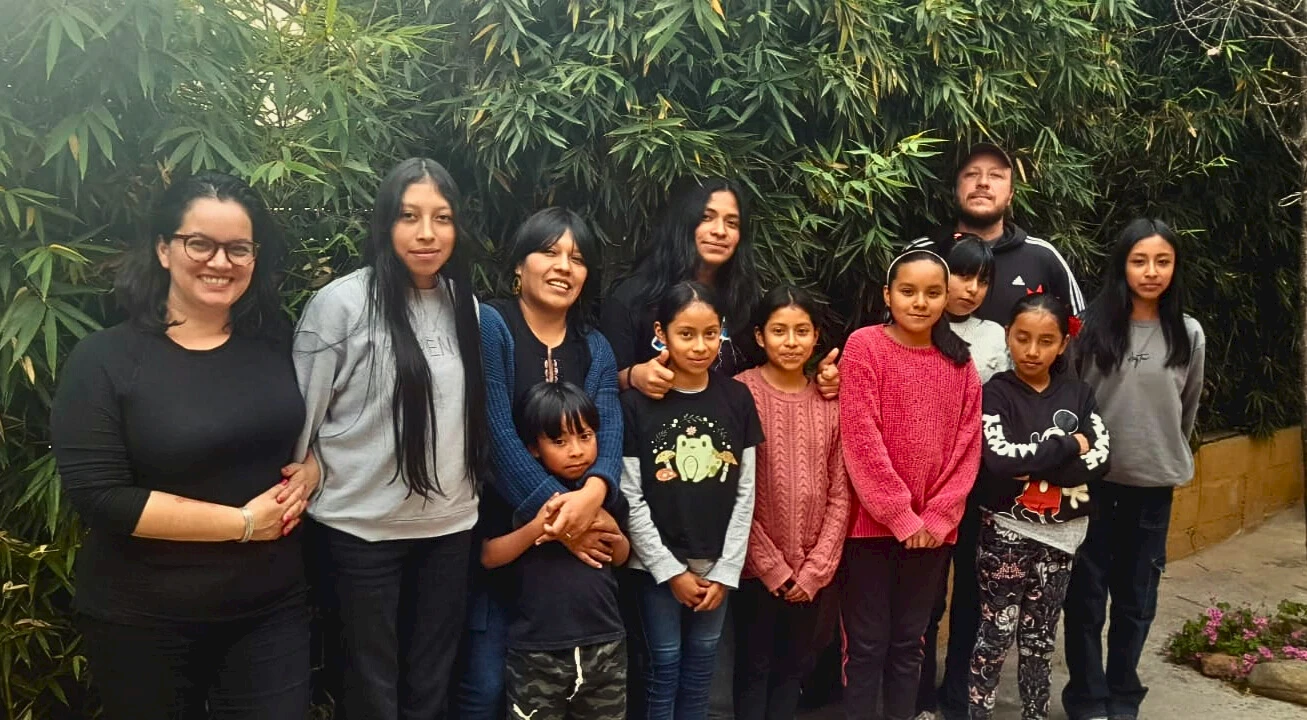
Visiting the cinema school for children, Zinacantan. Photo Natalia Arcos Salvo, January 2025

Church of Zinacantan. Photo Louis Henderson, January 2025
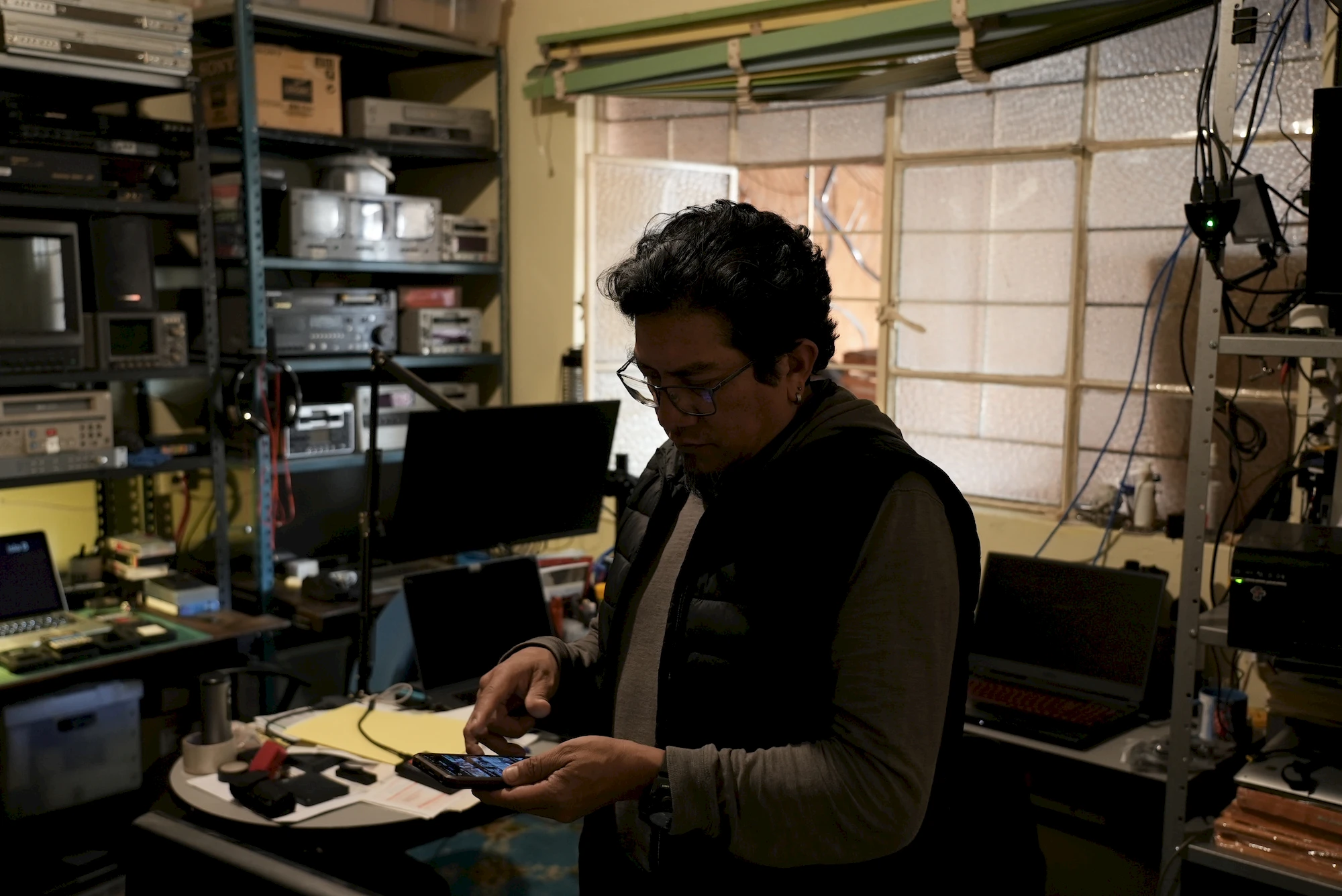
Paco from Promedios Media Agency. Photo Louis Henderson, January 2025
Related activities
-
–MACBA
Song for Many Movements: Scenes of Collective Creation

An ephemeral experiment in which the ground floor of MACBA becomes a stage for encounters, conversations and shared listening.
-
–MACBA
Visions of Panafrica. Film programme
Visions of Panafrica is a film series that builds on the themes explored in the exhibition Project a Black Planet: The Art and Culture of Panafrica, bringing them to life through the medium of film. A cinema without a geographical centre that reaffirms the cultural and political relevance of Pan-Africanism.
-
Museo Reina Sofia
Cinema Commons #1: On the Art of Occupying Spaces and Curating Film Programmes

On the Art of Occupying Spaces and Curating Film Programmes is a Museo Reina Sofía film programme overseen by Miriam Martín and Ana Useros, and the first within the project The Cinema and Sound Commons. The activity includes a lecture and two films screened twice in two different sessions: John Ford’s Fort Apache (1948) and John Gianvito’s The Mad Songs of Fernanda Hussein (2001).
-
Museo Reina Sofia
Sonic and Cinema Commons
Sonic and Cinema Commons is a research, programming and publishing project that explores how cinema and sonic experiences generate spaces for the formation of interpretive communities, foster collective debate and prefigure proposals for the commons. Co-organised with L’Internationale Online, 2025 and 2026.
Related contributions and publications
-
Housing Music
Onkar Singh KularSonic and Cinema Commons -
Present Present Present. On grounding the Mediateca and Sonotera spaces in Malafo, Guinea-Bissau
Filipa CésarSonic and Cinema CommonsPast in the Present -
Towards an Aesthetics of ‘Commanding by Obeying’ in Zapatista Audiovisual Material
Natalia Arcos SalvoEN es -

Echoes of Zapatismo outside Chiapas
Alessandra Pomarico -
The Kitchen, an Introduction to Subversive Film with Nick Aikens, Reem Shilleh and Mohanad Yaqubi
Nick Aikens, Subversive FilmSonic and Cinema CommonslumbungPast in the PresentVan Abbemuseum -
Live set: Apotome
Khyam AllamiSonic and Cinema Commons -
Opening Performance: Song for Many Movements, live on Radio Alhara
Jokkoo with/con Miramizu, Rasheed Jalloul & Sabine SalaméEN esInternationalismsSonic and Cinema CommonsPast in the PresentMACBA -
Mix tape: Let's funk up all genders!
Materia Hache / Others to the FrontEN esSonic and Cinema CommonsSituated OrganizationsMuseo Reina Sofia -
Live set: Una carta de amor a la intifada global
PrecolumbianEN esInternationalismsSonic and Cinema CommonsPast in the PresentMACBA -

Broadcast: Towards Collective Study in Times of Emergency (for 24 hrs/Palestine)
L’Internationale Online Editorial Board, Rana Issa, L’Internationale Confederation, Vijay PrashadInternationalismsSonic and Cinema Commons -
Mix tape: International
Roberta Miss aka Nur/SeSonic and Cinema CommonsM HKA -
Sonic and Cinema Commons: Editorial
L'Internationale Online Editorial BoardSonic and Cinema Commons -
Cine zapatista y estética obedencial: poéticas insurgentes desde la comunidad
Natalia Arcos Salvo, Louis HendersonEN esSonic and Cinema Commons