The Violence to Come: Pan-Africanism and the Lessons of Colonial Boomerang
An edited version of a lecture given at the Past in the Present Assembly and School of Common Knowledge in Barcelona, here historian and sociologist Javier Garcia Fernandez reflects on the 'political and intellectual necessity' of thinking Pan-Africanism, and the anticolonial project, from Europe today.
What might the struggles of the Global South teach us about the decolonization of Europe? What can the European continent learn from the historical suffering produced by more than five centuries of colonial and racial oppression on a global scale? What forms of critical knowledge, forged within the struggles of the Global South, call into question the subjectivity of those of us who have inhabited the metropolitan side of that history?
This discussion seeks to construct a critical perspective on how colonialism, racism and extractivist capitalism have operated not only as dispositifs of global exploitation, but also as forces of dehumanization within European populations themselves – and to determine which cultural projects might help us to apprehend the ways in which Europeans, too, have been dehumanized. Today, Europe is contorted between dynamics of self-destruction – manifested in identitarian retrenchment, the rise of authoritarianisms and the ecological crisis – and the possibility of learning from the Global South to inhabit, alongside others, different forms of humanity.
Why is it so important to speak of Pan-Africanism today? Why do so here, in Barcelona, in the Spanish state, in Western Europe, in the year 2025? First, I am grateful for the invitation to reflect on this question, as it allows us to situate the problem within its historical urgency.1 For this is not merely an academic or cultural concern, but a political and intellectual necessity of our present. As we well know, Western Europe is traversing a particularly dark conjuncture. We are witnessing the rise of renewed forms of authoritarianism, the proliferation of reactionary discourses, the advance of anti-feminism, and the intensification of narratives openly hostile to migrants. This turn cannot be understood in isolation from the crisis of the neoliberal global order that emerged in the aftermath of the Second World War, and which has been reconfigured in recent decades through the broken promises of democratization that marked the political cycle opened by mobilizations such as Occupy Wall Street, the Arab Spring, the square movements in Southern Europe, or the feminist strikes. During that cycle, experimental forms of democratic overflow sought to move beyond the limits of liberal representative democracy. Yet, far from being consolidated, those attempts at radical democratization have now entered a phase of retrenchment. Europe finds itself once again caught in a cultural struggle that reactivates old historical spectres. What we are witnessing today is the reactionary excess of the neoliberal order.
This is not the first time this has occurred. Europe creaks and fractures precisely in those sites where its political project fails to resolve its own contradictions; historical wounds remain latent and resurface cyclically. This phantom pain is the structural racial violence that has accompanied the very constitution of Europe as a modern project. Racial violence, as a constitutive dimension, manifests within Europe – at its most extreme moments – as fascism: a form of self-destruction that returns Europe to its own familial history, to the long trajectory of European colonialism.
Today, to think from Barcelona – from within Western Europe in 2025 – means to begin to pose an uncomfortable yet unavoidable question: How are we to save ourselves? What institutions, what communities, what forms of collective organization can be built to confront an authoritarian – and potentially self-destructive – wave that threatens, once again, to sweep across the European continent? This is not an unprecedented scenario; the history of the twentieth century reminds us that such trajectories unfolded in the years preceding 1917 and, more brutally, in the period culminating in 1945. There are solid grounds for thinking that they may be reactivated within current configurations.
This reflection acquires particular resonance in the context of the Spanish state, which, as we know, currently hosts of the only progressive government in Western Europe – an exception that reveals the weakness of transformative forces across the continent. It is, moreover, a government that includes factions situated to the left of classical social democracy, with ministers emerging from left-wing traditions.
However, the internal tensions within this government are symptomatic of broader disputes that are actively shaping the terrain of contemporary cultural struggles. Yet, while unstable equilibria are negotiated within institutions, the reactionary offensive intensifies outside, unfolding across multiple fronts: in the media and cultural production, in the judicial and policing apparatus, in the educational and university system, and within the sphere of labour. The efforts to build cultural hegemony and cohesion around a reactionary project are especially pronounced in metropolitan peripheries and working-class neighbourhoods.
It is precisely in these terrains that a decisive struggle is being waged – one oriented towards dismantling many of the social, democratic and feminist gains that are the outcome of more than seven decades of struggle and the cumulative expansion of social rights. What is at stake is not merely the reversal of specific public policies, but a deeper reconfiguration of the very conditions of possibility of the commons, within a conjuncture marked by the crisis of the neoliberal model and the reactivation of forms of structural violence we had assumed to be, at least partially, contained.
I would argue that the wound through which Europe is once again fracturing is bound up with the ensemble of violences that the European project historically enacted upon the peoples of the world. Within this fracture, a historical truth re-emerges: colonialism is not only a dispositif of external domination, but also produces, within metropolitan societies themselves, a persistent tension of self-hatred, self-destruction and a death drive.
In this sense, Pan-Africanism – as it convenes us here today – is a reminder of something fundamental: it is precisely those subjects who have endured oppression in its most intense and prolonged forms who are best placed to interpret and articulate it. It is historically dehumanized bodies that can show us how this historical pain may be transformed into experiences of communal reconstruction and into horizons for the overcoming of oppression.
We talk about Pan-Africanism because it constitutes one of the great global political utopias. It is a project that not only confronted the economic exploitation, political domination and cultural violence inherent to the colonial order but also came into conflict with the hegemonic emancipatory tradition, marked by its metropolitan, white, bourgeois, European and North American character. In this dual confrontation – against racial and material oppression, and against the Eurocentric limits of modern utopias themselves – Pan-Africanism generated a revolutionary creative force that was profoundly democratic, emancipatory and feminist.
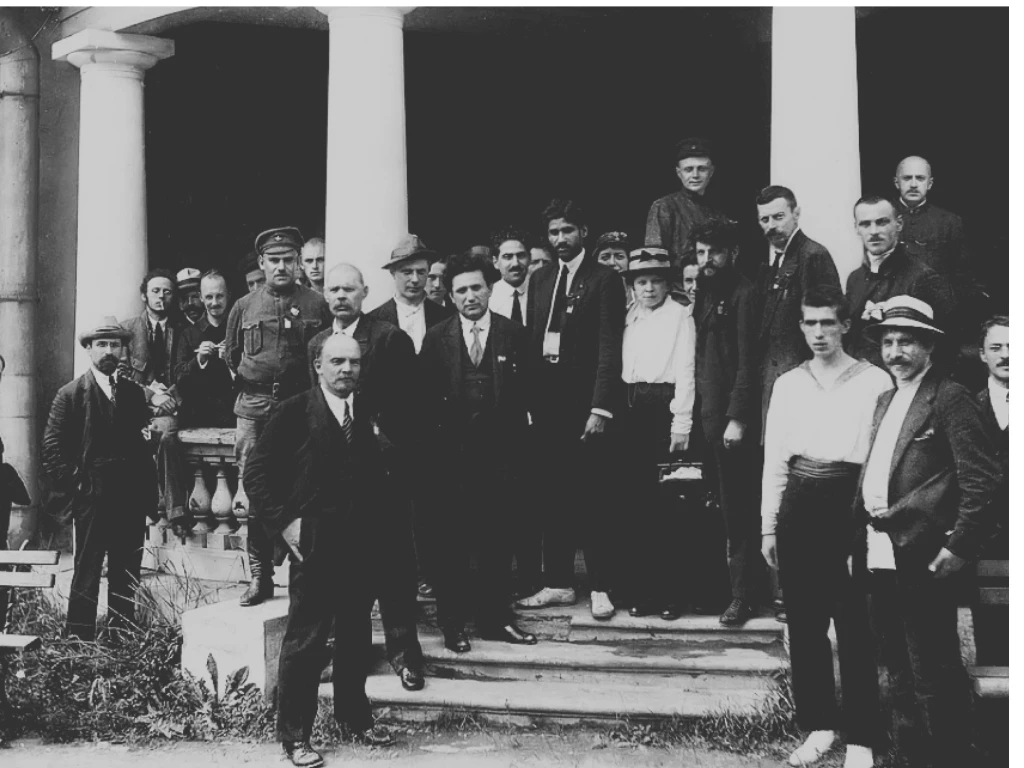
The Second Comintern Congress held at the Uritsky Palace, Petrograd 1920, showing Lenin, Maxim Gorky, Grigory Zinoviev, and Manabendra Nath Roy (M. N. Roy)
When we speak of Pan-Africanism, it is important to emphasize that many significant debates emerged within the context of struggles for racial equality in the United States. These struggles were inscribed within Marxist and communist traditions: indeed, a considerable number of African American militants were active in the international communist movement, participating in spaces such as the Comintern (the Communist International), founded in 1919 in the aftermath of the Russian Revolution. Figures such as Harry Haywood, an African American Marxist from Chicago; Antonio Gramsci from southern Italy; and M.N. Roy, an Indian revolutionary exiled in Mexico and shaped by experiences across both Asia and the Americas; as well as militants such as Andreu Nin, Andrés Maurín and other delegates from the Spanish state, all attended the congresses of the Third International.
Debate at the Comintern conferences focused on a question of fundamental importance for communists: namely, whether capitalism possesses an inherently imperialist character – that is, whether its logic of accumulation necessarily entails the domination of some countries by others.
In the early debates of the Communist International, Lenin had advanced his thesis on imperialism as the highest stage in the development of capitalism in the core countries.2 Delegates from the Global South, however – such as M.N. Roy and others from Asia and Africa – challenged this view, arguing that imperialism was not merely a higher stage, but the very condition of possibility for the development of capitalism in the core countries.
Another key thesis discussed at the Comintern conferences was Lenin’s widely disseminated argument in ‘The Right of Nations to Self-Determination’, developed in discussion with Rosa Luxemburg on the question of Poland, where he advanced the proposition that ‘no nation can be free if it oppresses other nations’.3 Here, Lenin was drawing on an earlier formulation by Marx, who had applied it to the case of Ireland and Great Britain – an argument that could be readily extended to debates around colonial independence. Marx, in turn, had formulated this idea during his studies of Ibero-American history at the British Library,4 drawing on a speech by the deputy Dionisio Inca Yupanqui in the Cortes of Cádiz, where he warned Spanish liberals that if they did not grant freedom to the American territories, they themselves would remain under the yoke of absolutism.5
It therefore starts to become clear that the violence exercised in the colonies reappears within metropolitan states themselves in the form of structural racism, repression, inequality and the exploitation of the popular classes. From this perspective, struggles for independence in the colonies are not a separate process, but rather a condition of the very possibility of revolution in Western states. So long as the working classes of Europe remain integrated into imperial projects and benefit – materially or symbolically – from colonial domination, they will continue to be traversed by a racial and imperial logic that blocks the construction of an egalitarian political community and, therefore, the unfolding of a revolutionary process in any full sense.
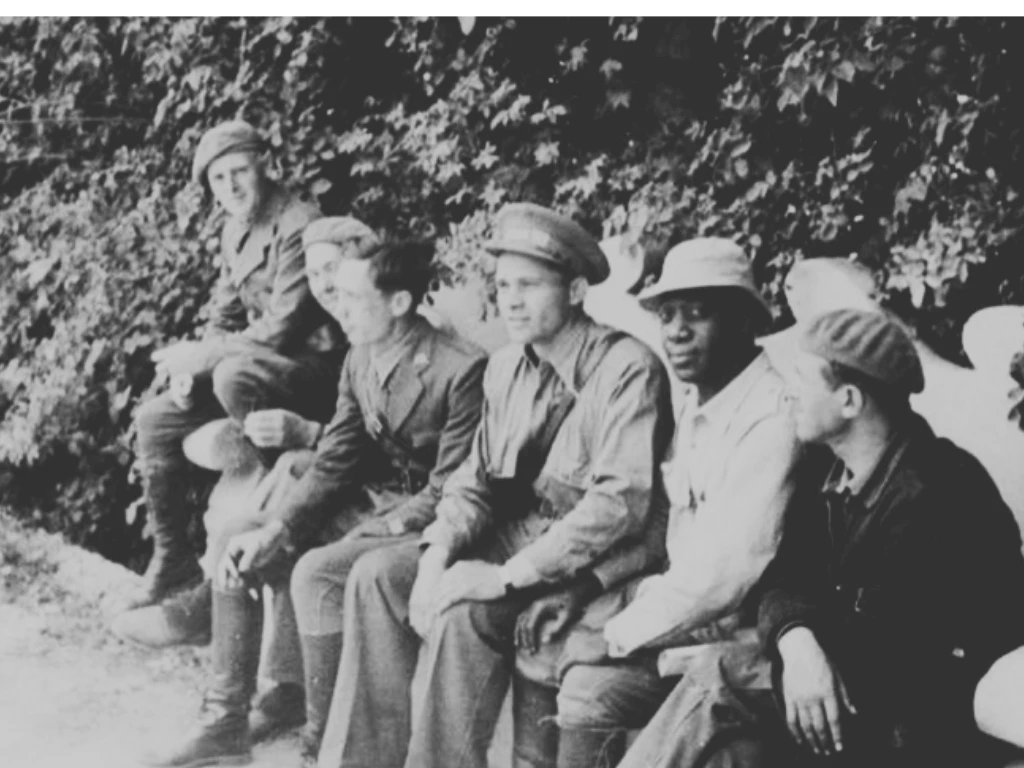
Harry Haywood alongside members of the Republican Army during the Spanish Civil War between 1936 and 1937. Abraham Lincoln Brigade Archives (ALBA)
Within this framework, African American Marxists, especially Harry Haywood,6 argued that advanced capitalist states not only project exploitation outward through imperial expansion but also reproduce internally forms of domination that closely resemble colonial relations. In the case of the United States, this gave rise to the exploitation of the Black population, understood as an internal nation whose liberation as a racialized group was intimately bound up with the liberation of American workers at large. It is Black workers – by virtue of their condition of super-exploitation – who are best positioned to organize and lead a socialist revolution capable of drawing in the wider white working class of the United States.
A similar argument can be found in Latin America in José Carlos Mariátegui’s interpretations of Peruvian reality. There, Indigenous peoples constituted an ‘internal nation’ subjected to double exploitation: as agricultural labourers on the haciendas, and as subjects dehumanized in cultural, linguistic and religious terms. Under these specific conditions of exploitation, the Latin American revolution would necessarily be led by the most exploited sectors of the popular classes – that is, by Indigenous peoples themselves. A comparable position can be traced in Gramsci’s analysis of the peasantry in southern Italy, as well as in M.N. Roy’s reflections on the peasantry in India.
In a certain sense, this amounts to a rather self-evident observation: the material reproduction of life in capitalist societies depends upon intensified forms of exploitation affecting specific groups, and these groups are not being integrated into emancipatory political projects. We are speaking of those who sustain food production, care work, and, more broadly, social reproduction – subjects occupying positions of structural super-exploitation. Yet, today, parts of the contemporary Left seem not to have fully grasped this articulation.
Authors such as Mariátegui in the Peruvian context, Gramsci in Italy, M.N. Roy in India, and Harry Haywood in the United States have all pointed in this direction: within states, there exist communities subjected to specific forms of intensified exploitation.7 There is no homogeneity within the working class; there are always positions in which oppression is exacerbated. These take different forms – migrant populations, racialized minorities, women, and particularly racialized women – but they share a common condition: they are situated at a point where the contradictions of the system are expressed with the greatest force.
It is precisely from these spaces, these ‘internal colonies’, that the possibility of transformation emerges – not as a moral claim, but because it is here that violence, inequality and exploitation are most concentrated, and thus where the conditions for rupture become most acute. In this sense, the possibility of emancipation necessarily passes through these subjects. Without addressing these structural inequalities, processes of transformation will remain incomplete.
From this perspective, Pan-Africanism offers a crucial key for thinking the European present. It is not a matter of looking towards Africa as an external elsewhere, but of recognizing that these same logics operate within Europe itself. It is from cities such as Barcelona that forms of inequality are reproduced. And it is within these subalternized communities that the real possibility of social transformation largely resides; those who sustain life, who most intensely experience crisis, and who, in many cases, are already generating alternative practices in their everyday lives.
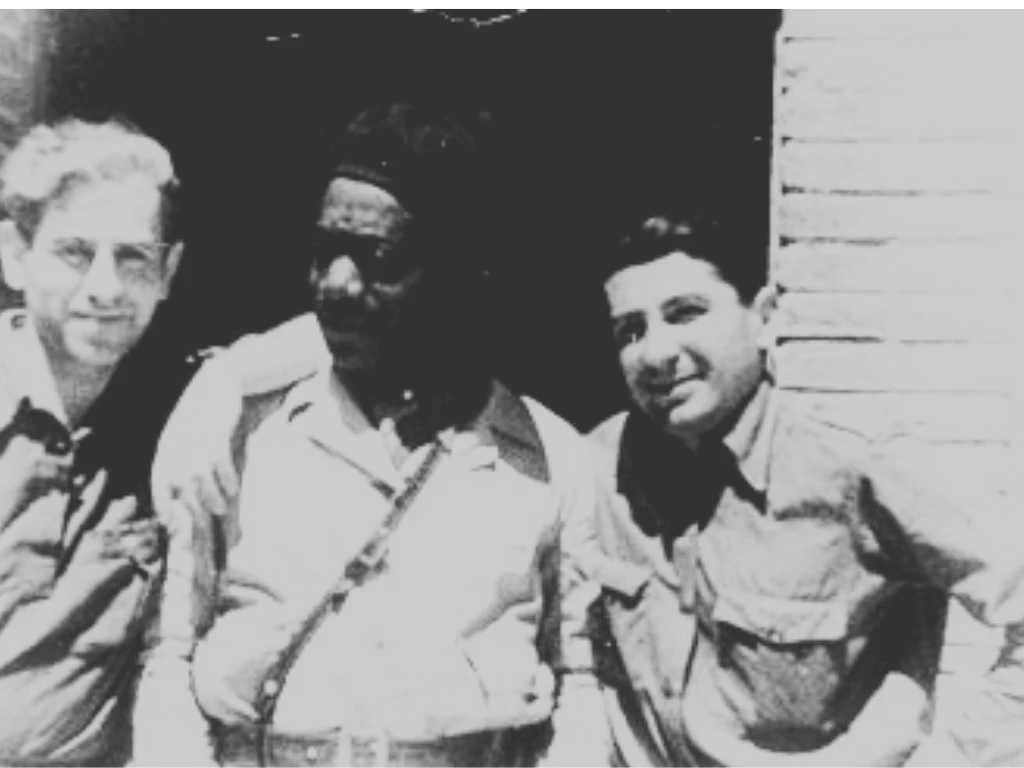
Photograph of Harry Haywood alongside members of the Republican Army during the Spanish Civil War between 1936 and 1937. Abraham Lincoln Brigade Archives (ALBA)
Another key concept developed within African American and Pan-Africanist thought during the 1920s and 1930s is the notion of colonial fascism, elaborated by George Padmore,8 an intellectual from Trinidad and Tobago whose trajectory unfolded across the United States, Germany and the United Kingdom. Drawing on this transnational experience – which allowed him to observe different forms of domination in both colonial and metropolitan contexts – Padmore argues that what came to be named ‘fascism’ in Europe does not constitute an absolute rupture, but rather the importing of forms of violence already extensively rehearsed in the colonies into the metropole. Racial domination, segregation, systematic violence, and the organization of spaces of confinement are not new phenomena, but structural practices of the colonial order that, at a certain historical moment, are displaced into the interior of Europe. Here, the distinction between fascism and colonialism is not a difference in the forms of violence, but a difference of location and perception. The same logics of extermination, racial hierarchization and extreme exploitation had long been deployed by imperial powers such as Great Britain, France, Belgium, Spain and Italy across Africa, Asia, the Caribbean and other regions of the world. What shifts in the twentieth century is that these modalities of violence come to be applied to European populations as well.
This is the fundamental fracture of modernity: the partitioning, the fragmentation of humanity itself. The moment policies of dehumanization are legitimized against others, that same logic ultimately rebounds upon society as a whole. This is precisely what George Padmore pointed to, and what a significant strand of European Marxism failed to grasp: that the Second World War cannot be explained solely as a process of ideological radicalization. It must be understood as an inter-imperialist conflict inscribed within the longue durée of European colonialism.
Throughout the nineteenth century, Europe developed through colonial expansion, capitalizing on the crises of other systems – in Africa, in the Ottoman Empire, and in China. The Opium Wars stand as a paradigmatic example of economic destabilization, military intervention and territorial domination as elements of a single integrated logic. Within this framework, the Industrial Revolution cannot be understood as a purely European process, but rather as a transformation sustained by colonial exploitation and by the extractivism of both resources and technologies – exemplified by Britain’s interventions through the Opium Wars.
From this point, the First World War breaks out precisely because of the unequal distribution of access to colonial markets. Powers with colonies had access to cheap resources, while empires excluded from these circuits – such as Germany or the Austro-Hungarian Empire – faced greater economic and inflationary pressures. War thus emerged as a struggle over the partitioning of the world.
The interwar period did not resolve this contradiction but rather deepened it: the colonial order was maintained, access to markets remained restricted for certain powers, and the conditions of crisis were reproduced. Within this context, fascism emerged as a violent reorganization of this tension, reintroducing the logics of domination, expansion and extermination constitutive of colonial rule into the European space.
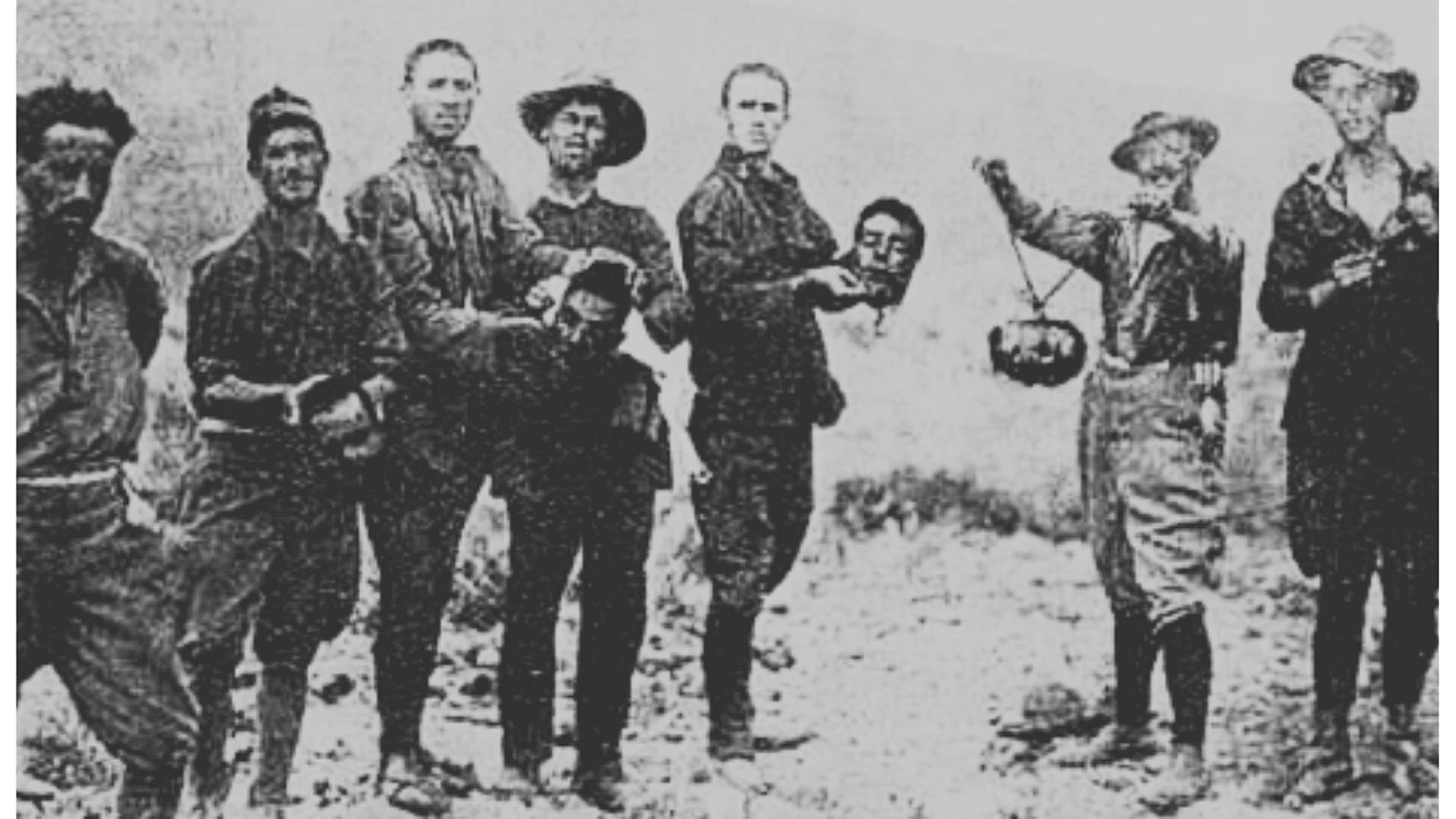
Legionnaires holding the heads of Rif fighters. Photograph published by Jacques Roger-Mathieu in The Memoirs of Abd el-Krim, 1926
These dynamics did not arise from nowhere; they were nourished by imperial and supremacist narratives consolidated during this period. Concepts such as Lebensraum (living space), certain formulations of Hispanidad and Zionism,9 and a range of national-imperial projects all expressed this will to expansion in contexts where empire was no longer fully viable. In this sense, they can be understood as empires without empire – formations whose frustration was translated into internal violence.
From this perspective, the rise of authoritarianism in Europe should not be understood as an anomaly, but rather as the return, within the metropolitan centre, of the forms of violence that Europe had exercised for centuries across the rest of the world. Fascism thus appears as a form of internal colonialism. The order that emerged after the Second World War, under US hegemony, did not fully dismantle these logics, but rather reorganized them. Western Europe was reconstructed as a space subordinated in military, economic and geopolitical terms – profoundly dependent, yet still largely marked by a self-perception grounded in racial superiority and historical centrality. For this reason, the question that emerges in the present – within Europe today – is unavoidable: What conditions make possible the resurgence, within the continent, of authoritarian, violent and profoundly dehumanizing forms? What transformations in political economy, culture and subjectivity allow these logics to re-establish themselves as a horizon?
Indeed, as early as the 1930s, Padmore warned that the European Left was failing to grasp how maintaining colonial systems would ultimately destabilize metropolitan societies themselves. He pointed, for instance, to the fact that the preservation of British rule in the Caribbean or French control in North Africa entailed a profound political cost: it inscribed an imperial, racist and bellicose ethos within society, while simultaneously obstructing the emergence of emancipatory projects of a socialist character within Europe itself.
This reading is reinforced when one considers the development of the Second World War. A significant proportion of the forces that contributed to the defeat of Nazism on European soil came from the colonies: troops from North Africa, Southeast Asia and the Caribbean played an active role in the liberation of Europe. This fact alone unsettles the Eurocentric narrative that frames the Second World War as an exclusively internal struggle between democracies and totalitarianisms.
Moreover, the political map of Europe at the time is not an image of a predominantly democratic continent. Authoritarian regimes, or systems severely limited in democratic terms, existed across multiple countries: from Portugal and Spain to Vichy France, Fascist Italy and Nazi Germany. Even in the British case, democratic functioning was suspended or significantly curtailed over extended periods, while extreme forms of violence continued to be exercised systematically in colonial territories.
From this perspective, the difference between fascist regimes and other European powers lies less in the presence or absence of violent practices than in their localization. Whereas fascism brought these logics into the interior of Europe, other powers continued to deploy them in their colonies. This helps to explain the construction of certain historical narratives in which some actors appear as defenders of freedom, while others are cast as absolute embodiments of evil – thereby obscuring the continuity of colonial violence within the global order.
If we turn to the Spanish case, it is striking that, in 1936, a significant part of the international Left mobilized against the state. Among them were numerous African American militants, whose presence formed part of a broader global militant and socialist agenda. In their case, these were militants who had initially attempted to travel to Ethiopia to confront the Italian invasion driven by Mussolini’s Fascism. However, the collapse of the Ethiopian Empire and the exile of its emperor ultimately redirected this political trajectory, which came to converge in the International Brigades in Spain.
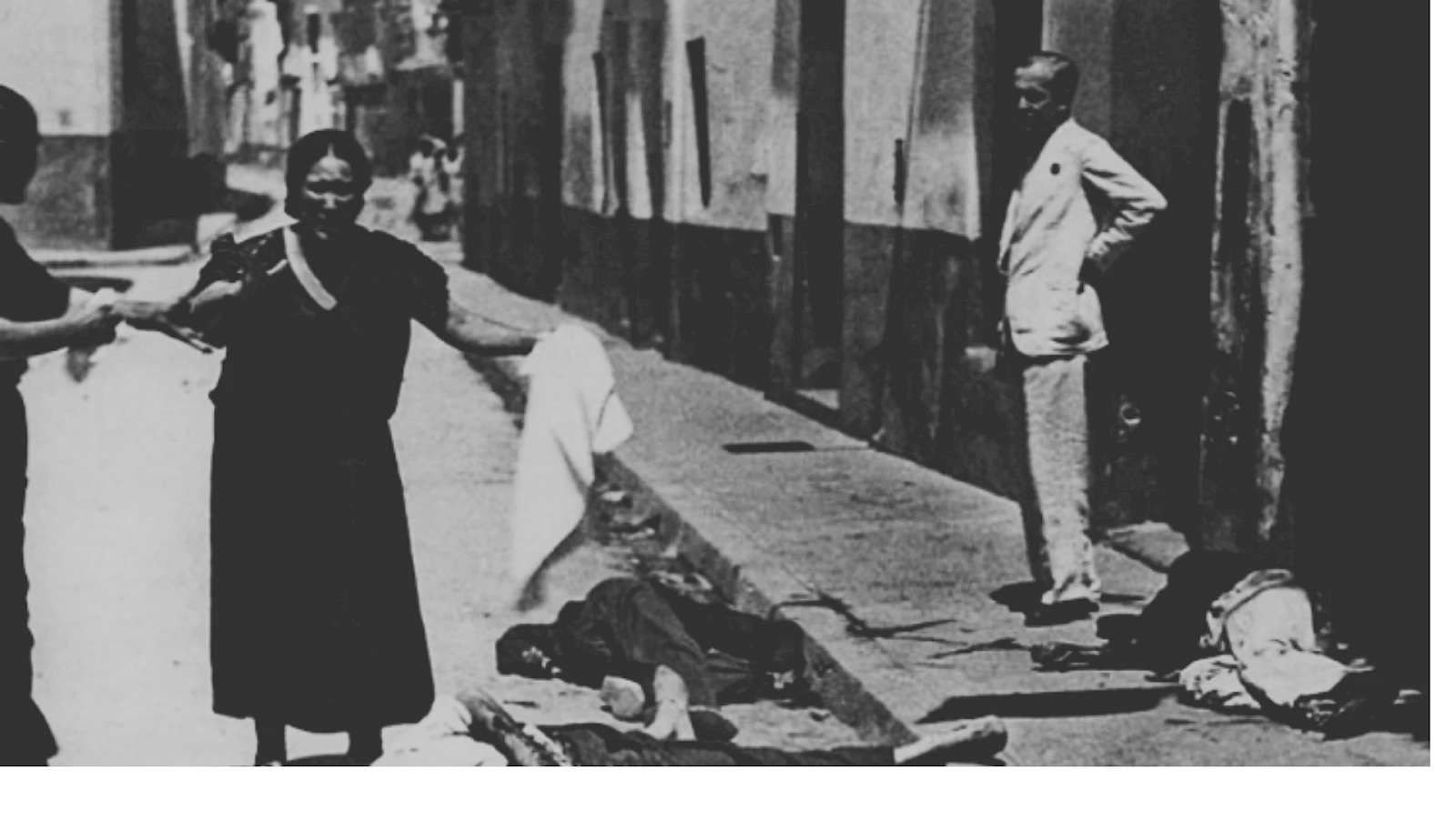
A woman mourns before the bodies of three men killed on Rodrigo de Triana Street, Seville, following the capture of the neighborhood by the forces of the Francoist commander Antonio Castejón Espinosa, 21 July 1936
From the standpoint of these militants, and of Pan-Africanist thinkers such as George Padmore, what was unfolding in Spain was clear: Francoism was not an anomaly, but rather a form of colonial fascism applied within the Iberian Peninsula itself. The violence deployed by the insurgent army directly echoed the colonial practices previously exercised in North Africa. For those who had experienced racialization and structural violence, it was evident that a logic of extermination was taking shape in which the category of the ‘political enemy’ was transformed into a racialized condition: the ‘Red’ came to be constructed as an absolute other, rendered disposable and subject to elimination.
Padmore develops this argument explicitly in texts such as ‘Why Moors Help Franco’ (1937), where he examines one of the central contradictions of the conflict, namely the support given by sections of the Moroccan population to the Francoist camp.10 His fundamental claim is that, had the Republic advanced a process of decolonization in Morocco, Franco would not have been able to assemble the army with which he launched the coup. The refusal to dismantle the colonial order allowed fascism to mobilize troops drawn from previously subjugated territories, thereby turning colonialism into a decisive military resource in the formation of a fascist army.
In this sense, Franco’s forces were composed, in part, of subjects who had directly endured colonial violence and who, at the same time, had been shaped within its logics. Extreme exploitation generates conditions in which subaltern populations can be recruited into competing projects of power, particularly when emancipatory movements fail to offer material responses. For Padmore, this is a direct consequence of the persistence of colonialism. The articulation between the national ideology and a logic of racial supremacy generated the conditions for an ultra-violent uprising that resulted in the death of hundreds of thousands of people and the establishment of a fascist regime that lasted for more than four decades. This regime deployed systematic forms of violence: forced labour camps, state-linked systems of labour exploitation, ideological and religious persecution, the suppression of languages and cultures, as well as specific forms of gendered violence that structured the subordination of women across generations.
Significantly, these forms of violence were not essentially different from those that the Spanish state itself had exercised in its colonial territories, such as North Africa. In other words, Francoism can also be read as an inward extension of colonial practices previously tested in other spaces.
If we move into the second half of the twentieth century, we encounter a reconfiguration of the geopolitical order under US hegemony, in which Western Europe is rearticulated without having fully resolved these inheritances. And yet, in the present, we are witnessing a situation in which many of the theoretical and political frameworks developed over recent decades appear to be entering into crisis in the face of the intensification of global violence.
In this regard, recent developments – such as the genocide in Palestine, new imperialist wars, and the intensification of Western intervention in the Global South – have called into question the explanatory and political capacity of categories such as human rights, liberal democracy, and even certain strands of decolonial thought. These developments reveal the limitations of approaches that are incapable of either preventing or fully comprehending contemporary forms of destruction. Violence no longer appears as an exception within the global order, but rather as part of a genocidal continuum that is reproduced simultaneously across multiple territories.
From this perspective, the thesis of colonial fascism acquires renewed contemporary relevance. Practices of control, exclusion and repression – raids, detention centres, deportations – form part of a political grammar that continues to operate within European societies. These are not marginal phenomena, but expressions of a structural logic that has never been fully dismantled.
It is within this context that the decolonization of Europe acquires its full meaning. The task for which Pan-Africanist thinkers and militants struggled – many of whom also took part in conflicts such as the Spanish Civil War – entailed understanding that the end of colonialism within the metropolis is a necessary condition for any genuinely emancipatory process.
This requires recognizing that the violence exercised against others is part of a system that, ultimately, turns back upon those who legitimize it. Wherever it becomes normalized, it sooner or later re-enters the interior of the social body itself. At this point, Pan-Africanism teaches us that the possibility of liberation cannot be conceived in terms of separation, but of relation. It does not consist in constructing solidarities for others, but in building with them – listening, learning and articulating a shared project alongside those bodies and communities that have historically endured the most intense forms of oppression.
Ultimately, the decolonization of Europe entails precisely such a displacement: ceasing to conceive of itself as the centre, abandoning a position of exteriority, and reconstructing itself as part of the world. To think Europe from the standpoint of Pan-Africanism means exactly this: a process of radical decentring that opens up the possibility of imagining other forms of community, beyond the colonial logics that have historically structured it. In a context of renewed imperial crisis and of the geopolitical decentring of the United States and Europe, the phantom pain of a return to internal violence is a tangible reality. Imperial nostalgias, hate speech against migrants, new forms of violence against women, and rhetorics exalting new authoritarianisms represent, as Padmore pointed out, a revival of colonial fascism in the form of the Sionization of Europe, of new apartheids, of new forms of sexual violence against women’s bodies. It is those communities within Europe (migrants, women, ethnic and national minorities) that once again sustain the revolutionary possibility in their hands. The social revolution will be theirs, or it will be no one’s.
Related contributions and publications
-
The Repressive Tendency within the European Public Sphere
Ovidiu ŢichindeleanuInternationalismsPast in the Present -
Rewinding Internationalism
InternationalismsVan Abbemuseum -
Troubles with the East(s)
Bojana PiškurInternationalismsPast in the Present -
Right now, today, we must say that Palestine is the centre of the world
Françoise VergèsInternationalismsPast in the Present -
Body Counts, Balancing Acts and the Performativity of Statements
Mick WilsonInternationalismsPast in the Present -

Until Liberation I
Learning Palestine GroupInternationalismsPast in the Present
Related activities
-
–MACBA
The Open Kitchen. The fermented seed, colonialism and extractivism

The MACBA Kitchen is a working group situated against the backdrop of ecosocial crisis. Participants in the group aim to highlight the importance of intuitively imagining an ecofeminist kitchen, and take a particular interest in the wisdom of individuals, projects and experiences that work with dislocated knowledge in relation to food sovereignty.
-
MACBA
The Kitchen: Workshop by Marina Monsonís

The Kitchen is a meeting place open to the participation of all, especially people and organizations that want to share their knowledge and experiences around the kitchen.
-
–MACBA
Where are the Oases?

PEI OBERT seminar
with Kader Attia, Elvira Dyangani Ose, Max Jorge Hinderer Cruz, Emily Jacir, Achille Mbembe, Sarah Nuttall and Françoise VergèsAn oasis is the potential for life in an adverse environment.
-
MACBA
Mobile Garden. A Place to Meet
An open space, a social space. How could the Museum be more open to the needs of the neighbourhood?
-
MACBA
Anti-imperialism in the 20th century and anti-imperialism today: similarities and differences
PEI OBERT seminar
Lecture by Ramón GrosfoguelIn 1956, countries that were fighting colonialism by freeing themselves from both capitalism and communism dreamed of a third path, one that did not align with or bend to the politics dictated by Washington or Moscow. They held their first conference in Bandung, Indonesia.
-
–MACBA
Song for Many Movements: Scenes of Collective Creation
An ephemeral experiment in which the ground floor of MACBA becomes a stage for encounters, conversations and shared listening.