Appeal from Artists and Cultural Workers in Serbia to International Colleagues
Following the publishing of the article ‘Mass Student Protests in Serbia: The possibility of different social relations’ by Marijana Cvetković and Vida Knežević in March 2025, L’Internationale Online publishes an appeal by the coalition Community of Arts and Culture Serbia.
We, artists, scholars, and cultural workers from Serbia, gathered in the informal initiative Community of Arts and Culture, wish to inform our international colleagues about the current situation in the cultural sector and the scale of repression that has shaped our work and lives over the past 18 months.
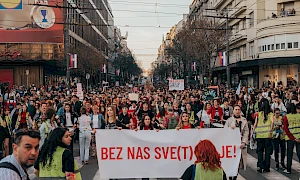
Since November 2024, when a canopy at a newly renovated railway station collapsed, killing 16 people, Serbia has witnessed the emergence of the largest student movement in its history. Mass protests followed, demanding accountability and exposing systemic corruption, media control, and the abuse of public institutions. In response, the government, in power since 2012, has intensified repression, censorship, and violence, marking one of the most difficult periods for Serbian society and its fragile democracy.
From the outset, cultural workers stood in solidarity with students. During 2025, many faced serious consequences: loss of funding, restricted access to public spaces and media, and professional retaliation. Long-standing problems, reduced budgets, unequal and politically controlled funding, nepotism, and institutional mismanagement, have deepened further. As a result, many artists and cultural workers now face severe economic insecurity, often without the basic means to sustain their work. This has been accompanied by censorship, workplace harassment, dismissals, and public attacks against those who speak out. Such practices have become widespread. Alongside economic and administrative measures, physical violence has also intensified, with students and citizens facing arrests and police brutality. These developments must be understood not as isolated incidents, but as a clear pattern of systemic repression, political pressure, and the instrumentalization of culture. What is at stake is not only the position of individual artists or cultural programs, but the very possibility of a free and autonomous cultural life, and with it, the integrity of public space and democratic processes.
In response, and encouraged by the student movement, we formed the Community of Arts and Culture. This initiative emerged from a shared struggle against repression and from the urgent need to defend the conditions necessary for the survival of the cultural and artistic scene in Serbia. One of our key activities is the Chronicle of Repression, documenting cases of pressure and repression in the cultural field. These conditions have severely affected international cooperation. Numerous projects, festivals, residencies, research, and exhibitions, have been halted due to lack of funding and resources. At the same time, some international artists have unknowingly participated in projects linked to structures aligned with the regime, which risks reinforcing these conditions.
In this context, the specialized world exhibition EXPO 2027 in Belgrade should be understood not as an isolated or independent project, but as one that is fully shaped and controlled by the current ruling regime, and as the culmination of its model of governance: marked by non-transparency, corruption, the bypassing of legal procedures, the privatization of public interest, and the instrumentalization of culture. A disproportionate share of public funds has been redirected toward this project, concentrating resources within structures aligned with the regime, while further undermining the already fragile cultural infrastructure and leaving the majority of local artists and cultural workers without access to basic support. While presented as a global cultural event, it raises serious concerns regarding legality, environmental impact, and the introduction of exceptional legal measures that undermine existing judicial frameworks.
At a time when repression, violence, and the erosion of academic and artistic freedom are intensifying, it is difficult to view such projects as genuinely progressive. The official EXPO slogan, “Play for Humanity,” stands in stark contrast to this reality.
We call on our international colleagues to:
- help amplify what is happening in Serbia
- engage in dialogue with us
- speak out against the growing threats to freedom, democracy, justice, and citizens’ rights
- carefully inform themselves before accepting any form of collaboration or participation in EXPO 2027 or related programs
- question and hold your governments and relevant institutions accountable regarding their countries’ participation in EXPO 2027 in Belgrade
Despite these challenges, we remain open to collaboration and exchange, and we welcome those who wish to share in our struggles and hopes. Artists and cultural workers in Serbia need your presence and active support. In times of global crisis, solidarity and collective resistance are more important than ever.
One World, One Struggle!
Related contributions and publications
-
Masovni studentski protesti u Srbiji: Mogućnost drugačijih društvenih odnosa
Marijana Cvetković, Vida KneževićEN rsInternationalismsPast in the Present -
The Repressive Tendency within the European Public Sphere
Ovidiu ŢichindeleanuInternationalismsPast in the Present -
Rewinding Internationalism
InternationalismsVan Abbemuseum -
Troubles with the East(s)
Bojana PiškurInternationalismsPast in the Present -
Right now, today, we must say that Palestine is the centre of the world
Françoise VergèsInternationalismsPast in the Present -
Body Counts, Balancing Acts and the Performativity of Statements
Mick WilsonInternationalismsPast in the Present -
Until Liberation I
Learning Palestine GroupInternationalismsPast in the Present
Related activities
-
Museo Reina Sofia
Palestine Is Everywhere
‘Palestine Is Everywhere’ is an encounter and screening at Museo Reina Sofía organised together with Cinema as Assembly as part of Museum of the Commons. The conference starts at 18:30 pm (CET) and will also be streamed on the online platform linked below.
-
HDK-Valand
Book Launch: Collective Study in Times of Emergency, Gothenburg
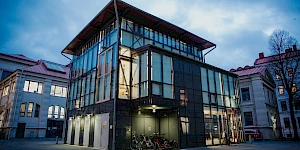
with Nick Aikens (L'Internationale Online / HDK-Valand) and Mills Dray (HDK-Valand), 17h00, Glashuset
-
Moderna galerija
Book Launch: Collective Study in Times of Emergency, Ljubljana
with Nick Aikens (L'Internationale Online / HDK-Valand), Bojana Piškur (MG+MSUM) and Martin Pogačar (ZRC SAZU)
-
WIELS
Book Launch: Collective Study in Times of Emergency, Brussels
with Nick Aikens (L'Internationale Online / HDK-Valand), Subversive Film and Alex Reynolds, 19h00, Wiels Auditorium
-
NCAD
Book Launch: Collective Study in Times of Emergency, Dublin
with Nick Aikens (L'Internationale Online / HDK-Valand) and members of the L'Internationale Online editorial board: Maria Berríos, Sheena Barrett, Sara Buraya Boned, Charles Esche, Sofia Dati, Sabel Gavaldon, Jasna Jaksic, Cathryn Klasto, Magda Lipska, Declan Long, Francisco Mateo Martínez Cabeza de Vaca, Bojana Piškur, Tove Posselt, Anne-Claire Schmitz, Ezgi Yurteri, Martin Pogacar, and Ovidiu Tichindeleanu, 18h00, Harry Clark Lecture Theatre, NCAD
-
–
Collective Study in Times of Emergency, Amsterdam
Within the context of ‘Every Act of Struggle’, the research project and exhibition at de appel in Amsterdam, L’Internationale Online has been invited to propose a programme of collective study.