How the Atomic Bomb Changed the World: A discussion on the geopolitical, philosophical and societal transformations of the nuclear era
This conversation considers the history, destruction and society's present day relationship to nuclear weapons, the deadliest ever created by humans. It is an edited transcript of a conversation that took place on Radio Slovenia, Channel 1 (PRVI), Intelekta Broadcast, 11 November 2025.
Alja Zore: Since the United States dropped atomic bombs on Hiroshima and Nagasaki 80 years ago, the world has changed. The air we breathe is different, containing radiation; the earth is different, having borne not only the radiation of those two bombs dropped in war, but also that of more than two thousand bombs detonated experimentally by the superpowers in subsequent decades. Other things that have changed include the ways wars and diplomacy are conducted, the way science is funded, and the world-position of humanity now that some of us possess the ability so suddenly to transform the Earth into an unrecognizable state: one in which our lives could not continue, at least not in their present form.
Despite the enormity of humans having created something so destructive, we engage with this issue relatively little today. In the first few decades after Hiroshima and Nagasaki fear was tangibly present, and the Cuban Missile Crisis, which pushed the world to the brink of nuclear war, led to treaties and arms limitations. Yet, today we seem reconciled with the fact that at least nine countries in the world possess atomic weapons, some of which are ready to be deployed at any given moment. Even the current abandonment of hard-won treaties and announcements of nuclear weapons-testing does not truly shake us.
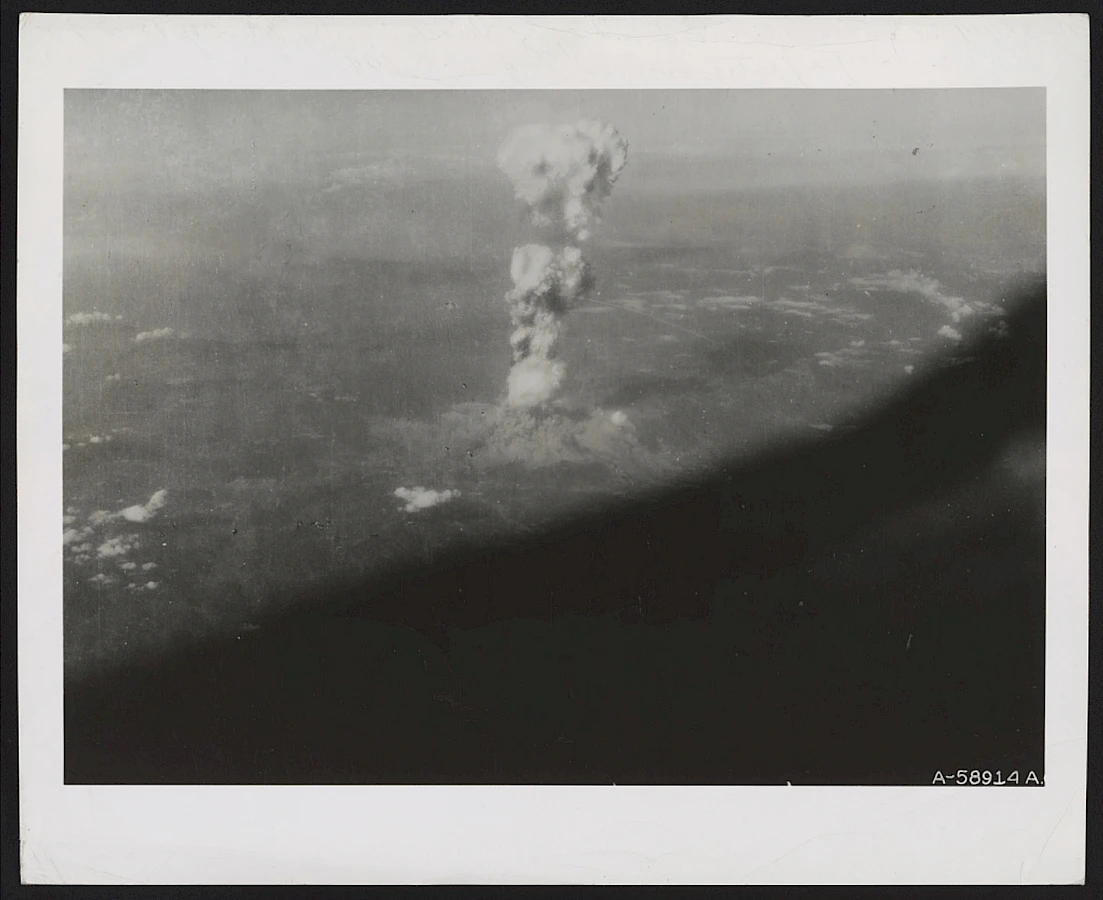
First atomic bombing of Hiroshima, Japan by B-29 superfortresses on 6 August, 1945. Gelatin silver print. Source: National Committee on Atomic Information National Committee on Atomic Information records
It is true that nuclear weapon stockpiles have been significantly reduced since the Cold War, but the superpowers still possess thousands of nuclear warheads – more than enough to destroy or radically disrupt much of life on Earth. At the same time, there appears to be little present fear of these weapons and less understanding of their danger. How do you explain this? Why is it so difficult for us to contemplate the atomic age?
Igor Bijuklič: President Trump recently authorized the testing of nuclear weapons, and the Russian Federation followed suit. It is therefore possible to say that today’s geopolitical situation has shattered the illusion that the nuclear threat is a relic of the Cold War. You mentioned a reduction in nuclear stockpiles. Does that actually mean anything? At the height of the Cold War in the 1980s, global nuclear weapon stockpiles were estimated at 60,000–70,000 warheads, enough to destroy the world several times over. Today, thanks to ‘reductions’ in global arsenals, we can now destroy the world a few times fewer. It is possible to argue that since 1945, the development, so-called ‘testing’ and use of the atomic bomb as a tool of extortion in international relations has never truly ceased, and nor has military training in their use. We could say that with the final treaties of the late 1980s a pause occurred, but we are once again in a potential renaissance of nuclear armament. Moreover, the current situation is worse, as most of the international treaties regulating development and testing have more or less expired, and their renewal is nowhere in sight.
We must also ask ourselves how we view the inaugural events of the atomic age in 1945 – that is, the first test at the Trinity site on 16 July, the bombings of Hiroshima and Nagasaki on 6 and 9 August: Where and how are they recorded in our collective memory? Unlike Rwanda or the Holocaust, these anniversaries never became UN ‘global days of remembrance’, even though it was clear, from the accumulation of warheads, that any future nuclear cataclysm would not be a local phenomenon. Even on this year’s 80th anniversary, the commemorative ceremony at the Peace Memorial Park in Hiroshima did not receive special attention by the successors and representatives of the event's key historical protagonists. In fact, it seems that the epoch-defining events that marked the dawn of the atomic age and the onset of the Anthropocene are not commemorated on a scale commensurate with their historical significance.
Their remembrance has been also trivialized and commodified. Consider what the word bikini evokes today. The two-piece swimsuit takes its name from Bikini Atoll, which was being used as a site for nuclear weapons testing!1 We see, therefore, that it is possible to make a commercial bestseller out of the apocalypse itself.
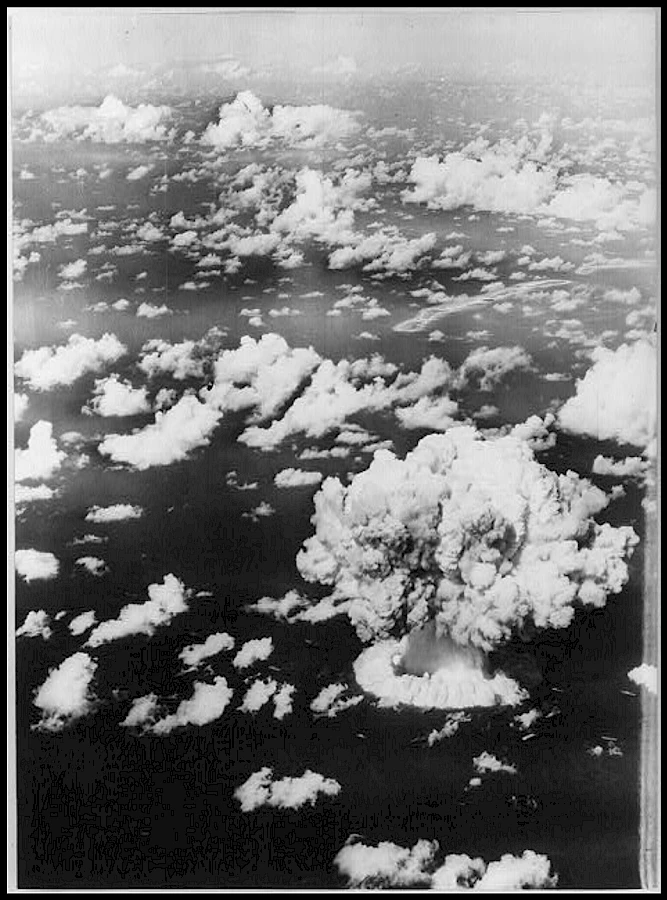
Mushroom cloud rising over Bikini atoll after atomic bomb explosion 1946. B&W film copy neg. Photo by USAF. Source: Library Of Congress Prints And Photographs Division Washington, D.C.
Gal Krizmanič: The problem is also that people in positions of power appear to have very poor knowledge about nuclear weapons. When Donald Trump spoke about wanting to resume nuclear testing, claiming that other countries are doing so as well, he was referring to recent testing by the Russian Federation. In both cases, these tests were, and are, not nuclear explosions, but rather tests of nuclear delivery systems, which the United States itself already conducts as well. For example, the US last tested its submarine-launched intercontinental ballistic missiles in September this year (2025). But at the same time, major military powers have begun modernizing their nuclear arsenals, most of which date back to the Cold War era, and are consequently increasing investments in these weapons. The US plans to invest more than a trillion dollars over the next 20 years, while the UK intends to invest around a hundred billion pounds to replace its ballistic missile submarine fleet. Yet increasingly, due to temporal distance, people in positions of responsibility seem to possess little or no knowledge about nuclear weapons or the past debates that took place around them.
AZ: You have highlighted the contrast between the present and the Cold War era, when both the people in positions of power as well as the public were much more deeply engaged with the issue of nuclear armament. But how aware were the Americans of what the atomic bomb could do when it was still in development, and to what extent did the effects of this weapon become clear to them immediately after its use? One would think not fully, because in the years following Hiroshima and Nagasaki they conducted an enormous number of tests, even though atmospheric radiation was then allegedly even higher than after the Chernobyl nuclear power plant exploded in 1986.
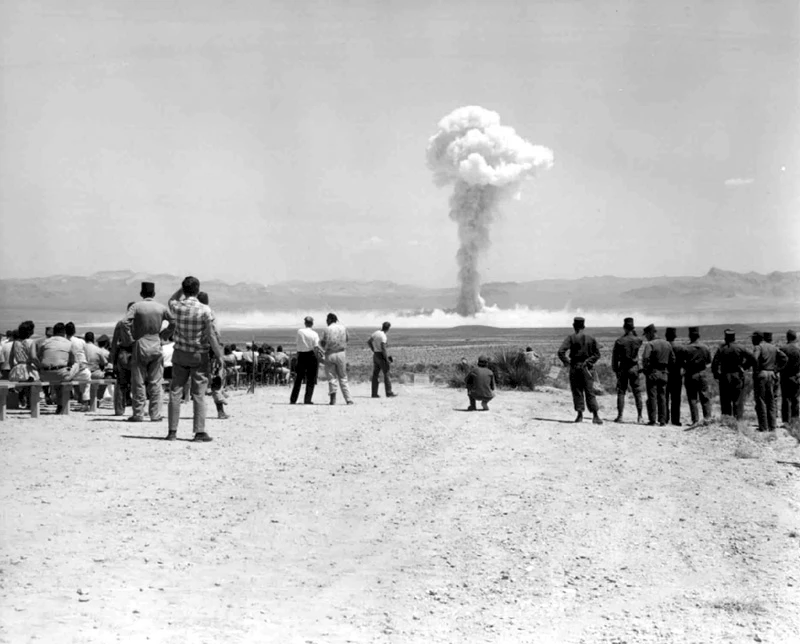
Nuclear test at the Nevada Test Site, 14 July 1962, part of Operation Sunbeam. Source: Wikimedia Commons
GK: The American debate on the use of nuclear weapons against Japan – both at the level of decision-makers and of the public – is fascinating, and keeps re-emerging. An interesting indicator was the 1995 exhibition prepared by the Smithsonian National Air and Space Museum to mark the 50th anniversary of the atomic bombing of Hiroshima. Veterans’ associations furiously protested any questioning of whether it had been justified. One of the demands they made in negotiations was that the exhibit must state that by doing so, the US avoided half a million casualties that would have been required to end the war by a land invasion of Japan. This is far removed from the rationale of the decision-making process that occurred at the time of the Potsdam Conference in the summer of 1945, during which the Trinity test also took place (demonstrating for the first time that the bomb worked) and at which the attention, including that of the US Delegation, was focused on deciding the fate of Europe. Partly for this reason, many key decisions were left to field commanders on the island of Tinian in the Pacific, including when the weapon would be dropped.
AZ: Did those field commanders also decide whether to use the atomic bomb at all, or only when to use it?
GK: These decisions remain the subject of historiographical debate and the distinction between them is not totally clear cut, also given that two bombs were used on two different major sites three days apart. What we do know is that they were arrived at via a process involving many people, not just issued as presidential orders. In preparation for using the nuclear bomb, two advisory committees were established: one that decided on targets, and another that decided on policy questions related to nuclear technology. What both committees treated as self-evident was that the nuclear bomb should be used, and they ultimately decided that it should be used on an urban civilian target so that the deterrent effect would be strong. They evaluated the possibility of dropping the bomb on a Japanese military base. They had a suitable target: a major Japanese naval base on the remote Truk Island (now Chuuk Lagoon). But they rejected this option because they judged the effect would not be sufficiently shocking. The same was true for the idea of dropping it over the sea in Tokyo Bay. The conclusion of these discussions was a list of Japanese cities against which the bomb should be used. Precisely when, which city, and at what tempo the bombing should be executed was left to military commanders. One must also keep in mind that, at the time all this was taking place, the US had been systematically firebombing the whole of Japan since the spring of 1945, destroying more than sixty Japanese cities. So the urban use of the nuclear bomb was a clear continuation of that strategy. When Secretary of War Henry Stimson objected to including the city of Kyoto among the targets due to its immense cultural significance, General Groves, commander of the Manhattan Project, interpreted this as political interference in military affairs.
IB: In May 2016, President Obama attended the commemorative ceremony of the 71st anniversary of Hiroshima. It is interesting to listen to his speech, in which the President of the United States was unable to articulate who the agent of this event was. The speech opens in simple, mythological, fairytale terms, describing how, on a bright August morning, ‘death fell from the sky’. The question is, to what extent are Americans themselves capable of confronting their country’s role in this historical event?
Regarding the first use of nuclear weapons, it is interesting to listen to historical revisions of that decision. Gar Alperovitz advances the thesis that the destruction of the two cities also served the perpetrators as a warning to the Soviet Union, then emerging as their Cold War adversary. Barton Bernstein offers another, perhaps more extreme thesis. There were six scenarios on the table for how to end the war in the Pacific in August 1945 including whether to continue conventional bombing, maintain a naval blockade, or revise the terms of surrender (to remove the demand that the Emperor must abdicate). Only one concerned the actual deployment of nuclear weapons against real targets, and yet it was never truly debated or decided upon. Chillingly, for Bernstein, this suggests that the bomb was used simply because it was available.
How are we best to understand this? In my view, through the lens of what the device itself represented. In his first address after the bombing, President Truman described the event as one of the greatest achievements of modern, organized science. Now imagine if the immense investment of resources into the development of the atomic bomb had yielded no epilogue, meaning no explosion: if this weapon was used merely as a deterrent, as a warning, or even against an isolated military target, we would never have learned its effects in light of the purpose for which it was manufactured – that is, mass destruction – which could only be known by using it to destroy cities and human beings. In this light, the first use of atomic weapons – which to this day we refer to as military – is extremely difficult to distinguish from a continuation of the nuclear experiment and weapon development programme itself. After the war ended, Truman established the Atomic Bomb Casualty Commission, sending numerous American doctors and scientists to study the long-term effects of nuclear radiation on survivors in Hiroshima itself, up until 1975, where treatment was not their primary objective. In short, we see that the drive to comprehend the ultimate effects of this instrument must be taken into account.
AZ: When we speak about the atomic bomb it really seems it does not function strictly as a physical weapon. Perhaps even more than the material destruction, the psychological effect the Americans created with this technology was what mattered most?
GK: The Americans already knew from intelligence reports that the Japanese government was divided and contemplating how to surrender. The dilemma, then, was not how to end the war, whether by invasion or the bomb, under the assumption that the Japanese were entirely fanatical and unwilling to surrender: this narrative emerged after the war and was never part of the discussions prior to its deployment. In 1945, a total war was drawing to a close, a war in which everything available was utilized, and the nuclear bomb was one such tool.
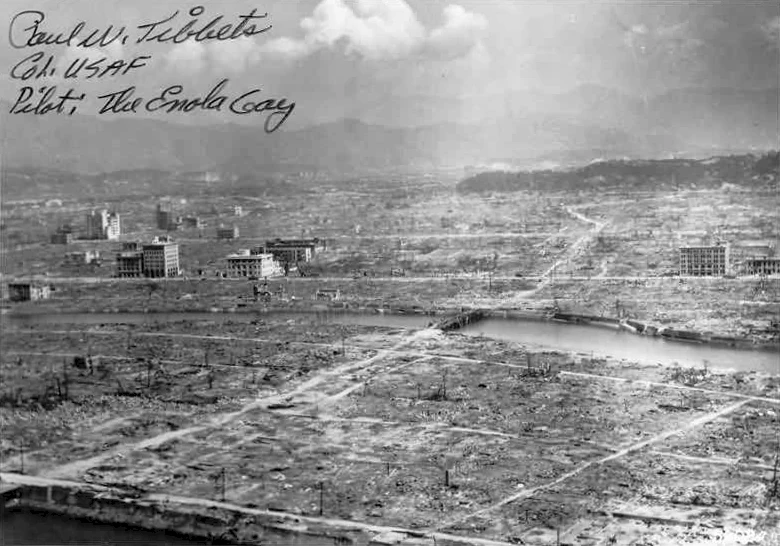
The remains of the city of Hiroshima in the aftermath of the atomic bombing, taken from the aircraft Enola Gay some time after the moment of detonation at 08:15:43 (local time) 6 August 1945. Photo with the handwriting of the pilot, colonel Paul Tibbets. Source: Wikimedia Commons
A few years later, during the Korean War the United States was again confronted with the question of whether to use nuclear weapons. It was determined that the weapon had no viable operational use that would yield victory or a significant breakthrough, and they realized the deterrent effect would be shattered if nuclear weapons were used without bringing about a decisive military turnabout. Nevertheless, nuclear powers continued to nurture somewhat schizophrenic military doctrines, planning the use of nuclear weapons for fully operational military purposes. At the height of the Cold War, in 1955 US President Eisenhower went so far as to say he saw no reason why these weapons should not be used like a conventional bullet. On the other hand, close US ally Franz-Josef Strauss, West German Defence Minister 1958–62, stated later: ‘War should be looked upon to be as terrible as our fantasy can imagine it, and I think then we shall have a more peaceful period in the next 100 years than we have in the last century.’2
AZ: In order to prevent it from happening?
GK: Precisely – and to preserve its deterrent effect.
IB: I would also add that one of the ways we have domesticated this device is precisely by calling it a ‘weapon’. I do not believe it is possible to think about the atomic bomb through these categories. One could argue that the atomic bomb is not a weapon.
AZ: Precisely because it cannot achieve concrete military objectives?
IB: Until now, it has always held true for so-called conventional weapons that a given weapon is developed vis-à-vis its capability to strike a specific military target. But the minimal effect of an atomic weapon is total destruction – it destroys virtually everything with total indifference. Throughout history, destruction was always a component of warfare, but never its primary objective. In the deployment of atomic weapons, it is no longer about destroying discrete conventional military targets but about destroying broader, non-combatant entities such as urban agglomerations, populations, the biosphere. Now the question arises: What, then, is the atomic bomb? If we cannot place it on the historical shelf alongside other weapons, where should it be placed?
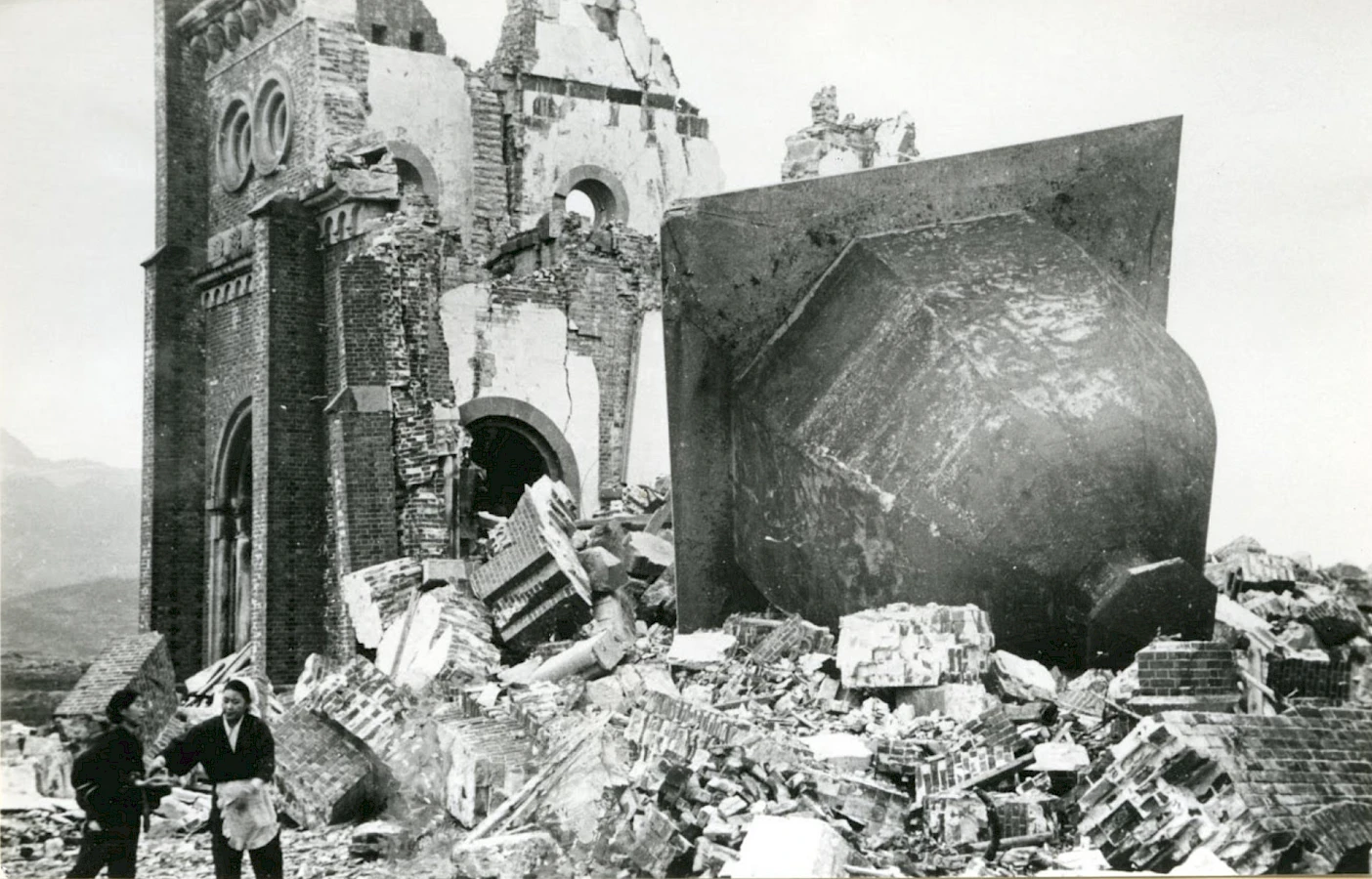
Cathedral Urakami Tenshudo after bombing, Nagasaki, January 1946. Source: Wikimedia Commons
If atomic weapons were developed neither as a deterrent nor as a tool of blackmail, but primarily as a means of total destruction, then in this sense it becomes possible to conceptualize Hiroshima alongside Auschwitz. On these grounds, one could argue that the increasing potency and accumulation of nuclear warheads during the Cold War was analogous to the continuation of – or, at least, to the intention to go on to commit – ‘Auschwitz by other means’, with or without genocidal intent as legally defined.3 The Cold War is rarely interpreted in this way, and there is a historical irony in the fact that while judicial proceedings were taking place in Europe against the new figure of the criminal-bureaucrat, as in the famous Eichmann trial, the preparation, development, and testing of weapons of mass destruction were simultaneously underway, conducted, under different ideological banners than of those standing trial in Europe, by scientist-bureaucrats. During the Cold War, thousands of them were just as diligently preparing the conditions for a scale of catastrophe in comparison with which the recently perpetrated horrors of the Third Reich would have appeared as little more than an exercise in ‘a provincial experimental theatre’.4
AZ: Perhaps this brings us to the creation of the atomic bomb. How did this process unfold? How did so many people agree to participate in something so destructive? And given that this was the first project of ‘Big Science’, how did it change the ways scientific research is conducted?
GK: At the beginning of World War II, several nations were investigating the feasibility of nuclear weapons. The discovery of nuclear fission and the possibility of a chain reaction occurred just before the outbreak of the war, and these discoveries were published openly in scientific journals throughout the spring and summer of 1939. Subsequently, several countries initiated secret research programmes, but only the United States decided, in late 1942, to launch a full-scale industrial programme, devoting 90 percent of its budget to constructing a brand-new sector capable of mass-producing these weapons. Approximately 1 percent of the US wartime budget went into the Manhattan Project and roughly the same proportion of American workers were employed in these industrial facilities, such as the site in Hanford, Washington where plutonium production reactors were built, unaware of what they were producing. By the end of the war, four explosive devices had been manufactured: the Trinity test, the two bombs dropped on Hiroshima and Nagasaki, and one that remained ready for use.
The initial key discoveries took place on a single workbench: now in a museum in Berlin one can view the table where Otto Hahn and Fritz Strassmann performed the fission/chain reaction experiment, engendering a monumental shift in the process of scientific discovery. For the development of the atomic bomb, the Los Alamos Laboratory was established 3–4 years later, employing 2,000 people and introducing an entirely novel structure for organizing research, complete with administrators and a vast technical support staff. Even during the war, scientists began reflecting on how to apply this model, which had proven so potent, to science in general. As early as 1944, several universities involved in the Manhattan Project each sought to establish a laboratory of their own explicitly modelled on Los Alamos, but stripped of the regime of secrecy that had so frustrated the scientists there. This was how the Brookhaven National Laboratory on Long Island, New York, came into being, opening in 1950. (The European laboratory CERN was created a few years later according to the Brookhaven model but ultimately housed no nuclear reactor, just a particle accelerator for ‘peacetime’ particle physics only).
IB: It is worth recalling President Eisenhower’s famous address on the ‘military-industrial complex’. We continue to repeat this phrase today, but a foundational element, really the bedrock of the entire structure is omitted: we must reconceptualize this entity as the military-industrial-scientific complex. Why does science find it so difficult to reflect upon the darker chapters of its history? One element is the popular perception that the results of technological developments are inherently ‘neutral’, implying that only the manner in which they are used retroactively imparts a moral character upon them, whether for good or evil ends.
AZ: Indeed, we often even view them as inherently positive.
IB: Primarily as progress, and progress is difficult to critique. Viewing such developments as neutral implies that the scientific research required to realise them is also morally ‘neutral’. In the case of the atomic bomb, this logic becomes impossible to sustain. What is most shocking is not that the bomb was invented, but that its ‘effect’ was subsequently refined and amplified, and furthermore, that nuclear warheads were manufactured in the same manner as any other product entering mass consumer circulation. Remember, the bomb was not only used twice: it has been used in more than 2,500 tests. When we consider the consequences of nuclear testing in the Marshall Islands from 1946 to roughly 1963, the hundreds of victims suffering from leukaemia and other radiation-related illnesses among the indigenous population as well as illnesses among American personnel, how can we label this neutral? Today, as states seek to revive nuclear testing, we must remember these largely uncommemorated acts.
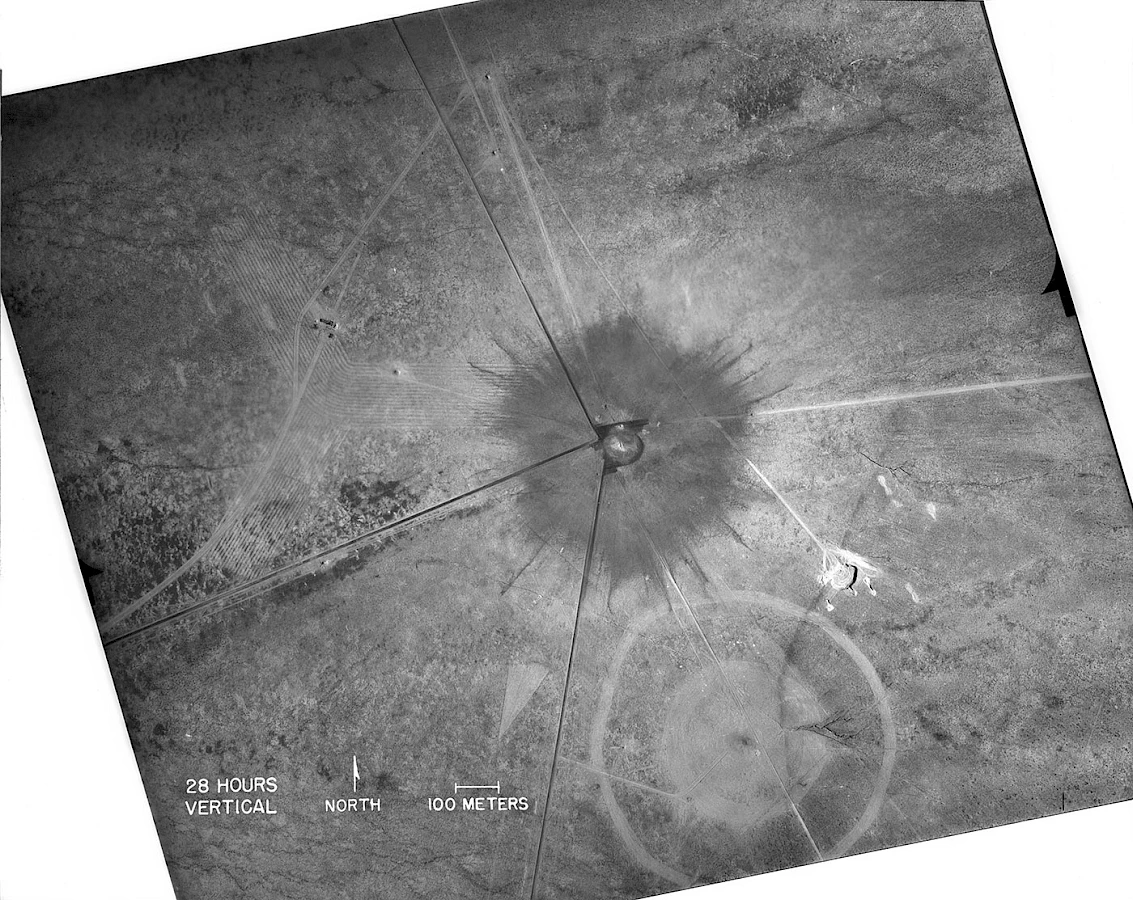
Aerial View of the Trinity Test Site, McDonald Ranch, 16 July 1945. This photo was taken 28 hours after the explosion, at ground zero. The circle at bottom right is where the 100-ton test was conducted on 7 May 1945. Source: atomicarchive.com
AZ: But why did countries accumulate so many bombs during the Cold War while simultaneously asserting that they must never actually be used? And how have the perspectives of politicians and decision-makers on the deployment of nuclear weapons evolved over time?
GK: What is interesting about nuclear arsenals during the Cold War is that in several countries, most notably the US, these weapons were not under the complete control of the military. Historian Alex Wellerstein has demonstrated in his latest book that President Truman felt misled regarding the decision to use atomic weapons, subsequently stripping the military of custody over them.5 For his entire tenure until 1952, nuclear weapons were not managed by the US military: civil authority rested with the Atomic Energy Commission, and even Eisenhower transferred operational control back to the military only gradually, between 1953 and 1959.6 Furthermore, at least initially, the military was often quite sceptical of nuclear weapons precisely because of the absolute destruction they wrought. Thus, a new intellectual elite formed – a clique within defence structures, partly in the Department of Defense and partly in the private sector, that began developing strategies for nuclear weapon deployment.
At the start of the Cold War, when NATO nations evaluated the conventional military force required to feel secure against the Soviet threat, they realized that maintaining such massive armies was politically unsustainable. Consequently, the US and NATO as a whole began relying on nuclear weapons against the strength of the Red Army. Thus, Moscow was threatened with a massive nuclear response to even limited conventional conflicts. This is the logic behind Strauss’s remark that nuclear war must be imagined as being as horrific as possible – it is a logic of deterrence.7 Over time, the logic of deterrence gave rise to the demand for the absolute reliability of the nuclear arsenal and its delivery system, which, it followed, must be capable of surviving an unexpected enemy first strike. Strategists envisioned the most extreme scenarios in which a nuclear retaliatory strike must still be launched, incidentally providing rationales for acquiring an extraordinarily high number of nuclear warheads.
IB: Following the end of the Cold War, it has been suggested that it was precisely the possession of such colossal arsenals that prevented direct conflict between the superpowers. Yet, when asked whether nuclear arsenals prevented conflict, Robert McNamara, architect of the US deterrence doctrine, responded, in effect: not at all; we were lucky – we came close twenty or thirty times.8 It is striking that the Cuban Missile Crisis, where we stood on the brink of apocalypse, has almost no place in our collective memory. Yet this event was the catalyst for the first serious treaties limiting the development and production of nuclear weapons.
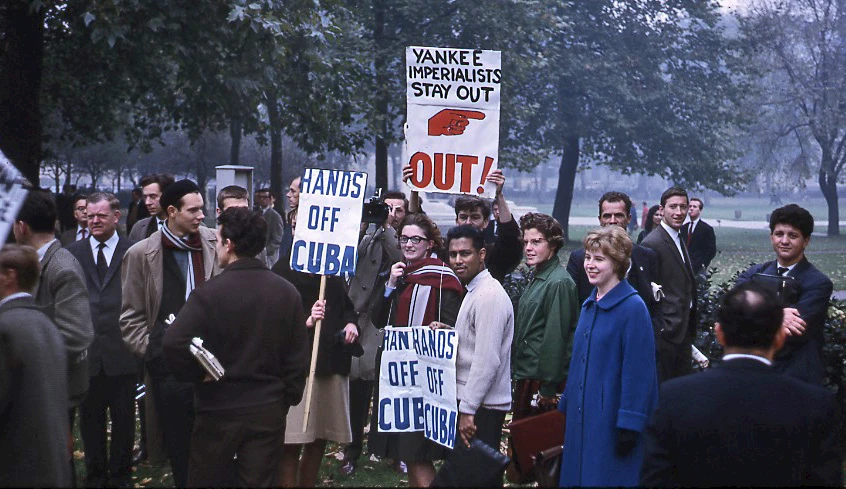
Hyde Park Protesters in October 1962, during the Cuban Missile Crisis. Source: Wikimedia Commons
AZ: As well as non-proliferation agreements and, eventually, limitations on testing. But another question opens here. To what extent did philosophy and literature reflect on the new atomic reality during the second half of the twentieth century? Of course, there have always been religions and myths portraying the end of the world – but for humans to be able to destroy the life of humanity as we know it seems to be a very new situation, worthy of serious rethinking.
IB: For me, this is where the radical nature of the atomic age lies: it translates the religious category of apocalypse into everyday geopolitical reality. However, unlike in the Judeo-Christian tradition, it is an apocalypse that is not followed by a Kingdom. A new human condition follows from this. We do not require technological implants or cyborgization to speak of a new kind of human being. With the atomic age, we have become ‘masters’ of the apocalypse, so to speak, although we would prefer to be rid of this mastery. Even if we could dismantle all arsenals, it would be nearly impossible to eradicate the knowledge we possess regarding nuclear energy and weapon design. This knowledge remains with us: hence, an exit from the atomic age is no longer possible.
Through an enormous expansion of human technical capability, a radically new disparity arises between what we can produce technically and our ability to mentally comprehend the consequences of our technical power. Are we able to imagine the possibility of nuclear warfare as the most horrific thing possible? Can our mental faculties even encompass it? The effect of atomic bombs is so vast – that is, supraliminal – that our senses, imagination, and moral capacity can no longer register it. Journalists and researchers who went to Hiroshima to gather survivor testimonies noted an inability to speak about the event – that is, a failure of language in the attempt to describe what transpired there.
The implication that something is so vast that our imaginative faculties are no longer equal to it has profound ethical consequences. We can conceptualize and mourn the murder of one person, or two, but at the scale of the destruction of an entire city it becomes impossible. What is most terrifying about this new human condition is that precisely when we are cap unleash effects of the highest magnitude, our faculties fail, leaving us cold and indifferent. Here is what underlies the hellish reign of the atomic age, redefining us beyond the classical anthropological definition, ‘all humans are mortal’: the production of nuclear weapons entails that, as Anders would say, ‘humanity can be killed as a whole’.9
Throughout our conversation, we have repeatedly noted that the events of the atomic age remain beneath the threshold of our fears and concerns. In an era where the climate crisis is already unfolding, we ought to recall this other crisis as well. We would then face at least two simultaneously. And although it sounds strange, especially in an era where fear has become a ubiquitous and popular tool of governance and manipulation, it is worth asking whether we ought to expand our capacity for feeling fear to meet the challenge. Are we capable of feeling fear where it is necessary, and to a degree proportionate to the actual danger? That is the essential question, the one with which I believe we ought to begin.