Climate Forum I – Readings
In the context of ‘The Climate Forum’, a series of online events hosted by HDK-Valand as part of Museum of the Commons (2023–2027), L’Internationale Online publishes two texts by Marwa Arsanios and Munem Wasif that appear in Climate: Our Right To Breathe (K Verlag and L’Internationale, 2022). Here, Nkule Mabaso, co-convenor of the first Climate Forum and one of the editors of Climate introduces the texts by way of three anecdotes.
The following anecdotes are organised around the seeds and the colour in order to draw to one’s mind the connections between feminist politics, land struggles, ethnobotany and sustained, embodied archival engagements that present pluralities of resistance to dominant economic and social systems. From Zayaan Khan’s contemplations on land, seed and food as a means of understanding the world, and Munem Wasif’s juxtaposition of archival plant images and Prussian blue cyanotypes of rice seeds that poethically speak of the degradation of indigenous agricultural practises by colonialism and its continuities through colonialist-capitalist legacies of monocultural production, to Marwa Arsanios on the politics of seed collections and preservation.
Anecdote 1
The creole seeds are beings with nonlegal status; the seed guardian is an undesired being with a legal status. She knows that the beings with nonlegal status are her only allies. In this desertic territory, there is a real water scarcity: the little water there is, is either sucked by the hydroelectric mechanism already in place or the one in the process of being built, then diverted through a government-built irrigation system to endless hectares of rice plantations.
Marwa Arsanios1
Anecdote 2
[undated notes]
In the leather bag the following items are contained:
- 2 Skirts, 1 brown, 1 check
- 1 navy twin set (new)
- 1 winter night dress
- 1 winter pyjamas
- 2 winder panties
- 1 blue dress
- 1 yellow jersey
The leather bags were given to the security branch on the 16 May 1969 and given to me on the 06 of May 1970 upon my admission to hospital.
[signed] W. Mandela2
Anecdote 3
In the performance gesture titled Made 5 Kisangati sits is a blue dress, on a chair in the middle of a river at the Kwame Nkrumah University, Kumasi, Ghana.
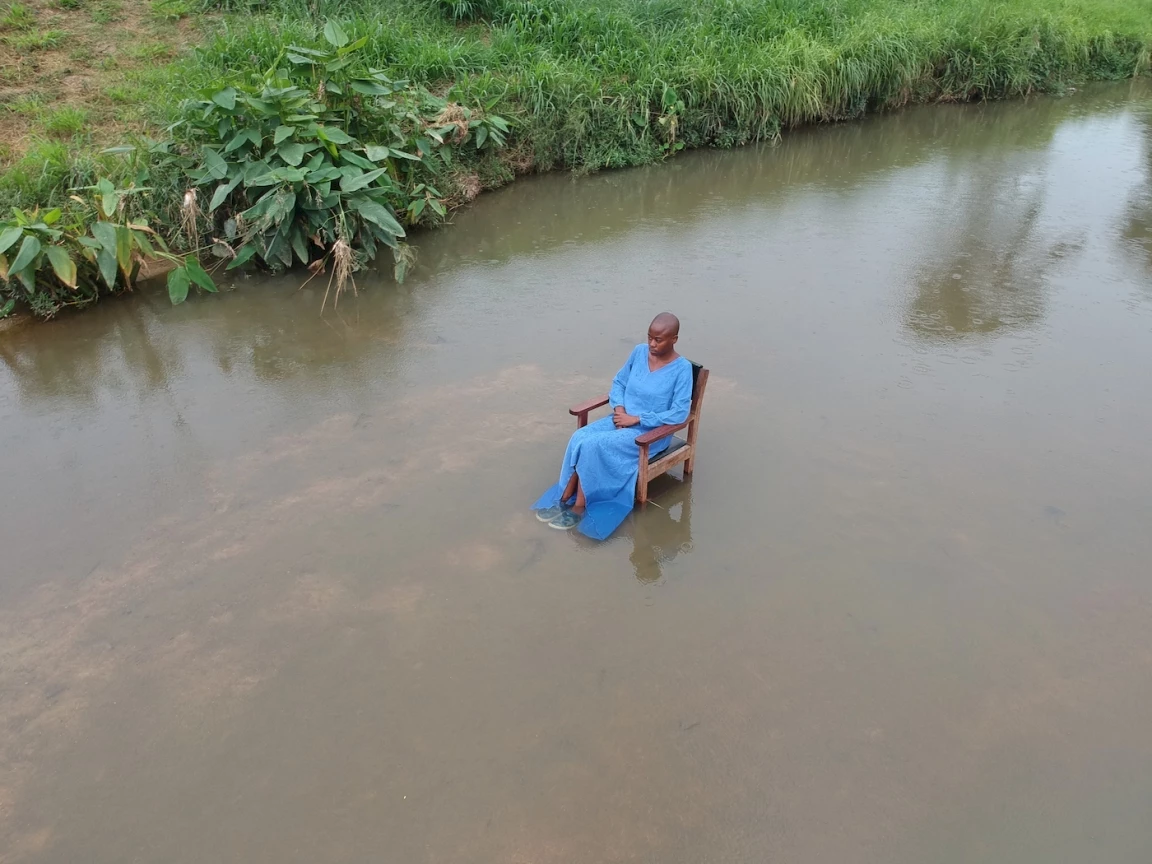
Kasangati Godelive Kabena, Made 5, 2022. Photo: Justice Amoh. Image courtesy of the artist.
Climate Forum I: Readings
Marwa Arsanios, ‘A Letter Inside a Letter: How Labor Appears and Disappears, 2022
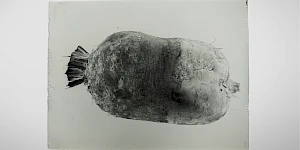
Munem Wasif, ‘Seeds Shall Set Us Free II, 2022
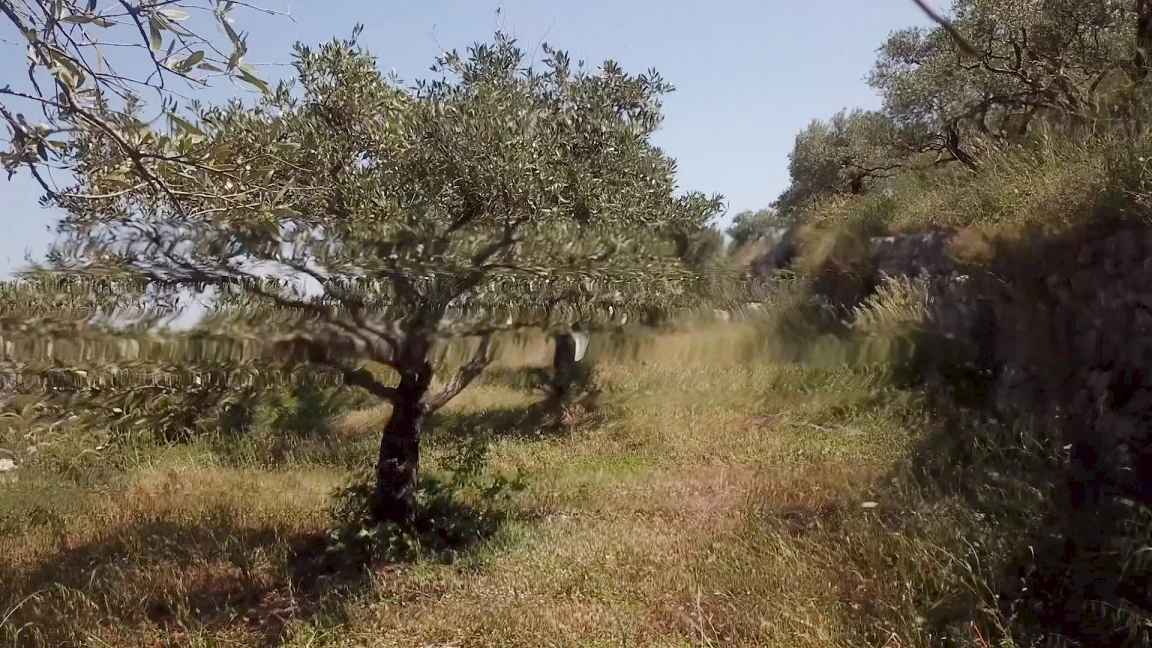
Marwa Arsanios, still from Who Is Afraid of Ideology? Part IV – Reverse Shot, 2022. Image courtesy of the artist.
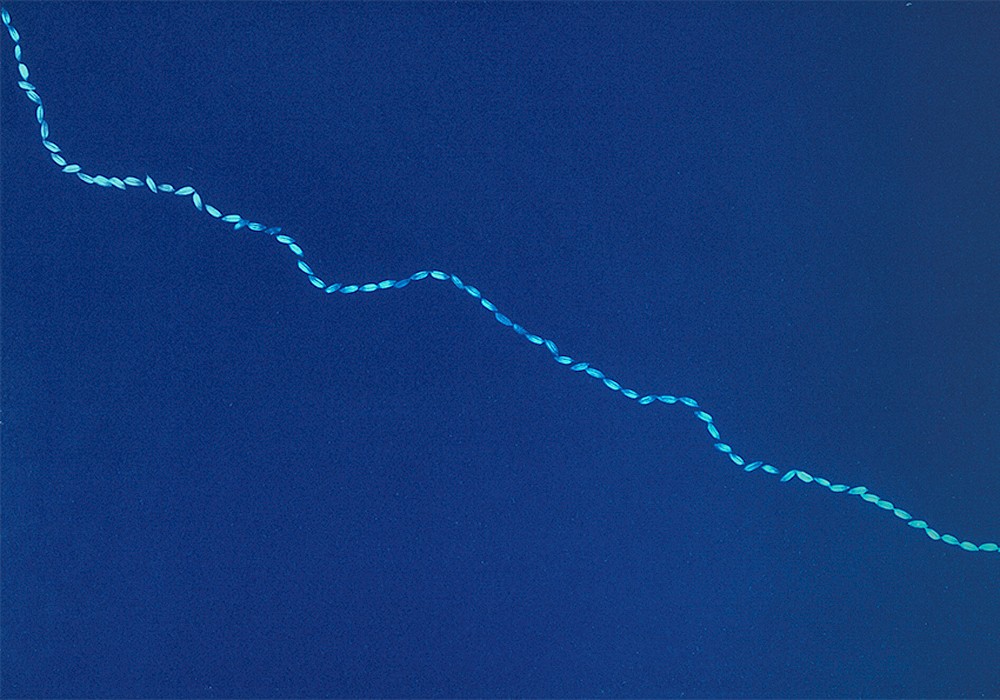
Munem Wasif, ‘Seeds Shall Set Us Free II’, detail (part of a series). Cyanotype with rice grains, 2022.
Related contributions and publications
-
Climate Forum II – Readings
Nick Aikens, Nkule MabasoLand RelationsClimateHDK-Valand -

Climate Forum III – Readings
Yolande Zola Zoli van der HeideLand RelationsClimate -
Decolonial aesthesis: weaving each other
Charles Esche, Rolando Vázquez, Teresa Cos RebolloLand RelationsClimate -
Climate Forum I – Readings
Nkule MabasoEN esLand RelationsClimateHDK-Valand -
…and the Earth along. Tales about the making, remaking and unmaking of the world.
Martin PogačarLand RelationsClimatePast in the Present -
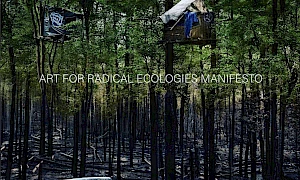
Art for Radical Ecologies Manifesto
Institute of Radical ImaginationLand RelationsClimateInstitute of Radical Imagination -
Pollution as a Weapon of War
Svitlana MatviyenkoClimate -
Ecologising Museums
Land Relations
Related activities
-
HDK-Valand
Climate Forum I
The Climate Forum is a space of dialogue and exchange with respect to the concrete operational practices being implemented within the art field in response to climate change and ecological degradation. This is the first in a series of meetings hosted by HDK-Valand within L'Internationale's Museum of the Commons programme.
-
–Van Abbemuseum
The Soils Project
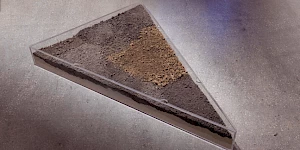
‘The Soils Project’ is part of an eponymous, long-term research initiative involving TarraWarra Museum of Art (Wurundjeri Country, Australia), the Van Abbemuseum (Eindhoven, Netherlands) and Struggles for Sovereignty, a collective based in Yogyakarta, Indonesia. It works through specific and situated practices that consider soil, as both metaphor and matter.
Seeking and facilitating opportunities to listen to diverse voices and perspectives around notions of caring for land, soil and sovereign territories, the project has been in development since 2018. An international collaboration between three organisations, and several artists, curators, writers and activists, it has manifested in various iterations over several years. The group exhibition ‘Soils’ at the Van Abbemuseum is part of Museum of the Commons. -
–Museo Reina Sofia
Sustainable Art Production
The Studies Center of Museo Reina Sofía will publish an open call for four residencies of artistic practice for projects that address the emergencies and challenges derived from the climate crisis such as food sovereignty, architecture and sustainability, communal practices, diasporas and exiles or ecological and political sustainability, among others.
-
–tranzit.ro
Non-Western Technologies for the Good Life
The experimental course ‘Non-Western Technologies for the Good Life’ (November 2023–May 2024) celebrates as its starting point the anniversary of 50 years since the publication of Tools for Conviviality, considering that Ivan Illich’s call is as relevant as ever.
-
–Moderna galerijaZRC SAZU
Open Call – Summer School: Our Many Easts
Our Many Easts summer school takes place in Ljubljana 24–30 August and the application deadline is 15 March. Courses will be held in English and cover topics such as the legacy of the Eastern European avant-gardes, archives as tools of emancipation, the new “non-aligned” networks, art in times of conflict and war, ecology and the environment.
-
–Institute of Radical Imagination
Gathering into the Maelstrom
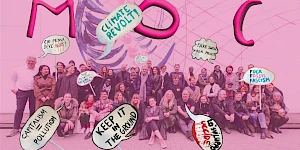
‘Gathering into the Maelstrom’ in Venice at Sale Docks is a four-day programme curated by Institute of Radical Imagination (IRI) and Sale Docks.